


For Beginners Only!!!
This is aimed at beginners. For those who are really new to the hobby, these words of wisdom are intended to help you in your headlong rush toward "old pro" status.
Although I surely do not try to pass myself off as an old pro, I have turned out four new models and two total rebuilds in the past couple of years, and the following facts come from those who have built many more models. It might add to my credentials if I confess to having built and flown two full-scale experimental aircraft. Both were basically wood and fabric. The art of building big ones is really not much different from building models.
I'll call these pearls of knowledge "axioms"—statements of self-evident truth. For instance, it surely is an axiom that the beginner will make many mistakes that have already been made by others. There probably aren't any "new" mistakes possible, so don't feel discouraged when you get underway.
Axiom #1: Study the plans before you start
If you thoroughly study your plans before you start cutting and gluing, you will build a much better model and build it faster. Don't let it get you down if the plans seem at first to be written in a foreign language and depict a futuristic space vehicle. Things will clear up the more you study. Studying plans is time well spent.
Select a section that you do understand and build it. You might start with the tail feathers rather than the fuselage. You will gain confidence as you go, and the plans will become clearer each day. Don't tackle something that has you completely confused.
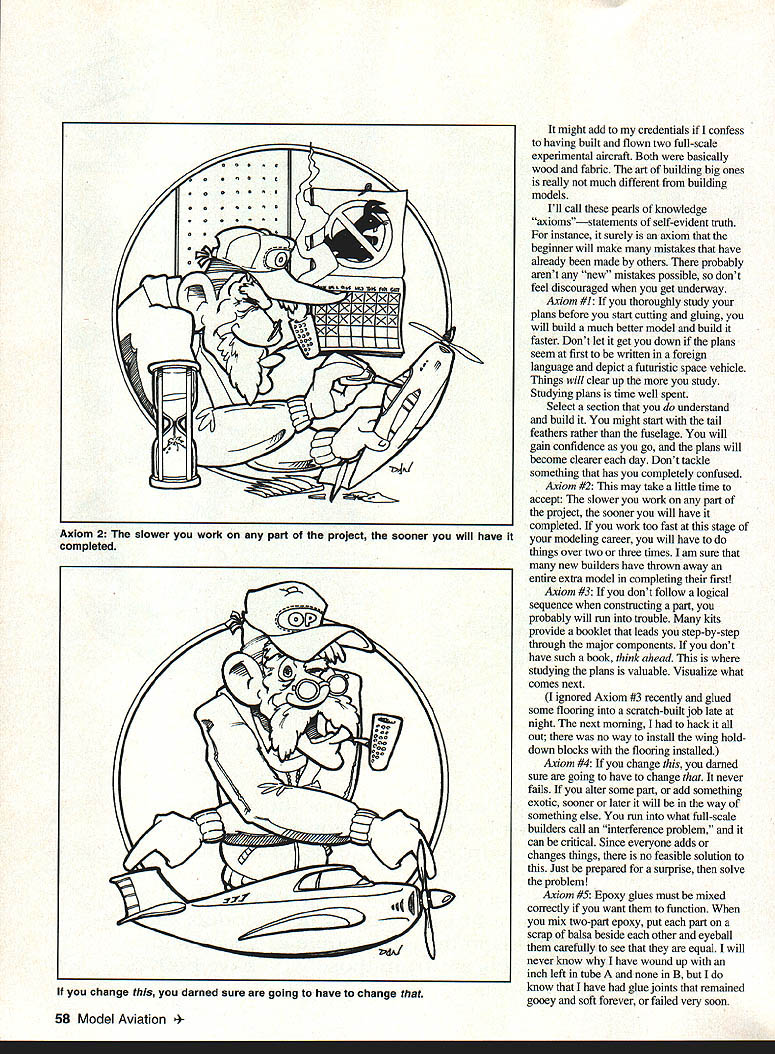
Axiom #2: Slow down to finish sooner
The slower you work on any part of the project, the sooner you will have it completed. If you work too fast at this stage of your modeling career, you will have to do things over two or three times. I am sure that many new builders have thrown away an entire extra model in completing their first!
Axiom #3: Follow a logical sequence
If you don't follow a logical sequence when constructing a part, you probably will run into trouble. Many kits provide a booklet that leads you step-by-step through the major components. If you don't have such a book, think ahead. This is where studying the plans is valuable. Visualize what comes next.
(I ignored Axiom #3 recently and glued some flooring into a scratch-built job late at night. The next morning I had to hack it all out; there was no way to install the wing hold-down blocks with the flooring installed.)
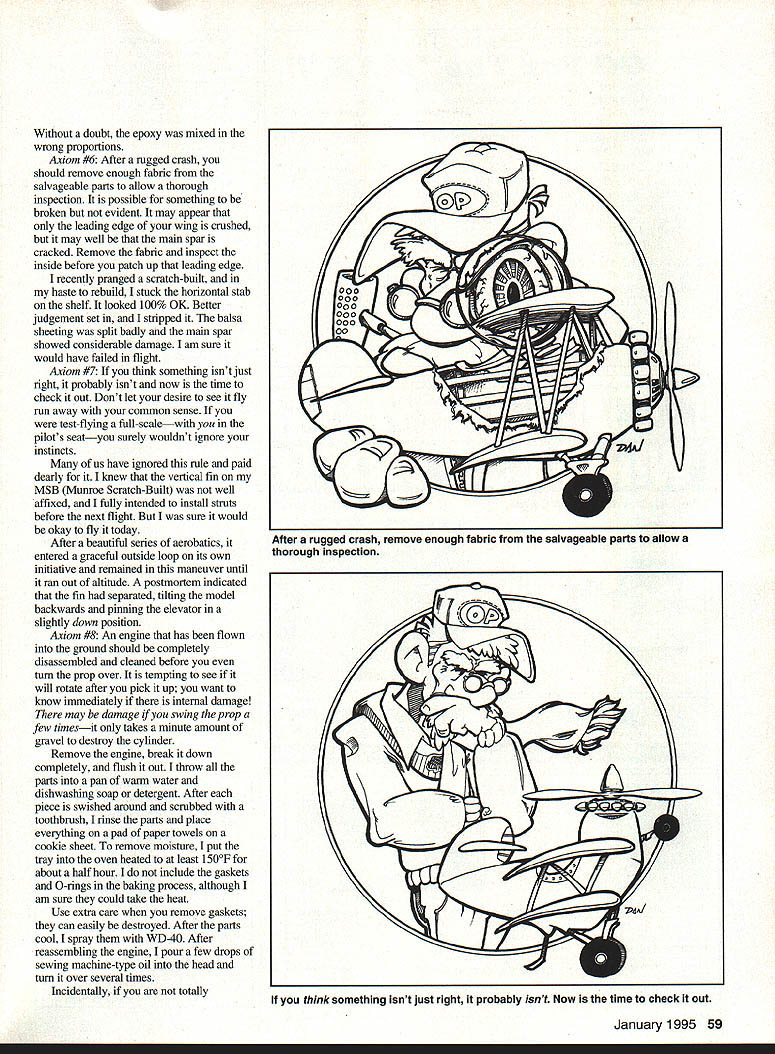
Axiom #4: Changing one thing forces other changes
If you change this, you darned sure are going to have to change that. It never fails. If you alter some part, or add something exotic, sooner or later it will be in the way of something else. You run into what full-scale builders call an "interference problem," and it can be critical. Since everyone adds or changes things, there is no feasible way to avoid this. Just be prepared for a surprise, then solve the problem.
Axiom #5: Mix epoxy correctly
Epoxy glues must be mixed correctly if you want them to function. When you mix two-part epoxy, put each part on a scrap of balsa beside each other and eyeball them carefully to see that they are equal. I will never know why I have wound up with an inch left in tube A and none in B, but I do know that I have had glue joints that remained gooey and soft forever, or failed very soon. Without a doubt, improper proportions are the usual cause.
Axiom #6: Inspect thoroughly after a crash
After a rugged crash you should remove enough fabric from the salvageable parts to allow a thorough inspection. What may be broken is not always evident. A leading edge that appears crushed may very well have the main spar cracked. Remove the fabric and inspect the inside before you patch up.
I recently crashed a scratch-built and, in my haste to rebuild, I at first thought the horizontal stab looked 100% OK. Better judgment set in, and I stripped it. The balsa sheeting was split badly and the main spar showed considerable damage that, I'm sure, would have failed in flight.
Axiom #7: Trust your instincts
If you think something isn't just right, it probably isn't. Now is the time to check it out. Don't let the desire to see it fly run away with your common sense. You surely wouldn't ignore your instincts on a full-scale test flight with a pilot's seat, so don't ignore them with models.
Many of us have ignored this rule and paid dearly. I knew the vertical fin on my MSB (Munroe Scratch-Built) was not well affixed, and I fully intended to install struts before the next flight. But I was sure it would be okay to fly that day. After a beautiful series of aerobatics, the model entered a graceful outside loop and on its own initiative remained in the maneuver until it ran out of altitude. The postmortem indicated the fin had separated, tilting the model backward and pinning the elevator slightly down.
Axiom #8: Disassemble and clean an engine after impact
An engine that has hit the ground should be completely disassembled and cleaned before you turn the prop over. It is tempting to see that it will rotate after a pickup, but you want to know immediately whether internal damage has occurred. A few swings of the prop can pick up a minute amount of gravel that will destroy a cylinder.
Remove the engine, break it down completely, and flush out the parts in a pan of warm water with dishwashing soap. After each piece is swished around and scrubbed with a toothbrush, rinse the parts and place everything on paper towels on a cookie sheet to remove moisture. Put the tray in an oven heated to at least 150°F for about a half hour. I do not include the gaskets and O-rings in the baking process, although they could probably take the heat.
Use extra care when you remove gaskets; they can easily be destroyed. After the parts cool, spray them with WD-40. After reassembling the engine, pour a few drops of sewing machine-type oil into the head and turn it over several times.
Incidentally, if you are not totally conversant with your engine, take extra pains to observe each piece as you dismantle it. I am embarrassed to admit that on two occasions I put parts back reversed; this resulted in a very recalcitrant engine, to say the least!
Axiom #9: Fix it when you see it
Fix it when you see it. This axiom revolves around the foibles of the human mind. If you are busy on one part of your project and notice something missing, wrong, or broken on another part, fix it immediately or write a note. Don't rely on your memory. I keep a pad of paper on my bench, and if it is not convenient to tackle aberrations, I immediately make notes when I see them. This simple procedure can save you much grief.
I ignored Axiom #9 while working on my 1/4-scale Mr. Mulligan, which was in my carport rather than on my bench. The screws holding the braces to the firewall were obviously loose and needed work. I forgot them and headed for the field. As the Mulligan screamed by in a low pass, I noted a very strange configuration up front: all six screws had backed out, and the cowl was trying to work its way through the prop—or vice versa!
General tips and encouragement
Having started your modeling career, you must have discovered that RC building is not the least expensive hobby around. (You could take up bird watching if you just want to see things fly.) So make a point of salvaging all the wood and parts that you can after a crash. This seems basic, but you will be amazed at how much money you can save. I rip off fabric and break off all sorts of pieces of balsa, then throw them in a scrap box at home. These pieces will save you money and many trips to the hobby shop.
I have never found a hobby where the beginner is assisted more than in RC building—it's a joy! There are few hard-and-fast rules where there is only one way to do something. Take full advantage of the old pros' help.
There is no better way for you to learn than by trying something your way. It may work out perfectly and give you a ton of satisfaction. If it does not work out, you will learn even more! And when you become an old pro, don't force your ideas on the beginner who holds you in awe.
You're on your way. Go to it!
Transcribed from original scans by AI. Minor OCR errors may remain.

