
The Bell-Anchor
'Scratch' Biltright
I am new to RC modeling, but I love to read Model Aviation when it comes each month. The first thing I turn to is the featured model design by one of the readers and illustrated with an out-of-sight cutaway drawing. Wow, I thought, I could do that too. Maybe. Why not?
I have worked as the lighthouse attendant here at Tierra del Fuego for several years and have tried several forms of airplane modeling from Free Flight to Control Line, Rubber power to Sailplanes. Trouble is the high winds just blow everything out to sea. Whoosh... it's gone!
The little plane weighs 42 lb. and flies fast enough to penetrate the breeze.
When I hit on the idea for this new plane, I knew I was on the right track. The little plane is designed to fly in 70‑knot winds, so it is heavier than most of the planes I have seen in Model Aviation. The little Bell‑Anchor weighs in at 42 lb. without fuel. With the high wing loading resulting from the 18‑in. wingspan, it flies fast enough to penetrate the breezes off my deck.
Let me explain some other features of this rather specialized design. For maximum strength I call for wing spars made of rolled cardboard. The little tubes of cardboard found on trouser hangers are perfect for the job. Save the wire part; you will need that for the landing gear axle. Coat the wing spars with six coats of clear dope and set aside to dry while you go outside and breathe deeply for a few minutes.
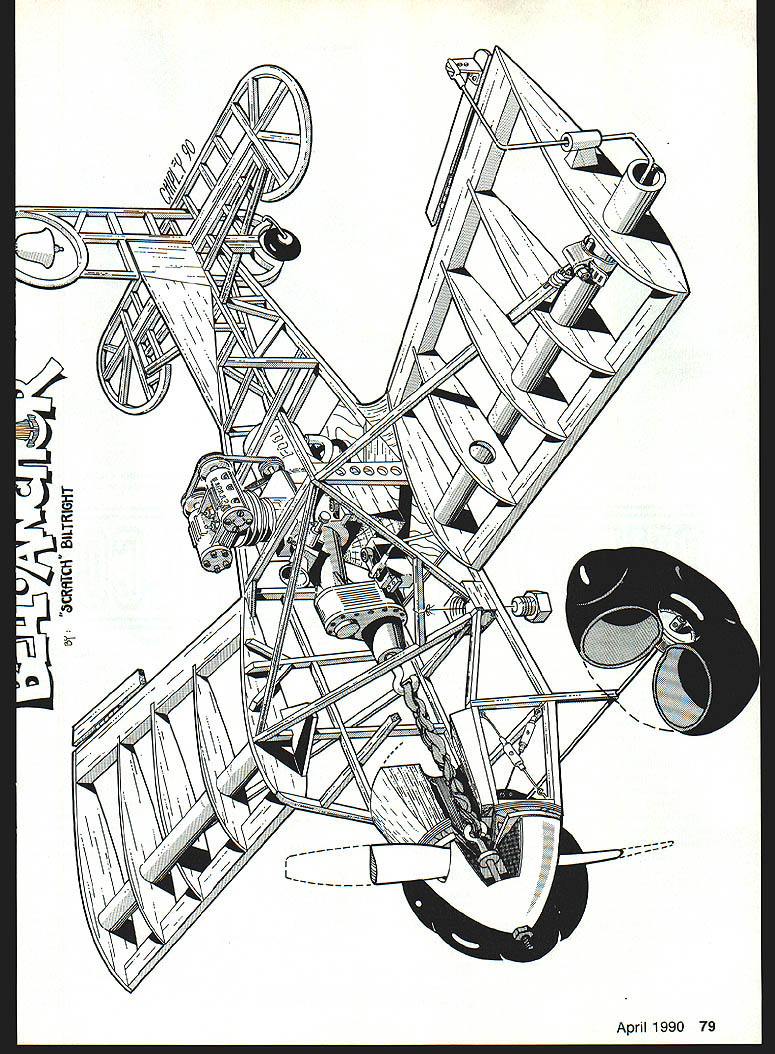
Notice the positioning and orientation of the ribs relative to the spars. This is both important and difficult to explain (and to accomplish). In fact it can safely be said that if you can build the wing correctly (as shown), you should have no trouble flying the plane.
Please note that the struts are functional as well as facetious. Make them from straight‑grained white oak aged at least three years in a pot of kimchee and then roasted slowly over a bowl of really hot Tex‑Mex chili for exactly one hour and 45 minutes per gram per cm. This will deliver a strut that not only makes a dynamite structural component, but it also makes a pretty good substitute for dynamite when you need to loosen those stuck jar lids in the kitchen. Let me caution you, however, about using them as chopsticks. One hard chomp and your whole face could be history. I am a firm believer in safety. Stuck out here on this rock, it could be weeks before the next supply ship arrives with a Band‑Aid, so I am very careful at all times.
Don't use the struts for chopsticks... your whole face could become history!
The stock Trexler wheels have 35 lb. of air pressure for flotation purposes.
Speaking of safety, let me point out another feature. It is a known fact that most accidents involving a model airplane propeller occur at the outer tips of the whirling prop. For absolute safety, I suggest removing the outer two inches of each blade. With this dangerous portion removed, the plane becomes very safe even for a novice to operate. Remember: safety first!
The fuselage structure is straightforward and should be no problem for experienced modelers with uncorrected astigmatism. I shall say no more here than to encourage you to strive for clean, neat joints in the interest of a sound structure.
Wheels are stock Trexlers inflated to 35 pounds of air pressure for flotation in the event the plane is forced to land at sea (a very real possibility for me where I am). Since Trexlers are so light and absorb landing shocks so well, a minimal structural support system is required. Use the leftover coat hanger wire from the wing spar source for the axle. It is quite sufficient, and it encourages conservation of materials. Out here I have become acutely aware of the need for conservation.
One wing is mounted low and the other high for a very good reason.
The careful observer may have noticed from the drawing that one wing is mounted low and the other high. This is for a very good reason.
The tail assembly is very straightforward (except it is at the back of the plane... it is straight backward rather than forward). Use balsa where possible, and glue parts securely. The bell in the upper part of the rudder is functional: it can be heard over the crashing of the waves and scream of the little engine. The bell also will alert the pilot to the dreaded "Dutch roll." I would certainly avoid this (wooden shoe?). The bell is also important from a nomenclature point of view. More about that later.
The engine and power train are a bit unusual, perhaps, for those of you in more moderate climes—but fairly common in these parts. For stiff breezes one needs a lot of power for penetration. So we have adapted the small air compressor from war‑surplus Italian torpedoes. We have equipped it with glow plugs (dual, for security) and a chain‑drive speed reduction unit to drop the outrageous 100,000 rpm to a more usable range. To reduce the intolerable shock and vibration this conversion puts out, I connect the power output shaft to the prop with a length of several rubber bands (from my earlier flying days). The rubber dampens and absorbs the spikes in the power curve nicely. This engine penetrates amazingly well.
I have sunk one ocean‑going tug and sent a Japanese whaling ship to drydock for major hull repairs. Crew members of the tug have been very nice about the whole thing and have taken to model building with enthusiasm. We now have a local RC club which we hope to register with the AMA as soon as possible... perhaps by the time you are reading this. Also, we have received some very kind notes from the local whale union, along with promises to re‑crew any and all model planes lost at sea.
The name of the aircraft, Bell‑Anchor, is derived from the bell in the tail, of course, and also from the extreme weight required for flight under our local conditions. The large spinner is filled with an extra three or four pounds of weight to ensure stability in the buffeting winds. The wings, naturally, are made of wood (with the hopefully excusable use of cardboard being another form of wood fiber, after all). If the Good Lord had wanted airplane wings made of metal, he would have made trees out of aluminum (I don't know what this means, but one of the crew from the tug boat says it is something pilots of full‑size airplanes say a lot).
Let's go! Get out your glue, your little sharp knives, your Band‑Aids, your materials, and your sense of humor... you'll need that the most. This hobby/sport should be fun first and foremost. Don't take it so seriously that you can't chuckle at yourself once in a while. The poor sods stuck out in the faraway places can still enjoy life as long as we have an airplane of some kind... any kind... to play with. So when the balmy breezes brush your brow or the sun seems just a tad too hot, think of us down here on this cold, windy rock managing to have what fun we can. Did I mention that the tug was a Swedish craft with an all‑female crew? Vive le morale aviation!
(Continued from page 78)
(Editor: You did note the cover date, didn't you?)
Transcribed from original scans by AI. Minor OCR errors may remain.

