
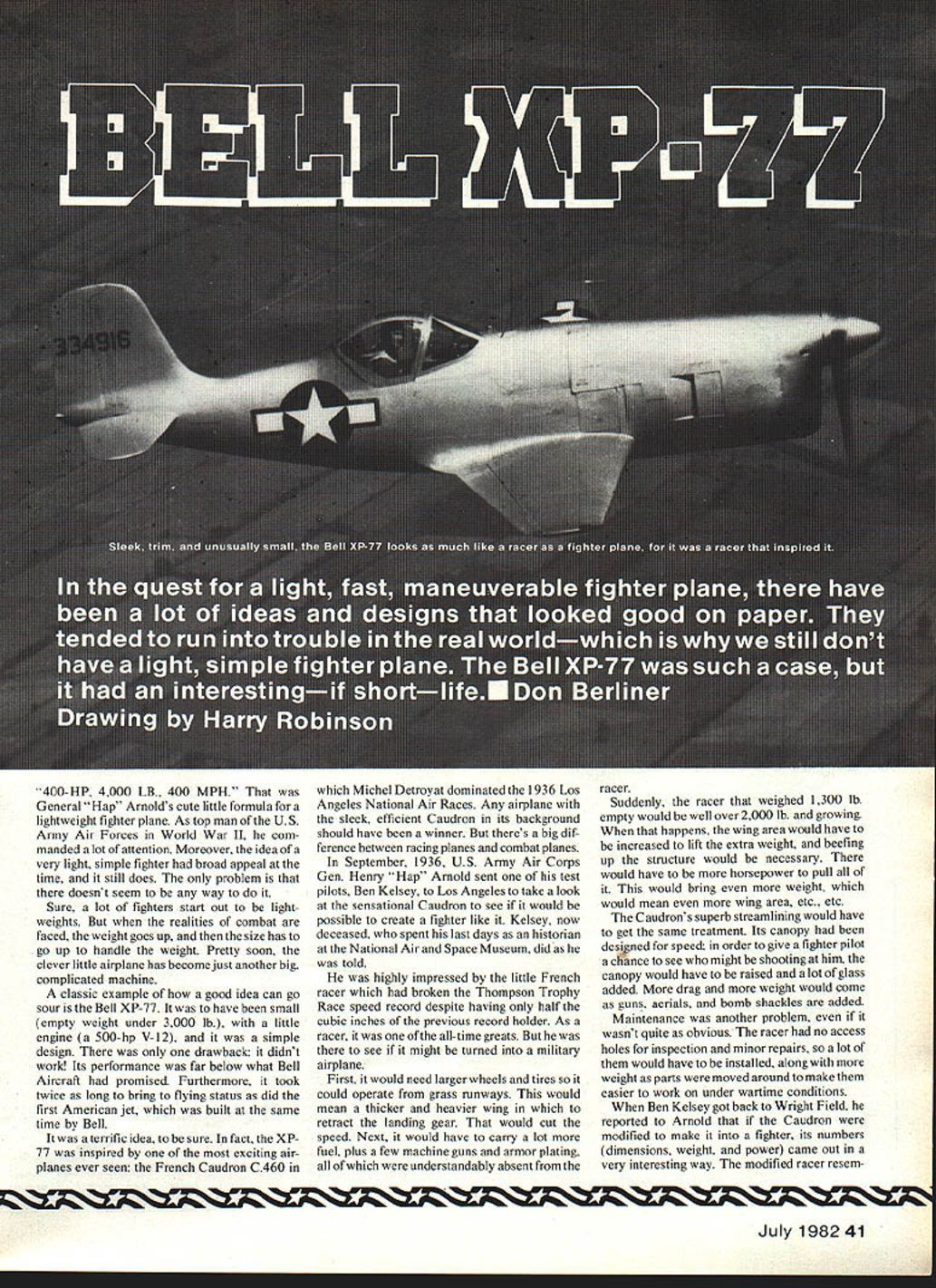
Bell XP-77
In the quest for a light, fast, maneuverable fighter plane there have been many ideas and designs that looked good on paper but ran into trouble in the real world. The Bell XP-77 was one such case: an interesting—if short—experiment that ultimately failed to meet expectations. — Don Berliner
Arnold’s formula
General "Hap" Arnold popularized a simple goal for a lightweight fighter:
- "400‑HP, 4,000 LB., 400 MPH."
That formula captured broad interest, but converting the idea into a practical combat airplane proved difficult.
Background and inspiration
In September 1936, Gen. Henry "Hap" Arnold sent test pilot Ben Kelsey to see the French Caudron C.460 racer, which had dominated the 1936 Los Angeles National Air Races. The Caudron was a sleek, efficient racer, and Kelsey was impressed. He examined whether such a design could be adapted into a military fighter.
Kelsey concluded that converting the C.460 into a fighter would require numerous and significant changes:
- larger wheels and tires for grass runways (requiring a thicker, heavier wing for retractable gear);
- much more fuel, armament (machine guns and cannon), and armor plating;
- increased wing area and stronger structure to handle added weight;
- a taller, more glazed canopy for pilot visibility (adding drag and weight);
- access panels and cowling changes to allow maintenance.
A racer that weighed about 1,300 lb. empty would, after conversion, exceed 2,000 lb. and grow further as more requirements were added. The result would likely resemble contemporary pursuit designs such as the Curtiss P-36 in size and weight, even if the external shapes differed.
Bell’s lightweight fighter effort (Tri-4 / XP-77)
Bell Aircraft had been exploring novel lightweight fighters for some time. A related concept—the P-39 Airacobra—was ordered in 1937 and initially qualified as a relatively light fighter, but it grew substantially in weight during development and production.
A few months after the P-39 entered service, Gen. Arnold revived the lightweight-fighter concept and Bell began design work on the Tri-4, which later became the XP-77. Key proposed characteristics (from Bell’s final report) included:
- high speed: 410 mph at 27,000 ft with a 500‑hp supercharged Ranger XV‑770‑9 engine;
- design gross weight: about 3,700 lb;
- armament: a 22 mm cannon firing through the propeller hub and two .50‑caliber synchronized nose guns;
- laminar-flow airfoil.
On May 16, 1942, an initial order for 25 aircraft was placed. Two weeks later Bell suggested cutting the order to six due to engine shortages. The contract price (including profit) was set at just under $500,000, with the first airplane originally to be delivered within six months and the sixth by January 1943.
Change to wooden construction and early troubles
In June 1942 the Army Air Forces decided the airplane should be built largely of wood to conserve scarce aluminum. Bell underestimated how difficult the change of materials would be. Consequences and complications included:
- redesign and manufacturing challenges for plywood construction;
- subcontracting work to firms experienced in wooden aircraft or gliders, producing delays and quality-control disputes;
- production problems at Goshen Veneer Co. and Vidal Research Corp. (wing cores and flight wing shortages);
- continued trouble with the Ranger XV‑770 engine, especially cooling issues.
By late June 1942 the design gross weight was revised to 3,650 lb, and then cut back to a structure for a 3,000 lb gross weight to reduce wing loading and takeoff run. Costs and schedules escalated:
- initial contract cost ≈ $500,000; by mid-development costs had risen to roughly $700,000 and later to about $2.5 million;
- subcontracting and production issues delayed completion of the first aircraft by more than a year.
Vidal Research eventually took over wing construction, but production problems (down to details like glue spread times) further delayed the program. Completion of the first airplane slipped to February 1944 and then to March 1944.
Prototypes, flight testing, and mishaps
- The XP-77 first flew at Bell’s Niagara Falls, NY factory on April 1, 1944.
- The prototype arrived at Wright Field on May 2, 1944. It showed serious vibration at 1,700 rpm and 2,300 rpm—likely due to the absence of shock absorbers on the engine mounts.
- On June 6, 1944 the prototype was assigned serial number 43‑34915.
- Official flight tests were carried out at Eglin Field, Florida, on the second XP-77 (serial 43‑34916), beginning in late July 1944.
- On October 2, 1944 the second prototype entered an inverted spin after an Immelmann turn. The pilot recovered to an upright flat spin from which he could not recover and had to bail out. The pilot survived, but the airplane was destroyed. That accident proved decisive; the program was terminated on December 2, 1944.
Performance and official evaluation
A March 1945 AAF report ("Flight Tests on the Bell XP-77 Airplane") summarized handling and performance:
- General handling characteristics were described as satisfactory, although test restrictions prevented dives, spins, or other violent maneuvers.
- One objectionable feature: fixed trim tabs on the ailerons and rudder, which provided only a single hands-off/rudder-free flight condition for each ground setting of the tabs.
- Visibility was good for all flight and ground conditions.
- Noise and vibration in the cockpit were considerable; cockpit heating was inadequate, making it very cold and uncomfortable in cold weather and at high altitude.
- Recorded speeds:
- 328 mph at military power (3,150 rpm and 41.6 in. manifold pressure) at a critical altitude of 12,600 ft.
- 330 mph at war emergency power (3,300 rpm and 57 in.) at a critical altitude of 4,000 ft.
- Maximum rate of climb: 3,650 ft/min at war emergency power at a critical altitude of 2,000 ft.
Conclusions from the report:
- Overall performance was inferior to existing AAF fighters.
- Test results were considerably lower than Bell’s estimated performance.
- Maximum speed at war emergency power was considerably lower than most AAF interceptors at military power.
- Maximum rate of climb at military power was very low for an interceptor, and the low service ceiling made the airplane unsuitable against high‑altitude aircraft.
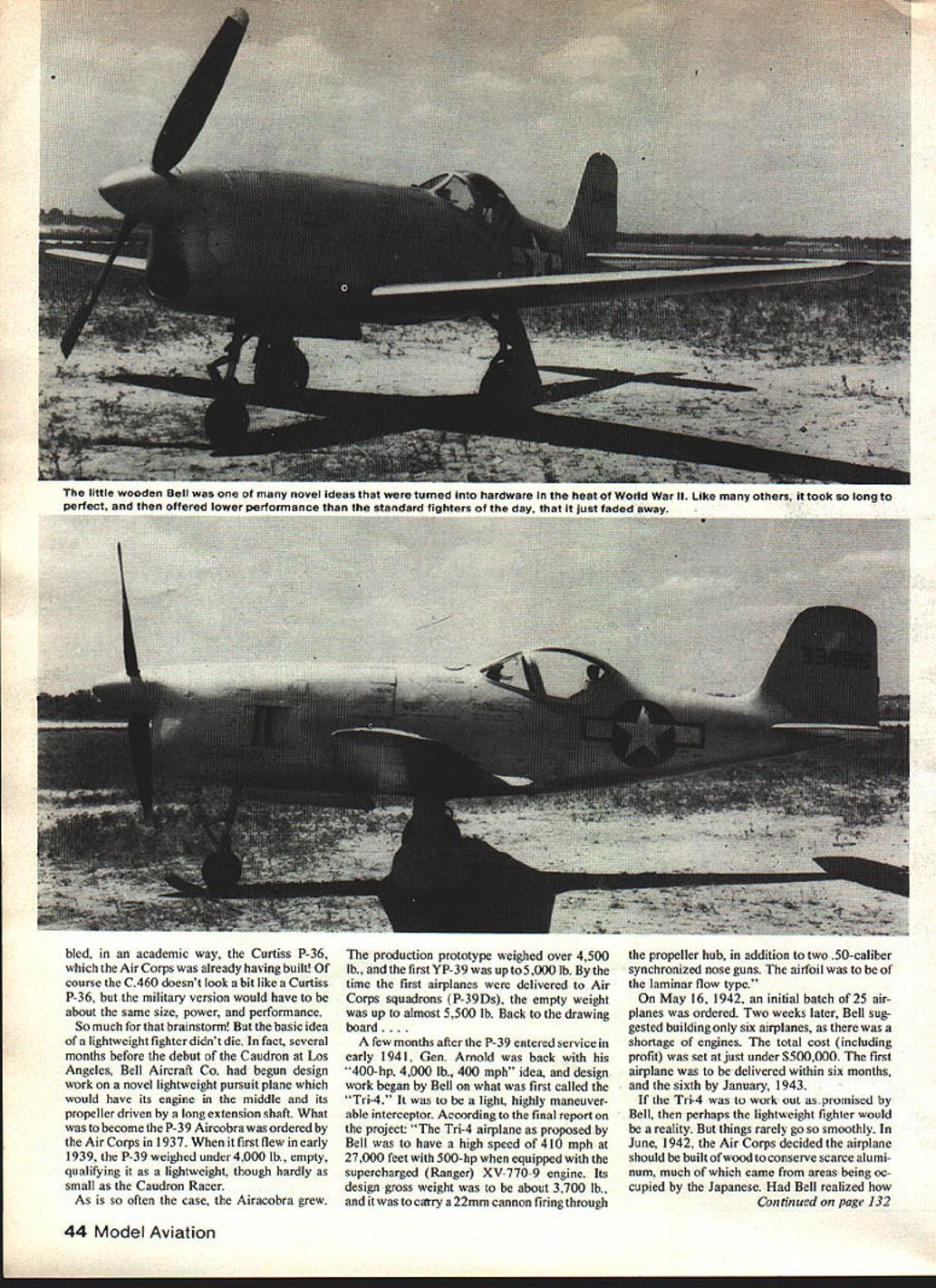
The XP-77’s cooling difficulties, poor high-speed handling, disappointing performance, and structure/production problems led the Army Air Forces to conclude the design could not meet operational requirements. The two prototypes provided only limited flight and structural data and were not placed into production.
Lessons learned and aftermath
The XP-77 experiment demonstrated the many difficulties of producing a lightweight fighter of largely wooden construction during wartime, especially when paired with an underdeveloped powerplant and extensive subcontracting. It reinforced the lesson that designing a truly lightweight combat fighter is very difficult—the initial weight and complexity savings often disappear once operational requirements are applied.
Bell itself was heavily occupied with higher-priority programs (P-63 Kingcobra and the secret P-59 Airacomet jet), which limited focus on the XP-77 and contributed to program curtailment.
The broader point remains: the ideal of a very light, simple fighter keeps reappearing, but aircraft tend to grow in weight and complexity as combat requirements are added.
Illustration and diagram notes
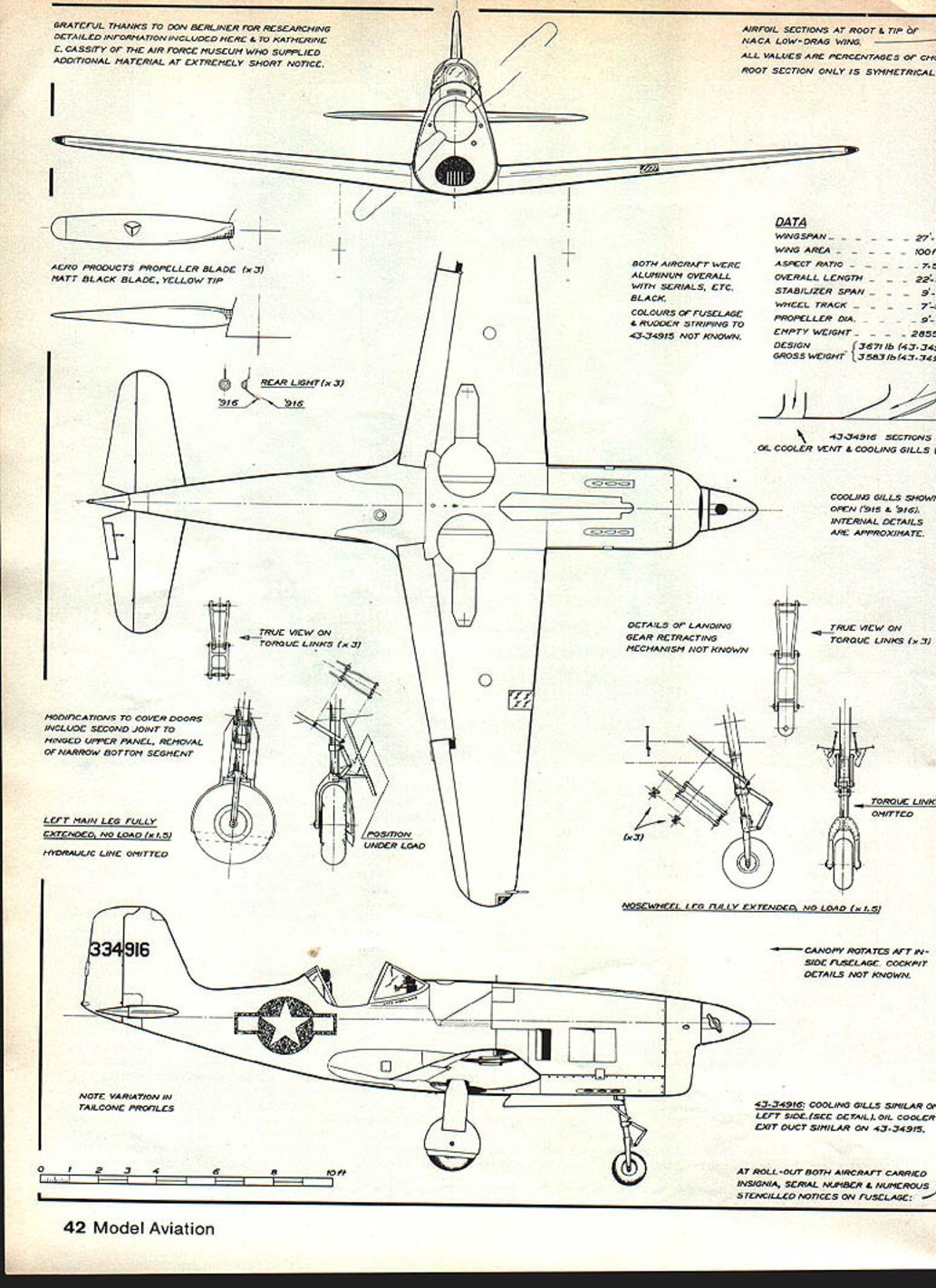
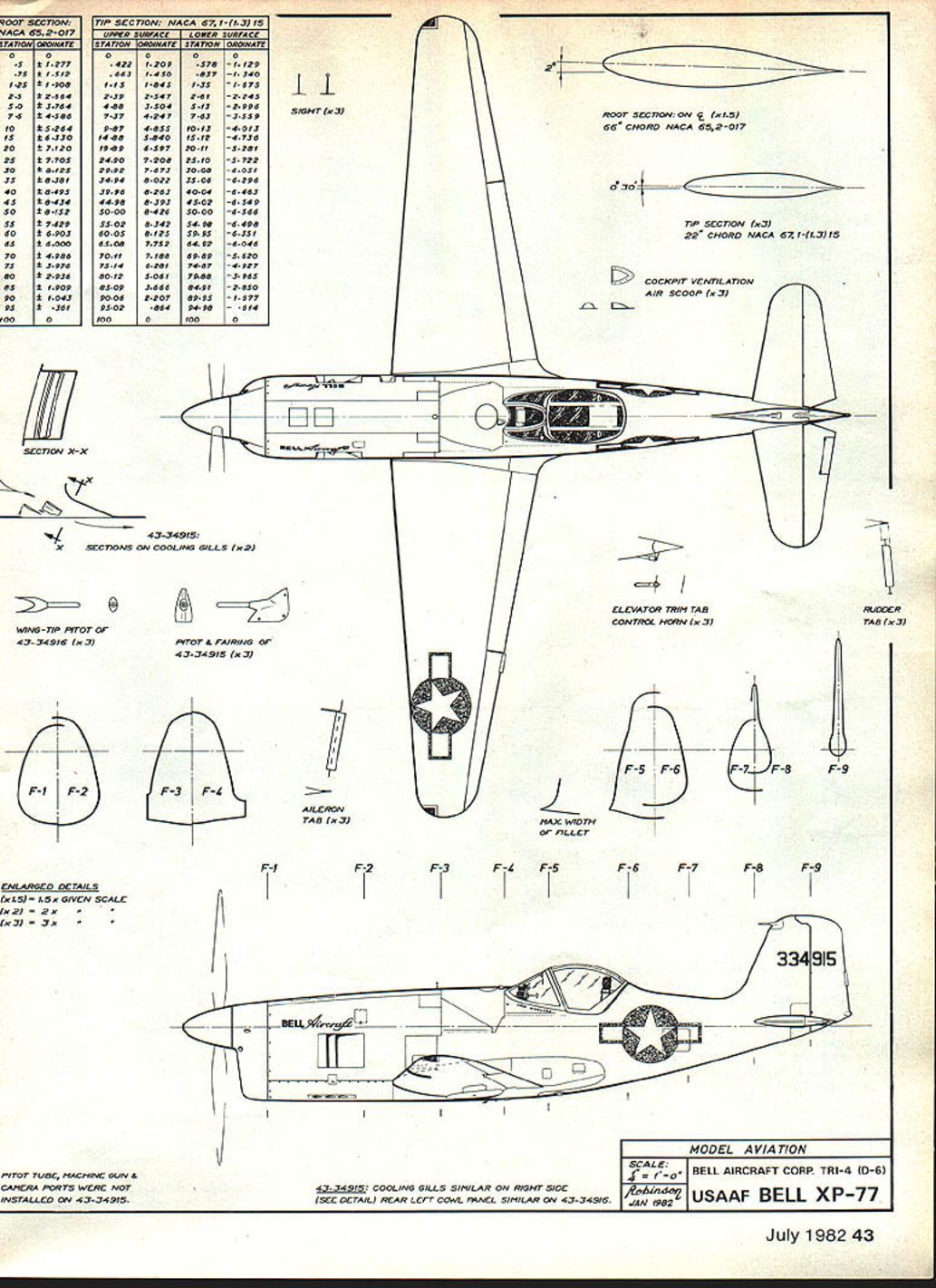
(The original page contained diagrams and figure captions; these are summarized here.)
- Airfoil sections at root and tip of NACA low-drag wing; values given as percentages of chord. Root section only is symmetrical.
- Both aircraft finishes were aluminum overall with serials and markings in black. Colors of fuselage and rudder striping for serial 43‑34975 are not known.
- Acro Products propeller blades (x3): matt black blade with yellow tip. Root section NACA 65.
- Serial 43‑34918: oil cooler vent and cooling gills shown open; internal details approximate.
- Serial 43‑34916: cooling gills similar on left side; oil cooler exit duct similar on 43‑34915.
- At roll-out both aircraft carried insignia, serial numbers, and numerous stenciled notices on the fuselage.
Acknowledgements
Grateful thanks to Don Berliner for researching detailed information included here, and to Katherine D. Cassity of the Air Force Museum for supplying additional material at extremely short notice.
Final remark
It was an interesting idea that didn't work but taught its creators a lesson: it is very, very difficult to build a truly lightweight fighter plane. General Dynamics would later experience a similar evolution with the F‑16, which grew from a lightweight concept into a Mach‑2+ fighter.
If you start with a Cassutt that will do close to 250 mph on 135 hp while weighing a little over 500 lb., and then add a couple of machine guns, more fuel, and a radio or two...
Transcribed from original scans by AI. Minor OCR errors may remain.

