
Bellanca Skyrocket
G. James Alaback
Origins and Lindbergh
When it was introduced in the spring of 1930, the Bellanca Skyrocket represented the latest and most powerful version of an already-famous airplane. The design traced its origin back five years to a record-breaking prototype.
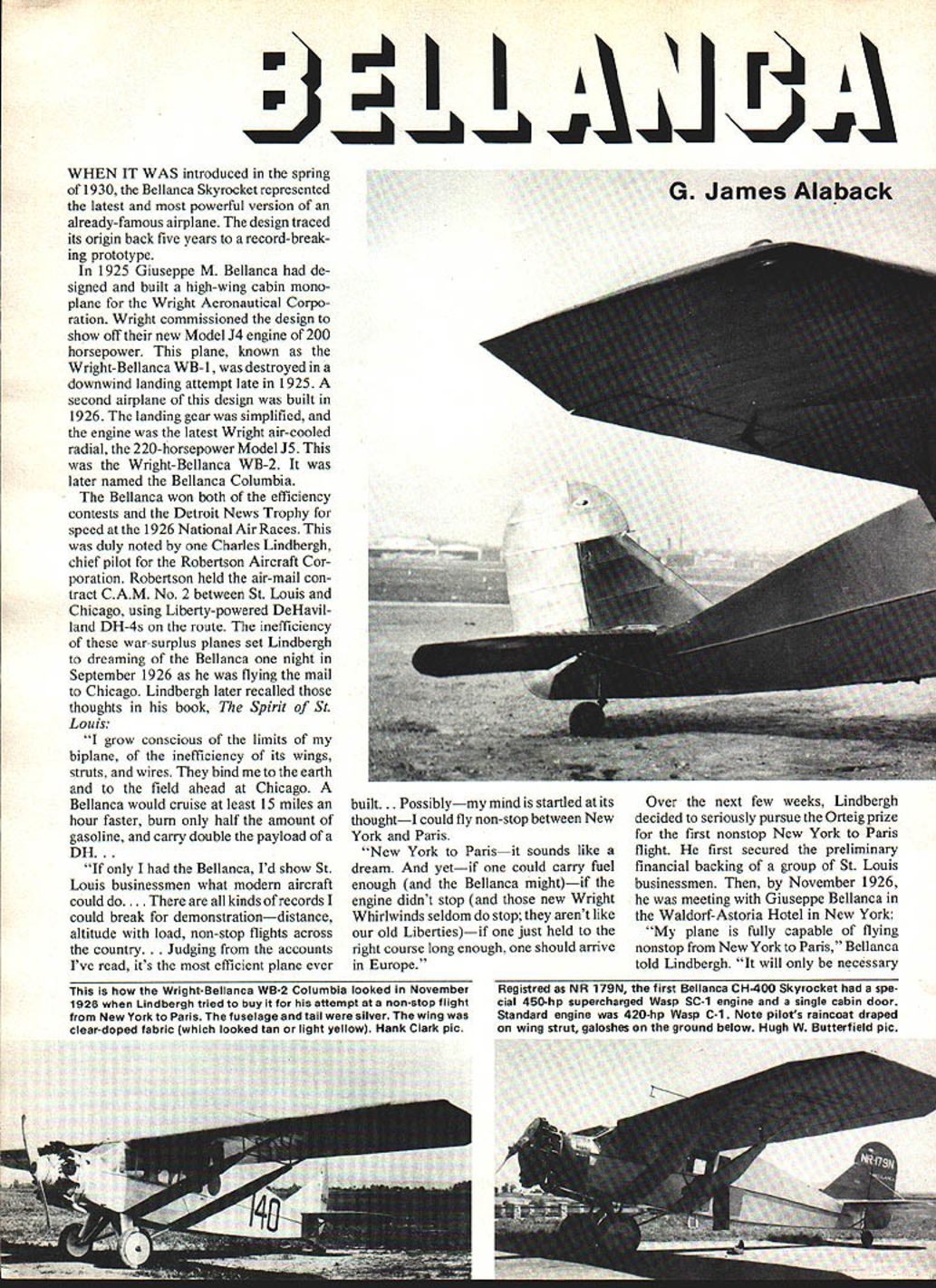
In 1925 Giuseppe M. Bellanca designed and built a high-wing cabin monoplane for the Wright Aeronautical Corporation. Wright commissioned the design to show off their new Model J-4 engine of 200 horsepower. This plane, known as the Wright‑Bellanca WB‑1, was destroyed in a downwind landing attempt late in 1925. A second airplane of this design was built in 1926 with simplified landing gear and the latest Wright air-cooled radial, the 220‑hp Model J‑5. This was the Wright‑Bellanca WB‑2, later named the Bellanca Columbia.
The Bellanca won both of the efficiency contests and the Detroit News Trophy for speed at the 1926 National Air Races. Charles Lindbergh, then chief pilot for the Robertson Aircraft Corporation (which held air‑mail contract C.A.M. No. 2 between St. Louis and Chicago, using Liberty‑powered De Havilland DH‑4s), took notice. The inefficiency of his war‑surplus DH‑4s led him to dream of the Bellanca in September 1926 while flying the mail. In The Spirit of St. Louis Lindbergh recalled thinking that a Bellanca would cruise faster, burn less gasoline, and carry double the payload of his DH. He began pursuing the Orteig prize for the first nonstop New York‑to‑Paris flight, secured preliminary backing from St. Louis businessmen, and by November 1926 was meeting with Giuseppe Bellanca in New York.
Bellanca told Lindbergh, "My plane is fully capable of flying nonstop from New York to Paris. It will only be necessary to put a big gasoline tank in the cabin." However, Lindbergh was unable to reach an agreement to buy the Columbia, and he ultimately flew the specially modified Ryan monoplane that crossed the Atlantic on May 20–21, 1927.
Sixteen days after Lindbergh's flight, on June 4–5, 1927, the Columbia also crossed the Atlantic nonstop. Clarence Chamberlin piloted the Bellanca across and landed at Eisleben, Germany, some 3,911 miles from New York.
Development and Certification
The transatlantic Columbia led to a whole line of commercial cabin planes. Giuseppe Bellanca secured new financial backing, set up his own factory, and began building duplicates of the Columbia—about 100 were built. Early models (J, CH, CH‑200 and the CH‑300 Pacemaker) were built under Approved Type Certificate (ATC) No. 47 with the 220‑hp Wright J‑5 Whirlwind engine. Most later versions were built under ATC No. 129 with the more powerful Wright J‑6‑9 of 330 hp.
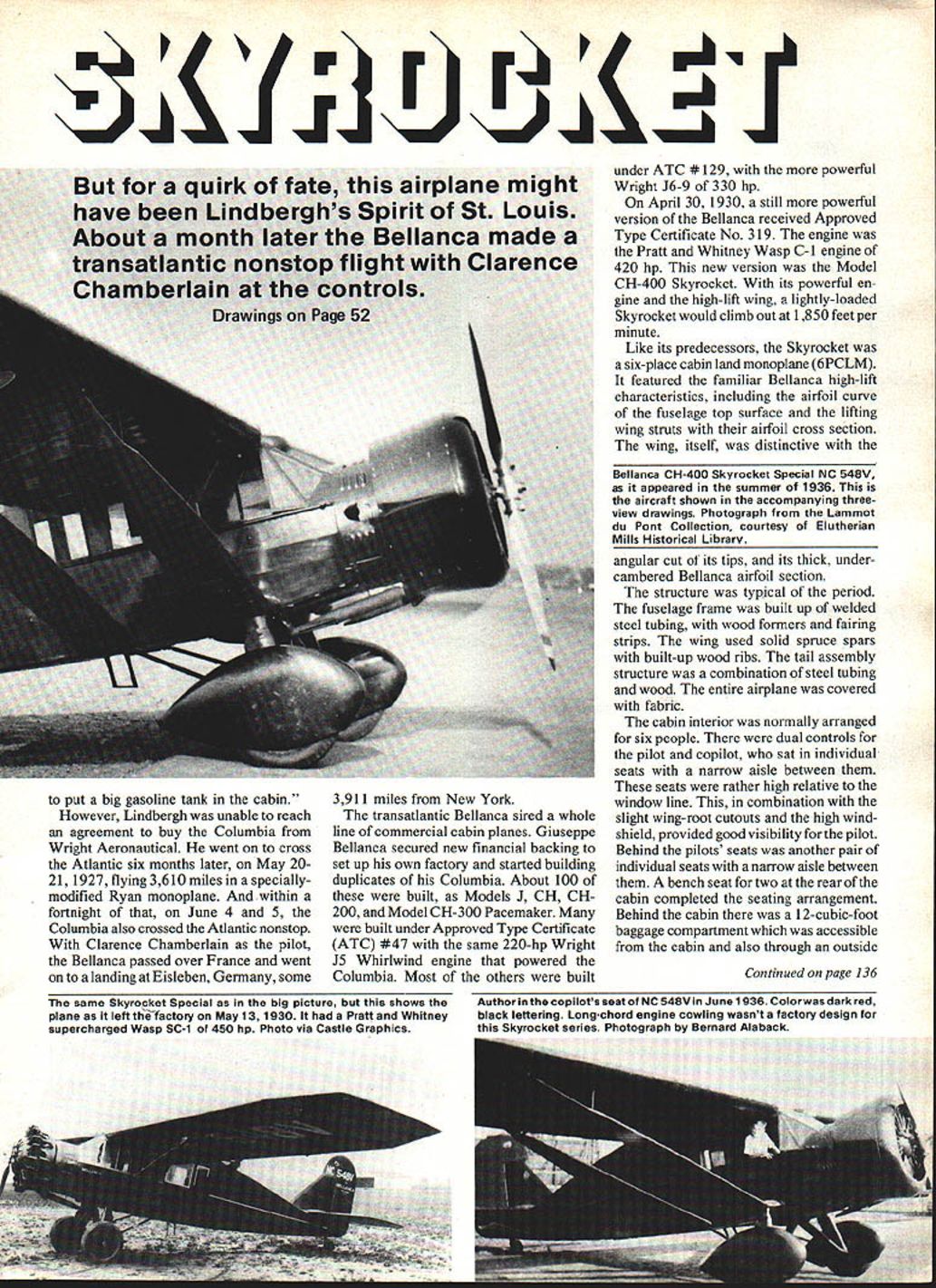
On April 30, 1930, a still more powerful version received Approved Type Certificate No. 319 with the Pratt & Whitney Wasp C‑1 engine of 420 hp. This new version was the Model CH‑400 Skyrocket. With its powerful engine and high‑lift wing, a lightly loaded Skyrocket would climb out at about 1,850 feet per minute.
Design and Construction
Like its predecessors, the Skyrocket was a six‑place cabin land monoplane (6PCLM) and featured familiar Bellanca high‑lift characteristics:
- Airfoil curve in the fuselage top surface.
- Lifting wing struts with an airfoil cross section.
- Thick, undercambered Bellanca wing section with angular tip cutouts.
Structure and materials were typical of the period. The fuselage frame was welded steel tubing with wood formers and fairing strips. The wing used solid spruce spars with built‑up wood ribs. The tail assembly combined steel tubing and wood. The entire airplane was fabric covered.
Some production variations and factory options included streamlined fairings over the landing gear pivot point, diagonal elevator bracing, short‑chord or long‑chord engine cowlings, landing lights, and wheel pants. Engine options and cabin door arrangements were significant differences affecting coverage under the Approved Type Certificate.
Cabin and Interior
The Skyrocket cabin normally seated six. Layout included:
- Pilot and copilot in individual seats with dual controls and a narrow aisle between them; seats were relatively high for good visibility aided by wing‑root cutouts and a high windshield.
- A second forward pair of individual seats behind the pilots, with a narrow aisle.
- A rear bench seat for two.
- A 12‑cubic‑foot baggage compartment behind the cabin, accessible from inside and via an outside door.
The interior was nicely trimmed; the Skyrocket’s depression‑era price—about equal to eight new Cadillacs—meant owners were typically large corporations or wealthy individuals.
Operational History and Owners
Typical buyers included:
- Bendix Aviation
- The May Co.
- National Battery
- Shell Oil
- A.O. Smith Corp.
- Socony Oil
- Film stars Wallace Beery and Ann Harding
In 1932 the U.S. Navy bought three Skyrockets designated XRE‑1, XRE‑2 and XRE‑3 (the latter assigned to the U.S. Marines). These Navy examples had short‑chord engine cowlings and no wheel pants.
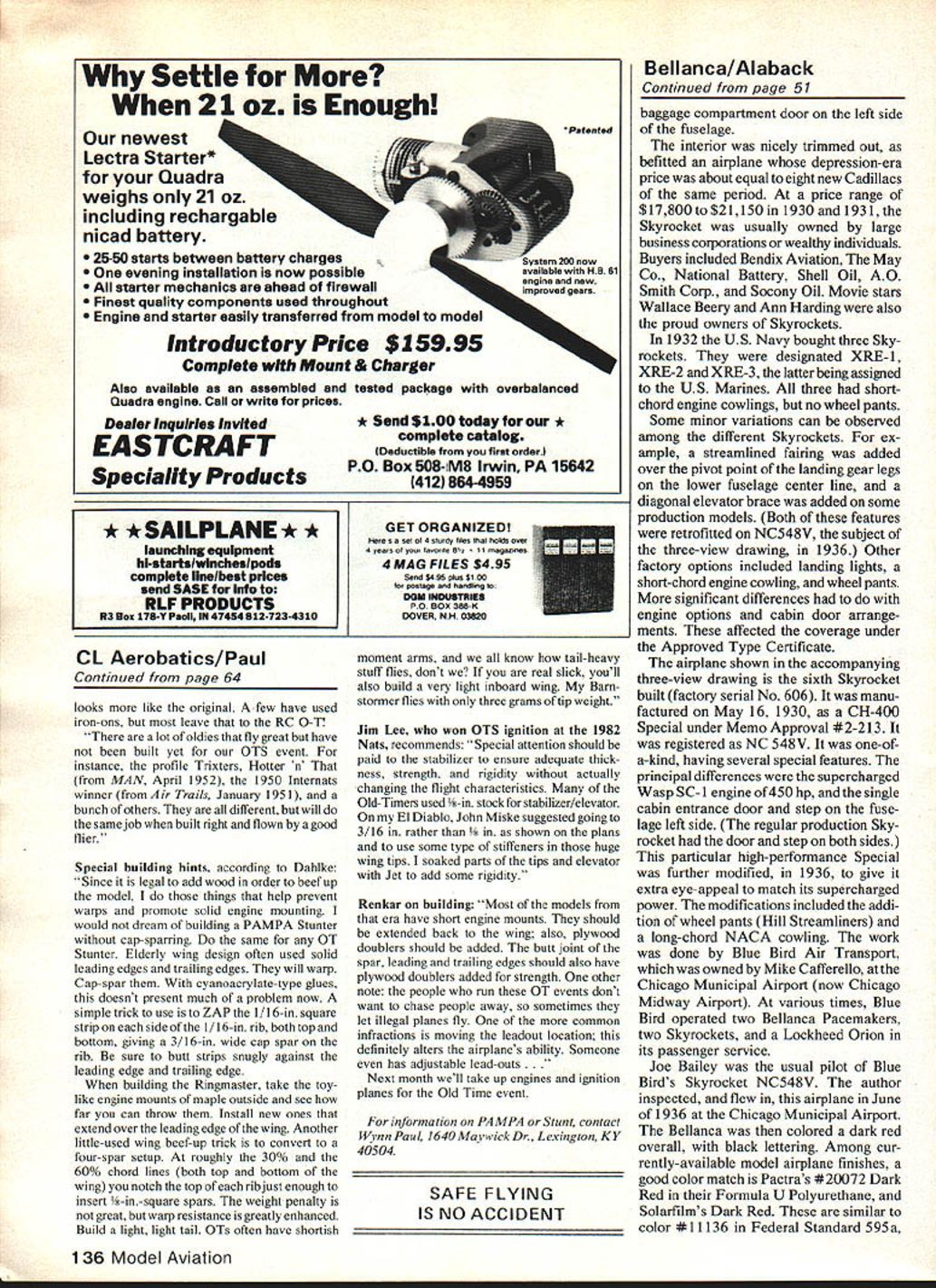
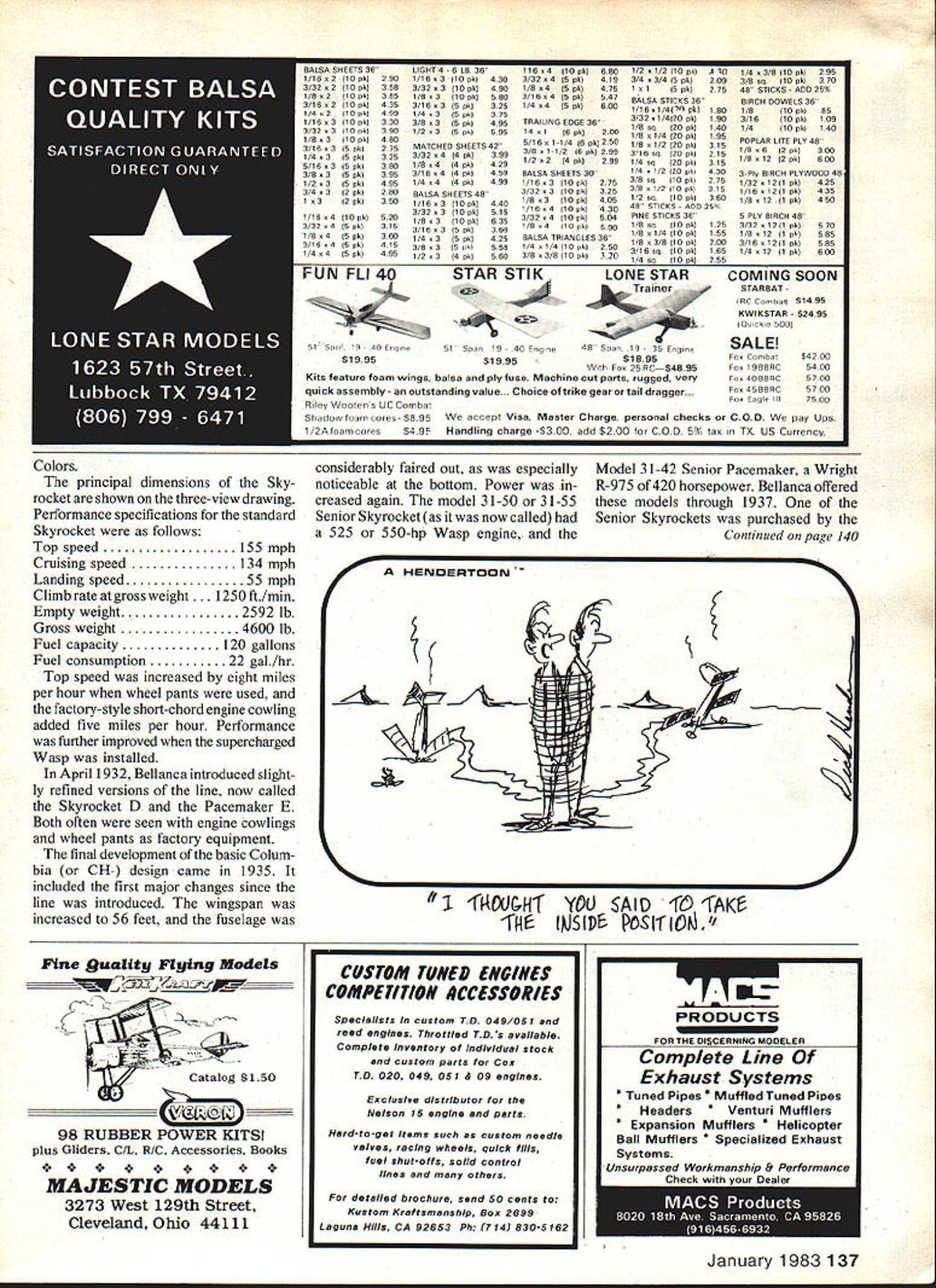
A notable factory special was the sixth Skyrocket built (factory serial No. 606), manufactured on May 16, 1930 as a CH‑400 Special under Memo Approval #2‑213 and registered NC548V. This one‑of‑a‑kind airplane featured a supercharged Wasp SC‑1 engine of 450 hp and a single cabin entrance door and step on the left side (regular production Skyrockets had doors and steps on both sides). In 1936 Blue Bird Air Transport (owned by Mike Cafferello) modified NC548V with wheel pants (Hill Streamliners) and a long‑chord NACA cowling. Blue Bird operated Bellanca Pacemakers, Skyrockets, and a Lockheed Orion in passenger service. Joe Bailey was the usual pilot of Blue Bird’s NC548V; the author inspected and flew in this airplane in June 1936. At that time the Bellanca was finished in dark red overall with black lettering.
Model airplane finish matches mentioned for reference included Pacita #20072 Dark Red and Solarfilm Dark Red (similar to Federal Standard 595a color #11136).
Later Developments and Variants
In April 1932 Bellanca introduced refined versions called the Skyrocket D and the Pacemaker E; these often featured engine cowlings and wheel pants as factory equipment.
The final development of the basic Columbia (CH‑) design came in 1935 with significant changes: wingspan increased to 56 feet, a more faired fuselage (especially at the bottom), and higher powerplants. The model 31‑50 or 31‑55 Senior Skyrocket used 525 or 550‑hp Wasp engines; the Model 31‑42 Senior Pacemaker used a Wright R‑975 of 420 hp. These models were offered through 1937. One Senior Skyrocket was purchased by the U.S. Navy as a JE‑1.
After World War II the manufacturing rights to this final version were sold to Northern Industries, Ltd., of Edmonton, Alberta, Canada, which produced a limited number of Senior Skyrockets as Model 31‑55A in the early postwar years. In 1950 the design was considered for entry in the U.S. Army liaison airplane competition (won by the De Havilland Beaver, later L‑20).
Notable Flights
Although the Bellanca was Lindbergh’s first choice to be the Spirit of St. Louis, fate made it the second airplane to fly the Atlantic nonstop by two weeks. Bellanca designs were also first across the Pacific nonstop: Clyde Pangborn and Hugh Herndon Jr. in Miss Veedol (Wasp C‑1, NR 796W, serial No. 3004) took off from Sabishiro Beach, Japan, on October 3, 1931, and landed 41 hours and 3 minutes later at Wenatchee, Washington, after 4,558 miles, winning the Tokyo Asahi prize.
Earlier long‑distance flights in Bellancas included Russell Boardman and John Polando’s New York–Istanbul flight in the Cape Cod (Wright J‑6‑9, NR 761W, serial No. 3001) in July 1931 (4,012 miles in 49 hours 20 minutes) and other notable Bellancas named Leonardo da Vinci, American Nurse, Pathfinder, Lithuania, and Warsaw. By 1931 there had already been 14 successful nonstop transatlantic crossings.
Production and Legacy
Over 200 of the CH, J, Pacemaker, Skyrocket series and variants were produced by Bellanca Aircraft Corporation of New Castle, Delaware, between 1927 and 1937. Today only five remain on the U.S. Civil Aircraft Register, but the Pacemakers and Skyrockets remain memorable to those who knew and flew them.
Specifications (standard Skyrocket)
- Top speed: 155 mph (increased by 8 mph with wheel pants; an additional 5 mph with short‑chord engine cowling; further improved with a supercharged Wasp)
- Cruising speed: 134 mph
- Landing speed: 55 mph
- Climb rate at gross weight: 1,250 ft/min
- Lightly loaded climb rate (CH‑400 with Wasp C‑1): ~1,850 ft/min
- Empty weight: 2,592 lb
- Gross weight: 4,600 lb
- Fuel capacity: 120 gallons
- Fuel consumption: 22 gal/hr
Note: The CH‑400 Skyrocket (Model CH‑400) used the Pratt & Whitney Wasp C‑1 (420 hp); factory options and special models included supercharged Wasp SC‑1 (450 hp), long‑chord NACA cowlings, wheel pants, and various cabin door arrangements.
Transcribed from original scans by AI. Minor OCR errors may remain.

