
Bergen County's New Model Aerodrome
The vision and the man behind it
For years he had dreamed of suddenly coming into an inheritance. Or maybe he'd win the state lottery. He was far from wanting the money for himself. His dream was to make life better for fellow modelers in northern New Jersey—specifically, Bergen County, where he had built and flown models all his life.
His concept was simple: buy a few square blocks of prime property, clear it out, and build a model airport.
I'm happy to say that his dream came true—not through a windfall, but through lots of planning, organizing, and hard work. It was also his good fortune to work with a most professional and cooperative County Parks and Recreation Department.
Like most modelers, Joe Beshar is a dreamer. He also is a doer. To get a model airpark built in northern New Jersey, you have to be a bit of both. — Geoff Styles
Why this matters
The key to this story is that if you can do it in Bergen County, New Jersey, within sight of the towers of New York City, you can do it almost anywhere.
Gaining county support
The man with the dream was Joe Beshar. Well known in the hobby as an avid modeler, Joe is of the old school of movers and shakers—men and women who can really make things happen.
Things finally began to happen when, after much effort, Joe secured an invitation to address the Bergen County Board of Freeholders, the administrative arm of the county, in May 1985.
Joe told the board of his background and of the history of model aviation as a sport in the metropolitan area. He talked about modelers who had moved up through the ranks to become a credit to society. He reminded his hearers of the county's provisions for other sports and asked them to give model aircraft fliers the same consideration. In other words, he asked that land be made available for model flying.
Joe kept the pot boiling. Throughout that year, he maintained contact with the Board of Freeholders by telephone and visit. He finally met with the newly appointed Director of Parks, Mr. C. Nurnberger, in May 1986, impressing him favorably. In less than a month (June 19, 1986), Joe was asked to address a regularly scheduled meeting of the Parks Commissioners. That was a big step forward.
To the Parks Commissioners, Joe again described his vision of a model airpark in Bergen County. He had the support of Mr. Nurnberger, and the parks officials showed sympathy and understanding. The chosen piece of land, owned by the county and adjacent to a multiuse park, was an illegal dumping ground for old cars, beer bottles, garbage, and assorted junk. After looking the site over, Joe pronounced it capable of transformation but warned that it would take a lot of backbreaking work.
Organizing and building the field
Over the next several months the county organized a construction program, and liaison was forged with all AMA clubs near the site. In March 1987, 12 AMA club presidents officially came together as the Bergen County Model Aerodrome (BCMA) Spearhead Committee.
This task force coordinated the cleanup of the land, removal of accumulated junk, and development of the model field. Operations and maintenance were coordinated at monthly meetings, still being held at this writing.
After months of dedicated labor by county workers, flying was opened on January 1, 1989. It was a great day for everyone who had contributed to the field. While improvements were still needed—fencing, a shelter, impound and frequency-control racks, paving of the parking lot and entry road, and more—plans had been made to accomplish them.
Two years later, in January 1991, Wolfgang Albrecht was appointed the new Director of the Department of Parks. Joe and the BCMA Committee found Mr. Albrecht equally as interested and helpful as his predecessor.
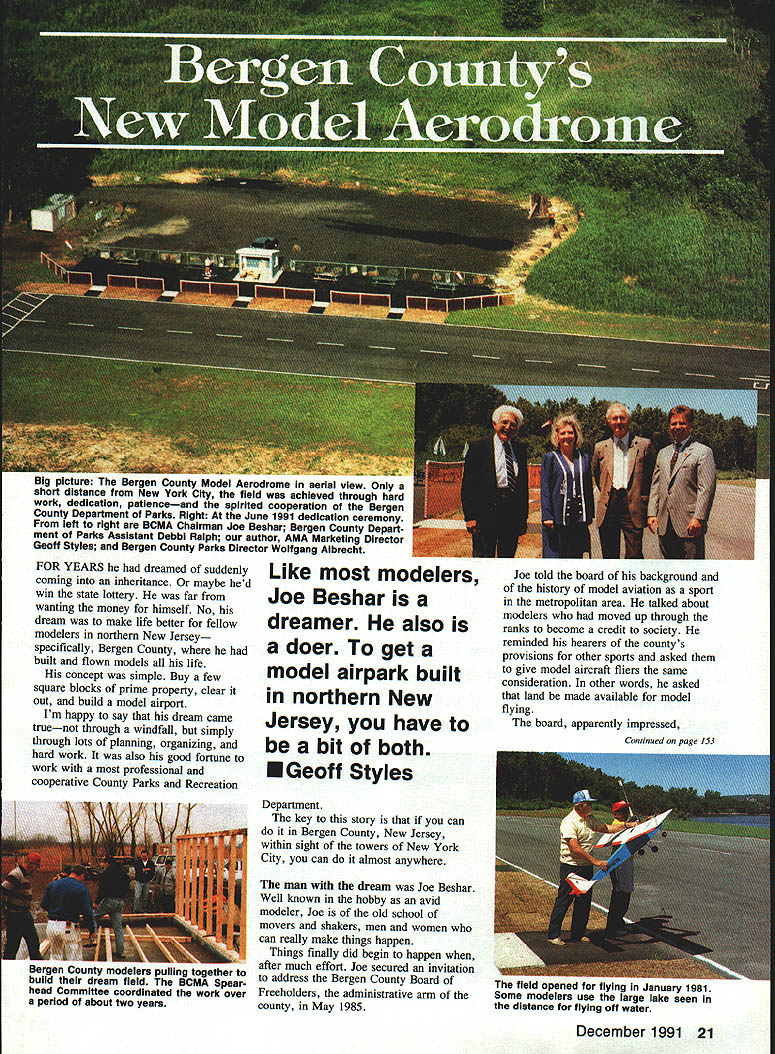
Fieldwork continued at an encouraging pace. The needed improvements were installed in time for the dedication ceremony in June 1991. Mr. Albrecht praised the contribution of the BCMA group to the community while downplaying the role of the county. He is gratified that the group has created a safe, scenic, supervised place for all model flying enthusiasts and at the same time removed an eyesore for the county.
Site features
- A paved runway that overlooks a large lake a few hundred feet distant.
- A small dock built and installed by the BCMA Committee for float-equipped aircraft and flying boats.
- No reported wildlife disturbances; ducks inhabit the lake and are accommodated. (On the author's visit, a duck was paused in the entry road.)
- An overfly area that is safe and adequate; another county park on the far side of the lake offers additional recreational activities.
While the Bergen County Model Aerodrome is far from being the country's most spacious model flying site, it is adequate. What's more, flying there can improve your proficiency. Those who use the field say that if you can cope with its enforced approaches and pattern, you can fly anywhere.
Pilot procedures, fees, and rules
All new pilots, regardless of experience, must undergo a procedure supervised by appointed check-pilots.
Requirements and process:
- Pass a written test.
- Make a successful flight under supervision.
- Present a valid AMA license (or photocopy).
- Pay a $20 annual fee.
After completing the process, modelers are issued a pilot permit by the secretary/treasurer, Vic Bock. Funds are used for field maintenance and improvements.
Fliers are made to understand that there's no substitute for proper conduct. Posted rules must be obeyed; violators lose their flying privileges. The county administration depends on BCMA to be self-policing and backs up its decisions.
Additional operational structure:
- Published lists of committee members/officers from all 12 area clubs are available at the field.
- Names and phone numbers of check-pilots and the names of field marshals are posted at the site.
- Larry Kraus, a retired technician, is chief field marshal.
Community and safety
Since the BCMA Committee is made up of club presidents and delegates, the dozen clubs communicate well with one another. Individual club functions and activities, invitations to flying and social gatherings, and information-swapping have built a solid fellowship among the clubs. With that kind of synergy, everyone benefits.
If this is a structured situation, that's partly because, as in full-scale aviation, safety comes first. The BCMA members and county officials must see to it that rules are followed and respected.
Conclusion
It's amazing to contemplate that within sight of New York City sits a model airpark in what appears an almost rural setting. A great job and a big thank-you to Joe Beshar and everyone in BCMA and the Bergen County administration who worked with him to make his dream come true. They're a first-class group of AMA members.
Transcribed from original scans by AI. Minor OCR errors may remain.

