
The Better Mousetrap--
HIGH TOW
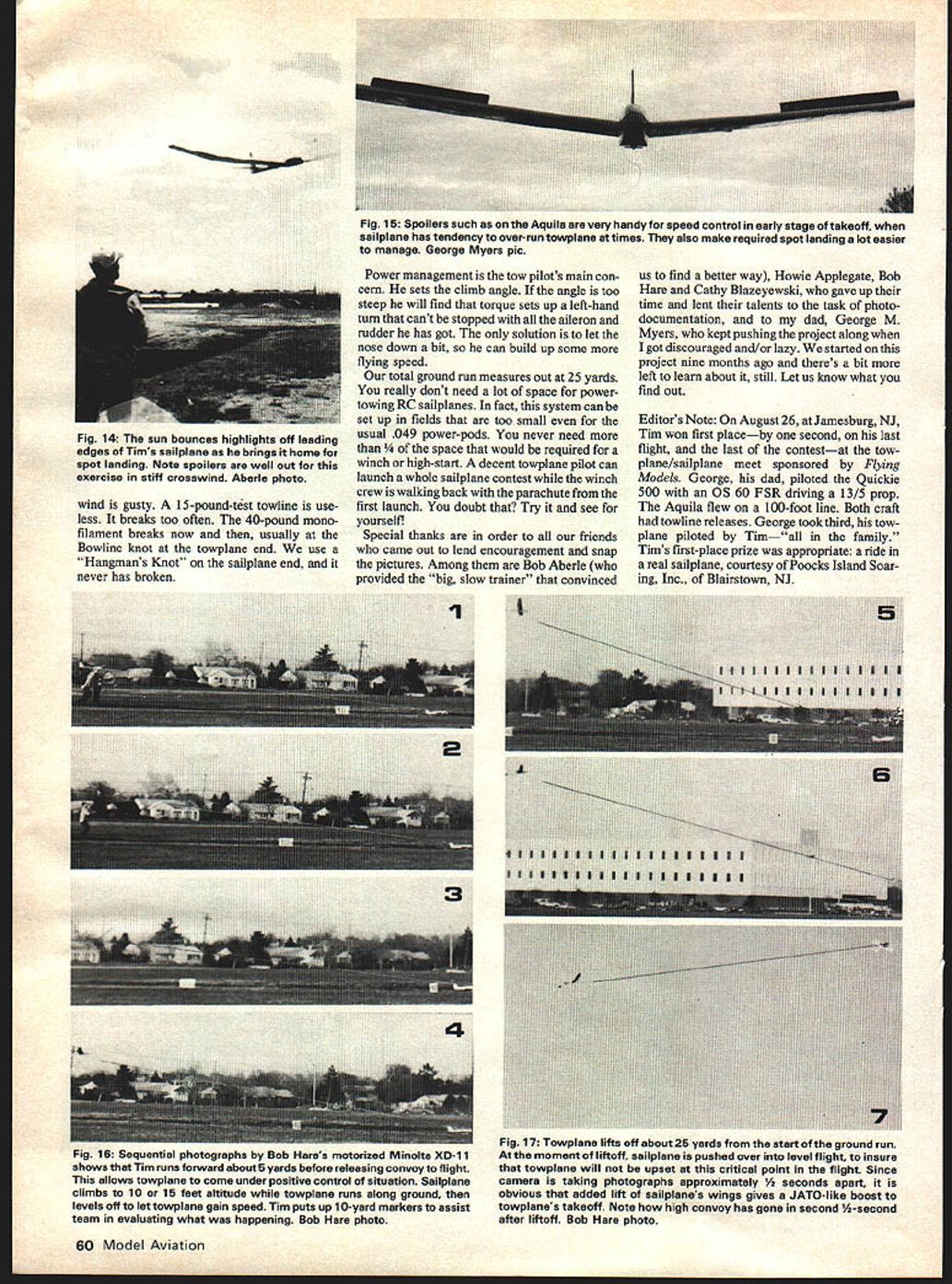
"A decent towplane pilot can launch a whole sailplane contest while the winch crew is walking back the parachute from the first launch." Strong words. But with the painstakingly tested methods described here, you can expect 25-yard rollouts with a 70-foot line (or less!) in fields that are even too small for .049 power‑pods—no more than 1/4 the space required for a winch or Hi‑start. — Timothy J. Myers
Bob Tupper is a nice guy. He's also a good sailplane pilot. But he had never seen my father and I do our power‑towing act. One day he agreed to meet us at the field to "try something new." I explained how to fly on tow while Dad set out the equipment. Dad towed him up. Bob had no trouble. They made a couple more tows, then hooked on the second towline. Bob's fifth power‑tow was a double, with me on the other line in my sailplane. No trouble! We made a dozen more doubles that evening. If a competent pilot can fly double tows right from the beginning, using a transmitter he's never handled before and a plane he's never flown before, why can't you?
There are a few things to learn, of course, but we can teach them to you. Read on.
Equipment and setup
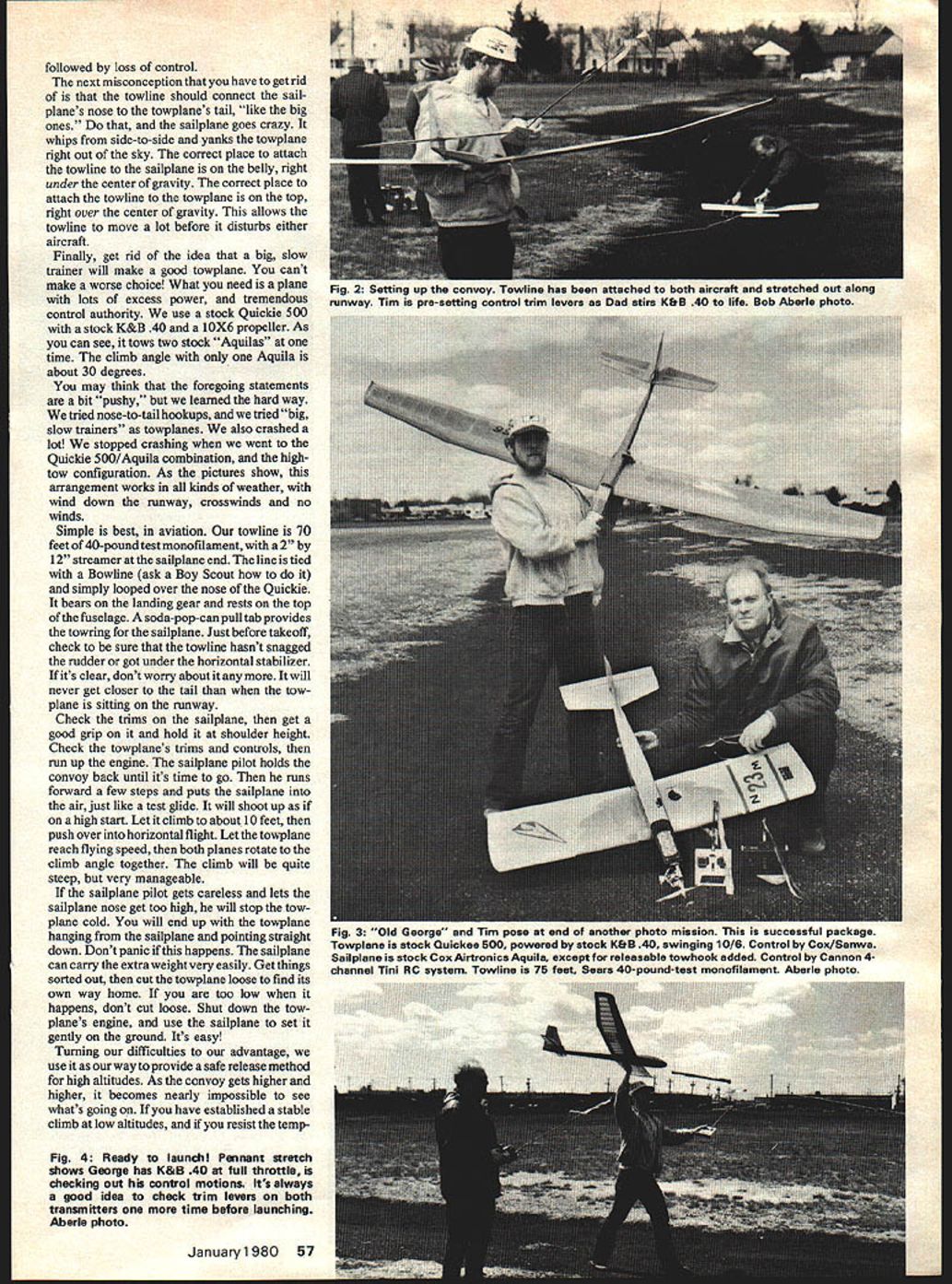
- Aerobatic airplane with at least a .35 engine (plenty of excess power and strong control authority). We use a stock Quickie 500 with a stock K&B .40 and a 10×6 prop; it can tow two stock Aquilas at once. With one Aquila the climb angle is about 30 degrees.
- Sailplane that is trimmed and balanced, and fairly stable. The pilot should have experience launching it from a winch or Hi‑start.
- Towline: we recommend 70 feet of 40‑pound‑test monofilament, with a 2" by 12" streamer at the sailplane end.
- Simple towhook on the sailplane (see towhook section).
- Basic field obstacles avoided; very short ground run required (about 25 yards).
We don't claim to be the first to tow an RC sailplane with an RC power plane, but we do claim our way is the easy, safe way. At the completion of the photo session for the double‑tow shown, we had made over 100 tows without damaging any of the aircraft used.
Why the "High Tow" method
First, forget about "realistic" trailing tows. Those are hard even for a pilot sitting on the end of the line. RC pilots are on the ground where visibility is poorer and keeping planes aligned is much harder. Trailing tow tends to produce slack in the line; slack is always followed by "twanging," which is always followed by loss of control.
The High Tow arrangement we use closely mimics a winch or Hi‑start: misalignments between towplane and sailplane are accommodated by changes in the angle of the towline, not by changes in line tension. This automatically stable geometry greatly reduces the chance of slack and twang.
Do not attach the towline nose‑to‑tail "like the big ones." That hookup makes the sailplane whip side to side and can yank the towplane out of the sky. Attach the towline to the sailplane on the belly, right under the center of gravity. Attach the towline to the towplane on the top, right over the center of gravity. These locations let the towline move considerably before it disturbs either aircraft.
Also discard the idea that a big, slow trainer makes a good towplane. You need excess power and tremendous control authority.
Towline and hardware
- Line: 70 feet of 40‑pound monofilament. A 12" streamer at the sailplane end helps keep the line visible and untangled.
- Towplane end: tie a Bowline knot and simply loop the line over the nose of the towplane so it bears on the landing gear and rests on the top of the fuselage. A soda‑pop‑can pull tab provides a convenient tow ring for the sailplane.
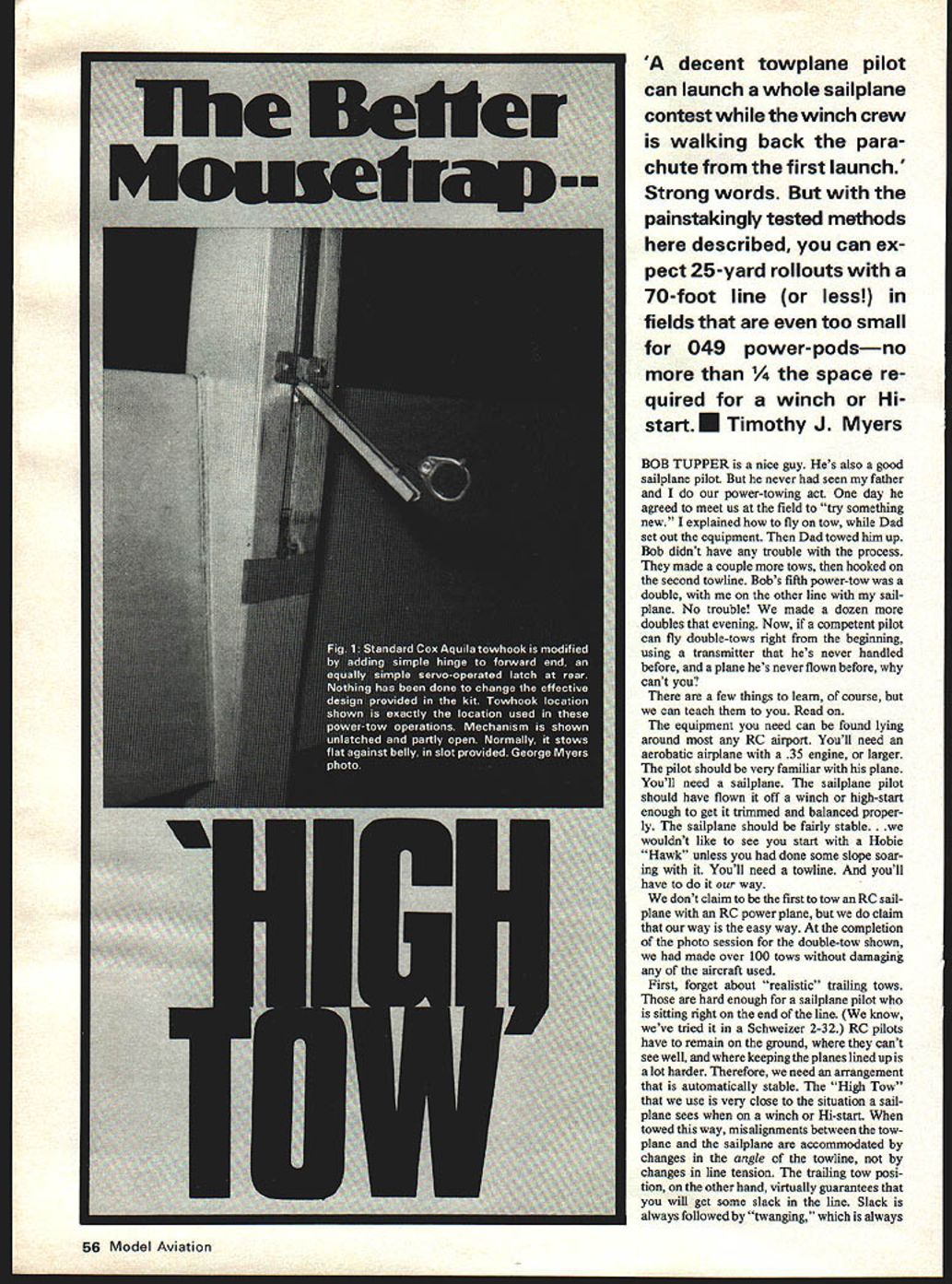
- Sailplane end: use a Hangman's Knot for reliability. We use an open hook design (the ring is not captive) and a tow‑release mechanism that is fail‑safe: the servo must exert force to prevent the latch from opening (avoid designs requiring the servo to overcome the towing force to release).
- In gusty wind, a 15‑pound test line is useless; it breaks too often. The 40‑pound monofilament occasionally breaks (usually at the Bowline) but is the practical compromise.
Before takeoff, always check that the towline hasn't snagged the rudder or gotten under the horizontal stabilizer. If it's clear, don't worry about it — it will never get closer to the towplane's tail than when the towplane is sitting on the runway.
Takeoff and climb procedure
- Check trims on both aircraft.
- Sailplane pilot: get a good grip and hold the sailplane at shoulder height.
- Towplane pilot: check trims and controls, run up the engine.
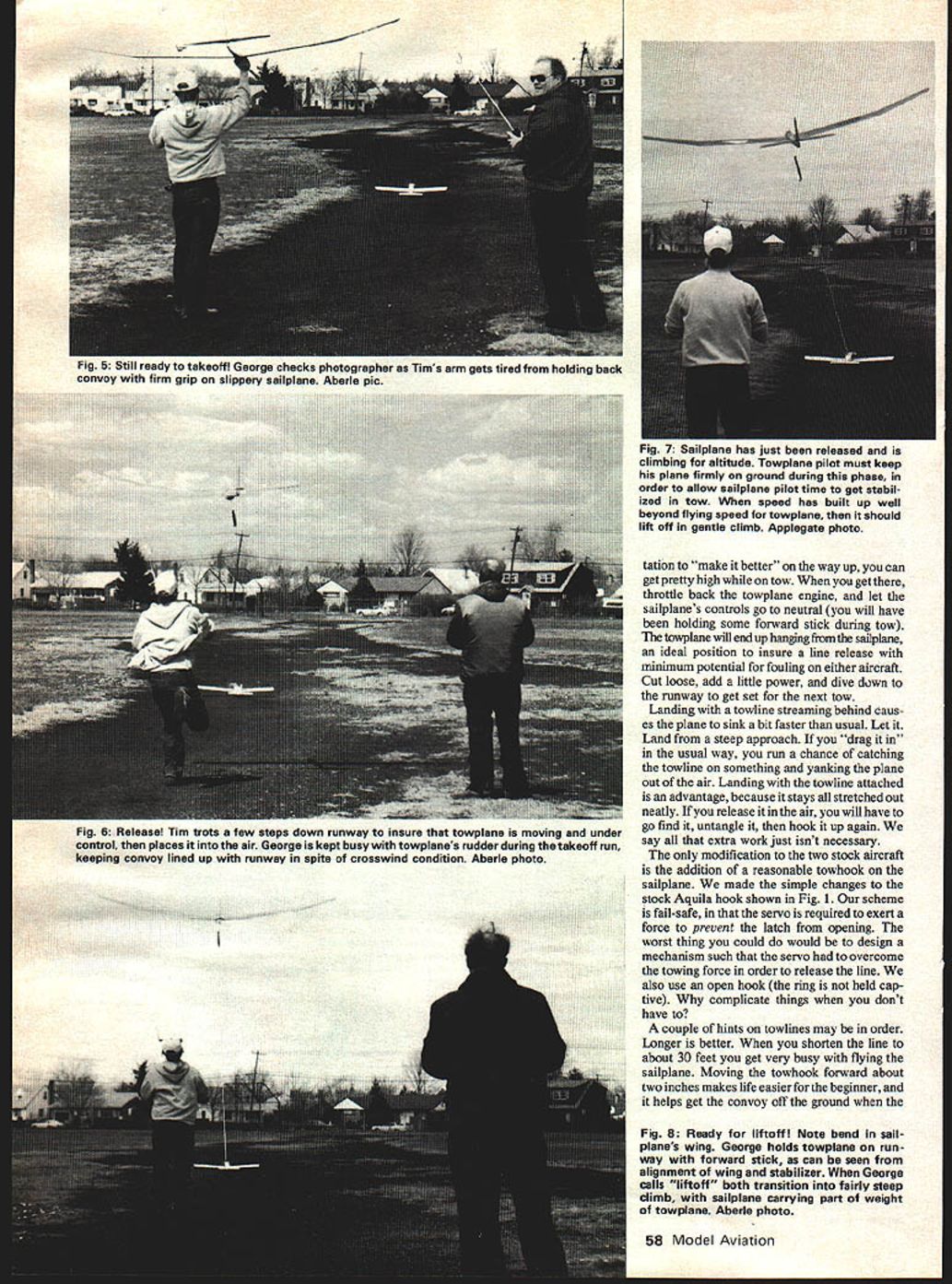
- Sailplane pilot holds the convoy back until it's time to go. Then run forward a few steps and put the sailplane into the air exactly like a test glide — it will shoot up as if on a Hi‑start.
- Let the sailplane climb to about 10 feet, then push over into horizontal flight.
- Let the towplane reach flying speed; both planes then rotate to the climb angle together. The climb is quite steep but manageable.
Power management is the tow pilot's main concern; he sets the climb angle. If the angle is too steep, torque may induce an uncorrectable left‑hand turn; the remedy is to lower the nose slightly to build flying speed.
Handling problems
- If the sailplane nose gets too high, it can stop the towplane cold. You may end up with the towplane hanging from the sailplane and pointing down. Don't panic. The sailplane can carry the extra weight. Get things sorted, then cut the towline to let the towplane return on its own.
- If the towplane is too low when this happens, do not cut loose. Shut down the towplane engine and use the sailplane to set it gently on the ground.
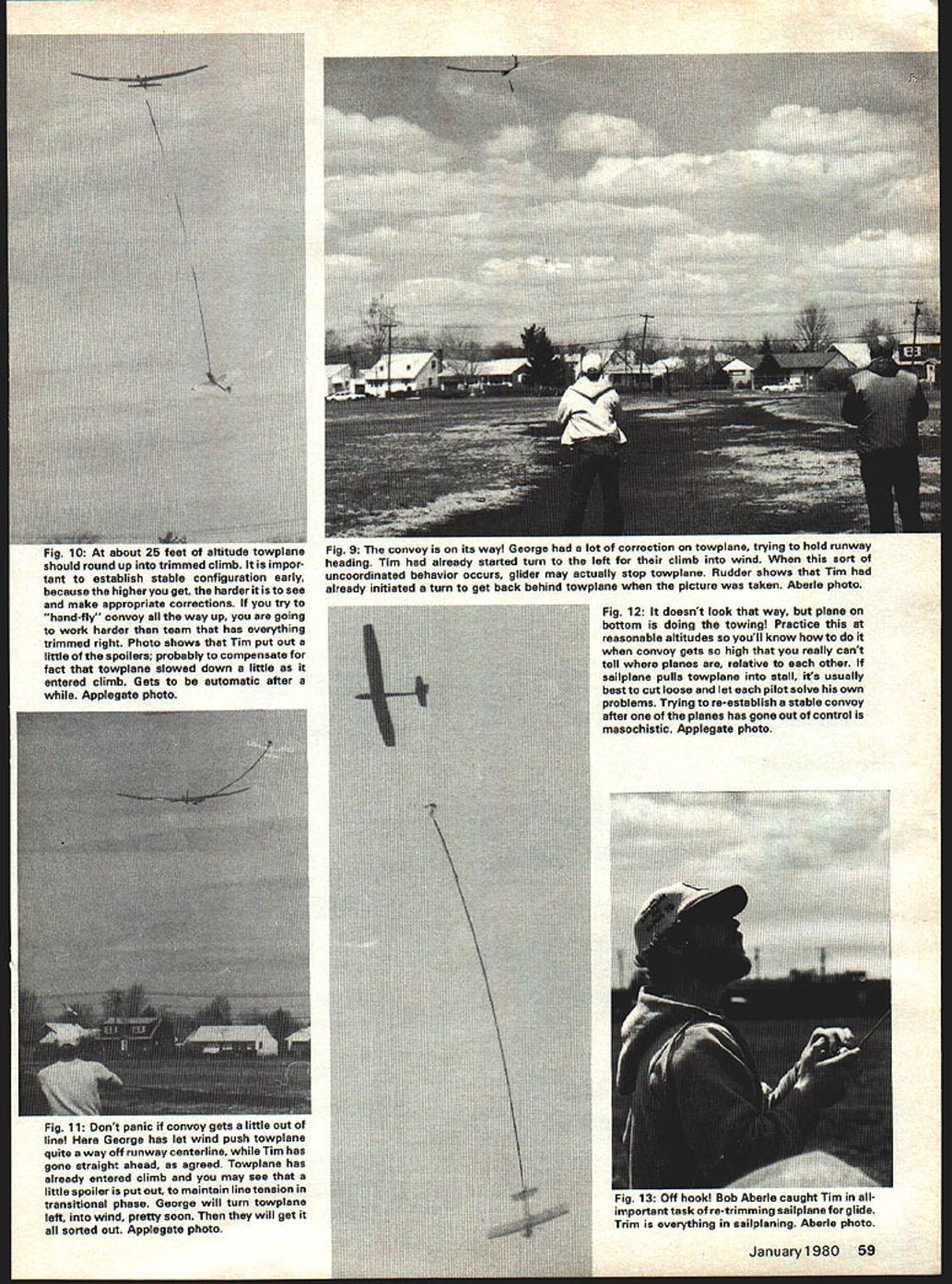
- If the sailplane pulls the towplane into a stall or one aircraft goes out of control, it's usually best to cut loose and let each pilot solve their own problems. Trying to reestablish a stable convoy after a severe upset is masochistic.
High‑altitude release technique
As the convoy gets higher, it becomes nearly impossible to see relative positions. If you have a stable climb at low altitude and resist the temptation to "improve" things while climbing, you can get quite high. When you reach the desired altitude, throttle back the towplane engine and let the sailplane controls go to neutral (you will have been holding some forward stick during tow). The towplane will end up hanging under the sailplane — an ideal position to ensure a clean line release with minimal fouling. Cut loose, add a little power, and dive to the runway for the next tow.
Landing with the towline
Landing with the towline streaming behind causes a slightly faster sink rate than usual. Accept that and land from a steep approach. If you try to "drag it in" as in a normal landing you risk catching the towline on something and yanking the plane out of the air. Leaving the line attached on landing keeps it stretched out neatly and avoids having to retrieve and untangle it before the next launch.
Towhook modification
The only modification to the two stock aircraft was the addition of a reasonable towhook on the sailplane. Our changes to the stock Aquila are simple and fail‑safe: the servo must exert force to keep the latch closed. We prefer an open hook (ring not captive) — simpler and less likely to foul.
Hints and tuning
- Longer lines are easier to fly on; shorter lines (around 30 feet) keep the sailplane pilot very busy.
- Moving the towhook forward about two inches helps beginners and eases getting the convoy off the ground when using shorter lines.
- If things are not perfectly trimmed, you will work harder than a team that has everything properly trimmed. Spoilers may be used briefly in transitional phases to maintain line tension.
Performance and results
Our total ground run measures about 25 yards. You really don't need much space for power‑towing RC sailplanes. This system can be set up in fields that are too small even for the usual .049 power‑pods and uses no more than 1/4 of the space required for a winch or Hi‑start. With a decent towplane pilot you can launch many sailplanes quickly — even while a winch crew is retrieving the parachute from the first launch.
We stopped crashing after switching to the Quickie 500/Aquila combination and using the high‑tow configuration. The arrangement works in crosswinds, wind down the runway, and calm conditions. During testing and photoshoots we made over 100 successful tows without damaging the aircraft.
Figure captions
- Fig. 9: The convoy is on its way. Towplane required a lot of correction to hold runway heading while the glider started a left turn into the wind. When uncoordinated behavior occurs, the glider may actually stop the towplane. Rudder input shows the glider pilot had already initiated a turn to get back behind the towplane. — Aberle photo.
- Fig. 11: Don't panic if the convoy gets a little out of line. Here the wind has pushed the towplane off the runway centerline while the glider pilot kept straight ahead as agreed. The towplane has already entered climb and you may see a little spoiler is put out to maintain line tension in the transitional phase. The towplane pilot will soon turn into the wind and get things sorted out. — Applegate photo.
- Fig. 12: It doesn't look that way, but the plane on the bottom is doing the towing. Practice at reasonable altitudes so you'll know how to react when the convoy gets so high you can't see relative positions. If the sailplane pulls the towplane into a stall, it's usually best to cut loose and let each pilot handle their own recovery. — Applegate photo.
- Fig. 13: Off hook! Bob Aberle caught Tim in the important task of re‑trimming the sailplane for its glide. Trim is everything in sailplaning. — Aberle photo.
Acknowledgments and closing
Special thanks to our friends who came out to encourage and photograph the project: Bob Aberle (who provided the "big, slow trainer" that convinced us to find a better way), Howie Applegate, Bob Hare, and Cathy Blazeyewski. Thanks also to my dad, George M. Myers, who kept pushing the project along when I got discouraged and/or lazy. We started this project nine months ago and there's still a bit more to learn. Let us know what you find out.
Editor's Note: On August 26, at Jamesburg, NJ, Tim won first place — by one second, on his last flight, and the last of the contest — at the towplane/sailplane meet sponsored by Flying Models. George, his dad, piloted the Quickie 500 with an OS 60 FSR driving a 13×5 prop. The Aquila flew on a 100‑foot line. Both craft had towline releases. George took third, his towplane piloted by Tim — "all in the family." Tim's first‑place prize was fitting: a ride in a real sailplane, courtesy of Pooch's Island Soaring, Inc., of Blairstown, NJ.
Transcribed from original scans by AI. Minor OCR errors may remain.

