




Big Bangers for Big Birds
Bob Beckman and Kirby Crawford
Part Three of our series on power plants for the big ’uns. Bob and Kirby discuss five engines that range from the smallest to about the biggest in gasoline burners.
This installment covers almost the entire size range of Big Bird gasoline burners, from the 1.2 cu. in. Mag-Aero to a 4.8 cu. in. special-order engine from Roush Mfg. It is interesting to note that both ends of the range are based on Kioritz products. In between the extremes, we look at three more engines: a Roper, a Husky, and a Kawasaki. Refer to Part 1 of this series (April ’81 Model Aviation) for a description of our test equipment and procedures.
Test equipment and tachometer
There has been one significant addition to our test equipment. We were beginning to have doubts about our venerable old Heathkit Thumb Tach. Now, thanks to Dick Penrod at Giezendanner USA, we have the use of one of the Giezendanner digital tachometers. This device is not only easier to read, but it is much more accurate. In addition, it helped us identify an embarrassing error in our original setup.
Bob’s old Thumb Tach had not been used for several years, and the instruction book was long gone. When checked against an incandescent light, the 3,000 rpm reading seemed correct (due to a faulty memory). With a little thought we would have realized it should have been 3,600. It was not until we read the instructions for the digital tach that the mistake became obvious. In cross-checking between the two we found that multiplying the Thumb Tach readings by 1.2 yields the same reading as the Giezendanner unit, within the ±200 rpm accuracy of the Thumb Tach itself. All previously published rpm figures should be adjusted accordingly. Please accept our apologies for the inconvenience.
The digital readout of the Giezendanner tach makes it possible to get closer rpm readings. The tach reads hundreds; it is stable enough to allow interpolation to the midpoint between readings. For example, a steady reading of 54 means 5,400 rpm. If the reading is changing back and forth between 54 and 55, you can read 5,450 rpm. The tach is easy to use: turn it on, point it toward the propeller, and vary the position until a steady reading is obtained. The best position depends on light conditions. We are pleased with the tach’s operation and feel it is a valuable addition to the project.
Note: thrust figures previously published remain valid within their published accuracy. Only the rpm figures need adjustment.
Spark ignition basics
From the mail and from talking to other modelers, it seems many people trying to use these engines do not understand the basics of spark ignition. That’s understandable, since several generations of modelers have never used anything but glow engines.
Stated simply, the compressed charge of gasoline and air in the cylinder is ignited by a spark jumping between the electrodes of the spark plug. The spark is produced by high voltage generated in the magneto coil and timed by either mechanical points or an electronic circuit. The energy required is produced by magnets on the flywheel passing close to the pole pieces of the magneto. With the exception of electronic ignition circuits, these systems all involve gaps, and the proper adjustment of these various gaps is vital to engine operation. All of the data sheets we publish include these settings. An essential tool for a Big Banger user is a set of feeler gauges, available at any auto parts store.
Here are the important gaps and adjustments:
- Spark plug gap: Affects the amount of spark produced and, to a small extent, the exact timing. Typical plug gap is on the order of 0.025 to 0.035 in.
- Points gap (mechanical ignition): The points are opened and closed by a cam on the crankshaft. When the points open, the high tension is produced that causes the spark at the spark plug. Points are adjusted by positioning the crankshaft until the points are open and then varying the size of the opening. If the points never open or never close, there will be no spark. If points are too close they will stay closed longer than they should, effectively retarding the spark and reducing power, especially at high speed. Points are usually set at about 0.015 in. when fully open.
- Magneto air gap: Should be as small as possible because the closer the magnets pass the pole pieces, the more energy is developed for the spark. The quality of the crankshaft bearings and the size of the flywheel determine the gap needed to ensure the magnets do not touch. About 0.010 in. is typical for chainsaw engines.
Since these gaps are mechanical, wear and vibration can change them over time. Periodic adjustment is required to keep the engine running at peak performance. It is also wise to check these settings on a new engine because you never know what may have happened to the engine between factory and delivery.
Notes on the current test engines
Listed below are additional notes and subjective data on the current set of test engines.
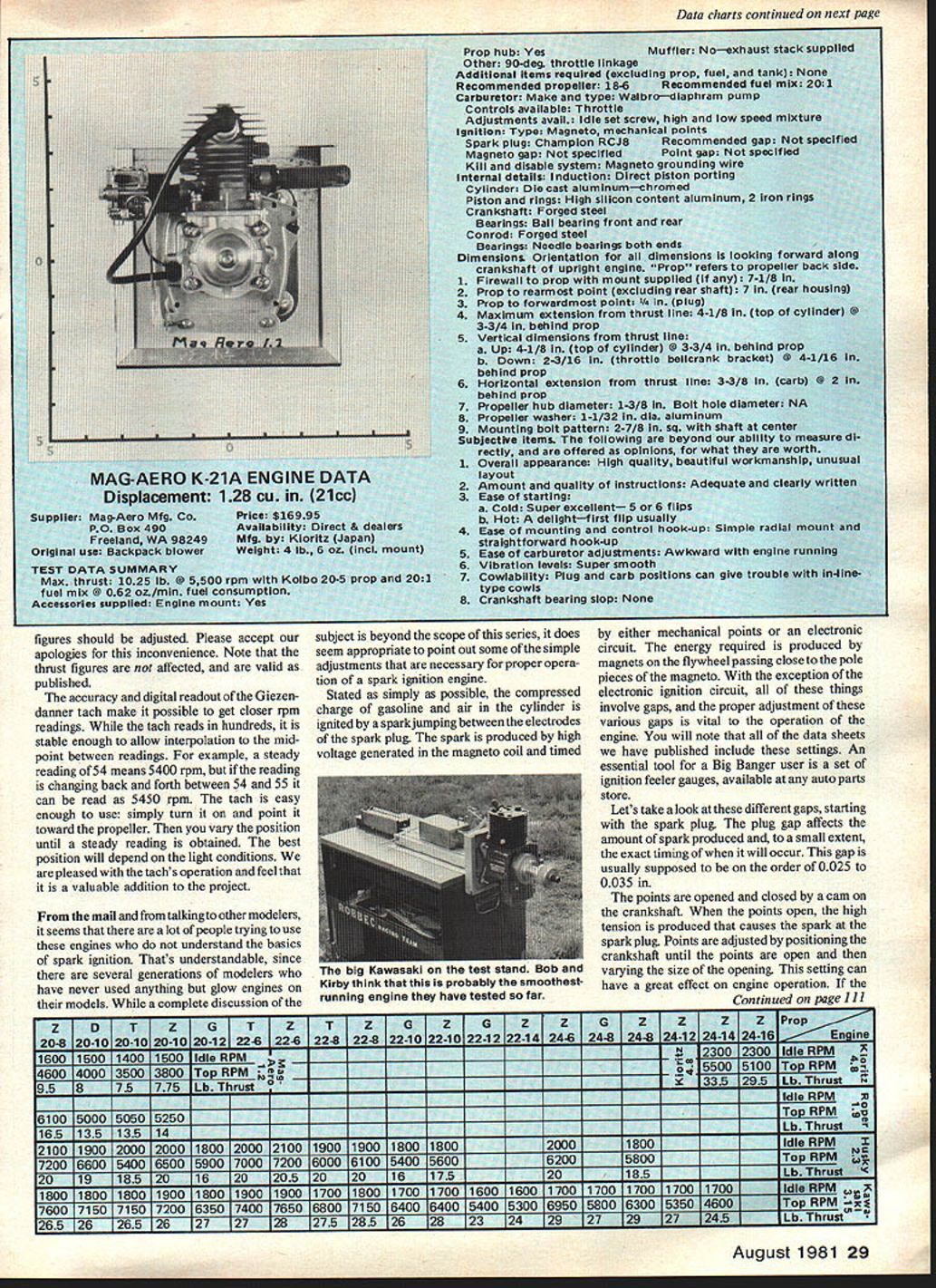
Mag-Aero
This beautiful engine is both fascinating and frustrating. Like its bigger Kioritz-based relative, the 2.4 cu. in. engine, the Mag-Aero is extremely well made and a delight to operate. At first glance it seems ideally suited to aircraft use, but it has some detracting characteristics.
The large, cup-shaped rear housing contains the flywheel, magneto, and points. As a result, the back of the engine is much less cluttered than most Big Bangers, which should make it easier to cowl. Unfortunately, the positioning of the spark plug dictates a very flat-faced cowl, and the horizontal protrusion of the carburetor complicates mounting in in-line cowls. Radial cowls would be easier, but the actual length of the engine would require a false firewall in the scale position forward of the actual firewall to which the engine is mounted.
Despite the awkward layout, the Mag-Aero’s quality makes it an outstanding big-bird powerplant. It would be particularly useful for some quarter-scale designs originally powered by big glow engines. The lower vibration level of the Mag-Aero would be more compatible with the lighter construction that has proven inadequate for larger chainsaw engines. For example, the Mag-Aero would be ideal for a Piper Cub in the 12- to 14-lb. range.
Another interesting possibility is the radial engine version of the Gee Bee Sportster. We were impressed by the quality, easy starting, and smooth running of this engine.
Specifications (typical for this engine):
- Prop hub: Yes
- Muffler: No (exhaust stack supplied)
- Other: 90-degree throttle linkage
- Additional items required (excluding prop and fuel tank): None
- Recommended propeller: 18×6
- Recommended fuel mix: 20:1 (gasoline:oilmix)
- Carburetor: Walbro diaphragm-type pump
- Controls available: Throttle
- Adjustments available: Idle set screw, high/low speed mixture
- Ignition type: Magneto with mechanical points
- Spark plug: Champion RCJ8
- Kill/disable system: Magneto grounding wire
- Induction: Direct piston porting
- Cylinder: Die-cast aluminum, chromed
- Piston rings: High-silicon-content aluminum with 2 iron rings
- Crankshaft: Forged steel
- Bearings: Ball bearings front and rear
- Conrod: Forged steel with needle bearings at both ends
- Orientation: Dimensions shown looking forward along crankshaft; upright engine
- Note: “prop” refers to the propeller back side
Roper 1.9
This engine is about the least expensive gasoline burner available. Horner Sales offers used "factory demo" engines for $34.95 and new engines for $49.95. A couple of clarifications are in order: the "factory" referred to is the Roper factory, and the engines, new or used, have not been modified for aircraft use.
The modification is not difficult and can be done without machine tools; the procedure is outlined in the instruction sheet that comes with the engine. In addition to doing the engine mods, you will need to make or buy a motor mount and a prop hub. Horner offers both, and any of the prop hubs made for the Quadra will fit.
Our test engine was one of the used demo units, but Gene Horner had already done the conversion work. Under the circumstances we skipped our usual break-in run and went straight to tests. We found that backing the idle screw out all the way still resulted in idle speeds no lower than 3,000 rpm. Since the stop arm was resting directly on the screw bracket, there was nothing we could do in the field. High-speed operation was not affected, so we continued with our tests.
In discussing this engine with Gene Horner, he mentioned that it could be a bear to start. He recommends using a puller and cord in his instructions. One possible reason for hard starting is the fairly large magneto air gap required because of the rather loose needle bearings on the crankshaft.
Once started, the engine produced credible power for its size and is surprisingly comfortable at high speeds. At low speeds, however, it is a shaker. This engine is usable and offers reasonable value for the price.
Husky 2.3
For several years, J. C. Enterprises has been selling a converted 2.0 cu. in. McCulloch chainsaw engine called the Husky. Our test engine was the first of a new, slightly larger 2.3 version. The 2.3 is almost identical to the earlier model except for size.
The layout of the Husky is one of the best we have seen for aircraft application. Both the carburetor and the magneto are mounted in front of the cylinder, instead of sticking out the side or bottom of the engine. This makes cowling the engine much easier. A built-in vacuum-operated pump (originally for oiling the saw chain) is left on when the engine is converted; this could be used for a smoke system. If you remove the pump and drill one new mounting hole you can cut another inch or so off the bottom of the casting and get the engine into even tighter cowls.
One unfortunate difference in the new engine is that the carb does not have a built-in choke. On the other hand, it has larger cooling fins and should run a little cooler over long periods at full throttle.
We feel the Husky 2.3 is a valuable addition to the Big Banger list. It will be particularly useful for models with in-line cowls.
Kawasaki TA-51
We reported on the smaller Kawasaki engine in Part 1 of this series. This TA-51 is more of the same quality, beautiful workmanship, and superb operating characteristics.
We had noted in our earlier report that a change in the carburetor mounting resulted in much easier adjustment while running. This engine had that change and was quite easy to work with. One minor surprise was that the carb has no idle adjustment screw. This caused a little difficulty during our tests, but in a normal installation you would use the throttle servo to set the idle.
Another minor difference involves trimming the rectangular crankcase casting. While removing excessive material has little effect on the weight or size of the smaller model, it can affect the TA-51. By relocating the electronic ignition module and trimming the casting down the magneto, about an inch can be removed — which could be important in some cowlings.
With its smooth running, power output, and adjustment-free electronic ignition, we consider the Kawasaki an outstanding engine.
Kioritz 4.8
We do not have a complete report on this engine at this time, but we felt it should be mentioned. The engine is one of several available from Roush Mfg. on a special-order basis. These units are larger and more expensive than the average modeler will ever want. They are special-purpose powerplants that would be out of place at the average flying field. On the other hand, if you have a special application and the facilities to handle it, it's nice to know the power is available.
There are many good things about this engine. The carburetor is right in front of the cylinder, and the entire ignition system is inside the flywheel. The exhaust comes out the back, of course, but the engine is no wider than the flywheel — a tidy layout. It would be great if manufacturers would adopt this layout in engines the size of the Quadra or even the 2.4 Kioritz.
The engine comes from one of the larger Kioritz professional chainsaws. The Roush brothers have done a beautiful job converting it to aircraft use, and we understand many inquiries for this and other large engines are coming from people building microlights and powered hang gliders. Roush can supply engines up to 5.6 cu. in.
The reason we have so little operational data is that we had difficulty getting it to run. The engine has fairly high compression, and the starting procedure is somewhat different from what we have been using. Our first session with the engine resulted in only one run, mainly because we weren't doing things right. The next weekend we had a little more luck getting it started the first time, but then we ran into some ignition problems and decided to hold off until we could sort things out. We are reporting what we can now and will add operating data as we get it.
We are not interested in using this engine ourselves, but we are impressed by it. Like all Kioritz products, it is of very high quality, with conversion work to match. We consider our starting problems due to lack of familiarity with this level of engine size.
Acknowledgements
We wish to thank the following firms for their assistance in this part of the Big Banger project:
- CB Associates, Inc., 21658 Gould Way, Hayward, CA 94545 (Kawasaki)
- Dynathrust Props, Inc., 2541 NE 11th Ct., Pompano Beach, FL 33062
- Giezendanner USA, PO Box 818, Pottstown, PA 19464
- Grish Bros., St. John, IN 46373
- Horner Sales, Inc., 300 Dixie Hwy., Beecher, IL 60401 (Roper)
- J C Enterprises, 2251 SW 28th Terrace, Ft. Lauderdale, FL 33312 (Husky)
- Mag-Aero Mfg. Co., PO Box 490, Freeland, WA 98249
- Roush Mfg., PO Box 251, Sandyville, OH 44671 (Kioritz)
- Top Flite Models, Inc., 1901 Narragansett Ave., Chicago, IL 60639
- J & Z Products, 25029 S. Vermont Ave., Harbor City, CA 90710 (Zinger)
Transcribed from original scans by AI. Minor OCR errors may remain.

