
Big Bangers for Big Birds
Bob Beckman and Kirby Crawford
Here is the latest report from our intrepid team of big-engine testers. In this installment we look at four popular Giant Scale engines, with an interlude to answer some questions submitted by readers. Part 4.
Those of you who have been following this series may remember the lead photos for Part 1 back in the April issue. They showed us doing our thing all bundled up in coats and gloves. (The big ear muffs were as useful at ear warming as they were at sound deadening.) Those first test runs were made in late November and early December, and anyone who thinks that Virginia is too far south to get cold doesn't know about northern Virginia.
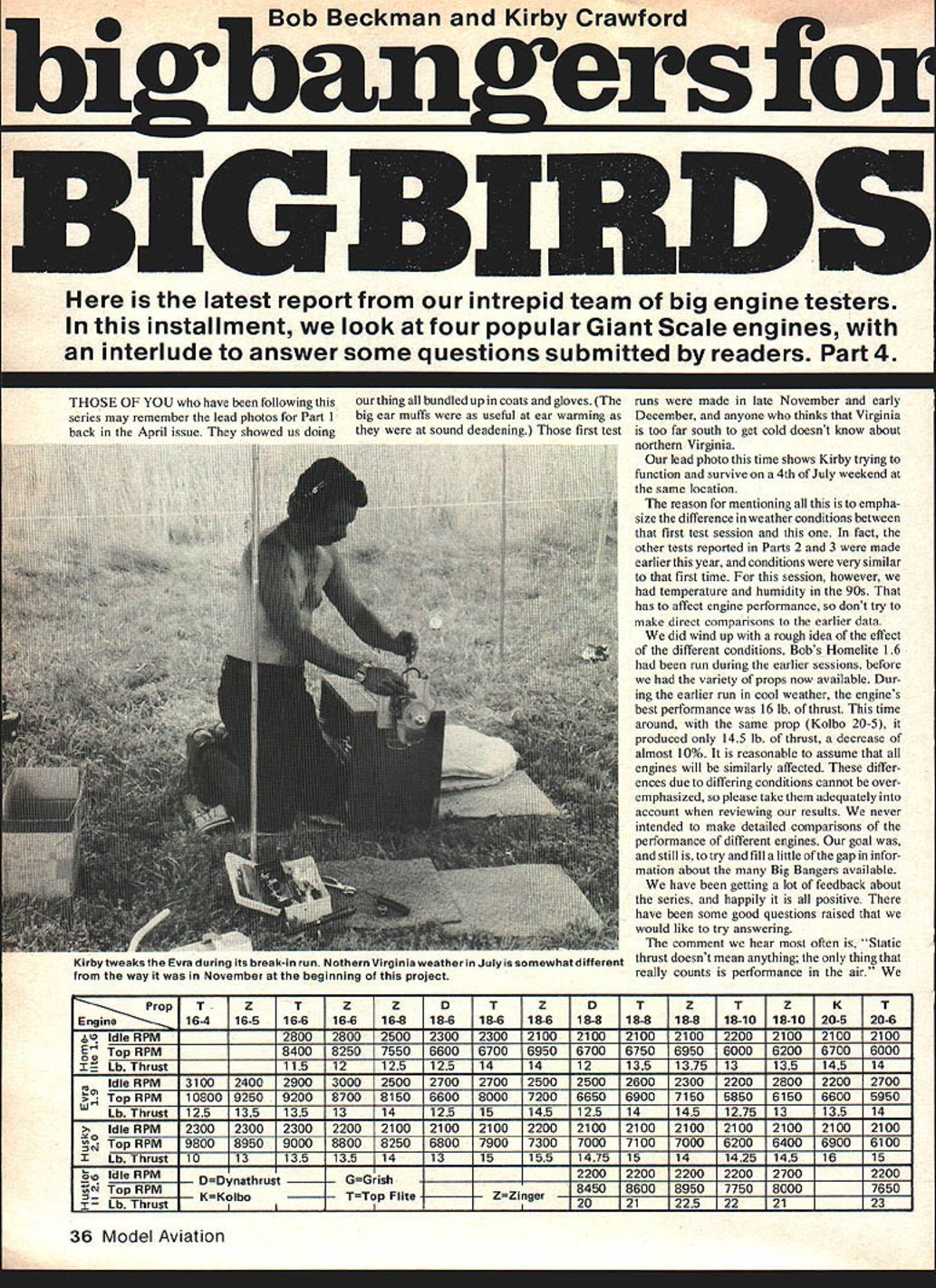
Our lead photo this time shows Kirby trying to function and survive on a 4th of July weekend at the same location.
The reason for mentioning all this is to emphasize the difference in weather conditions between that first test session and this one. In fact, the other tests reported in Parts 2 and 3 were made earlier this year, and conditions were very similar to that first time. For this session, however, we had temperature and humidity in the 90s. That has to affect engine performance, so don't try to make direct comparisons to the earlier data.
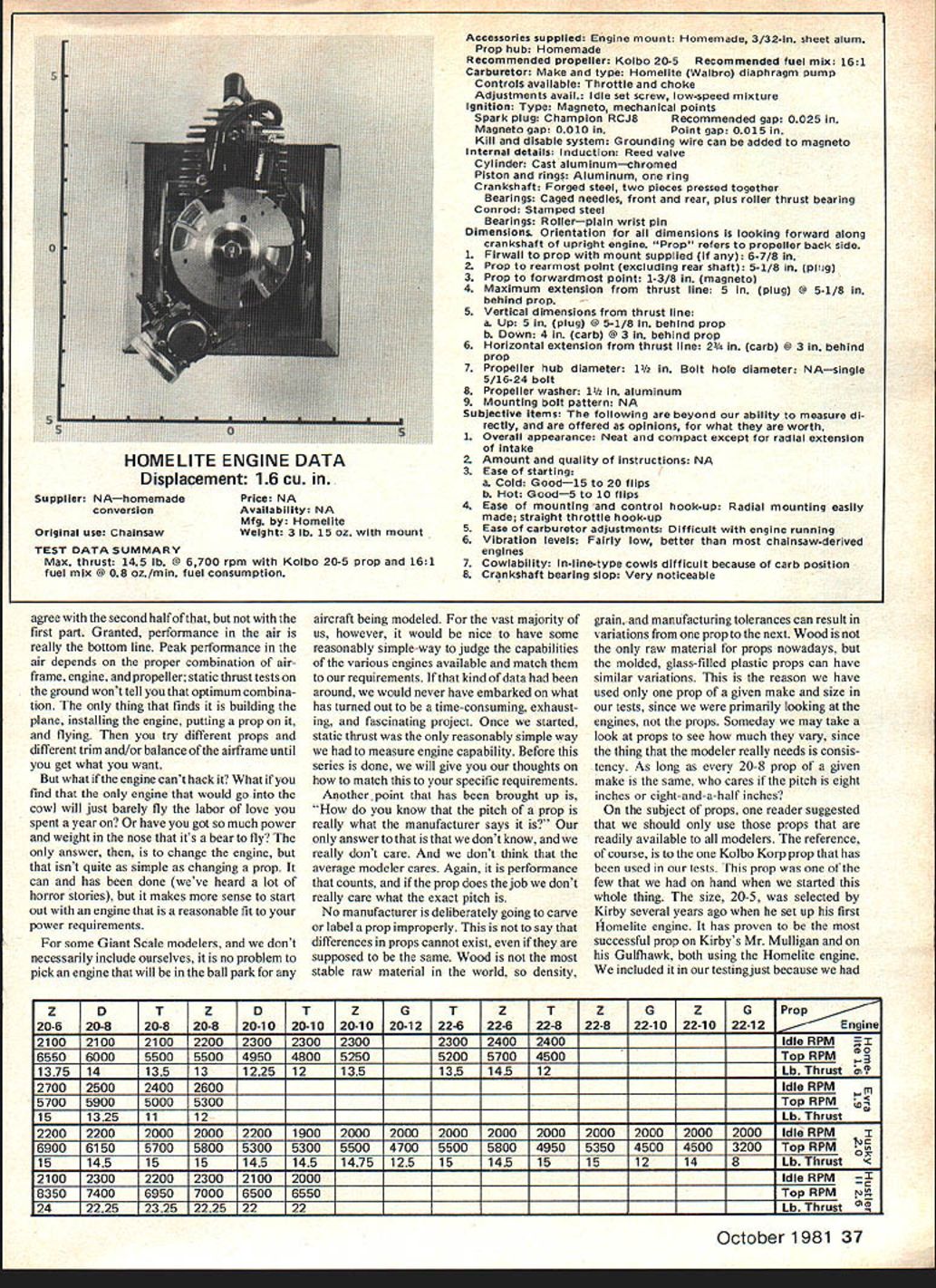
We did wind up with a rough idea of the effect of the different conditions. Bob's Homelite 1.6 had been run during the earlier sessions, before we had the variety of props now available. During the earlier run in cool weather, the engine's best performance was 16 lb. of thrust. This time around, with the same prop (Kolbo 20-5), it produced only 14.5 lb. of thrust, a decrease of almost 10%. It is reasonable to assume that all engines will be similarly affected. These differences due to differing conditions cannot be over-emphasized, so please take them adequately into account when reviewing our results. We never intended to make detailed comparisons of the performance of different engines. Our goal was, and still is, to try and fill a little of the gap in information about the many Big Bangers available.
We have been getting a lot of feedback about the series, and happily it is all positive. There have been some good questions raised that we would like to try answering.
The comment we hear most often is, "Static thrust doesn't mean anything, the only thing that really counts is performance in the air." We agree with the second half of that, but not with the first part. Granted, performance in the air is really the bottom line. Peak performance in the air depends on the proper combination of airframe, engine, and propeller; static thrust tests on the ground won't tell you what the optimum combination is. The only thing that finds that is building the plane, installing the engine, putting a prop on it, and flying. Then you try different props and different trim and/or balance of the airframe until you get what you want.
But what if the engine can't hack it? What if you find that the only engine that will go into the cowl will just barely fly the labor of love you spent a year on? Or have you got so much power and weight in the nose that it's a bear to fly? The only answer then is to change the engine, but that isn't quite as simple as changing a prop. It can and has been done (we've heard a lot of horror stories), but it makes more sense to start out with an engine that is a reasonable fit to your power requirements.
For some Giant Scale modelers, and we don't necessarily include ourselves, it is no problem to pick an engine that will be in the ballpark for any aircraft being modeled. For the vast majority of us, however, it would be nice to have some reasonably simple way to judge the capabilities of the various engines available and match them to our requirements. If that kind of data had been around, we would never have embarked on what has turned out to be a time-consuming, exhausting, and fascinating project. Once we started, static thrust was the only reasonably simple way we had to measure engine capability. Before this series is done, we will give you our thoughts on how to match this to your specific requirements.
Another point that has been brought up is, "How do you know that the pitch of a prop is really what the manufacturer says it is?" Our only answer to that is that we don't know, and we really don't care. And we don't think that the average modeler cares. Again, it is performance that counts, and if the prop does the job we don't care what the exact pitch is.
No manufacturer is deliberately going to carve or label a prop improperly. This is not to say that differences in props cannot exist, even if they are supposed to be the same. Wood is not the most stable raw material in the world, so density, grain, and manufacturing tolerances can result in variations from one prop to the next. Wood is not the only raw material for props nowadays, but the molded, glass-filled plastic props can have similar variations. This is the reason we have used only one prop of a given make and size in our tests, since we were primarily looking at the engines, not the props. Someday we may take a look at props to see how much they vary, since the thing that the modeler really needs is consistency. As long as every 20-8 prop of a given make is the same, who cares if the pitch is eight inches or eight-and-a-half inches?
On the subject of props, one reader suggested that we should only use those props that are readily available to all modelers. The reference, of course, is to the one Kolbo prop that has been used in our tests. This prop was one of the few that we had on hand when we started this whole thing. The size, 20-5, was selected by Kirby several years ago when he set up his first Homelite engine. It has proven to be the successful prop on Kirby's Mr. Mulligan and in his Gullhawk, both using the Homelite engine. We included it in our testing just because we had it.
The use of mufflers is another subject that keeps coming up. As we pointed out in the last installment, since we don't have mufflers for all the engines, we decided to make all our runs without them. Three of the current engines came with mufflers, so this looked like a good time to get some idea of what their effect is. The Husky has a small stamped-steel muffler assembly that is part of the original chainsaw installation. After we had completed our other tests, we made two additional runs with the same prop. First, we ran without the muffler and made sure we had the engine peaked out. Then we put the muffler on and re-tuned the engine. The most noticeable effect was an improvement in the engine's idling. On the top end, however, it dropped about 100 rpm and lost almost a pound of thrust.
The Hustler and the Evra have similar mufflers that are made by B & B Specialties. The mufflers have fairly large rectangular expansion chambers with two good-sized tubular stacks. We were unable to run the Hustler with its muffler, but we did run the Evra as described above for the Husky. The same improvement in idle was observed, but this time at the high end the engine picked up 200 rpm and a solid pound of thrust. Obviously, as with the smaller model engines, the right amount of back pressure can actually increase an engine's output, but too much will rob you of power. We didn't even try to judge the noise reduction, if any.
We wish to thank the following firms for their assistance in this part of the Big Bangers project:
- Dynathrust Props, Inc., 2541 NE 11th Ct., Pompano Beach, FL 33062.
- E.W.H. Specialties, Inc., 3012 Avenue "E" East, Arlington, TX 76011 (Super Hustler Mk II).
- Giezendanner USA, P.O. Box 818, Pottstown, PA 19464.
- Grish Bros., St. John, IN 46373.
- Hobby Lobby International, 1 Franklin Pike Circle, Brentwood, TN 37027 (Evra).
- J & Z Products, 25029 S. Vermont Ave., Harbor City, CA 90710 (Zinger).
- JC Enterprises, 2251 SW 28th Terrace, Ft. Lauderdale, FL 33312 (Husky).
- Top Flite Models, Inc., 1901 Narragansett Ave., Chicago, IL 60639.
Big Bangers/Beckman-Crawford
Now let's get to our notes and subjective comments about the four engines tested this time.
Homelite 1.6
This engine is not currently available in directly usable form, but it is fairly easy to convert (several are in use around the country), and we have had many inquiries about it — since Kirby and I both use it. As far as we are concerned, it is a noteworthy unit.
The engine reported on here was converted by Bob for use in his F9C-2 Sparrowhawk. The engine was purchased from the local Homelite service center for $65.00 in July or August of 1978. A milling machine and lathe were used to do the conversion work, but they are not absolutely necessary. The excess crankcase casting can be cut away with a hacksaw and file, as Kirby did. We each turned out our own prop adapters, but any of the units available for use on the Quadra will fit on the Homelite. The fins can be left on the flywheel, at a small weight penalty.
The engine is a good size for some of the smaller Giant Scale designs. It has proven to be a reliable and rugged power plant, but it is difficult to cowl anything but a radial engine design. The intake manifold extending at an angle opposite the cylinder makes it almost impossible to get the engine into inline or flat-engine-type cowls. Note that all of our applications so far have been radials.
Kirby's 28-lb. Gulfhawk is far beyond what we now consider reasonable for an engine of this size. While the aircraft is underpowered, it does fly. The little Homelite pulls it through very realistic aerobatics.
Hobby Lobby / Evra 190 (1.9 cu. in.)
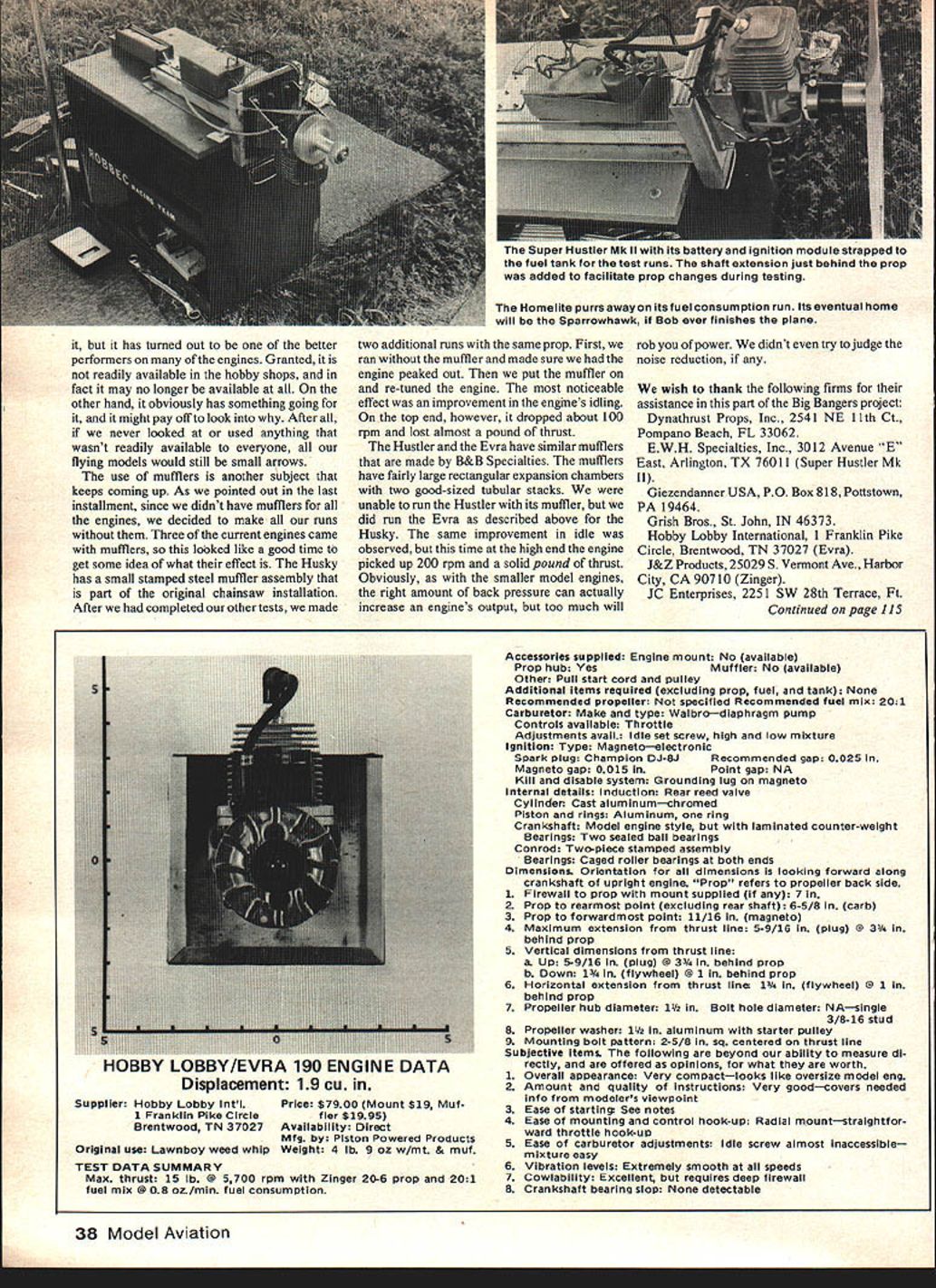
The Evra 190 is one of the larger engines we have worked with up to now. It has been available for three or four years, and was introduced fairly early in the continuing swell of interest in Giant Scale. It represents a merging of model-airplane and "small" engine techniques, and in our opinion has received less attention from modelers than it truly deserves.
The people at Hobby Lobby took the cylinder, piston, flywheel and ignition system of a wet-whip engine and designed a model-engine-type crankcase and crankshaft, complete with massive ball bearings to support the shaft. A Walbro diaphragm-pump carburetor is mounted on the crankcase rear cover with a reed valve to control induction. The result is an engine that looks, in many ways, like a larger version of the engines modelers have used for years, but it retains the carburetor and self-contained ignition that have been proven in literally millions of "small" gasoline engines. The crankcase design belongs to Hobby Lobby, but the engines are manufactured by Piston Powered Products, the company that makes the original engine.
An electronic ignition system is used, and the engine starts easily once you realize and allow for one important factor: the engine must be turning over at approximately 400 rpm before the ignition system will generate a spark. While it is possible to do this by hand, it is difficult, and this point was not really clarified in the information supplied with early models of the engine. The current engines include a starter pull rope, and a pulley is built into the prop washer. For our tests we used both the pull rope and a Sullivan electric starter. The engine started immediately using either method, but we never got a pop out of it when flipping by hand.
Once past the starting characteristics of the engine, there are several items of interest — some good, some bad. One of the nicest things about the Evra is its "in-line" layout. In the past we've talked about how nice it is to have an engine that is no wider than the flywheel, and this is certainly it. In the Evra's case this is accomplished by putting the magneto right in front of the cylinder and the intake on the rear crankcase cover. And, of course, that leads to one of the worst things about the engine. If you look at the data sheets, you'll find that there is only 3/16 in. between the carburetor and the firewall, and that the carb does not have a built-in choke. Even on our open test-stand mounting, it was hard to properly choke the engine. A built-in remotely operable choke would be a valuable addition to this engine.
As near as we could tell, this Evra had never been run, even briefly. Most engines we have worked with have shown signs of at least some test runs. We decided to give it an extra tankful of "break-in," but even so it had a tendency to heat up during our operations. The indications are that, like several of the other engines, this one will need a fair amount of running to reach full peak.
With its low vibration and easily cowled shape, the Evra should be a good engine for the lighter Giant Scale models, especially those where the original used a flat or in-line engine.
Husky 2.0
We covered the 2.3 Husky in a previous report, and there isn't much more to say about this slightly smaller one. It is one of the more easily cowled engines, especially if the oiler pump is removed. On the other hand, that pump could be very useful for a smoke system if you have the room for it. We were struck by the fairly flat power curve of the engine.
The Husky 2.0 is a well-made engine from a company with a very good reputation in the "small" engine field. It should be able to handle any of the aircraft designed for the Quadra, and will be easier to get into some of them.
Super Hustler Mk II
This is another engine that has been available for some time. Our test engine is the latest version with, we understand, significant differences in the ignition system. We have no personal experience with the earlier model, so we cannot compare the two.
The Hustler is significantly different from most Big Bangers. Instead of a magneto, it uses an on-board battery and coil to generate the spark, with timing provided by a Hall Effect sensor and electronic amplifier. This arrangement results in a cleaner-looking engine, since the usual flywheel and magneto coil are gone. With the carb in front of the cylinder, the Hustler is an easily cowled engine.
On the other hand, the ignition system requires a relative myriad of wires, with an attendant increased probability of failure. Our test runs were cut short by problems that couldn't be straightened out on the field. First, one of the crimped-on battery connectors came off. We managed to locate the problem and effect a temporary fix. Later, the engine began to run rough, and then it refused to start at all. We found that a lead that had been soldered to the ground lug had broken. We took care of that one, but still had no spark. We finally decided to put off further attempts until we could sort things out. As a result, we did not get to some of the larger props, and do not have fuel consumption figures.
We had covered the range of props including the recommended 20-8, and our figures do show a peak with the Zinger 20-6. We will add data as we can collect it.
Like the Evra, the Hustler appears to be an effort to produce a Big Banger whose configuration is closer to what modelers have come to expect. It certainly accomplishes that, but we wonder if it's worth the added complication of the ignition system.
Transcribed from original scans by AI. Minor OCR errors may remain.

