


Bob Beckman and Kirby Crawford
Big Bangers for Big Birds
Four new BBs this time: from 1.28 cu. in. to 5 cu. in. None of them were on the market when the authors wrote their last review! Two are U.S.-made, one from Germany, one from Japan.
This installment of Big Bangers is notable for several reasons. First, three of the test runs were made on a day almost exactly one year after the first run that started this series. The weather, understandably, was very similar to what we had that first time around: cold and cloudy, but no rain. The atmosphere at the club flying field was quite different, however. Last year we couldn't take a deep breath without someone asking either, "What are you doing?" or "Are those model engines?" This time, everyone knew what we were doing, and about the only comment we heard was, "I didn't know there were so many Giant Scale engines."
Well, we didn't know that, either. We have sometimes asked ourselves if we would have started this whole thing if we had known how many there were (or rather, how many there were going to be). Actually, the four engines covered this month not only weren't available when we started, they hadn't even been thought of by the people now supplying them! All four are new entries to the Giant Scale engine field, and sizewise they span the range from one of the smallest we've looked at to the largest yet.
The fourth run, on the Contempo Magnum II, was several weeks after the first three. We didn't have the Magnum on hand during the earlier runs, and winter closed in on us before we could test it. We kept waiting for a break that would let us get the data we needed, but it didn't come until mid-February. At that point, the club flying field was nothing but mud, so Bob conned his neighbors into sitting still for a couple of hours of engine noise, and the test runs were made in his front yard.
Contrary to our usual practice, two of the engines were not brand new when we got them. The Magnum and the Titan used in the tests reported here had both been run by the supplier, but at the time we got them no other units were available. We saw no indication of any internal modifications in either case.
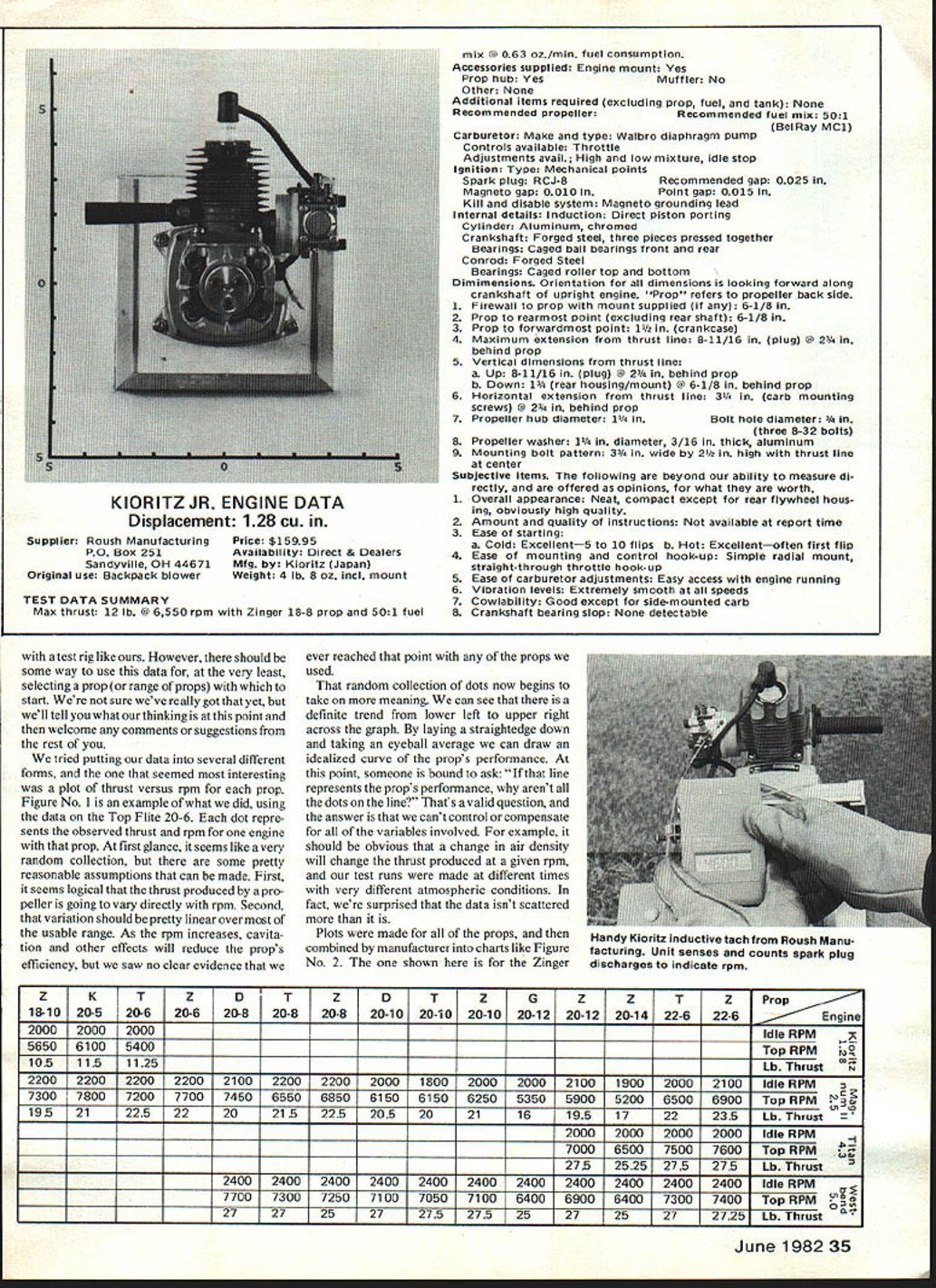
While we were waiting for the snow to go away, we spent some of the time trying to analyze all the data we have. As we have said many times, static thrust is far from the full story about engine/prop combinations. The only thing that really counts is what happens in the air, and there's just no way to include all the variables with a test rig like ours. However, there should be some way to use this data for, at the very least, selecting a prop (or range of props) with which to start. We're not sure we've really got that yet, but we'll tell you what our thinking is at this point and then welcome any comments or suggestions from the rest of you.
We tried putting our data into several different forms, and the one that seemed most interesting was a plot of thrust versus rpm for each prop. Figure No. 1 is an example of what we did, using the data on the Top Flite 20-6. Each dot represents the observed thrust and rpm for one engine with that prop. At first glance, it seems like a very random collection, but there are some pretty reasonable assumptions that can be made. First, it seems logical that the thrust produced by a propeller is going to vary directly with rpm. Second, that variation should be pretty linear over most of the usable range. As the rpm increases, cavitation and other effects will reduce the prop's efficiency, but we saw no clear evidence that we ever reached that point with any of the props we used.
That random collection of dots now begins to take on more meaning. We can see that there is a definite trend from lower left to upper right across the graph. By laying a straightedge down and taking an eyeball average we can draw an idealized curve of the prop's performance. At this point, someone is bound to ask: "If that line represents the prop's performance, why aren't all the dots on the line?" That's a valid question, and the answer is that we can't control or compensate for all of the variables involved. For example, it should be obvious that a change in air density will change the thrust produced at a given rpm, and our test runs were made at different times with very different atmospheric conditions. In fact, we're surprised that the data isn't scattered more than it is.
Plots were made for all of the props, and then combined by manufacturer into charts like Figure No. 2. The one shown here is for the Zinger props, because we had more different sizes of Zinger than anything else. The other brands showed essentially the same characteristics.
Once the data was put into this form, several interesting things became visible. First, note how close the 18-8 and 18-6 lines are. During our test runs, we had several times wondered about the performance of the Zinger 18-6 compared to the same size Top Flite. We would often re-run one or the other to verify a reading. (Apparently we have two 18-8 Zingers, but one of them is labeled 18-6. That is a possible manufacturing error which might occur, but we doubt that it could happen often. On the other hand, it is possible the two prop sizes could be quite close in performance, but that seems less likely in view of the other data.)
Of much more interest is the fact that the plots form families of curves. By that we mean that there are groups of lines that have similar characteristics, in this case the slope or steepness of the line. As a result, they form a pattern of parallel lines across the graph. It turns out that our propeller performance curves are in families by the diameter of the prop. If we had been asked in advance, we probably would have assumed that any such families would be by pitch rather than diameter. Looking at Figure No. 2, you can see that all the 16-in. props have performance curves that are parallel to each other, and not very steep. At the other end of the range, the 24-in. prop lines are also parallel, but much steeper.
We don't really know yet what all of this means. Instinctively, we feel that there should be some simple way to use the information. John Burns (in his "Big Propellers" article in the July 1981 issue of Model Builder) presented data and procedures for propeller selection. While his work was extremely interesting, we feel that it is of limited use to most modelers. We are not going to try and do all of our thinking on this subject and will come back to it in our next installment.
Now let's get to our subjective impressions of the four engines covered this time.
Kioritz Jr.
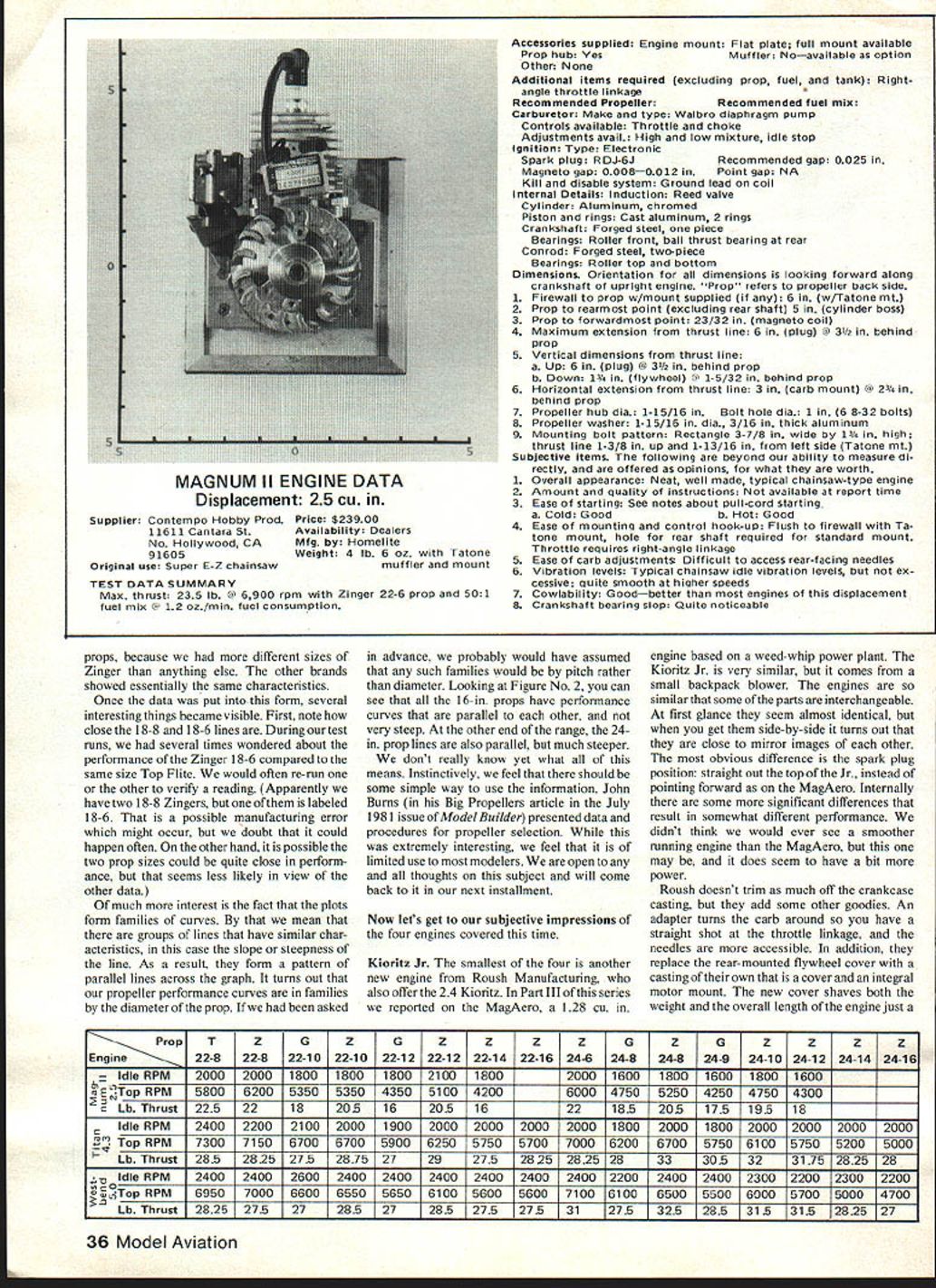
The smallest of the four is another new engine from Roush Manufacturing, who also offer the 2.4 Kioritz. In Part III of this series we reported on the MagAero, a 1.28 cu. in. engine based on a weed-whip power plant. The Kioritz Jr. is very similar, but it comes from a small backpack blower. The engines are so similar that some of the parts are interchangeable. At first glance they seem almost identical, but when you get them side-by-side it turns out that they are close to mirror images of each other. The most obvious difference is the spark plug position: straight out the top of the Jr., instead of pointing forward as on the MagAero. Internally there are some more significant differences that result in somewhat different performance. We didn't think we would ever see a smoother running engine than the MagAero, but this one may be, and it does seem to have a bit more power.
Roush doesn't trim as much off the crankcase casting, but they add some other goodies. An adapter turns the carb around so you have a straight shot at the throttle linkage, and the needles are more accessible. In addition, they replace the rear-mounted flywheel cover with a casting of their own that is a cover and an integral motor mount. The new cover shaves both the weight and the overall length of the engine just a bit.
In addition to the Kioritz Jr., Roush offers the parts to convert a MagAero into essentially the same engine.
The Kioritz Jr. is a fine engine for the lower end of the Giant Scale field. Easy starting and extremely smooth running are two of its outstanding features.
Magnum II
If you thought all the new engines were coming from Japan, take heart, this one is made in the U.S.A. It comes from Contempo Hobby Products and is based on a Homelite chainsaw engine. Contempo's arrangement with Homelite has resulted in what could be an important precedent in our hobby. The Magnum is a ready-to-use Giant Scale engine that is backed by a nationwide organization for warranty, parts, and maintenance. Even some (and maybe all) of the parts unique to our application will be stocked by Homelite parts depots.
At 2.5 cu. in., the engine has 25% more displacement than a Quadra. Its weight and external dimensions, however, are very close to the same. It will fit nicely into most any aircraft designed to use the Quadra, and its extra power is a godsend to many of those designs. While externally similar in size and layout, the two engines have significant design differences. The Magnum utilizes reed-valve induction and electronic ignition, while the Quadra is piston-ported with mechanical points. As with most chainsaw-derived engines, the Magnum has a rear shaft. In this case it is a bit longer than most, but it can be cut off or shortened.
The carburetor positioning is even more unhandy than on a stock Quadra. The throttle takes some fancy linkage, and the needles point straight back and are difficult to get to. These things are annoying, but we've been getting around them for years on other engines. Contempo is working on an adapter to rotate the carb, and it may be available as an option.
Speaking of options, Tatone has made a very nice mount and a muffler for the engine. Our test runs were made without the muffler, as is our usual practice. After the fuel consumption run, we put on the muffler to see what effect it had. On the high end, the rpm dropped from 6,900 to 6,700, with a corresponding drop of 1.5 lb. of thrust. The idle performance was enhanced, becoming smoother and more reliable. These results are typical of all the engines we have run with mufflers.
We had some starting problems with our test engine. For some reason, we never got a pop when turning it over by hand. We put on one of Dynathrust's Dynahubs so that we could use a pull cord, and the engine started right up. We have had several reports from around the country about how easy this engine is to start, and we are at a loss to explain our experience. We plan to make further tests and will pass on the secret when we learn it.
One additional point should be made. Some people familiar with the origins of the Super Hustler have the mistaken impression that this is the same engine. While both are made by Homelite, and they are similar in displacement (2.5 and 2.6 cu. in.), they are completely different engines. The Magnum II's operating characteristics are typical of chainsaw engines, but (for its displacement) it is smaller and lighter than most. It is particularly welcome as an alternative to the Quadra for designs needing a bit more power.
Titan
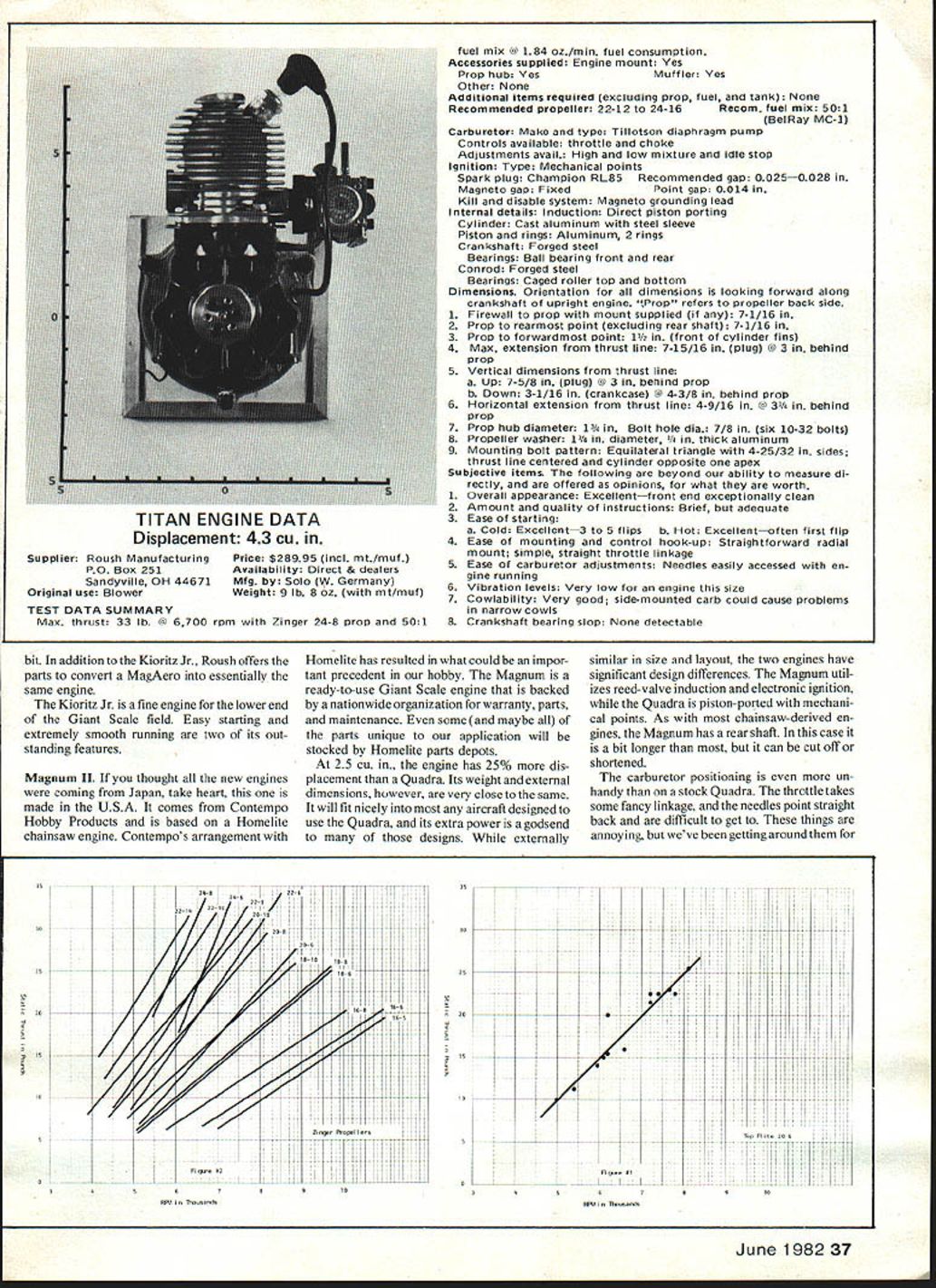
This is the first West German engine to show up as a Giant Scale power plant. It's another blower engine and exhibits the smoothness we have come to expect of such engines. Its construction is similar to the Kioritz blower engines, with side-mounted carb and exhaust, and a rear-mounted flywheel. This is another Roush engine, and they have equipped it with a custom-designed rear cover and mount.
At 4.3 cu. in., this is one of the largest engines we have handled. For its size, however, it is trim and compact. With no flywheel bulk just behind the prop, it will cowl easily. Even the side carb and exhaust should be no problem on the size of aircraft its power will pull.
This engine comes with a B&B muffler as standard equipment. Our test run with the muffler showed a drop of 50 rpm and 1/2 lb. of thrust. The idle was already good, but the muffler did smooth it out a bit.
The Titan is an easy-starting, smooth-running, powerful engine that will be of particular interest to big bird buffs hooked on WWII fighter types.
Westbend
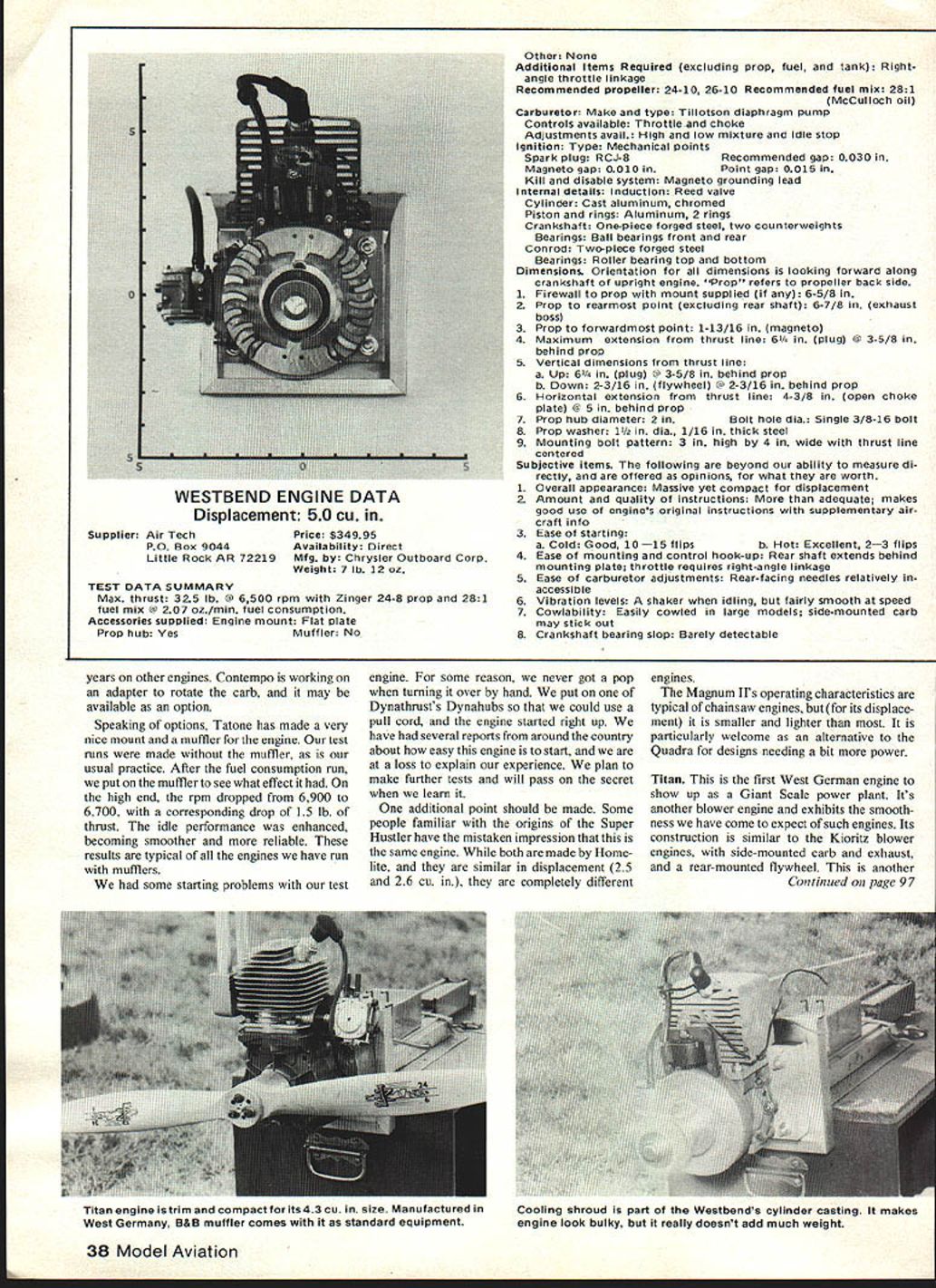
At 5 cu. in., this is the largest engine we have tested to date. This is another U.S. product, and while we have heard of several individuals converting these engines, this is the first time it has been offered in a ready-to-go state.
The basic engine is produced by Chrysler Outboard Corp., but we have been unable to determine its original use. It is laid out like a chainsaw engine, with shafts out each end. In this case, however, the shaft we want to use has a left-hand thread. The prop adapter screws onto the shaft and then is locked in place with two cap screws. A single 5/16-in. prop bolt is used, which we consider marginal. The size of this engine and the props it will use certainly call for a six-bolt hub.
The engine has an exceptionally blocky look because of the cooling shroud that is cast into the cylinder along with the cooling fins. That shroud can't be doing us any harm, and it's well worth the few ounces it adds.
Despite its size, the engine was easily started and handled well. It is another power source well suited to the larger, higher-performance models.
WESTBEND ENGINE DATA
- Displacement: 5.0 cu. in.
- Supplier: Air Tech, P.O. Box 9044, Little Rock, AR 72219
- Price: $349.95
- Availability: Direct
- Manufactured by: Chrysler Outboard Corp.
- Weight: 7 lb. 12 oz.
Test Data Summary
- Max. thrust: 32.5 lb. @ 6,500 rpm with Zinger 24-8 prop
- Fuel consumption: 28:1 fuel mix = 2.07 oz./min.
- Accessories supplied:
- Engine mount: Flat plate
- Prop hub: Yes
- Muffler: No
- Other: None
- Additional items required (excluding prop, fuel, and tank): Right-angle throttle linkage
- Recommended propeller: 24-10, 26-10
- Recommended fuel mix: 28:1 (McCulloch oil)
Carburetion and Ignition
- Carburetor make and type: Tillotson diaphragm pump
- Controls available: Throttle and choke
- Adjustments available: High and low mixture and idle stop
- Ignition type: Mechanical points
- Spark plug: RCJ-8
- Recommended gap: 0.030 in.
- Magneto gap: 0.010 in.
- Point gap: 0.015 in.
- Kill and disable system: Magneto grounding lead
Internal Details
- Induction: Reed valve
- Cylinder: Cast aluminum, chromed
- Piston and rings: Aluminum, 2 rings
- Crankshaft: One-piece forged steel, two counterweights
- Bearings: Ball bearings, front and rear
- Conrod: Two-piece forged steel
- Conrod bearings: Roller bearing, top and bottom
Dimensions
(Orientation for all dimensions is looking forward along crankshaft of upright engine. "Prop" refers to propeller back side.)
- Firewall to prop with mount supplied (if any): 6-5/8 in.
- Prop to rearmost point (excluding rear shaft): 6-7/8 in. (exhaust boss)
- Prop to forwardmost point: 1-13/16 in. (magneto)
- Maximum extension from thrust line: 6-1/4 in. (plug) 3-5/8 in. behind prop
- Vertical dimensions from thrust line:
- Up: 6-1/4 in. (plug) 3-5/8 in. behind prop
- Down: 2-3/16 in. (flywheel) @ 2-3/16 in. behind prop
- Horizontal extension from thrust line: 4-3/8 in. (open choke plate) @ 5 in. behind prop
- Prop hub diameter: 2 in. Bolt hole dia.: Single 3/8-16 bolt
- Prop washer: 1/4 in. dia., 1/16 in. thick steel
- Mounting bolt pattern: 3 in. high by 4 in. wide with thrust line centered
Subjective Items
(The following are beyond our ability to measure directly, and are offered as opinions.)
- Overall appearance: Massive yet compact for displacement.
- Amount and quality of instructions: More than adequate; makes good use of engine's original instructions with supplementary aircraft info.
- Ease of starting:
- Cold: Good, 10–15 flips
- Hot: Excellent, 2–3 flips
- Ease of mounting and control hook-up: Rear shaft extends behind mounting plate; throttle requires right-angle linkage
- Ease of carburetor adjustments: Rear-facing needles relatively inaccessible
- Vibration levels: A shaker when idling, but fairly smooth at speed
- Cowling fit: Easily cowled in large models; side-mounted carb may stick out
- Crankshaft bearing slop: Barely detectable
Acknowledgements
We wish to thank the following firms for their cooperation:
- Air Tech, P.O. Box 9044, Little Rock, AR 72219 (Westbend)
- Contempo Hobby Products, 11611 Cantara St., North Hollywood, CA 91605 (Magnum II)
- Dynathrust Props, Inc., 2541 NE 11th Ct., Pompano Beach, FL 33062
- Grish Bros., St. John, IN 46373
- J.Z. Products, 25029 So. Vermont Ave., Harbor City, CA 90710 (Zinger)
- Roush Manufacturing, P.O. Box 251, Sandyville, OH 44671 (Kioritz Jr. and Titan)
- Top Flite Models, Inc., 1901 Narragansett Ave., Chicago, IL 60639
Transcribed from original scans by AI. Minor OCR errors may remain.

