
Big Bangers for Big Birds
Authors
- Bob Beckman
- Dick Roe
Background
Those of you who have been following this series may recall our original objectives. We felt that both active and potential Giant Scalers lacked useful data about the many large, gasoline-fueled engines that were becoming available. As a result, many modelers have been unable to make logical selections for the aircraft they wished to build.
To provide information most modelers could easily relate to, we confined our testing to measurements of static thrust and rpm with various propellers — and of fuel consumption with the prop that produced the highest thrust. In addition, physical dimensions, weight, design details, etc., were included. A listing of the engines tested and the relating issue dates is provided near the end of this article.
This month we report on comparison runs made with many of the engines involved. It is not our intent to make value judgments of the engines. We have tried to be as objective as possible in collecting and presenting the information you need to make decisions for your particular situation. The purpose of the data presented here is to show the range of power available to aid you in selecting the engine(s) most likely to be successful in your projects.
Test plan and what actually happened
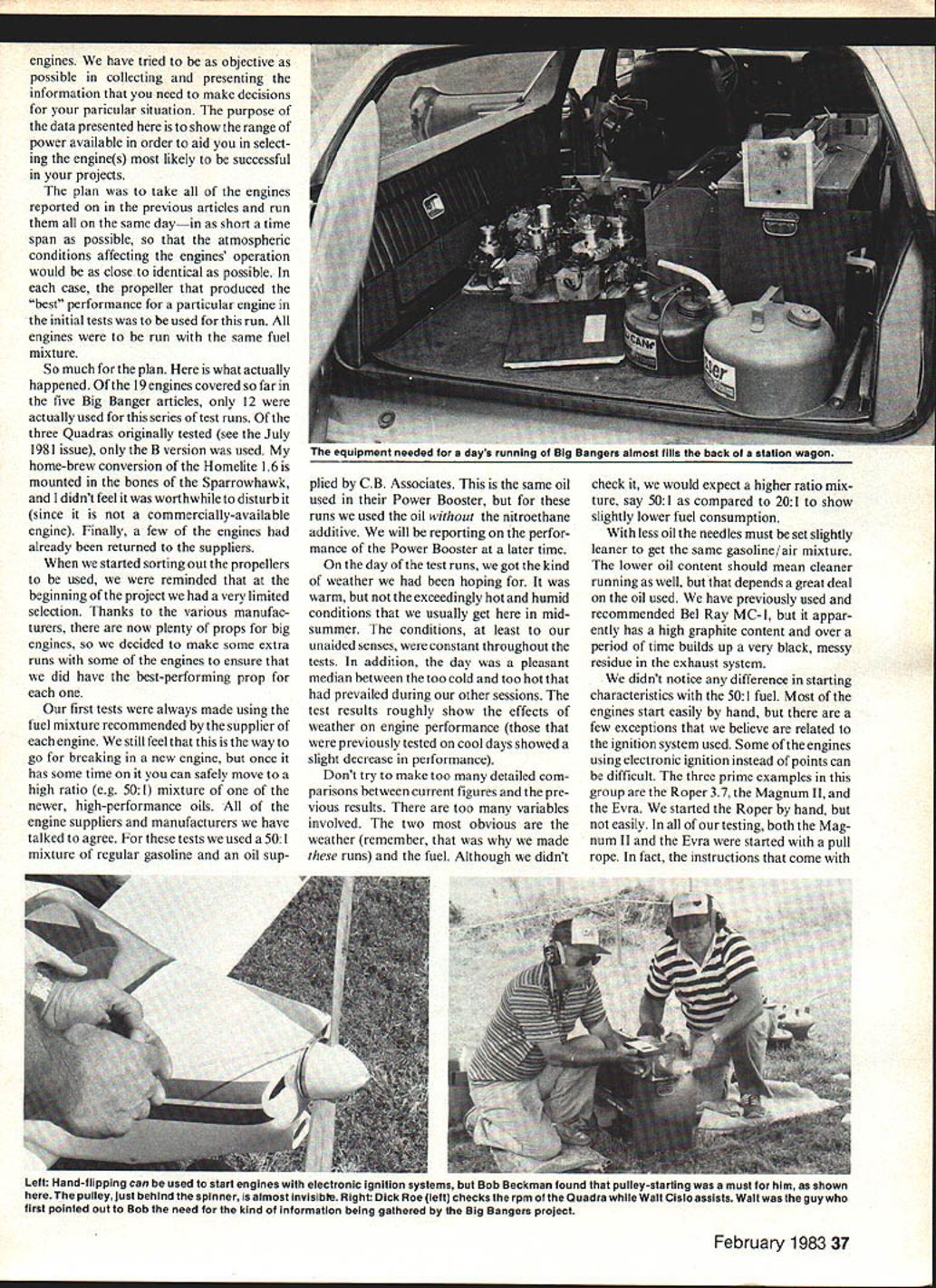
The plan was to take all of the engines reported on in previous articles and run them all on the same day — in as short a time span as possible — so that atmospheric conditions affecting engine operation would be as close to identical as possible. For each engine, the propeller that produced the "best" performance in the initial tests was to be used for this run. All engines were to be run with the same fuel mixture.
What actually happened: of the 19 engines covered in the five Big Banger articles, only 12 were available for this series of test runs. Of the three Quadras originally tested (see the July 1981 issue), only the B version was used. A home-brew conversion of the Homelite 1.6 is mounted in the bones of the Sparrowhawk and was not disturbed. A few engines had already been returned to suppliers.
When sorting propellers, we found a much larger selection available than at the start of the project, so we made extra runs with some engines to be sure we were using the best-performing prop for each.
Fuel, mixture and running conditions
Our first tests were always made using the fuel mixture recommended by each engine supplier. We still feel that is the way to break in a new engine, but once it has time on it you can safely move to a higher-ratio mixture (e.g., 50:1) of one of the newer, high-performance oils. All engine suppliers we consulted agree.
For these comparative tests we used a 50:1 mixture of regular gasoline and an oil supplied by C.B. Associates. This is the same oil used in their Power Booster, but for these runs we used the oil without the nitroethane additive. We will report on the Power Booster’s performance at a later time.
On the day of the tests the weather was near ideal for our purposes: warm but not overly hot or humid. Conditions felt constant throughout the tests and were a pleasant median between the too-cold and too-hot conditions of other sessions. Test results roughly show the effects of weather on engine performance (engines previously tested on cool days showed a slight decrease in performance).
Be cautious about making detailed comparisons between current figures and previous results — there are too many variables (notably weather and fuel). A higher oil ratio (50:1 vs. 20:1) should show slightly lower fuel consumption. Needles are set slightly leaner with less oil to achieve the same gasoline/air mixture. Lower oil content should mean cleaner running, but that depends on the oil used. We previously recommended Bel Ray MC-1, but it has a high graphite content and over time builds a very black residue in the exhaust system.
Starting characteristics and electronic ignition
We didn’t notice any difference in starting characteristics with the 50:1 fuel. Most engines start easily by hand, but several exceptions seem related to the ignition system used. Some engines using electronic ignition instead of breaker points can be difficult to hand-start. Prime examples are the Roper 3.7, the Magnum II, and the Evra. The Roper can be started by hand but not easily. In our testing both the Magnum II and the Evra were started with a pull rope. Evra instructions call for this technique and supply the required pulley. Many Roper users also use pull cords.
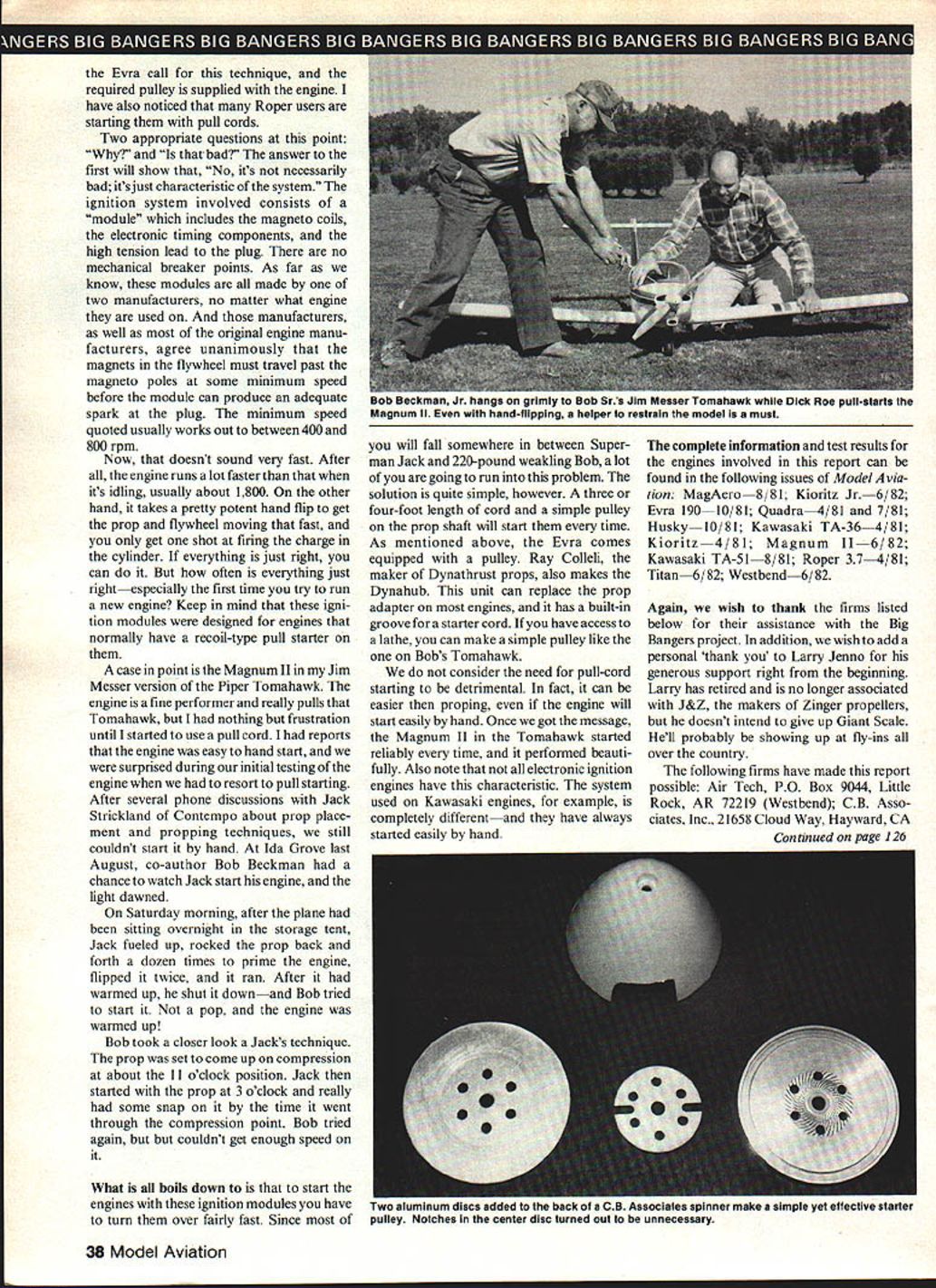
Why pull cords? The ignition module (magneto coils, electronic timing components, and high-tension lead to the plug) requires the flywheel magnets to pass the magneto poles at a minimum speed before producing an adequate spark. The quoted minimum speed is usually between about 400 and 800 rpm. That doesn’t sound fast, but getting that speed reliably with a single hand flip can be difficult. These modules were designed for engines that normally have a recoil-type pull starter.
A case in point: the Magnum II in a Jim Messer Piper Tomahawk. The engine performs well in flight but was frustrating to hand-start until a pull cord was used. Observing a skilled operator showed that prop positioning and a strong flip were essential; many pilots will find a short starter cord with a simple pulley on the prop shaft an easy and reliable solution. The Evra comes with a pulley; Ray Colleti’s Dynahub can replace the prop adapter on most engines and includes a groove for a starter cord. If you have a lathe, you can make a simple pulley.
We do not consider the need for pull-cord starting to be detrimental—in many cases it is easier than propping, even if the engine will start by hand. Note that not all electronic-ignition engines have this characteristic; Kawasaki engines use a different system and have always started easily by hand.
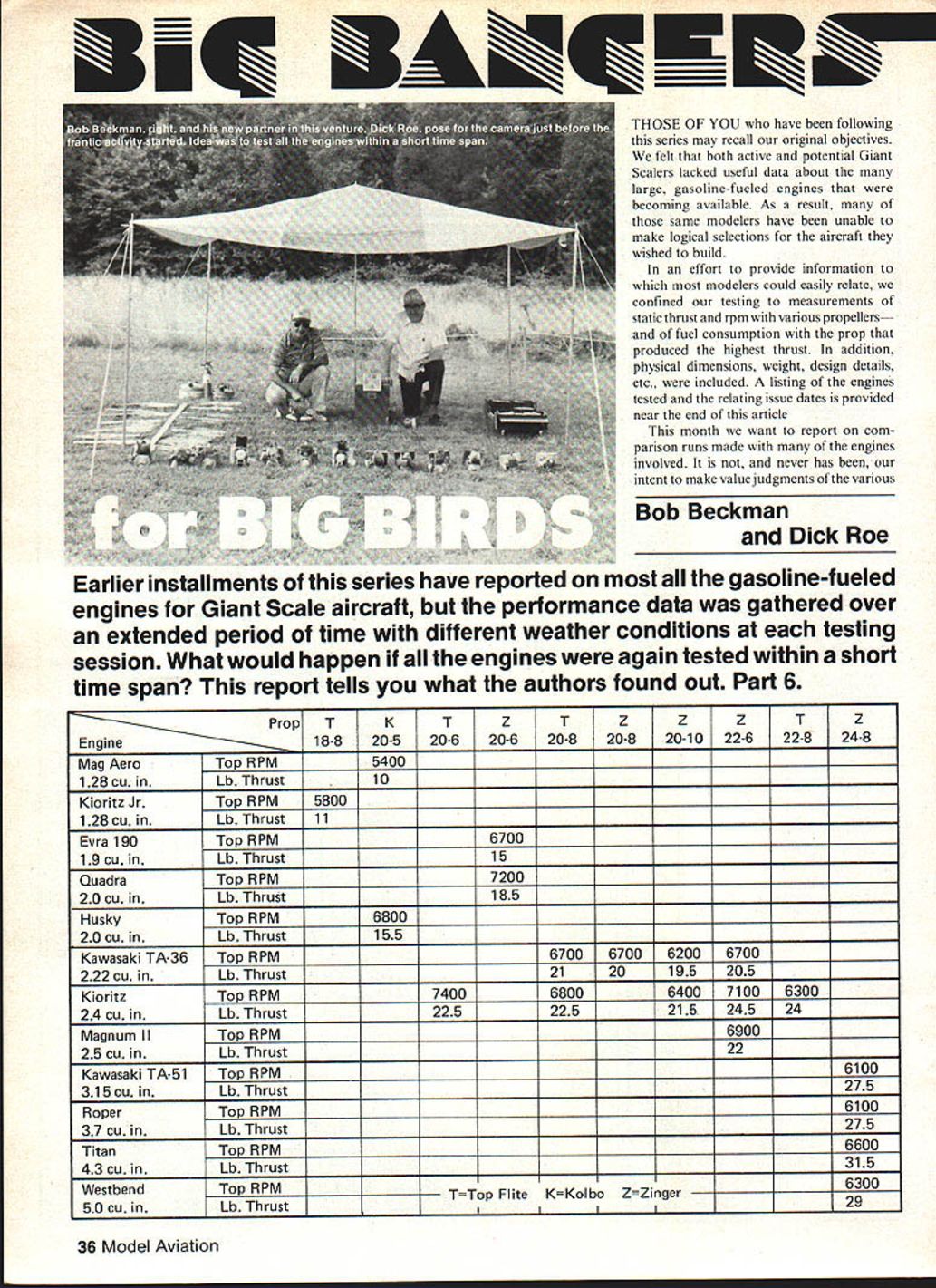
Engine test results
T = Top Flite; K = Kolbo; Z = Zinger
- Mag Aero — 1.28 cu. in.
- Top RPM: 5,400
- Lb. Thrust: 10
- Kioritz Jr. — 1.28 cu. in.
- Top RPM: 5,800
- Lb. Thrust: 11
- Evra 190 — 1.9 cu. in.
- Top RPM: 6,700
- Lb. Thrust: 15
- Quadra B — 2.0 cu. in.
- Top RPM: 7,200
- Lb. Thrust: 18.5
- Husky — 2.0 cu. in.
- Top RPM: 6,800
- Lb. Thrust: 15.5
- Kawasaki TA-36 — 2.22 cu. in.
- Top RPMs (various props tested): 6,700; 6,700; 6,200; 6,700
- Lb. Thrust (corresponding runs): 21; 20; 19.5; 20.5
- Kioritz — 2.4 cu. in.
- Top RPMs (various props tested): 7,400; 6,800; 6,400; 7,100; 6,300
- Lb. Thrust (corresponding runs): 22.5; 22.5; 21.5; 24.5; 24
- Magnum II — 2.5 cu. in.
- Top RPM: 6,900
- Lb. Thrust: 22
- Kawasaki TA-51 — 3.15 cu. in.
- Top RPM: 6,100
- Lb. Thrust: 27.5
- Roper — 3.7 cu. in.
- Top RPM: 6,100
- Lb. Thrust: 27.5
- Titan — 4.3 cu. in.
- Top RPM: 6,600
- Lb. Thrust: 31.5
- Westbend — 5.0 cu. in.
- Top RPM: 6,300
- Lb. Thrust: 29
Where to find the complete information
The complete information and test results for the engines involved in this report can be found in these issues of Model Aviation:
- Mag Aero — 8/81
- Kioritz Jr. — 6/82
- Evra 190 — 10/81
- Quadra — 4/81 and 7/81
- Husky — 10/81
- Kawasaki TA-36 — 4/81
- Kioritz — 4/81
- Magnum II — 6/82
- Kawasaki TA-51 — 8/81
- Roper 3.7 — 4/81
- Titan — 6/82
- Westbend — 6/82
Acknowledgments and contributors
Again, we wish to thank the firms listed below for their assistance with the Big Bangers project, and a personal thank-you to Larry Jenno for his generous support from the beginning. Larry has retired and is no longer associated with J&Z (makers of Zinger props), but he still intends to fly Giant Scale and will likely be at many fly-ins.
The following firms made this report possible:
- Air Tech, P.O. Box 9044, Little Rock, AR 72219 (Westbend)
- C.B. Associates, Inc., 21658 Cloud Way, Hayward, CA 94545 (Kawasaki)
- Contempo Hobby Products, 11611 Cantara St., North Hollywood, CA 91605 (Magnum II)
- Dynathrust Props, Inc., 2541 N.E. 11th Court, Pompano Beach, FL 33062
- Gibbs Hobby & Research, 6195 Hillfield St. N.W., North Canton, OH 44720 (Kioritz)
- Giezendanner USA, P.O. Box 818, Pottstown, PA 19464 (Tachometer)
- Hobby Lobby International, 1 Franklin Pike Circle, Brentwood, TN 37027 (Evra 190)
- Horner's Sales, 30 Dixie Hwy., Beecher, IL 60401 (Roper)
- J.C. Enterprises, 2251 S.W. 28th Terrace, Fort Lauderdale, FL 33312 (Husky)
- J&Z Products, 25029 S. Vermont Ave., Harbor City, CA 90710 (Zinger)
- Mag Aero Mfg. Co., P.O. Box 490, Freeland, WA 98249
- Roush Mfg. Co., 3405 Cleveland Ave. S.W., Canton, OH 44707 (Kioritz, Jr. & Titan)
- Top Flite Models, Inc., 1001 Narragansett Ave., Chicago, IL 60639
- Trinden Manufacturing Ltd., P.O. Box 544, Huron Park, Ontario, Canada N0M 1Y0 (Quadra)
- U.S. Quadra, 1032 East Manitowoc Ave., Oak Creek, WI 53154
Transcribed from original scans by AI. Minor OCR errors may remain.

