
BIG BANGERS for BIG BIRDS
Bob Beckman and Dick Roe
In this installment our authors check out and describe four engines of use in the Giant Scale field, including a revisit to an old friend in a new form—the Q-35 with electronic ignition. Use of P.K. Products' Superstarter was found to be a big aid in the project. Part 7.
Of all our engine reports to date, this has turned out to be the most difficult in some respects and the easiest in others. A combination of weather and equipment problems forced us to have a total of four sessions in order to complete runs on four engines. Normally, we would do all of them in one session. This was all spread out from March to June, with cool conditions for the first runs and hot, humid conditions at the completion.
The first runs were with the big 4.3 cu. in. Hornet. It was a clear but cool day in March, and things were moving along nicely. We got an early start and expected to make runs on all four engines that day. Toward the end of the runs on the Hornet, we found a fatigue fracture on part of the test-stand engine mount. Since one of us had to be in front of the engine at least part of the time, and (under the circumstances) neither of us wanted to be the one, we quit for the day.
During the following week the test stand was completely overhauled, and we planned to finish things off on the weekend. Naturally, it rained. That weekend—and the next, and the next. By then it was getting close to time for the Toledo show, and Roush Mfg. needed two of the engines, the Cobra and Cobra Jr., for the company's display booth. We both planned to go to Toledo, anyway, so everything was put on hold.
Late in April we got the Cobra back, but not the Cobra Jr. It turns out that, due to supply difficulties, Roush had to drop the Jr. They're working on a replacement for it, but in the meantime we had to find another engine to round out the group. We were already planning on the new Q-50 Quadra, so we decided to include the electronic ignition version of the Q-35.
About this time we received a sample of the new H&K Superstar for the Q-35. We took one look at it, got one from P.K. Products, and begged another one for the Q-50. These little jewels are what made this batch of engine runs one of the easiest we've had.
For those of you who haven't heard about it yet, the Superstar is a simple, inexpensive device that makes starting a Big Banger as easy as snapping your fingers. It is a heavy coil spring and a one-way clutch that mounts on the rear shaft of the engine. You wind the spring one turn by pulling the prop backwards; when you release the prop, the spring powers the engine through two or three revolutions. And it does it fast enough to generate a good spark from any kind of ignition system. Installation of the starter is simple, and the few ounces involved are nothing compared to the advantages. Anyone with a Quadra would be foolish not to invest in one of these, we think. In fact, the Quadra people are talking about making the starter a standard accessory on all Quadras in the near future.
Unfortunately, the starter is not available for all engines. Currently, you can get them for both Quadras and for the Magnum II. Any engine with a rear shaft is a potential candidate, but each engine usually requires a unique combination of clutch and housing, which means special tooling for each one. As with anything else, that means that a large-quantity market must exist before it is practical to go into production. If the demand for a particular engine is great enough, we're sure P.K. will meet it.
It should be obvious by now that we are very enthusiastic about the Superstar. If you consider the problem presented by the need to run four engines with each of 30 to 50 propellers, and do it all in one day (usually), you can understand that enthusiasm. Ours is an extreme case, but anyone who has ever worn out an arm trying to get an engine going will be just as enthusiastic.
Getting back to our struggles to complete the engine runs, we're now up to late April or early May. We've finally got what looks like a good weekend, and we've got starters on two of the four engines. In short order we completed the last few runs on the Hornet and moved on to the Q-50. This was our first experience with the starter, and it performed as advertised. Before long, the brand-new engine was off and running on its initial break-in.
Then we ran into trouble. After the break-in run, we changed props and started the test runs. But this time, when the prop was released, there was one bang from the engine and horrible grating noises from the rear shaft. Pulling the engine off the mount, we found that the one-way clutch was now a two-way clutch. The anchor loop of the spring had snapped off. On reflection, we realized that we had inadvertently wound the spring too tightly before releasing the prop. This had overstressed and broken the clutch. We set the Q-50 aside and went on to the Q-35.
Being careful to wind the starter spring no more than one turn, we got through all the runs on the Q-35 with no trouble at all. The ease of starting was phenomenal, and it really speeded up a rather tedious job. We were quickly sold on the starter, despite the problem with the Q-50. By this time we were pretty sure we had done ourselves in, anyway. Unfortunately, it meant that we now had two engines, the Q-50 and the Cobra, that we would have to start by hand.
We no sooner got started with the Cobra, however, when our nice day suddenly became a downpour. We hastily packed up and ruefully contemplated the fact that, in almost three months, we had managed to test only two engines. We set our sights on the following weekend and hoped for the best.
The additional delay did have one happy result: we were able to get a replacement for the Q-50 starter. Our final session was, relatively speaking, a breeze. The starter on the Q-50 worked flawlessly, and the Cobra turned out to be a fairly easy-starting engine. After much stumbling and fumbling, we finally had the data presented here.
In addition to the Superstarter, we had some new props to try. These were the new "progressive pitch" propellers from Zinger. For more years than we like to admit, we have been using "true pitch" props where the angle of the blade decreases from hub to tip so that the theoretical advance per revolution of the airscrew remains the same at all points along the blade. On these new props, the pitch varies from low at the hub to high at the tip. They are not "variable pitch" in the usual sense of that term, so we are calling them "progressive pitch." On some of them, the angle actually increases toward the tip.
What does this buy you? And why? The number of different answers you'll get to those questions is almost equal to the number of people you ask. We haven't had a chance to use the props in the air yet, but we've seen them in action and talked to people who have been using them. With the right prop for your engine and plane, it's almost as if you had a constant-speed prop on the engine. Engine speed seems to be more nearly constant through almost any maneuver. Performance at low aircraft speeds (i.e., takeoff and vertical climbs) is improved without hurting high-speed performance.
Don't look for anything spectacular in our static test results, however. We have said right from the start that static thrust doesn't come close to telling the full story about engine and propeller performance. It is useful for our testing because it helps to show relative performance of different engines, but the only thing that counts in the long run is performance in the air. From what we've seen and heard, these new props from Zinger do perform where it counts.
Now, for our subjective comments on these four engines.
Hornet
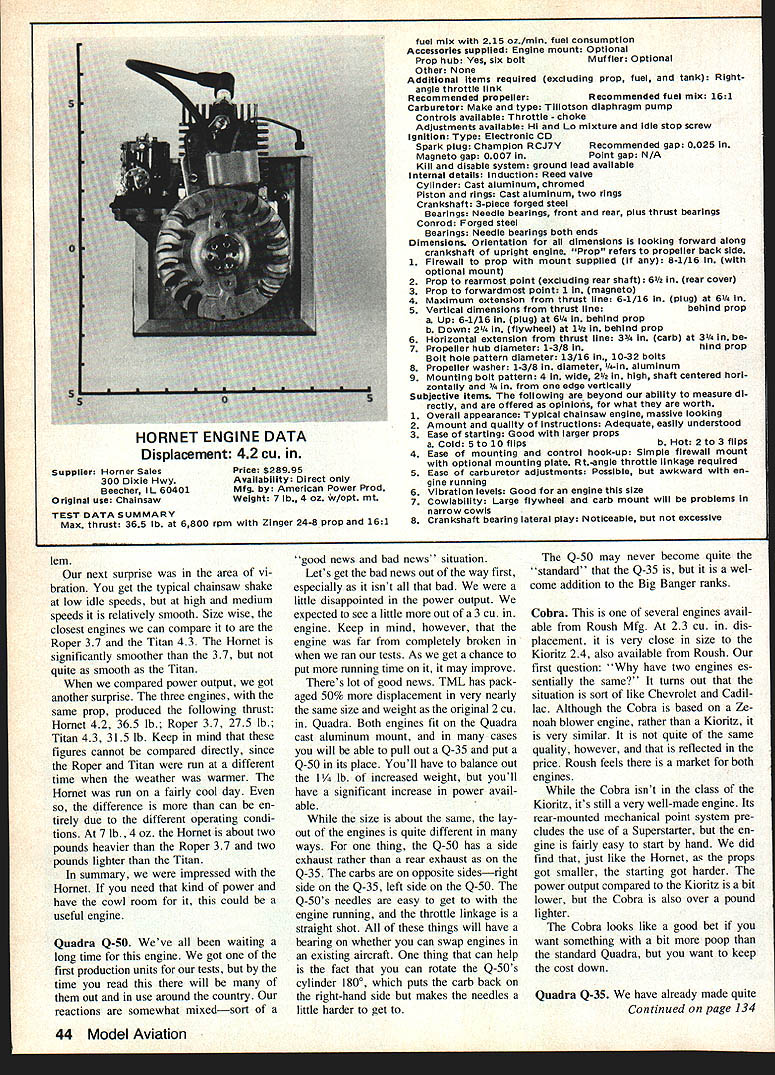
This is a big, blocky-looking engine with the typical chainsaw appearance. The engine is big, with a larger-than-usual flywheel, but it's not excessively large for its displacement. Our first reaction was sort of "Ho-hum, another big chainsaw mill with a prop on."
We were pleasantly surprised at the Hornet's performance. First, we expected it to be a bear to start. Not so! It was surprisingly easy to get going, so long as there was a reasonably large prop on it. When we got down to some of the smaller sizes, it was a bit balky, but its best props are up in the 22- and 24-inch range, so that really isn't a problem.
Another surprise was in the area of vibration. You get the typical chainsaw shake at low idle speeds, but at high and medium speeds it is relatively smooth. Size-wise, the closest engines we can compare it to are the Roper 3.7 and the Titan 4.3. The Hornet is significantly smoother than the 3.7, but not quite as smooth as the Titan.
When we compared power output, we got another surprise. The three engines, with the same prop, produced the following thrust:
- Hornet 4.2: 36.5 lb.
- Roper 3.7: 27.5 lb.
- Titan 4.3: 31.5 lb.
Keep in mind that these figures cannot be compared directly, since the Roper and Titan were run at a different time when the weather was warmer. The Hornet was run on a fairly cool day. Even so, the difference is more than can be entirely due to the different operating conditions. At 7 lb., 4 oz., the Hornet is about two pounds heavier than the Roper 3.7 and two pounds lighter than the Titan.
In summary, we were impressed with the Hornet. If you need that kind of power and have the cowl room for it, this could be a useful engine.
Hornet Engine Data
- Displacement: 4.2 cu. in.
- Supplier: Horner Sales, 300 Dixie Hwy., Beecher, IL 60401
- Price: $289.95
- Availability: Direct only
- Manufacturer: American Power Prod.
- Weight: 7 lb., 4 oz. with optional mount
- Original use: Chainsaw
Test Data Summary
- Max. thrust: 36.5 lb. at 6,800 rpm with Zinger 24-8 prop
- Fuel mix: 16:1
- Fuel consumption: 2.15 oz./min.
- Accessories supplied: Engine mount optional
- Prop hub: Yes, six-bolt
- Muffler: Optional
- Other: None
Additional items required
- Right-angle throttle link (excluding prop, fuel, and tank)
Recommended
- Propeller: (not specified)
- Fuel mix: 16:1
Carburetor
- Make and type: Tillotson diaphragm pump
- Controls available: Throttle, choke
- Adjustments available: Throttle and low mixture and idle stop screw
Ignition
- Type: Electronic CD
- Spark plug: Champion RCJ-7Y
- Recommended gap: 0.025 in.
- Magneto gap: 0.007 in.
- Point gap: N/A
- Kill and disable system: Ground lead available (magneto)
Internal details
- Induction: Reed valve
- Cylinder: Cast aluminum, chromed
- Piston and rings: Cast aluminum, two rings
- Crankshaft: One-piece forged steel
- Bearings: Needle bearings, front and rear, plus thrust bearings
- Conrod: Forged steel
- Connecting-rod bearings: Needle bearings both ends
Dimensions (orientation looking forward along crankshaft of upright engine; "prop" refers to propeller back side)
- Firewall to prop with mount supplied (if any): 8-1/16 in. (with optional mount)
- Prop to rearmost point (excluding rear shaft): 6-1/2 in. (rear cover)
- Prop to forwardmost point: 1 in. (magneto)
- Maximum extension from thrust line: 6-1/16 in. (plug) at 6-1/4 in. behind prop
- Vertical dimensions from thrust line:
a. Up: 6-1/16 in. (plug) at 6-1/4 in. behind prop b. Down: 2-1/4 in. (flywheel) at 1-1/2 in. behind prop
- Horizontal extension from thrust line: 3-11/16 in. (carb) 2 in. behind prop
- Propeller hub diameter: 1-9/16 in.
- Bolt hole pattern: Single 5/16-24
- Mounting bolt pattern: Cast mount 2-5/16 in. square centered on shaft
- Propeller washer: 1-3/8 in. diameter, 1/4 in. aluminum
Subjective items
- Overall appearance: Typical chainsaw engine appearance; somewhat massy-looking
- Amount and quality of instructions: Adequate, easily understood
- Ease of starting: Good
- Cold starting: Good with larger props
- Ease of mounting and control hook-up: Simple firewall mount with optional mounting plate; right-angle throttle linkage required
- Ease of carburetor adjustments: Possible, but awkward with side mounting
- Vibration levels: Good for an engine this size
- Cowling clearances: Large flywheel and carb mount will be problems in narrow cowlings
- Crankshaft bearing lateral play: Noticeable, but not excessive
Quadra Q-50
We've all been waiting a long time for this engine. We got one of the first production units for our tests, but by the time you read this there will be many of them out and in use around the country. Our reactions are somewhat mixed—sort of a "good news and bad news" situation.
The bad news first: we were a little disappointed in the power output. We expected to see a little more out of a 3 cu. in. engine. Keep in mind, however, that the engine was far from completely broken in when we ran our tests. As we get a chance to put more running time on it, it may improve.
The good news: TML has packaged 50% more displacement in very nearly the same size and weight as the original 2 cu. in. Quadra. Both engines fit on the Quadra cast aluminum mount; in many cases you will be able to pull out a Q-35 and put a Q-50 in its place. You'll have to balance out the 1-1/2 lb. of increased weight, but you'll have a significant increase in power available.
While the size is about the same, the layout of the engines is quite different in many ways. For one thing, the Q-50 has a side exhaust rather than a rear exhaust as on the Q-35. The carbs are on opposite sides—right side on the Q-35, left side on the Q-50. The Q-50's needles are easy to get to with the engine installed, and the throttle linkage is a straight shot. All of these things will have a big bearing on whether you can mount it in an existing aircraft. One thing that can help is the fact that you can rotate the Q-50's cylinder 180°, which puts the carb back on the right-hand side but makes the needles a little harder to get to.
The Q-50 may never become quite the "standard" that the Q-35 is, but it is a welcome addition to the Big Banger ranks.
Cobra
This is one of several engines available from Roush Mfg. At 2.3 cu. in. displacement it is very close in size to the Kioritz 2.4, also available from Roush. Our first question: "Why have two engines essentially the same?" It turns out that the Cobra is similar in design to the Kioritz, but it has different carburetion and ignition, and is intended for a slightly different market.
While the Cobra isn't in the class of the Kioritz, it's still a very well-made engine. Its rear-mounted mechanical point system precludes the use of a Superstarter, but the engine is fairly easy to start by hand. We did find that, just like the Hornet, as the props got smaller, the starting got harder. The lower output compared to the Kioritz is a bit surprising, but the Cobra is also over a pound lighter.
The Cobra looks like a good bet if you want something with a bit more pop than the standard Quadra, but you want to keep the cost down.
Quadra Q-35 (Electronic Ignition)
We have already made quite a few remarks about this engine earlier in our series. The new electronic-ignition version brings modern starting and ignition reliability to the tried-and-true Q-35 platform.
Q-35 Elec Ign Engine Data
- Displacement: 34 cc (2.07 cu. in.)
- Supplier: Trinden Mfg. Ltd. (TML), PO Box 544, Huron Park, Ont.
- Price: $136.95
- Availability: Dealers throughout Canada and the world
- Original use: Chainsaw
- Weight: 3 lb. 13 oz.
Test Data Summary
- Max thrust: 18.25 lb. @ 6,700 rpm (Kolbo 20-5 prop)
- Fuel mix: 20:1
- Fuel consumption: 1-3/4 oz/min
Accessories supplied
- Engine mount: Stamped plate (optional cast aluminum)
- Prop hub: Yes, single bolt
- Muffler: No
- Other: None
Additional items required
- Right-angle throttle link (excluding prop, fuel tank)
Recommended
- Propeller: 18 x 6, 20 x 8
- Fuel mix: 20:1
Carburetor
- Make/type: Walbro diaphragm pump
- Controls available: Throttle
- Adjustments available: High, low mixture; idle stop screw
Ignition
- Type: Electronic CD
- Spark plug: Champion RCJ-7Y
- Recommended gap: .0025
- Magneto gap: .0010 in.
- Point gap: N/A
- Kill/disable system: Grounding lug available (magneto)
Internal details
- Induction: Piston porting
- Cylinder: Cast aluminum, chromed
- Piston rings: Cast aluminum ring
- Crankshaft: One-piece forged steel
- Bearings: Roller bearings front & rear
- Conrod: Stamped steel plate
- Wrist pin bearing: Ball bearing; crankshaft bearings: roller bearings
Dimensions (orientation looking forward along crankshaft; upright engine; "prop" refers to propeller back side)
- Firewall to prop (prop mount supplied): 6-1/4 in. (optional cast mount)
- Prop to rearmost point (excluding rear shaft plug): 5-3/4 in.
- Prop to forwardmost point: 1-3/8 in. (magneto)
- Maximum extension from thrust line: 5-1/2 in. top fin 3-5/8 in. behind prop
- Vertical dimensions from thrust line:
a. Up: 5-1/2 in. top fin 3-5/8 in. behind prop b. Down: 1/4 in. flywheel 1-1/2 in. behind prop
- Bolt hole pattern diameter: Single 5/16-24
- Propeller washer: 1/2 in. diameter, 1/4 in. aluminum
- Mounting bolt pattern (cast mount): 2-5/16 in. square centered on shaft
Subjective items
- Overall appearance: Typical chainsaw compact appearance
- Amount and quality of instructions: (Not specified)
- Ease of starting: (Not specified)
- Cold starting: (Not specified)
- Ease of mounting and control hook-up: (Not specified)
- Ease of carburetor adjustments: (Not specified)
- Vibration levels: (Not specified)
- Cowling clearances: (Not specified)
- Crankshaft bearing lateral play: (Not specified)
Transcribed from original scans by AI. Minor OCR errors may remain.

