

Bob Beckman and Kirby Crawford
Big Bangers for Bigbirds
Our Giant Scale contributing editor teamed up with another noted flier of big birds to give us a good look at four of the gasoline-burners being used to power the RC biggies. Part I.
GIANT SCALE, a fairly recent term, is used to describe RC aircraft larger than what has come to be considered the "usual" RC model. But big birds aren't really new. In the early days of RC, it took a good-sized plane to carry the radio gear needed, and even when our modern lightweight equipment came along, a few dedicated souls stayed with the large format.
The problem, however, was finding adequate power. The Giant Scale movement, as we see it today, didn't really get started until gasoline engines of roughly 2 to 3 cu. in. displacement became readily available. For some time, people had been converting chain-saw and other "small" engines for driving propellers, but the real spark was when the Quadra, already converted, became available in quantity. From that point on, the big birds became miniature aircraft, not just big chaperoned Free Flight models. Giant Scale really took off.
Today, there is a fairly wide selection of engines available to Giant Scale builders. As a result, the many newcomers to the field are faced with the problem of deciding on a power plant.
Bob Beckman's RC Giant Scale column receives almost daily queries about the various plans and kits available — and what engine to use. A modeler getting ready to start a new project, be it kit-built, plan-built, or scratch-built, has a lot of questions. What engine has the power I need? Will it fit in the space I have available? What is the mounting bolt pattern? How does the throttle hook-up? What do I need in addition to the engine? And so on.
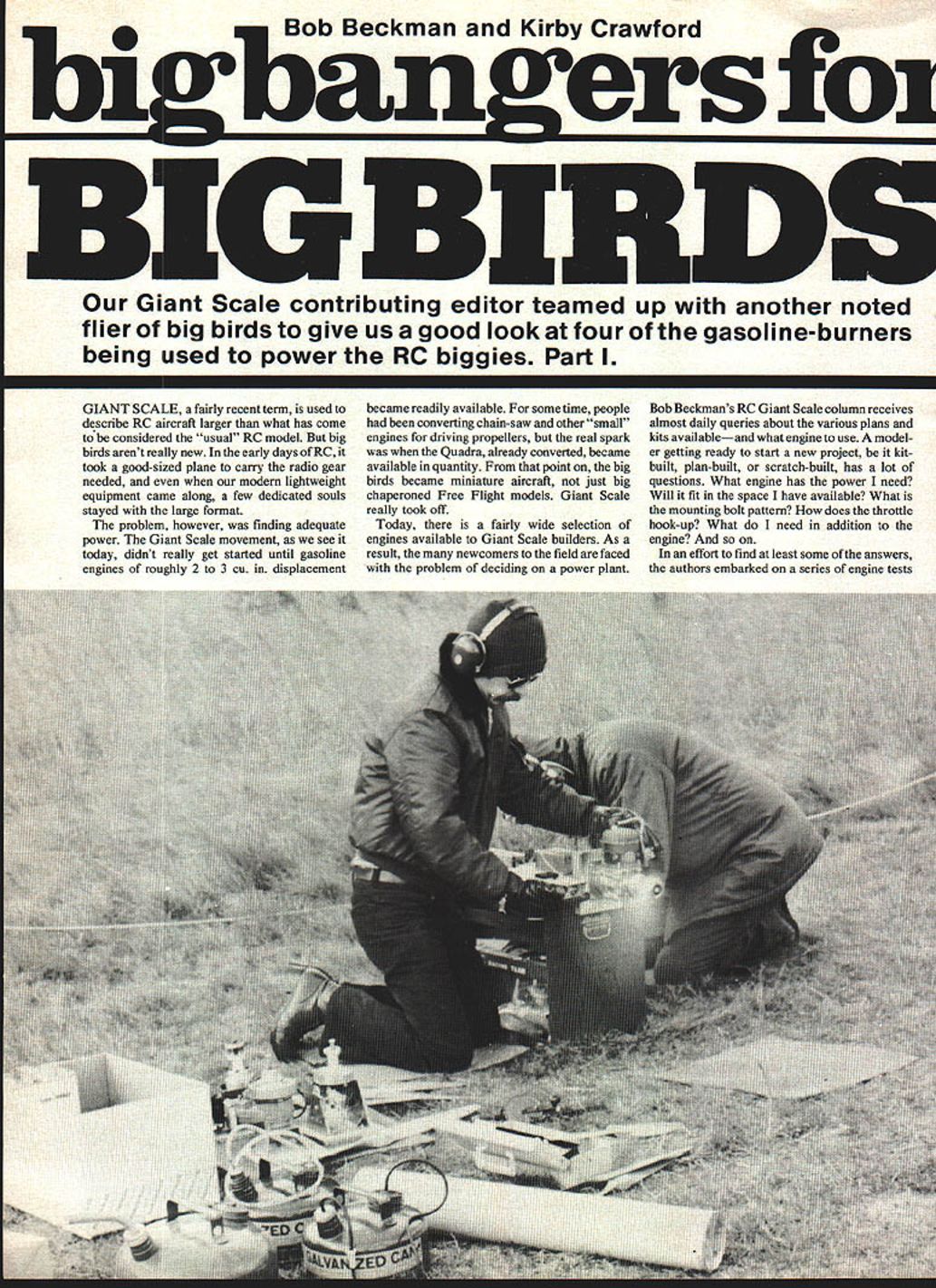
In an effort to find at least some of the answers, the authors embarked on a series of engine tests and evaluations. The idea was to test and examine the kinds of things that would be easily understood and most useful to the average modeler. Things like rpm, static thrust, fuel consumption, physical dimensions, and weight can be measured and reported objectively. Additional factors of interest and/or importance that are subjective by nature (or beyond our ability to measure objectively) are included, but are clearly identified.
The test procedures, deliberately, are not very sophisticated. Our test equipment consists of a venerable Heathkit Thumb Tach, a homemade 50-lb capacity thrust measuring test stand, a 25-lb capacity scale for weight measurements, and a stopwatch. This is the kind of setup that almost any modeler could come up with, but probably wouldn't do for just one or two engines. We expect to run 15 or 20 engines before we're through. The current series of tests will cover gasoline-burners only. If there is enough interest we may do a series on the larger glow engines and prop drives.
It is not our intent to make or imply any recommendations for or against any particular engine(s). What we have tried to do is collect and make available the data that you, the potential users, need in order to make informed decisions about Giant Scale power plants. Every big bird engine that we know of is capable of flying some kind of Giant Scale aircraft, but no one engine is suitable for every design. We hope our efforts will help.
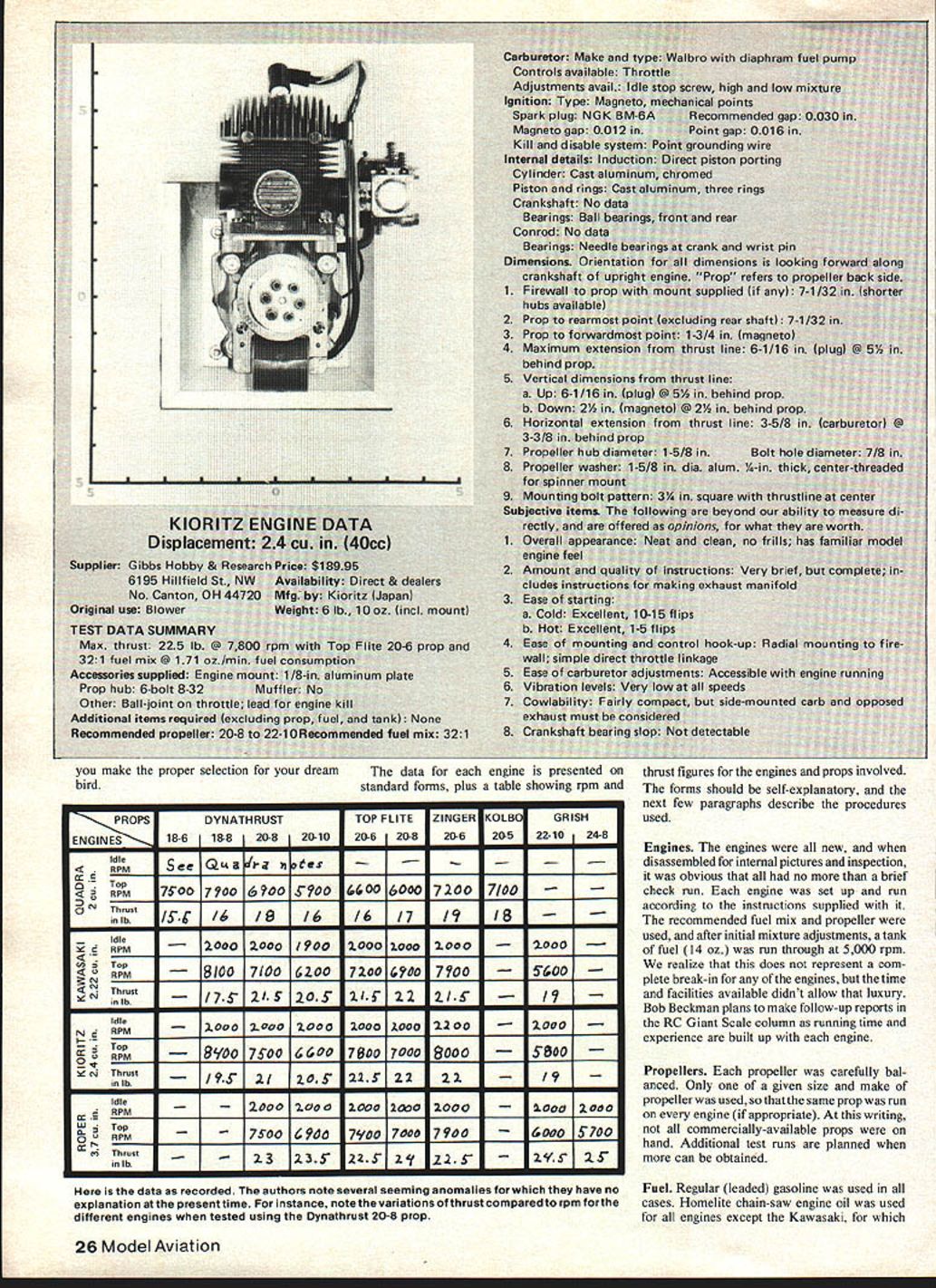
The data for each engine is presented on standard forms, plus a table showing rpm and thrust figures for the engines and props involved. The forms should be self-explanatory, and the next few paragraphs describe the procedures used.
Engines
The engines were all new, and when disassembled for internal pictures and inspection, it was obvious that all had no more than a brief check run. Each engine was set up and run according to the instructions supplied with it. The recommended fuel mix and propeller were used, and after initial mixture adjustments, a tank of fuel (14 oz.) was run through at 5,000 rpm. We realize that this does not represent a complete break-in for any of the engines, but the time and facilities available didn't allow that luxury. Bob Beckman plans to follow up reports in the RC Giant Scale column as running time and experience are built up on each engine.
Propellers
Each propeller was carefully balanced. Only one of a given size and make of propeller was used, so that the same prop was run on every engine (if appropriate). At this writing, not all commercially available props were on hand. Additional tests with other props are planned when more can be obtained.
Fuel
Regular (leaded) gasoline was used in all cases. Homelite chain-saw oil was used for all engines except the Kawasaki, for which Bel Ray MC-1 was specified. In all cases the gas/oil ratio was as listed for the particular engine.
Starting
Unless otherwise noted, all starting was done by hand (and wrist, arm, and shoulder — they all get sore). We found that the best starting procedure for any of the engines, when cold, was to fully open the throttle, close the choke (or choke by hand if no choke on engine), and flip the prop through until the engine pops. Then reset the throttle to a point just above idle, partially open the choke, and continue flipping until the engine runs. The choke is gradually opened as the engine warms up. When warm, the engines usually start quickly on the low throttle setting with little or no choking.
Note that the above procedure is usable only when the engine is well secured, as it was on our test stand. Since it is possible for the engine to start during the choking stage, this procedure should not be used with the engine mounted in a plane. Once experience is gained with a given engine, the required number of choking flips can be done with the ignition off.
Thrust measurement
We all know that static thrust does not tell the whole story. Things change once the prop starts moving through the air instead of just moving air. This is why different airplanes can require different props, even though using the same engine. However, if done with reasonable care, static thrust measurements can be a good gauge of relative performance for both engines and propellers. Besides, for us, it was the only game in town.
Test sequence
After the initial break-in as described above, the mixture and idle adjustments were rechecked for minimum reliable idle speed, with maximum high speed and good transition. Initially this was done with each propeller, but no significant difference could be detected, so the final procedure was to make the adjustments once, and leave them for all subsequent runs.
The sequence followed was:
- Measure idle rpm.
- Measure maximum rpm.
- Measure thrust at maximum rpm.
This was repeated with each propeller available, moving up and down in size and pitch until a significant decrease in performance identified the practical limits for the engine. In the case of the larger engines, the upper limit could not be identified with the propellers which were available to us at the time of these tests.
After running each propeller, the one producing the highest thrust was used for the fuel consumption check. The 14-oz. tank was topped off, the engine was started and set at top speed, and a stopwatch was used to time the run until the tank was empty.
The rpm and thrust data presented here doesn't always match previously published figures. That isn't surprising, considering the many variables involved. However, the test runs reported here were all performed on the same day, using the same equipment, and over a time span of about four hours during which there were no major changes in the weather conditions.
We wish to thank the following firms for their assistance with this project:
- CB Associates, Inc. (Kawasaki), 21658 Cloud Way, Hayward, CA 94545.
- Dynathrust Props, Inc., 2541 NE 11th Court, Pompano Beach, FL 33062.
- Gibbs Hobby & Research (Kioritz), 6195 Hillfield St., N.W., North Canton, OH 44720.
- Grish Bros., St. John, IN 46373.
- Horner's Sales (Roper), 300 Dixie Hwy., Beecher, IL 60401.
- Top Flite Models, Inc., 1901 Narragansett Ave., Chicago, IL 60639.
- Trail Manufacturing Ltd. (Quadra), P.O. Box 549, Huron Park, Ont. N0M 1Y0, Canada.
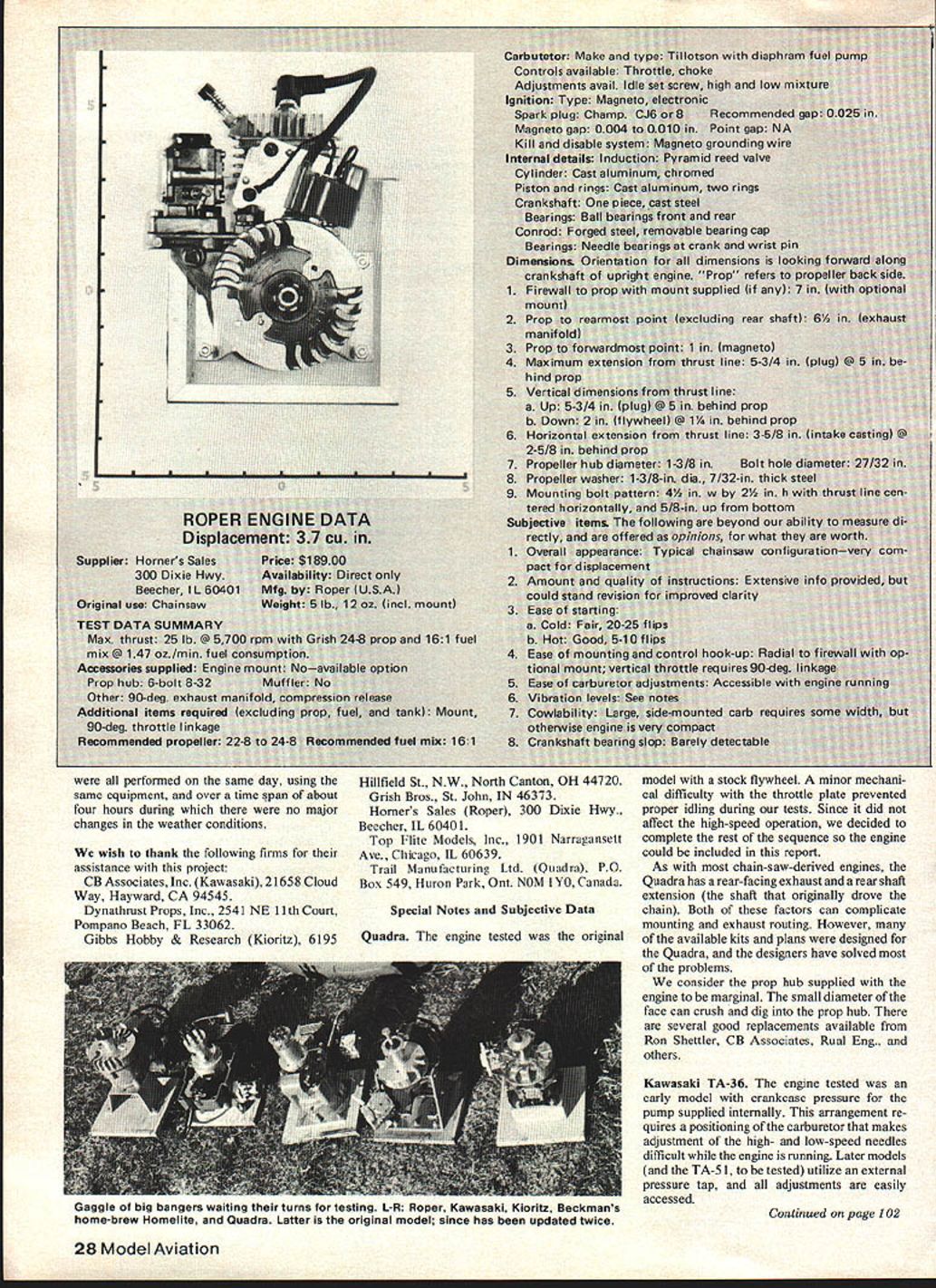
ROPER ENGINE DATA
Displacement: 3.7 cu. in.
Supplier: Horner's Sales, 300 Dixie Hwy., Beecher, IL 60401
Price: $189.00 Availability: Direct only Mfg. by: Roper (U.S.A.) Original use: Chainsaw Weight: 5 lb., 12 oz. (incl. mount)
TEST DATA SUMMARY
- Max. thrust: 25 lb. @ 5,700 rpm with Grish 24-8 prop and 16:1 fuel mix
- Fuel consumption: 1.47 oz./min.
Accessories supplied:
- Engine mount: No — available option
- Prop hub: 6-bolt 8-32
- Muffler: No
- Other: 90-deg. exhaust manifold, compression release
Additional items required (excluding prop, fuel, and tank):
- Mount
- 90-deg. throttle linkage
Recommended propeller:
- 22-8 to 24-8
Recommended fuel mix:
- 16:1
Carburetor:
- Make and type: Tillotson with diaphragm fuel pump
- Controls available: Throttle, choke
- Adjustments available: Idle set screw, high and low mixture
Ignition:
- Type: Magneto, electronic
- Spark plug: Champ. CJ6 or CJ8
- Recommended gap: 0.025 in.
- Magneto gap: 0.004 to 0.010 in.
- Point gap: N/A
- Kill and disable system: Magneto grounding wire
Internal details:
- Induction: Pyramid reed valve
- Cylinder: Cast aluminum, chromed
- Piston and rings: Cast aluminum, two rings
- Crankshaft: One piece, cast steel
- Bearings: Ball bearings front and rear
- Conrod: Forged steel, removable bearing cap
- Connecting bearings: Needle bearings at crank and wrist pin
Dimensions (Orientation for all dimensions is looking forward along crankshaft of upright engine. "Prop" refers to propeller back side.)
- Firewall to prop with mount supplied (if any): 7 in. (with optional mount)
- Prop to rearmost point (excluding rear shaft): 6½ in. (exhaust manifold)
- Prop to forwardmost point: 1 in. (magneto)
- Maximum extension from thrust line: 5-3/4 in. (plug) @ 5 in. behind prop
- Vertical dimensions from thrust line:
a. Up: 5-3/4 in. (plug) @ 5 in. behind prop b. Down: 2 in. (flywheel) @ 1½ in. behind prop
- Horizontal extension from thrust line: 3-5/8 in. (intake casting) @ 2-5/8 in. behind prop
- Propeller hub diameter: 1-3/8 in.
Bolt hole diameter: 27/32 in.
- Propeller washer: 1-3/8-in. dia., 7/32-in. thick steel
- Mounting bolt pattern: 4¼ in. w by 2½ in. h with thrust line centered horizontally, and 5/8 in. up from bottom
Subjective items (The following are beyond our ability to measure directly, and are offered as opinions.)
- Overall appearance: Typical chainsaw configuration — very compact for displacement
- Amount and quality of instructions: Extensive info provided, but could stand revision for improved clarity
- Ease of starting:
a. Cold: Fair, 20–25 flips b. Hot: Good, 5–10 flips
- Ease of mounting and control hook-up: Radial to firewall with optional mount; vertical throttle requires 90-deg. linkage
- Ease of carburetor adjustments: Accessible with engine running
- Vibration levels: See notes
- Cowlingability: Large, side-mounted carb requires some width, but otherwise engine is very compact
- Crankshaft bearing slop: Barely detectable
Special Notes and Subjective Data
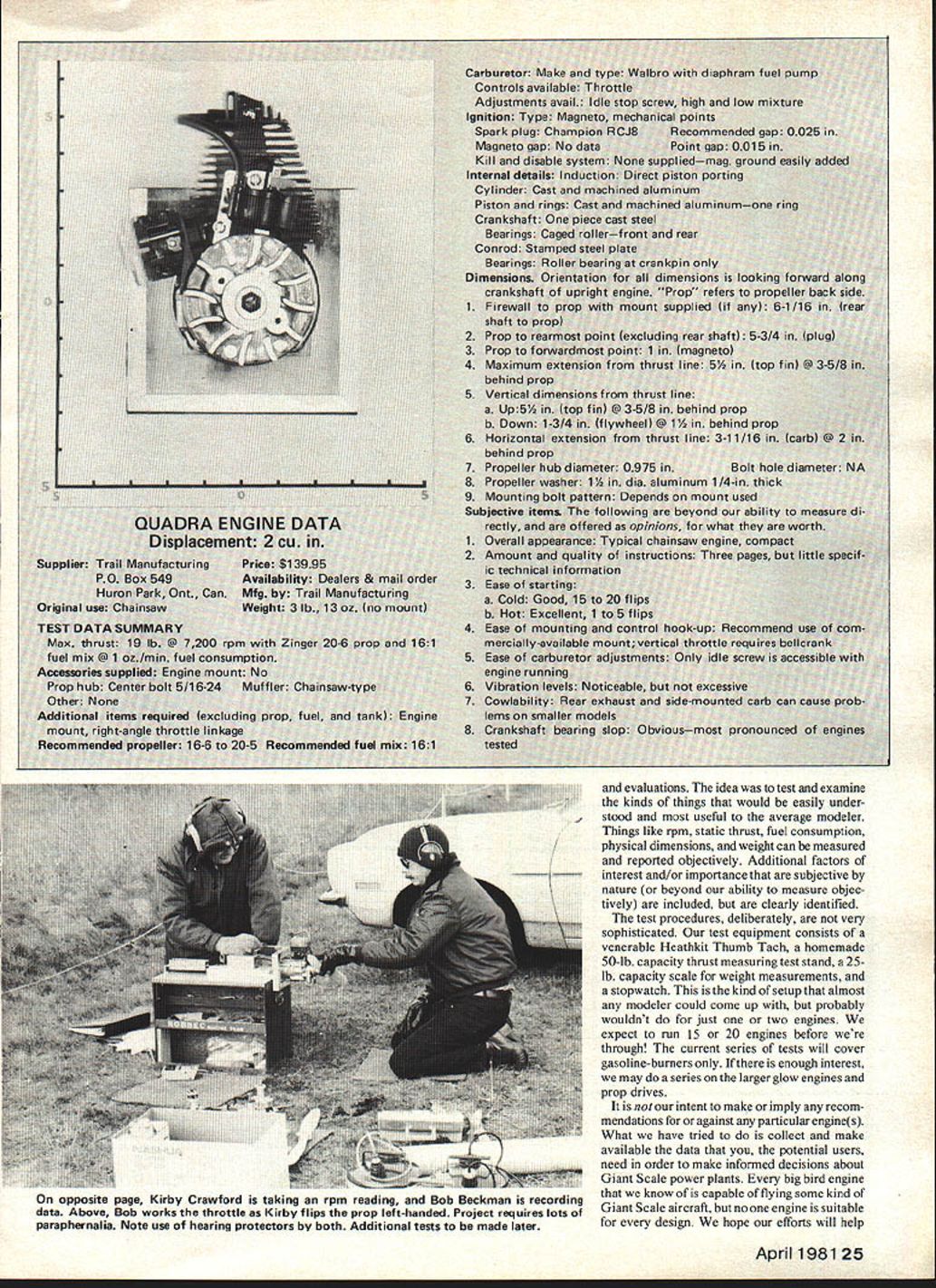
Quadra
The engine tested was the original model with a stock flywheel. A minor mechanical difficulty with the throttle plate prevented proper idling during our tests. Since it did not affect the high-speed operation, we decided to complete the rest of the sequence so the engine could be included in this report.
As with most chain-saw-derived engines, the Quadra has a rear-facing exhaust and a rear shaft extension (the shaft that originally drove the chain). Both of these factors can complicate mounting and exhaust routing. However, many of the available kits and plans were designed for the Quadra, and the designers have solved most of the problems.
We consider the prop hub supplied with the engine to be marginal. The small diameter of the hub face can crush and dig into the prop hub. There are several good replacements available from Ron Shetler, CB Associates, Runl Eng., and others.
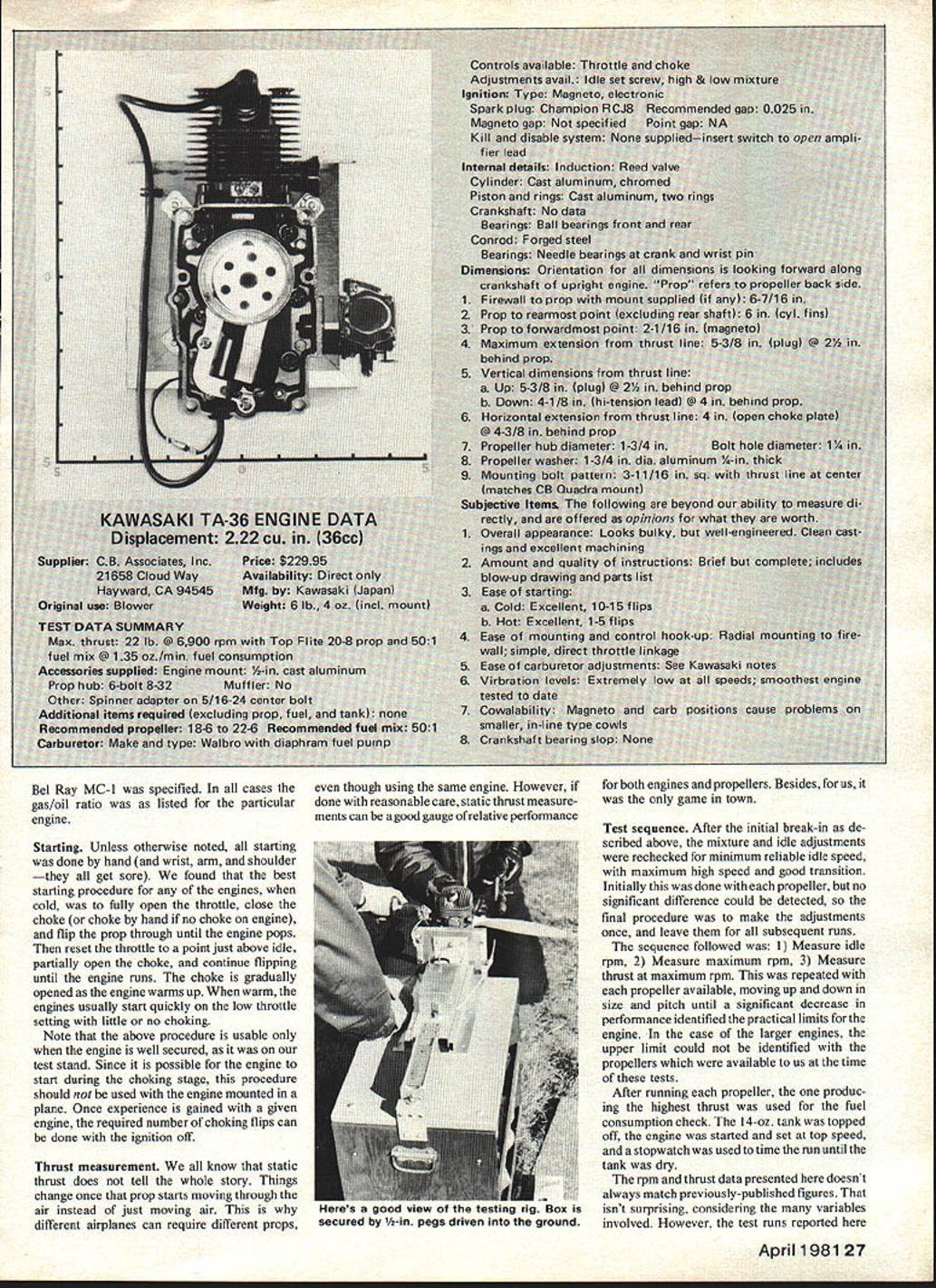
Kawasaki TA-36
The engine tested was an early model with crankcase pressure for the pump supplied internally. This arrangement requires positioning of the carburetor that makes adjustment of the high- and low-speed needles difficult while the engine is running. Later models (and the TA-51, to be tested) utilize an external pressure tap, and all adjustments are easily accessed.
Engine Impressions
The bulky look of the Kawasaki engine is due to the rectangular portions of the crankcase casting. While these can be removed, it turns out that the weight saved is less than three ounces. That doesn't justify the machining costs.
An unusual feature of the Kawasaki engines is that the cylinder can be repositioned by 180 degrees. The normal configuration is with the carb on one side and the exhaust on the other. The cylinder on our test engine had been rotated so that the carb and exhaust are on the same side. This makes horizontal mounting a snap when you have a cowl like the Pitts.
The Kawasaki is a high-quality, cool-running, smooth engine.
Kioritz
This engine makes the best first impression, and pretty well lives up to it. Like all the blower-derived engines, it was designed for long periods of high-speed running, as opposed to a chain-saw's short bursts. In addition, the K-engine's usual application requires low vibration. Both of these design goals fit our requirements perfectly.
While it is significantly different in many respects, the Kioritz shares one characteristic with the Quadra: their carburetors do not have built-in chokes. Hand-choking can be awkward and downright dangerous on an uncowled engine — and practically impossible inside a cowl. Dario Brisighella has available an add-on choke for the Quadra, which probably will fit just as well on the Kioritz.
The relatively high fuel consumption figure was, we suspect, due to the noticeable amount of fuel drawn out of the carb air intake while running. A ram-air scoop on the carb should result in slightly leaner mixture settings and better fuel consumption.
The Kioritz is a smooth, cool-running, high-quality engine.
Roper
This was the maximum displacement engine in the current test series, and you would expect most of the measurements to be maximum, also. Not so!
It did have the maximum thrust measurements, and even so we weren't really able to identify the peak with the props available. It did not have the maximum weight and physical dimensions. And it didn't have the maximum fuel consumption (see Kioritz notes).
It did have the maximum vibration levels. The first time we ran the engine, it was shaking so much that we couldn't get a screwdriver on the otherwise easily accessible mixture screws. We had to stop the engine to make changes to the low-speed mixture until we got things calmed down. Once we had the mixture set properly, and the engine warmed up, it smoothed out nicely. While the Roper's vibration is relatively high, especially at idle, it does not detract significantly from the engine's usefulness.
We were struck by the size-to-displacement ratio of this engine. It requires very little more space than a Quadra. The large flywheel close behind the prop does mean that you need a fairly flat-faced cowl. A longer prop adapter would simplify getting the engine into a tapering cowl. The carb has an external pressure pick-up, and it can be rotated 180 degrees. This places the mixture adjustments so they face forward. They would then be accessible on a cowled engine, even though they could not be accessed with the engine running.
This completes Part I of our report. Unfortunately, Part II will not appear next month. It was December when this was written, and the temperature outside was just over 10 degrees (and that's not Celsius). The next chapter in this continuing story will have to wait on the availability of both equipment and decent weather. We hope that the information presented here will be of use. We will add to it as soon as possible.
Transcribed from original scans by AI. Minor OCR errors may remain.

