
Big Birds of Long Ago
John R. Walker
Much has been written in recent model aircraft press about the "big birds." Some writers have tried to pinpoint who first conceived large, realistic flying miniature aircraft. I don't want to start an argument or take credit from anyone, but a recent find opens an interesting window on early work in this area.
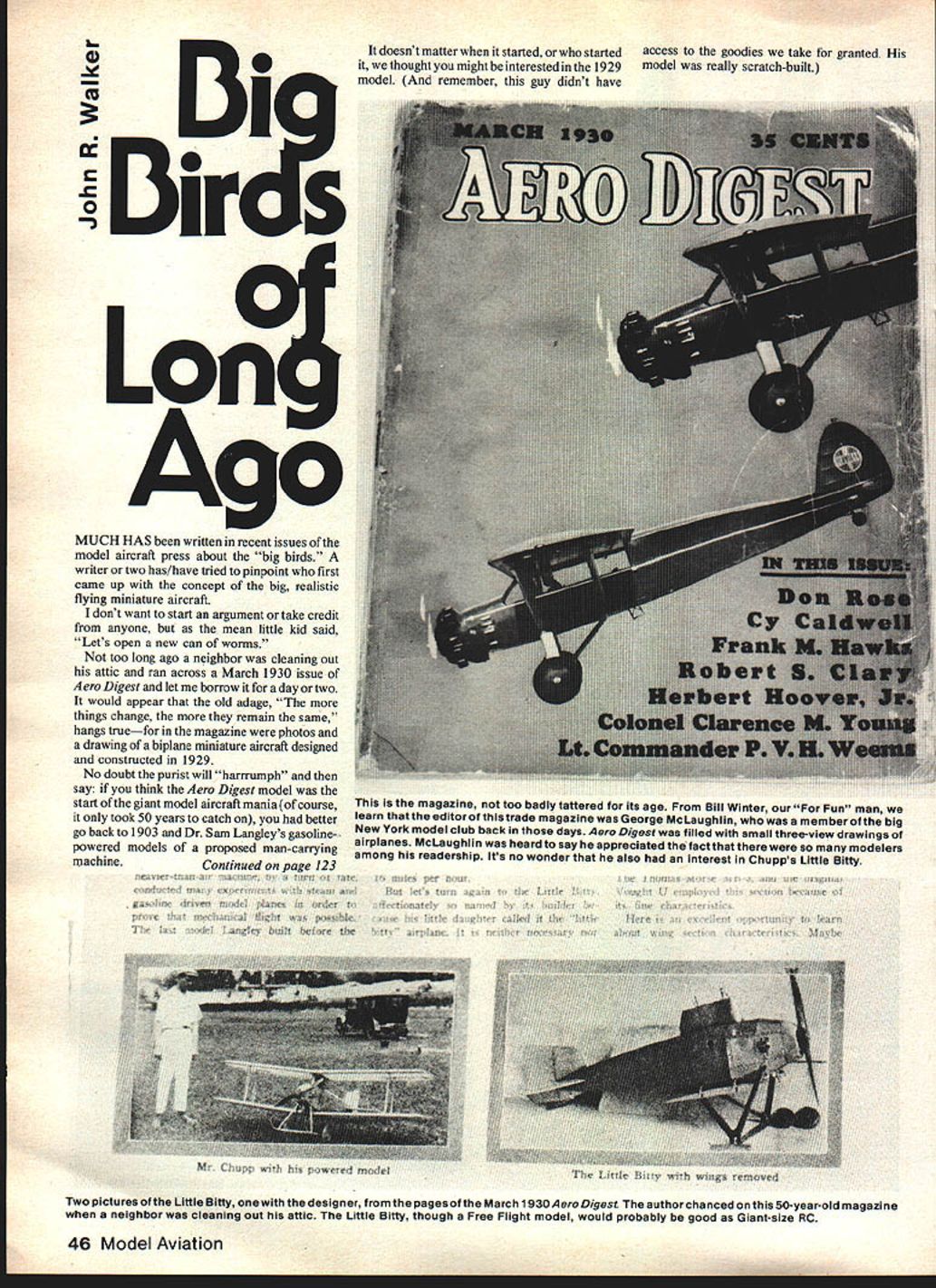
A neighbor cleaning his attic ran across a March 1930 issue of Aero Digest and let me borrow it. The magazine contained photos and a drawing of a biplane miniature designed and constructed in 1929. It confirms that the idea of a large, realistic model goes back much farther than most of us think.
Background
- The editor of Aero Digest at the time was George McLaughlin, who had ties to a major New York model club and appreciated the magazine's many modeler readers.
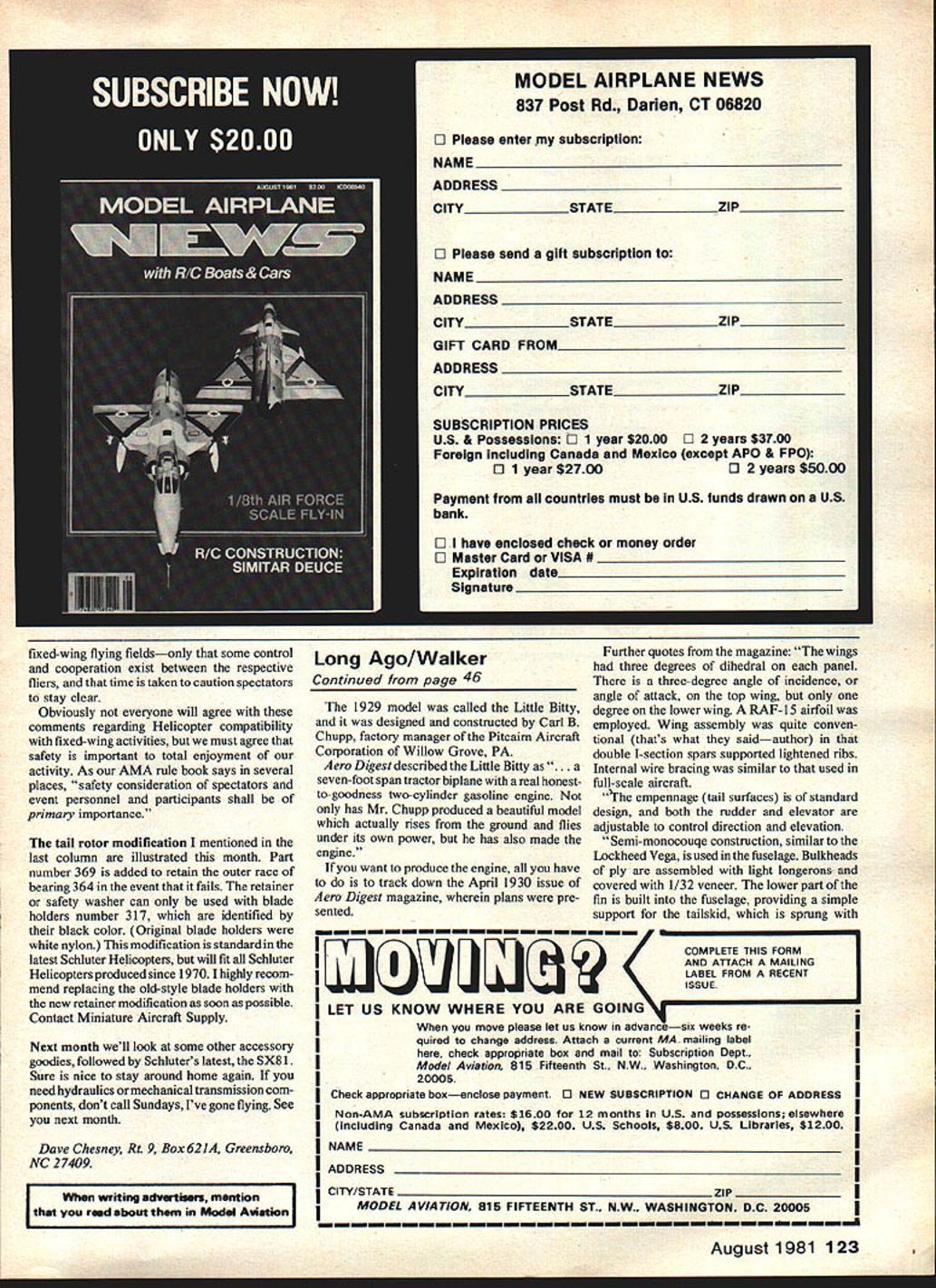
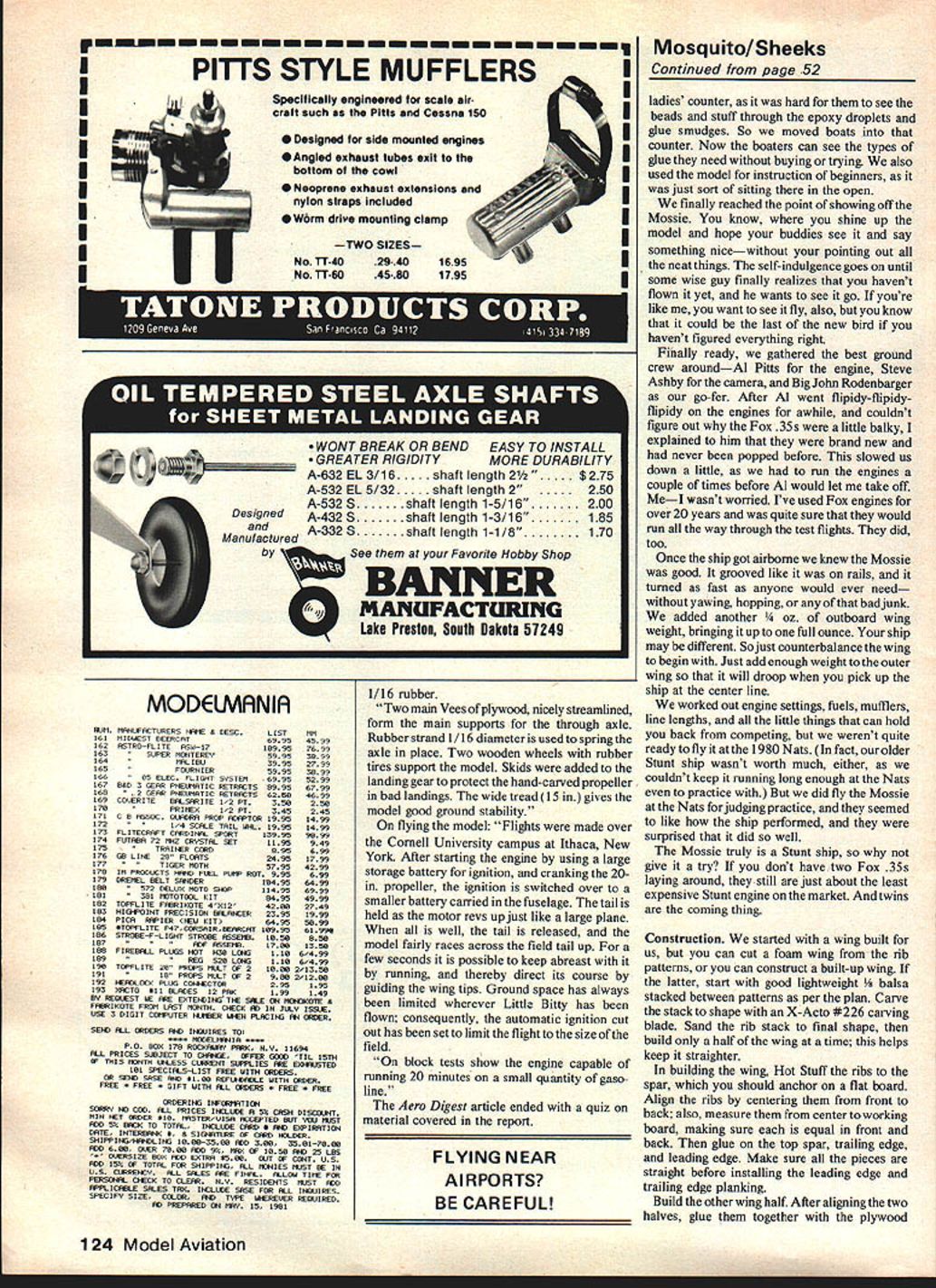
- Aero Digest regularly carried small three-view drawings of aircraft and occasionally covered noteworthy model work. One such item was Carl B. Chupp's biplane model, "Little Bitty."
The Little Bitty
Aero Digest described the Little Bitty as "a seven-foot span tractor biplane with a real, honest-to-goodness two-cylinder gasoline engine." Carl B. Chupp, factory manager at Pitcairn Aircraft Corporation, Willow Grove, Pa., designed and built the model — and he built the engine as well.
If you want to reproduce the engine, the April 1930 issue of Aero Digest presented plans.
Construction details
- Wings
- Three degrees of dihedral on each panel.
- Angle of incidence (angle of attack): 3 degrees on the top wing, 1 degree on the lower wing.
- RAF-15 airfoil employed.
- Wing assembly: double I-section spars supporting lightened ribs.
- Internal wire bracing similar to that used on full-scale aircraft.
- Empennage (tail surfaces)
- Standard design.
- Rudder and elevator adjustable for control of direction and elevation.
- Fuselage
- Semi-monocoque construction similar to the Lockheed Vega.
- Ply bulkheads assembled on light longerons and covered with 1/32-inch veneer.
- Lower part of the fin built into the fuselage, providing simple support for a sprung tailskid.
- Landing gear
- Two main Vees of plywood, nicely streamlined, form the main supports for the through axle.
- Rubber strand, 1/16-inch diameter, used to spring the axle in place.
- Two wooden wheels with rubber tires.
- Skids added to the landing gear to protect the hand-carved propeller in bad landings.
- Wide tread (15-inch) provides good ground stability.
Engine, starting and flight tests
- Engine: real two-cylinder gasoline engine handcrafted by Chupp.
- Starting procedure:
- A large storage battery used for ignition to start the engine while cranking the 20-inch propeller.
- After starting, ignition is switched to a smaller battery carried in the fuselage.
- Flight description:
- Flights were made over the Cornell University campus at Ithaca, New York.
- The tail is held as the motor revs up; when released the model races across the field tail up.
- For a few seconds it was possible to keep abreast of the model by running and to help direct its course by guiding the wing tips.
- Because flying space was limited, an automatic ignition cut-out was set to limit the flight to the size of the field.
- Engine endurance: on block tests the engine proved capable of running 20 minutes on a small quantity of gasoline.
Notes
- Aero Digest's April 1930 issue includes plans for the engine and further details.
- The original Aero Digest article concluded with a quiz on the material it covered.
Transcribed from original scans by AI. Minor OCR errors may remain.

