

Big New Twin: Boeing 777
L.D. Bookbinder
RC scale ducted-fan fliers take note: here's a new subject to watch. It'll be a couple of years yet until the prototype takes to the air, so you have lots of time to get ready. When's the last time you had a twin-ducted-fan civilian aircraft with folding wings?
Orders and background
After twenty years as king of the really huge airliners, Boeing's immense 747 is finally about to get some real competition — from Boeing. The twin-engined 777 has just gotten the official go-ahead for production, thanks to United Air Lines, whose reputation for foresight in going out on a limb for new designs dates back to the mid-1930s when it pioneered the Douglas DC-3.
With an order for 34 of the high-tech 777s, which will look like an enlarged 767, plus options for 34 more (as well as 30 plus 30 of the latest version of the 747), United has placed a $22 billion order, the largest in history by a commercial firm. Additional orders for the 777s are possible from British Airways, Delta Airlines, Cathay Pacific and at least one Japanese airline, now that United has opened the door.
The first deliveries of 777s are currently scheduled for the middle of 1995, as the airlines move to replace their older three-engined Lockheed L-1011 Tri-Stars and McDonnell Douglas DC-10s.
Competition for the 777 will come from the new McDonnell Douglas MD-11 and the Aérospatiale A330 and A340 Airbuses, which are further along in their development. But Boeing has the advantage of already equipping more of the world's airlines, and so more operators are familiar with the way Boeing does business.
Design and capacity
The initial version of the 777, priced at a mere $100 million apiece, will carry from 360 to 390 passengers depending on the seating arrangement. Designed for an ultimate load of 440 passengers, the cabin will be almost as wide as that of the 747 and able to accommodate as many as ten seats across in a 3-4-3 configuration (where only 20% of passengers sit by a window). Each passenger will have almost three cubic feet of overhead storage space. For extra-long flights, there can be a below-deck rest area for a replacement crew.
Folding wingtips
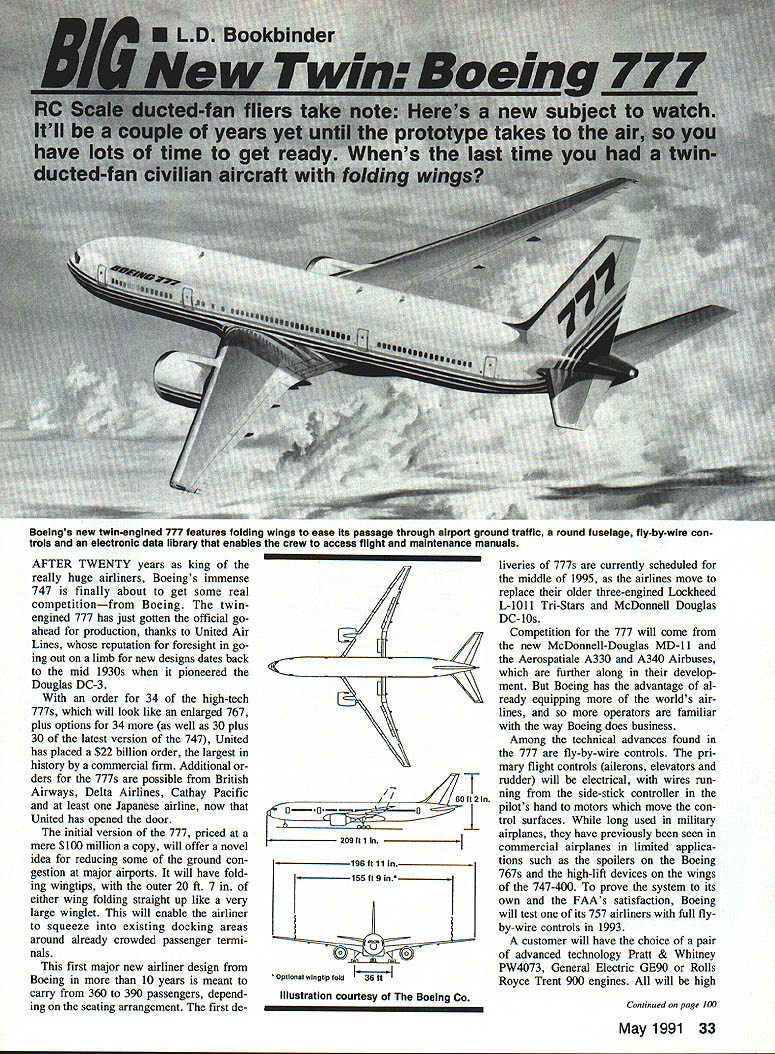
To reduce some of the ground congestion at major airports, the 777 will have folding wingtips: the outer 20 ft 7 in of either wing will fold straight up like a very large winglet. This will enable the airliner to squeeze into existing docking areas around already crowded passenger terminals. When folded, the wingspan reduces from 196 ft 11 in to 155 ft 9 in.
Flight controls — fly-by-wire
Among the technical advances found in the 777 are fly-by-wire controls. The primary flight controls (ailerons, elevators and rudder) will be electrical, with wires running from the side-stick controller in the pilot's hand to motors that move the control surfaces. While long used in military airplanes, they have previously been seen in commercial airplanes in limited applications, such as the spoilers on the Boeing 767 and the high-lift devices on the wings of the 747-400. To prove the system to its own and the FAA's satisfaction, Boeing will test one of its 757 airliners with full fly-by-wire controls in 1993.
Engines
A customer will have the choice of a pair of advanced-technology engines:
- Pratt & Whitney PW4073
- General Electric GE90
- Rolls-Royce Trent 900
All will be high-bypass-ratio turbofans offering improved fuel consumption and reduced noise. They will develop at least 60,000 lb of thrust in their initial versions and as much as 90,000 lb in later versions.
Cockpit and onboard systems
The cockpit is advanced, too. The instrument panel will go beyond the dramatic simplification of the 1980s—a few cathode-ray-tube displays in place of the intimidating clutter of hard-to-read gauges—to flat-panel displays. Already in use in the 747-400, these displays are smaller and lighter, making flight and engine information even easier to read and thus increasing safety by reducing the pilot's workload.
An electronic data library will enable the crew to access flight and maintenance manuals and approach charts on board; maintenance personnel will be able to download diagnostic information for use during repairs.
Materials and structure
The 777 will show an increased use of exotic composites as these appealingly light and strong materials become better understood. Advanced carbon-graphite epoxy will be used in the structural boxes for the vertical and horizontal tails, floor beams and trailing-edge flaps. New developments in epoxy resins make this material stronger, as well as easier to fabricate and repair.
Variants and performance
Development versions of the 777 may include:
- A long-range variant to carry 300–320 passengers for up to 7,350 miles.
- A stretched very-long-range version with a maximum range of about 9,000 miles for trans-Pacific flights.
These will involve increases in maximum weight from a little over 500,000 lb for the first airplanes to almost 600,000 lb for later variants.
Dimensions (first version)
- Length: 209 ft 1 in
- Wingspan: 196 ft 11 in (155 ft 9 in with tips folded)
- Overall height: 60 ft 2 in
The new generation of widebodies
In the first generation of the wide-body era, the Boeing 747 enabled the airlines and their passengers to get accustomed to the crowding and the economic advantages of unprecedented seating capacity. While other transportation costs were rising steadily, the price of a ticket for a long flight actually dropped. Next came the second generation—DC-10, TriStar and Airbus A300—which brought the travel revolution to domestic flying.
Now the third generation is almost upon us, with far greater emphasis on economy, safety and noise reduction. While hardly as exciting as the prospect of an advanced supersonic transport, the new wide-bodied airliners will have a far greater impact on the travel plans of millions of business and vacation travelers.
Transcribed from original scans by AI. Minor OCR errors may remain.

