
Bigbangers for Bigbirds
Bob Beckman and Kirby Crawford
The Quadra engine is in greater use than any other Giant Scale engine of this type, for it has been around longer. Actually, there have been three variations of the Quadra through the years. Our authors provide much data. Part 2.
Introduction
If you scratch the majority of Giant Scale models, you'll uncover a Quadra under the cowl. While there are quite a few big bangers available now, the Quadra was the first to appear in any real quantity. Literally thousands are now in use. Most of the Giant Scale kits on the market were designed for the Quadra since it was about the only thing around when the kits were developed two or three years ago. This blocky-looking Canadian chainsaw engine has, and continues to have, a tremendous influence on the whole Giant Scale field.
Part I of this series included one version of the Quadra. There are basically three slightly different versions on the market: the original model, a version with a "factory balanced" flywheel, and the latest model with minor external changes and some more significant internal changes. In addition, any one of the three might have a "Brisighella balanced" flywheel installed, making six variations — and confusion reigns supreme. In this part of "Big Bangers," we will try to clear up some of that confusion.
General test comments
Before getting into the Quadra, we want to make a few comments that apply to this test series in general.
- Keep in mind that static thrust doesn't tell the whole story about any engine/propeller/aircraft combination. Before we are through, we plan to report on in-flight experience with as many engines and props as we can.
- All of the engines are run without mufflers, even though we know that a little back pressure usually helps. Since we didn't have mufflers for all the engines, we felt it would be better not to use any of them.
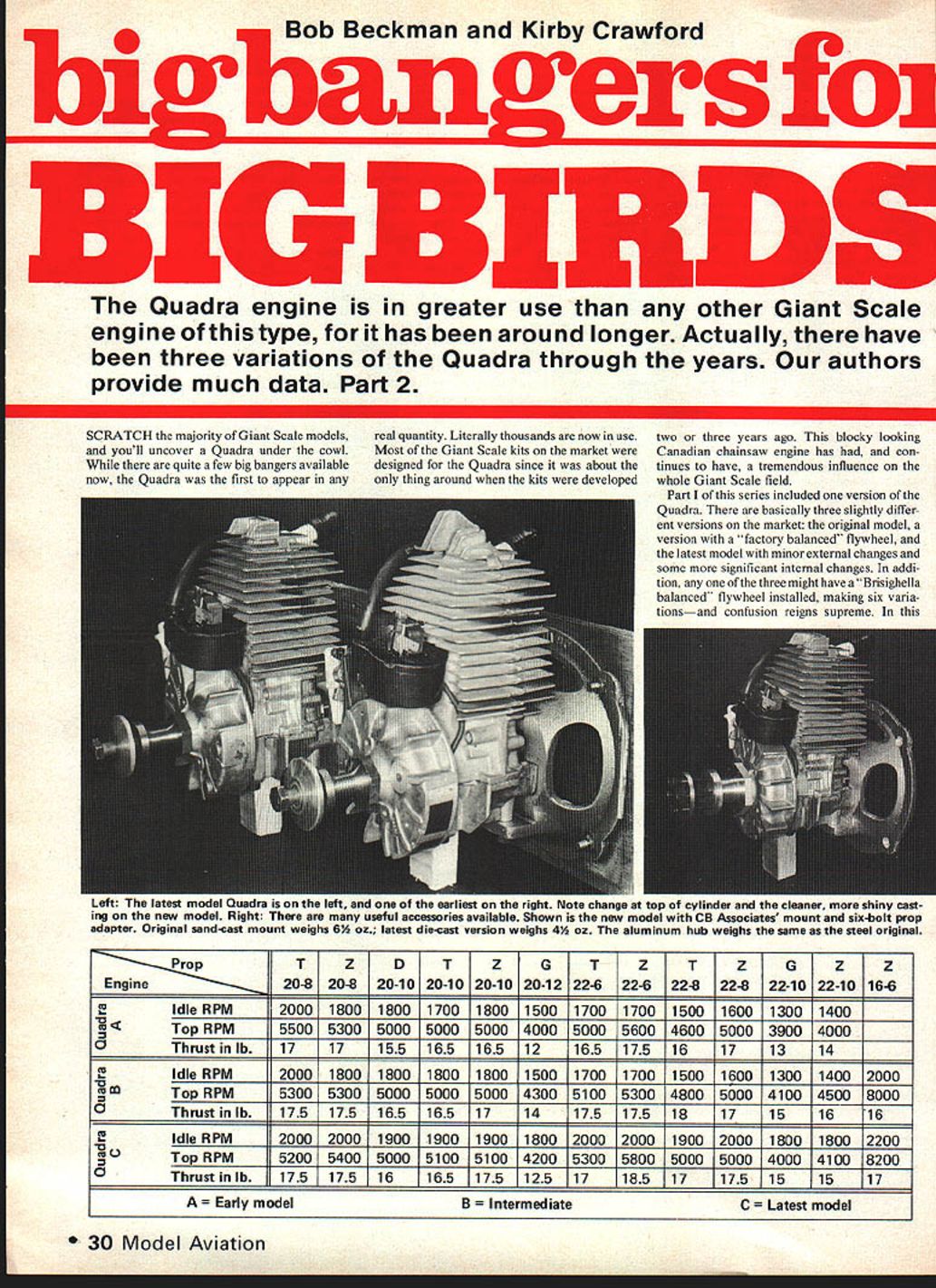
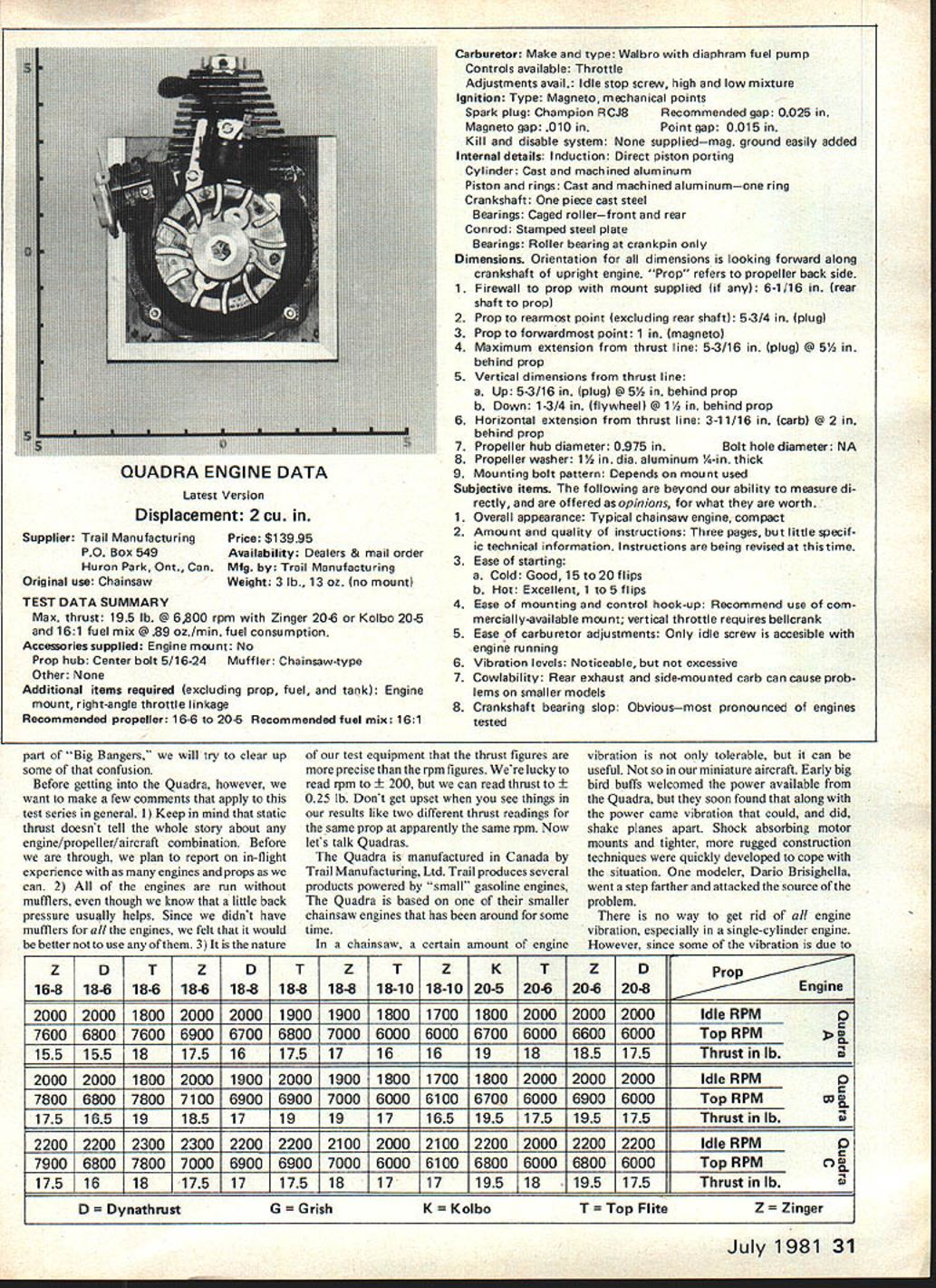
- It is the nature of our test equipment that the thrust figures are more precise than the rpm figures. We're lucky to read rpm to ±200, but we can read thrust to ±0.25 lb. Don't get upset when you see things in our results like two different thrust readings for the same prop at apparently the same rpm.
Now let's talk Quadras.
Manufacturer and background
The Quadra is manufactured in Canada by Trail Manufacturing, Ltd. Trail produces several products powered by "small" gasoline engines. The Quadra is based on one of their smaller chainsaw engines that has been around for some time.
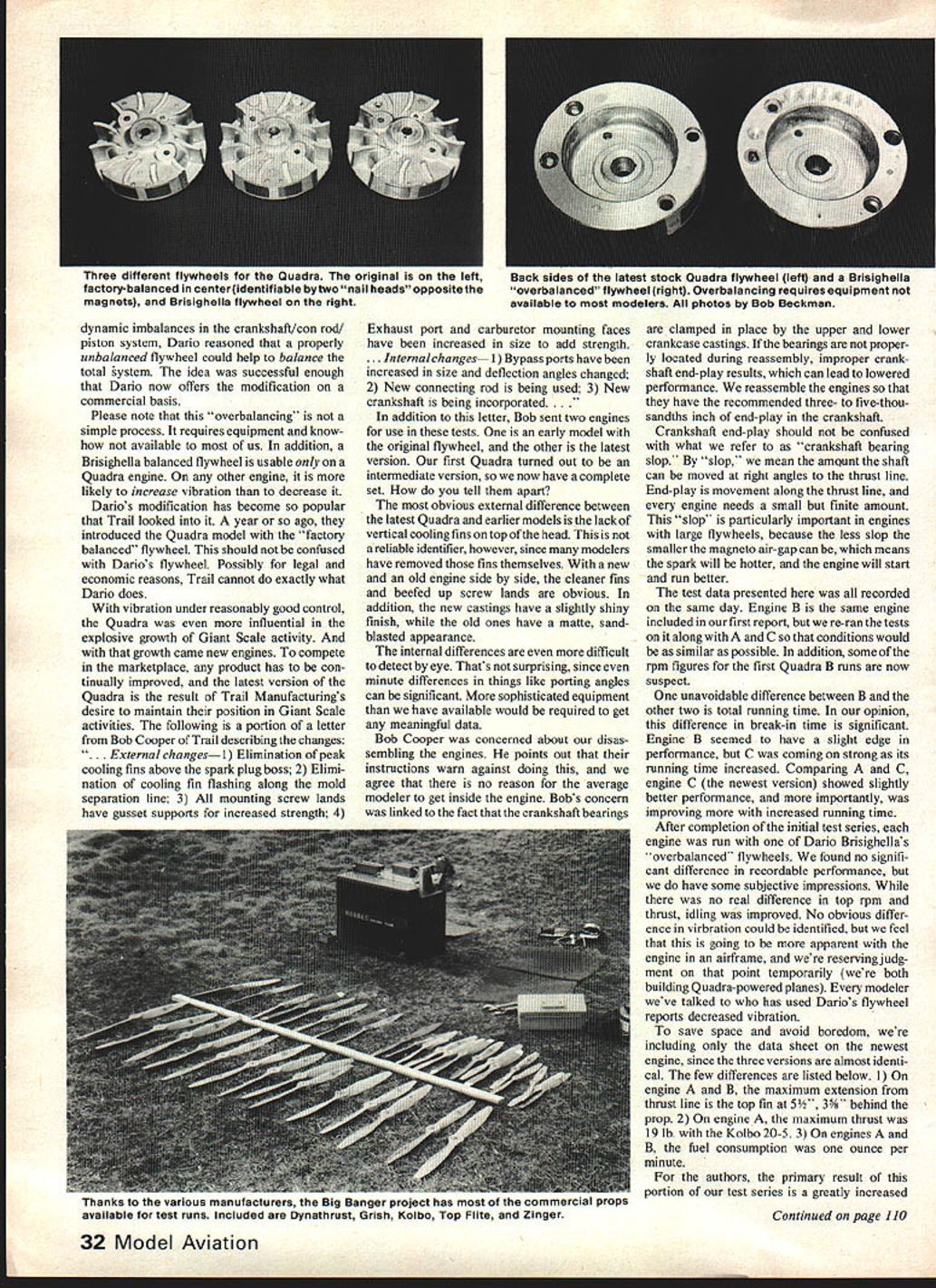
In a chainsaw, a certain amount of engine vibration is not only tolerable, but it can be useful. Not so in our miniature aircraft. Early big-bird buffs welcomed the power available from the Quadra, but they soon found that along with the power came vibration that could, and did, shake planes apart. Shock-absorbing motor mounts and tighter, more rugged construction techniques were quickly developed to cope with the problem. One modeler, Dario Brisighella, went a step farther and attacked the source of the problem.
Brisighella flywheel modification
There is no way to get rid of all engine vibration, especially in a single-cylinder engine. However, since some of the vibration is due to dynamic imbalances in the crankshaft/con-rod/piston system, Dario reasoned that a properly unbalanced flywheel could help to balance the total system. The idea was successful enough that Dario now offers the modification on a commercial basis.
Please note that this "overbalancing" is not a simple process. It requires equipment and know-how not available to most of us. In addition, a Brisighella-balanced flywheel is usable only on a Quadra engine. On any other engine, it is more likely to increase vibration than to decrease it.
Dario's modification has become so popular that Trail looked into it. A year or so ago, they introduced the Quadra model with the "factory balanced" flywheel. This should not be confused with Dario's flywheel. Possibly for legal and economic reasons, Trail cannot do exactly what Dario does.
Trail's latest model — changes
With vibration under reasonably good control, the Quadra was even more influential in the explosive growth of Giant Scale activity. And with that growth came new engines. To compete in the marketplace, any product has to be continually improved, and the latest version of the Quadra is the result of Trail Manufacturing's desire to maintain their position in Giant Scale activities.
Portions of a letter from Bob Cooper of Trail describe the changes:
- External changes:
- Elimination of peak cooling fins above the spark plug boss.
- Elimination of cooling fin flashing along the mold separation line.
- All mounting screw lands have gusset supports for increased strength.
- Exhaust port and carburetor mounting faces have been increased in size to add strength.
- Internal changes:
- Bypass ports have been increased in size and deflection angles changed.
- New connecting rod is being used.
- New crankshaft is being incorporated.
Bob Cooper sent two engines for use in these tests. One is an early model with the original flywheel, and the other is the latest version. Our first Quadra turned out to be an intermediate version, so we now have a complete set.
Identifying the versions
The most obvious external difference between the latest Quadra and earlier models is the lack of vertical cooling fins on top of the head. This is not a reliable identifier, however, since many modelers have removed those fins themselves. With a new and an old engine side by side, the cleaner fins and beefed-up screw lands are obvious. In addition, the new castings have a slightly shiny finish, while the old ones have a matte, sandblasted appearance.
The internal differences are even more difficult to detect by eye. That's not surprising, since even minute differences in things like porting angles can be significant. More sophisticated equipment than we have available would be required to get any meaningful data.
Disassembly and crankshaft notes
Bob Cooper was concerned about our disassembling the engines. He points out that their instructions warn against doing this, and we agree that there is no reason for the average modeler to get inside the engine. Bob's concern was linked to the fact that the crankshaft bearings are clamped in place by the upper and lower crankcase castings. If the bearings are not properly located during reassembly, improper crankshaft end-play results, which can lead to lowered performance. We reassemble the engines so that they have the recommended three to five thousandths of an inch of end-play in the crankshaft.
Crankshaft end-play should not be confused with what we refer to as "crankshaft bearing slop." By "slop," we mean the amount the shaft can be moved at right angles to the thrust line. End-play is movement along the thrust line, and every engine needs a small but finite amount. This "slop" is particularly important in engines with large flywheels, because the less slop the smaller the magneto air-gap can be, which means the spark will be hotter, and the engine will start and run better.
Test procedure and observations
The test data presented here was all recorded on the same day. Engine B is the same engine included in our first report, but we re-ran the tests on it along with A and C so that conditions would be as similar as possible. In addition, some of the rpm figures for the first Quadra B runs are suspect.
One unavoidable difference between B and the other two is total running time. In our opinion, this difference in break-in time is significant. Engine B seemed to have a slight edge in performance, but C was coming on strong as its running time increased. Comparing A and C, engine C (the newest version) showed slightly better performance, and more importantly, was improving more with increased running time.
After completion of the initial test series, each engine was run with one of Dario Brisighella's "overbalanced" flywheels. We found no significant difference in recordable performance, but we do have some subjective impressions. While there was no real difference in top rpm and thrust, idling was improved. No obvious difference in vibration could be identified, but we feel that this is going to be more apparent with the engine in an airframe, and we're reserving judgment on that point temporarily (we're both building Quadra-powered planes). Every modeler we've talked to who has used Dario's flywheel reports decreased vibration.
To save space and avoid boredom, we're including only the data sheet on the newest engine, since the three versions are almost identical. The few differences are listed below:
- On engines A and B, the maximum extension from the thrust line is the top fin at 5/32", 3/8" behind the prop.
- On engine A, the maximum thrust was 195 lb with the Kolbo 20-5.
- On engines A and B, the fuel consumption was one ounce per minute.
For the authors, the primary result of this portion of our test series is a greatly increased respect for the Quadra and its capabilities. All three engines were easy starting. Thrust outputs were, in some cases, surprisingly high, and improving with running time. Vibration levels were not excessive and were lower than some of the other chainsaw-derived engines. With the added considerations of availability and price, it's hard to beat.
Acknowledgments
We wish to thank the following for their support of this portion of our project:
- Dario Brisighella, 1032 East Manitowoc Ave., Oak Creek, WI 53154
- CB Associates, Inc., 21658 Cloud Way, Hayward, CA 94545
- Dynathrust Props, Inc., 2541 NE 11th Court, Pompano Beach, FL 33062
- Grish Bros., St. John, IN 46373
- JZ Products (Zinger), 25029 S. Vermont Ave., Harbor City, CA 90710
- Top Flite Models, Inc., 1901 Narragansett Ave., Chicago, IL 60639
- Trail Manufacturing, Ltd., Huron Park, Ont. N0M 1Y0, Canada
Transcribed from original scans by AI. Minor OCR errors may remain.

