
Bjorn Karlstrom
By Don Berliner
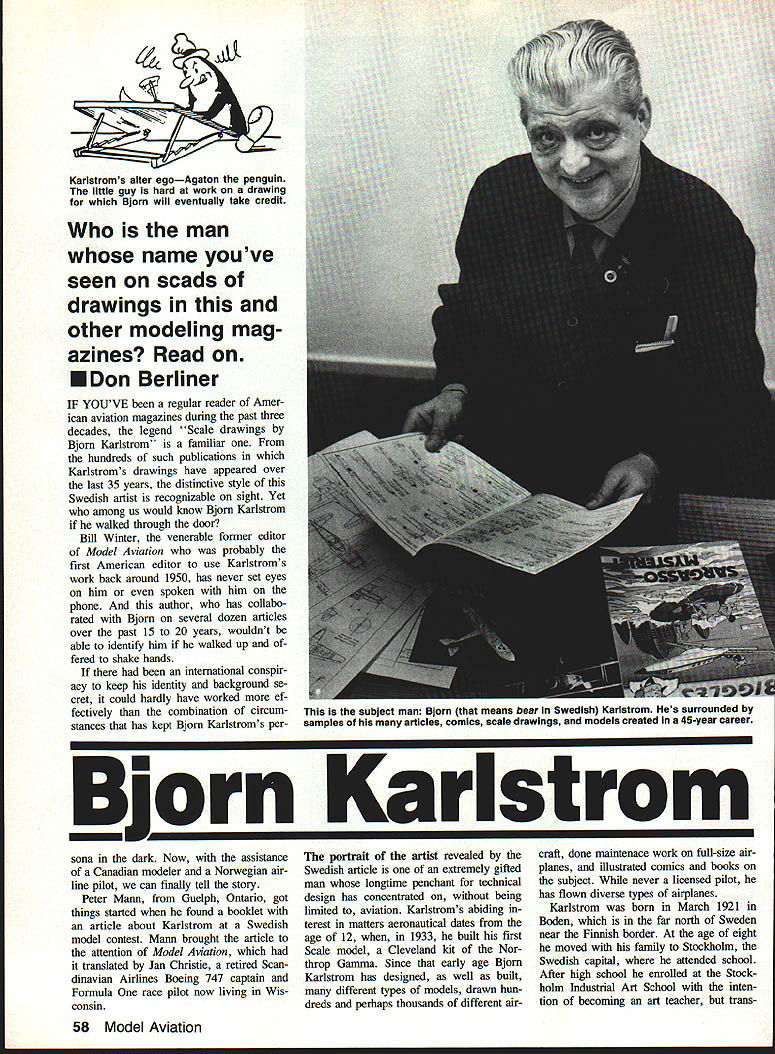
If you've been a regular reader of American aviation magazines during the past three decades, the legend "Scale drawings by Bjorn Karlstrom" is a familiar one. From the hundreds of publications in which Karlstrom's drawings have appeared over the last 35 years, the distinctive style of this Swedish artist is recognizable on sight. Yet who among us would know Bjorn Karlstrom if he walked through the door?
Bill Winter, the venerable former editor of Model Aviation who was probably the first American editor to use Karlstrom's work around 1950, has never set eyes on him or even spoken with him on the phone. The author, who has collaborated with Bjorn on several dozen articles over the past 15 to 20 years, likewise wouldn't be able to identify him if he walked up and offered to shake hands.
If there had been an international conspiracy to keep his identity and background secret, it could hardly have worked more effectively than the combination of circumstances that has kept Bjorn Karlstrom's persona in the dark. Now, with the assistance of a Canadian modeler and a Norwegian airline pilot, we can finally tell the story.
Peter Mann, from Guelph, Ontario, got things started when he found a booklet with an article about Karlstrom at a Swedish model contest. Mann brought the article to the attention of Model Aviation, which had it translated by Jan Christie, a retired Scandinavian Airlines Boeing 747 captain and Formula One race pilot now living in Wisconsin.
Early life and education
Karlstrom was born in March 1921 in Boden, in the far north of Sweden near the Finnish border. At the age of eight he moved with his family to Stockholm, where he attended school. After high school he enrolled at the Stockholm Industrial Art School with the intention of becoming an art teacher, but he transferred to the engineering branch. The curriculum included a two-month stint in the aircraft shop for practical experience. Karlstrom became skilled in aircraft carpentry; the two-month period stretched into two years. During that time he applied his artistic talent to special paint jobs on a variety of aircraft, and his interest in a wide variety of airplanes flourished.
Early career and comics
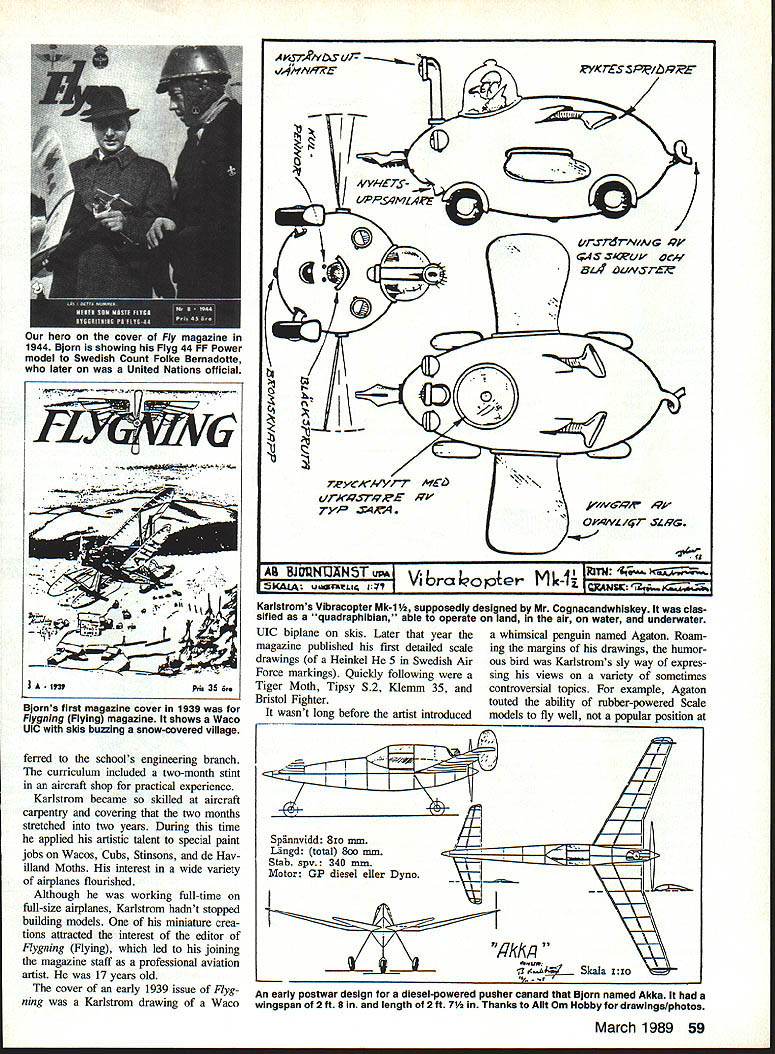
Although working full-time on full-size airplanes, Karlstrom hadn't stopped building models. His miniature creations attracted attention and led to professional work as an aviation artist for Flygning (Flying) and other publications.
Later that year the magazine published his first detailed scale drawings (of a Heinkel He 5 in Swedish Air Force markings). Quickly following were a Tiger Moth, Tipsy S.2, Klemm 35, and Bristol Fighter.
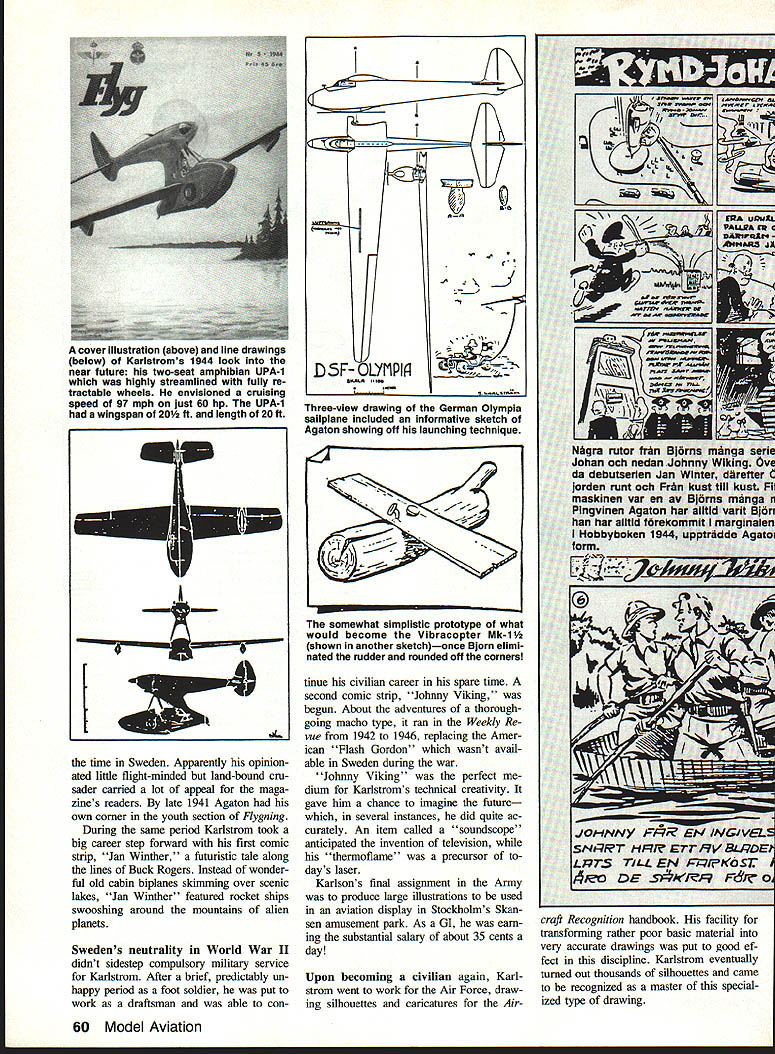
It wasn't long before the artist introduced a whimsical penguin named Agaton. Roam magazine published his humorous drawings in the margins of his scale drawings; the penguin was Karlstrom's sly way of expressing his views on a variety of sometimes controversial topics. For example, Agaton voiced the ability of rubber-powered scale models to fly well, not a popular position at the time. By late 1941 Agaton had his own corner in the youth section of Flygning.
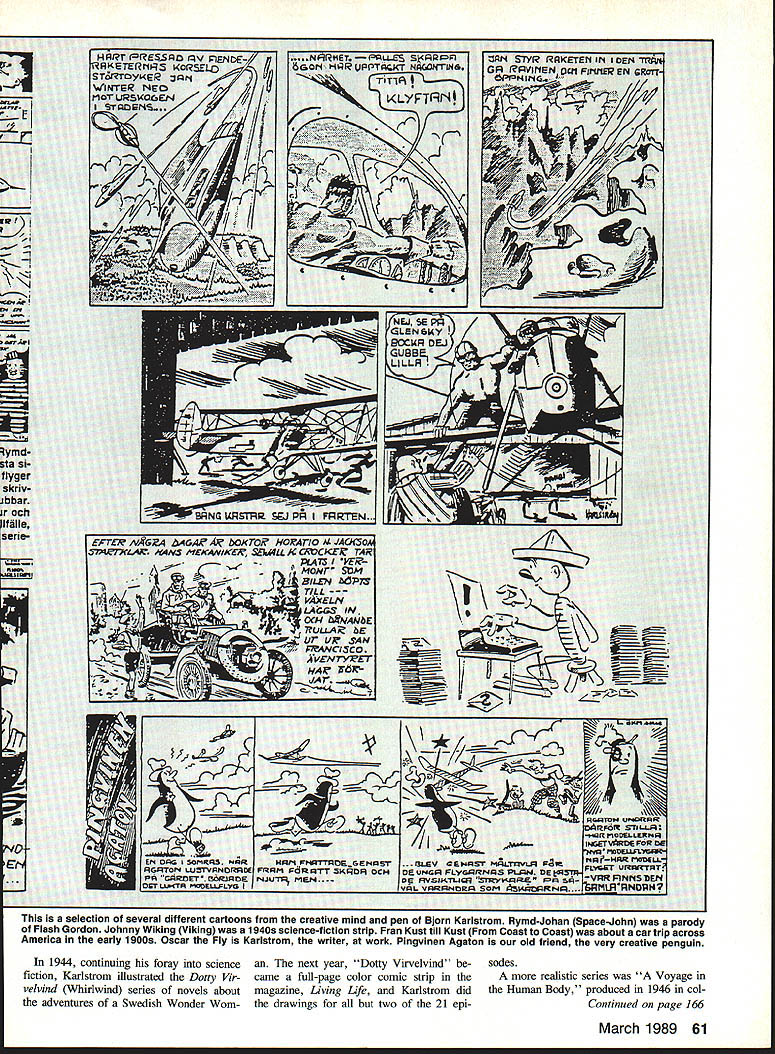
During the same period Karlstrom launched his first comic strip, "Jan Winther," a futuristic tale along the lines of Buck Rogers featuring rocket ships swooshing around alien planets. He followed with "Johnny Viking," a macho-adventure strip that ran in the Weekly Revue from 1942 to 1946, replacing the American "Flash Gordon" which wasn't available in Sweden during the war.
"Johnny Viking" was an ideal medium for Karlstrom's technical creativity and gave him a chance to imagine the future. In several instances he anticipated later inventions: an item called a "soundscope" foreshadowed television, while his "thermoflame" anticipated ideas similar to today's lasers.
In 1944, continuing his foray into science fiction, Karlstrom illustrated the Dotty Virvelvind (Whirlwind) series of novels about the adventures of a Swedish Wonder Woman. The next year, Dotty Virvelvind became a full-page color comic strip in the magazine Living Life, and Karlstrom did the drawings for all but two of the 21 episodes.
A more realistic series was "A Voyage in the Human Body," produced in 1946 in color. It was a collaboration with a writer who later became a leading cancer scientist. The story followed a group of miniaturized scientists who went into a human body to fight tuberculosis; bacteria were represented by humanoid monsters. The series continued for 30 installments before being canceled because many readers found it difficult to accept; some objected to Karlstrom's drawings of scantily clad young women.
In 1949 he created "Space-Johan," a parody of Flash Gordon, which concluded with the hero and his sidekick stuck in jail—a refreshing departure from the usual tidy endings. That same year he began another space comic strip, "Leo Falk," which packed in more realistic action and prophetic themes of space travel. Some original drawings from "Leo Falk," which ran until 1952 in Technical World, were purchased by the Swedish National Museum for display. "Leo Falk" was resurrected in 1983 by Svenska Dagbladet, Sweden's second-largest daily newspaper.
Diverging from aerospace, Karlstrom created "From Coast to Coast," introduced in Motor in 1954. It was a documentary-style comic strip full of antique cars depicting a cross-country drive in America during the early part of the century.
World War II and military service
Sweden's neutrality in World War II didn't exempt Karlstrom from compulsory military service. After a brief and predictably unhappy period as a foot soldier, he was put to work as a draftsman and was able to continue his civilian career in his spare time. His final army assignment was to produce large illustrations for an aviation display in Stockholm's Skansen amusement park. As a GI, he earned about 35 cents a day.
Upon becoming a civilian again, Karlstrom went to work for the Air Force, drawing silhouettes and caricatures for the Aircraft Recognition handbook. His facility for transforming rather poor basic material into very accurate drawings was put to good effect in this discipline. Karlstrom eventually produced thousands of silhouettes and came to be recognized as a master of this specialized type of drawing.
Postwar work and international recognition
During the 1940s Karlstrom's drawings appeared in every Swedish aviation publication, many technical and mechanical magazines, and several general-circulation periodicals. In the early 1950s he decided to export his talents and acquired an American agent, the colorful former air-show barker "Blimp" Friedman. It was through Friedman that Bill Winter first learned of the profile Swede's work. In the ensuing years, Karlstrom's scale drawings enriched the pages of:
- Air Trails
- Model Airplane News
- Flying
- American Aircraft Modeler
- R/C Modeler
- National Aeronautics
- R/C Sportsman
- The New York Herald Tribune
From the beginning, Karlstrom exhibited a rare talent for rendering almost any airplane, including many he could not possibly have seen. Using whatever information was available, by some inborn gift he was able to visualize the aircraft and produce accurate, detailed drawings in a minimum of time. Colleagues recall that he was always a pleasure to work with and consistently delivered excellent drawings on schedule.
Karlstrom also had a knack for predicting future design trends. Once, in 1953, this landed him in trouble. He had made a drawing of a delta-winged aircraft he believed could be built in the near future. The drawing appeared in Newsweek under the heading, "Is This Sweden's New Fighter Aircraft?" He was summoned to the Ministry of Defense, where officers asked whether he knew someone at SAAB and whether he was unpatriotic. He couldn't deny making the drawing but pointed out that the same drawing had been published in Flygning in 1950. The officers checked, found he was correct, and quickly ended their investigation. When the prototype of the SAAB Draken delta jet was unveiled not long afterward, Karlstrom's foresight was vindicated.
Modeling, industrial design, and other achievements
There has been much more to Bjorn Karlstrom than aviation illustration and space comics. He was a very active modeler during the 1930s and 1940s, specializing in large-scale models such as Stinsons and Fairchilds. In 1944 he produced the FLYG 44, the first diesel-engined free-flight craft in Scandinavia to exhibit really good flying characteristics. As early as 1938 he had built a simple rubber-powered free-flight model that used a mechanism resembling wide-chord, pivoting wing struts for roll control.
Toward the end of his active building career, Karlstrom became a popular speaker, giving lectures to numerous model clubs on the construction of small-scale airplanes. He continued to create cutout paper models, many of which appeared as inserts in All About Hobby magazine.
Karlstrom was also an industrial designer and draftsman. During the 1950s and 1960s he created a variety of successful vehicle designs and illustrated trucks for Scania-Vabis and locomotives for Motala Verkstad. From 1952 to 1965 he designed all the models built by the Crescent firm; his popular 2000 moped was likened to sculpture. He designed boats to be powered by outboard motors, including his dinghy—1,600 of which were sold. Motor magazine published plans to two motorboats he designed; one, the Ballerina, had a 50-hp Mercury engine and could reach 45 knots.
Karlstrom also designed the body for the SAAB Sonett II sports car. He designed a home freezer and a streamlined lawn mower as well.
He achieved all of this without formal engineering training; his gift for design and methodical mind compensated for that lack.
Awards and legacy
A lifetime of creativity brought Karlstrom recognition beyond financial reward. He was presented the Soderberg Plaque by the Swedish Aviation History Association, and in 1981 he received the Paul Tissander Diploma from the Federation Aeronautique Internationale (FAI).
The next time you look at a set of scale drawings and notice that familiar name with the bracing Scandinavian ring, take a moment to think about the man behind the pen. Now that we know the range and depth of his contribution to aviation and aeronautical design, seeing Bjorn Karlstrom's name will conjure more than images of ice-bound fjords and glittering peaks. Whether or not he has set foot on the western side of the Atlantic, this talented and knowledgeable man has had a great impact on American aviation and its readers.
Transcribed from original scans by AI. Minor OCR errors may remain.

