

BLADDER GRABBER
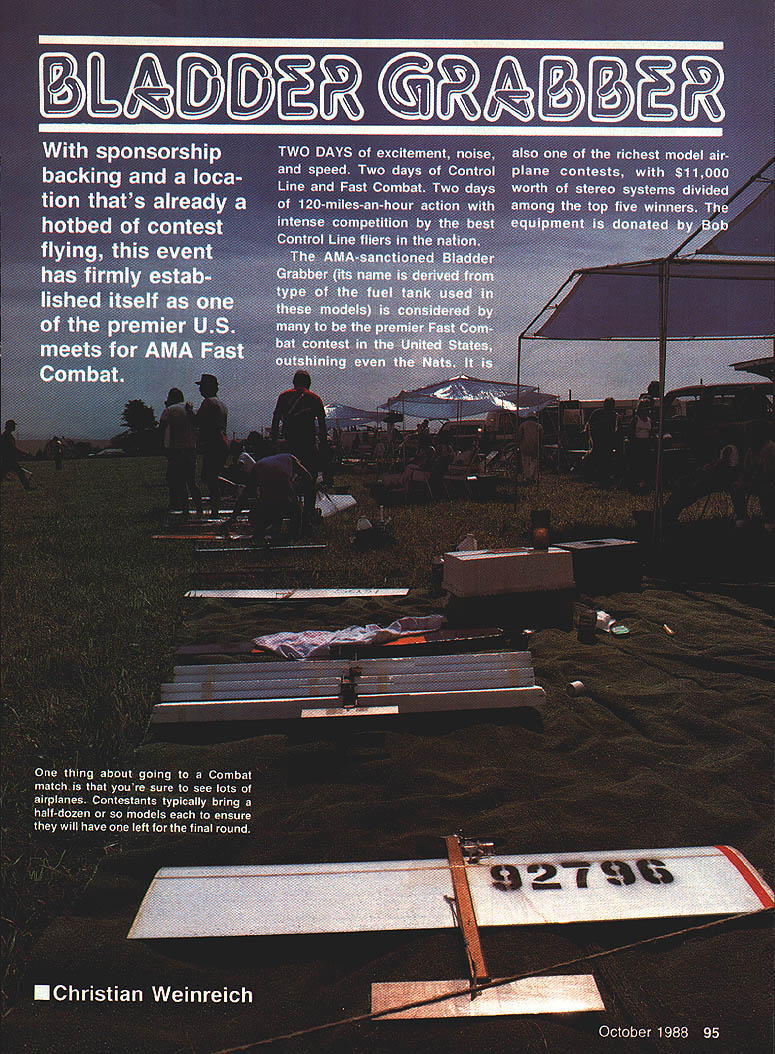
With sponsorship backing and a location that's already a hotbed of contest flying, this event has firmly established itself as one of the premier U.S. meets for AMA Fast Combat.
Overview
Two days of excitement, noise, and speed. Two days of Control Line and Fast Combat. Two days of 120‑miles‑an‑hour action with intense competition by the best Control Line fliers in the nation.
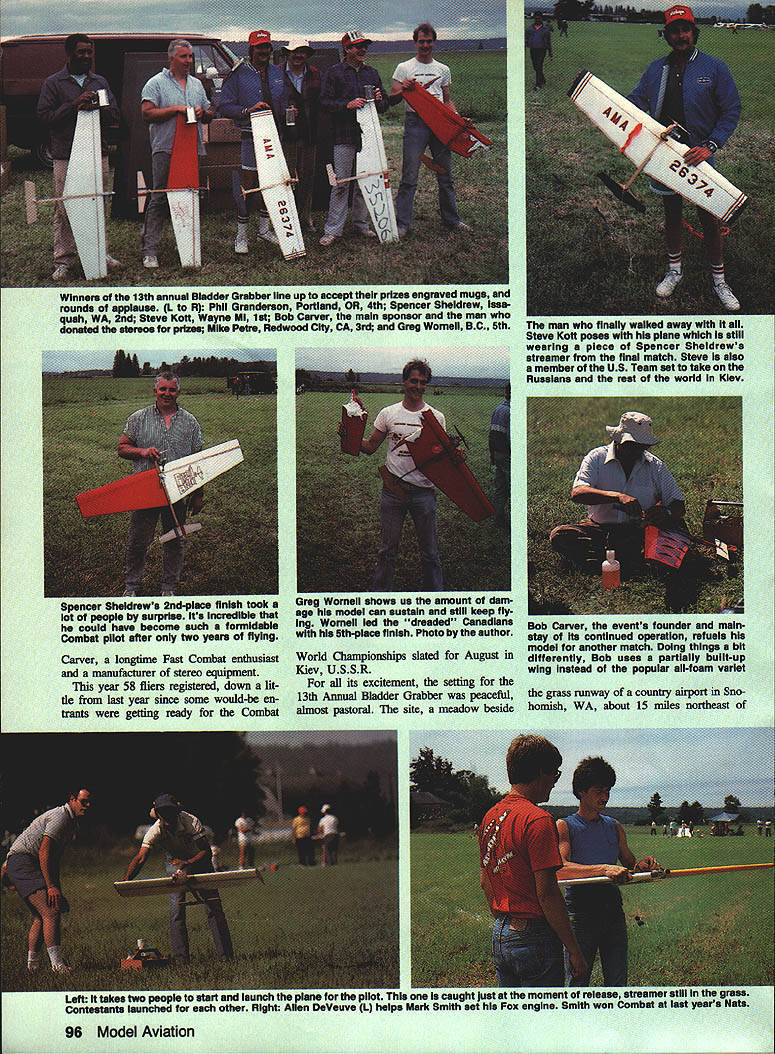
The AMA‑sanctioned Bladder Grabber (its name is derived from the type of fuel tank used in these models) is considered by many to be the premier Fast Combat contest in the United States, outshining even the Nats. It is also one of the richest model airplane contests, with $11,000 worth of stereo systems divided among the top five winners. The equipment is donated by Bob Carver, a longtime Fast Combat enthusiast and a manufacturer of stereo equipment.
This year 58 fliers registered, down a little from last year since some would‑be entrants were getting ready for the Combat World Championships slated for August in Kiev, U.S.S.R.
The site and weather
For all its excitement, the setting for the 13th Annual Bladder Grabber was peaceful, almost pastoral. The site was a meadow beside the grass runway of a country airport in Snohomish, WA, about 15 miles northeast of Seattle.
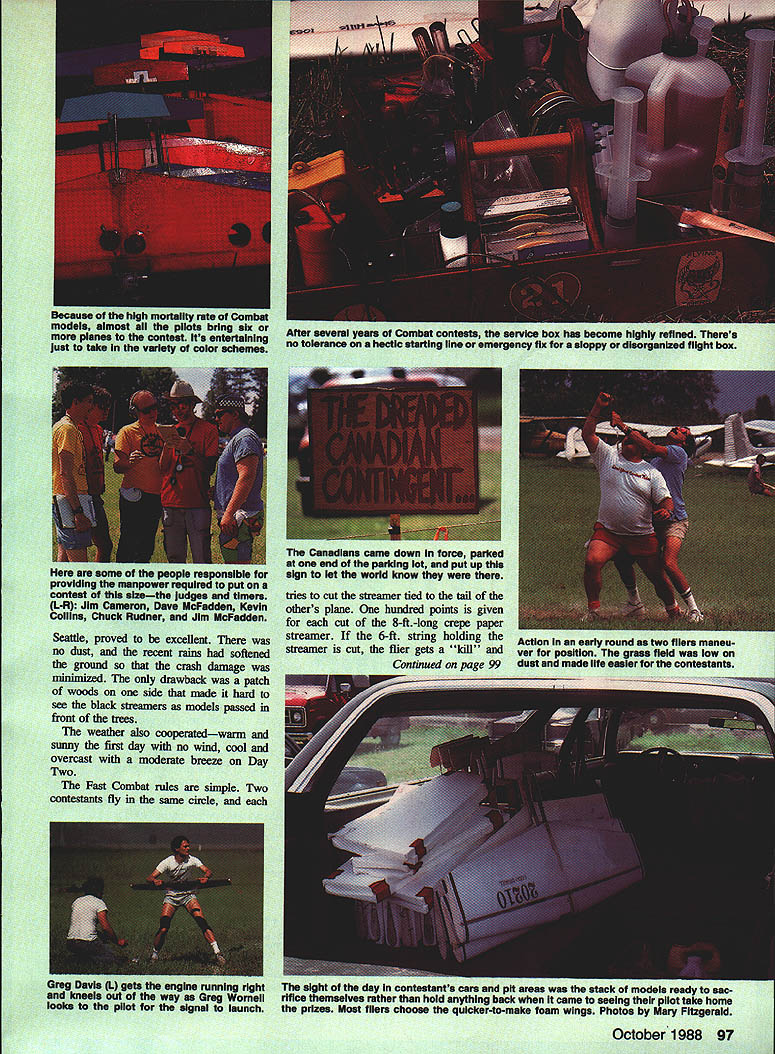
The site proved to be excellent. There was no dust, and the recent rains had softened the ground so that crash damage was minimized. The only drawback was a patch of woods on one side that made it hard to see the black streamers as models passed in front of the trees.
The weather also cooperated—warm and sunny the first day with no wind, cool and overcast with a moderate breeze on Day Two.
Rules and match action
The Fast Combat rules are simple. Two contestants fly in the same circle, and each tries to cut the streamer tied to the tail of the other's plane. One hundred points are given for each cut of the 8‑ft. crepe paper streamer. If the 6‑ft. string holding the streamer is cut, the flier gets a "kill" and the opponent's plane is considered downed.
Matches can last up to five minutes. Fliers accumulate points until the second plane is downed. However, action in the air is anything but simple. Models fly at eye‑blurring speeds on 60‑ft. lines. The sound, like enraged hornets, fills the air as planes circle, swoop, and climb, black and orange streamers flying, engines screaming as pilots maneuver for position.
Ground action is equally frantic. Fliers dance around the center circle trying to stay out of each other's way and keep lines from tangling. Midair collisions are frequent; the ear‑splitting noise stops abruptly and suddenly—whoomp—and the sky is littered with pieces of Styrofoam and balsa wood. Crashes are common, sometimes because a flier doesn't pull out of a dive in time, often because control lines get tangled. Tangled lines cause five‑ and six‑way flyaways; snapped lines mean models become free flight. Fortunately, no one was hurt and little damage was done. Because of the Styrofoam and balsa carnage, everyone brings half‑dozen models to a contest to ensure they will have something to fly in later rounds.
Competitors and results
To many people's surprise, the meet produced a very strong performance by Spencer Sheldrew of Issaquah, WA, who came second. Sheldrew first saw the Bladder Grabber two years ago and had never built or flown a model. Last year he entered for the first time; this year he led everyone into the final round competition.
He was beaten decisively in the final two matches by Steve Kott of Wayne, MI—Kott will fly in the World Championships in Kiev—who was a tour de force. Sheldrew's making the final two matches put pressure on Kott because Kott had beaten Sheldrew twice before. The Bladder Grabber is a triple‑elimination contest, which means a flier has to lose three times before being out. At one point Kott had lost twice and Sheldrew only once. If Sheldrew had won either of the two matches Kott would have suffered his third defeat and Sheldrew would have won the Bladder Grabber. Kott succeeded in turning the tables, getting a kill in the opening seconds of both rounds.
Sheldrew, far from disappointed in his overall performance, set a goal of making the second day. "Never in my wildest dreams did I think I would get this far."
Phil Gunderson of Portland, OR, who came in fourth this year and has won the contest twice before, practiced by playing video games and air hockey. He also flew his plane at night, training himself to control his model without depending solely on sight; this helps him concentrate on the opposition in a match.
Last year's Nats winner, Mark Smith (Ft. Worth, TX), found that he'd improved his models too much. "I built new planes this year, which are quicker and faster than my old ones. I was not used to them and I did not fly well," Smith ruefully explained. Though he didn't place in this year's Bladder Grabber, he's planning to return next year. There's something about Combat flying that just gets in your blood!
Bob Carver, who continues to compete despite never having won a Bladder Grabber (although this year he placed a respectable seventh), summed it up: "It's the ultimate video game. It's one flier against another; it's strategy, maneuvering, evasion, and attack. It's all the things actual fighter pilots have to do."
"I'll give Bob the last word, too," he says. "You know you've been alive after you've flown a Combat match." As a motto for Combat, that observation is hard to beat.
Practice, construction, and engines
As with competitive flying in general, the secret to success in Fast Combat is practice. Sheldrew's roommate Chuck Matheny practices about 10 hours a week. Like others, he practices with smaller, less expensive models used in Bladder Grabber. Although contest planes are very fast, 1/2A planes are not as fast; their control lines are shorter so that the reaction time required is about the same as for the bigger contest models.
Just as important as practice is the construction of the models and proper modification of the engines. Typical construction details:
- Wings: Styrofoam reinforced with balsa, carbon fiber, and fiberglass strapping tape.
- Stabilisers: Built for lightness.
- Tail booms: Built‑up or made of carbon fiber arrow shafts.
- Wingspan: About 4 ft.
- Weight: 18 to 20 oz. (about half the weight is the engine and mounts).
Like many participants, Kott designs his own planes and reworks the engines, installing brass cylinder liners, aluminum pistons, and modified crankshafts. Most of the engines in the contest started out as Fox .35s.
Technology and the sport's evolution
"Combat has come a long way in the past 20 years," Bob Carver remarked. "Comparing a Combat plane of 20 years ago to one of today is like comparing a Model T to a new Porsche." Carver, who has been flying for 25 years, explained that speeds have gone from 80 to 120 mph as engine power has risen from one‑half horsepower to two. Aerodynamics have changed, airfoil shapes are different, moments are better, and planes can turn tighter and accelerate faster.
"And as performance has improved," he reminded us, "so has the skill level of the pilots."
Final thoughts
Combat flying combines strategy, skill, and engineering—practice and careful construction reward the dedicated competitor. It is noisy, demanding, risky, and utterly addictive: one flier's description that you really have been alive after a Combat match seems an apt motto for the sport.
Transcribed from original scans by AI. Minor OCR errors may remain.

