
BOBCAT
This no-nonsense Slow Rat design is capable of winning performances for years to come. The state-of-the-art review is made to order for those who "play" with engines.
John Kilsdonk
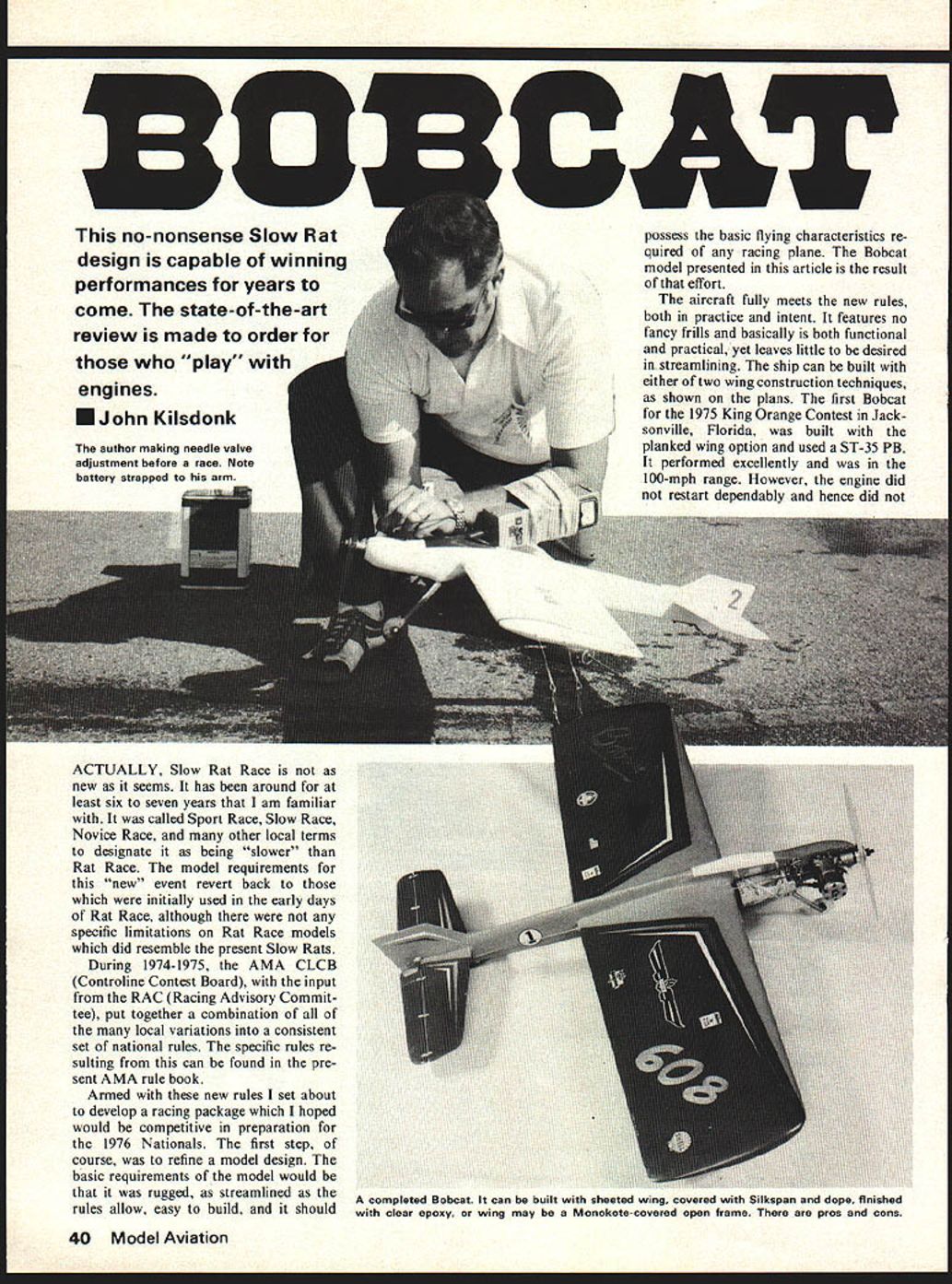
The author making needle valve adjustment before a race. Note battery strapped to his arm.
ACTUALLY, Slow Rat Race is not as new as it seems. It has been around for at least six to seven years that I am familiar with. It was called Sport Race, Slow Race, Novice Race, and many other local terms to designate it as being "slower" than Rat Race. The model requirements for this "new" event revert back to those which were initially used in the early days of Rat Race, although there were not any specific limitations on Rat Race models which did resemble the present Slow Rats.
During 1974-1975, the AMA CLCB (Controline Contest Board), with the input from the RAC (Racing Advisory Committee), put together a combination of all of the many local variations into a consistent set of national rules. The specific rules resulting from this can be found in the present AMA rule book.
Armed with these new rules I set about to develop a racing package which I hoped would be competitive in preparation for the 1976 Nationals. The first step, of course, was to refine a model design. The basic requirements of the model would be that it was rugged, as streamlined as the rules allow, easy to build, and it should possess the basic flying characteristics required of any racing plane. The Bobcat model presented in this article is the result of that effort.
The aircraft fully meets the new rules, both in practice and intent. It features no fancy frills and basically is both functional and practical, yet leaves little to be desired in streamlining. The ship can be built with either of two wing construction techniques, as shown on the plans. The first Bobcat for the 1975 King Orange Contest in Jacksonville, Florida, was built with the planked wing option and used a ST-35 PB. It performed excellently and was in the 100-mph range. However, the engine did not restart dependably and hence did not
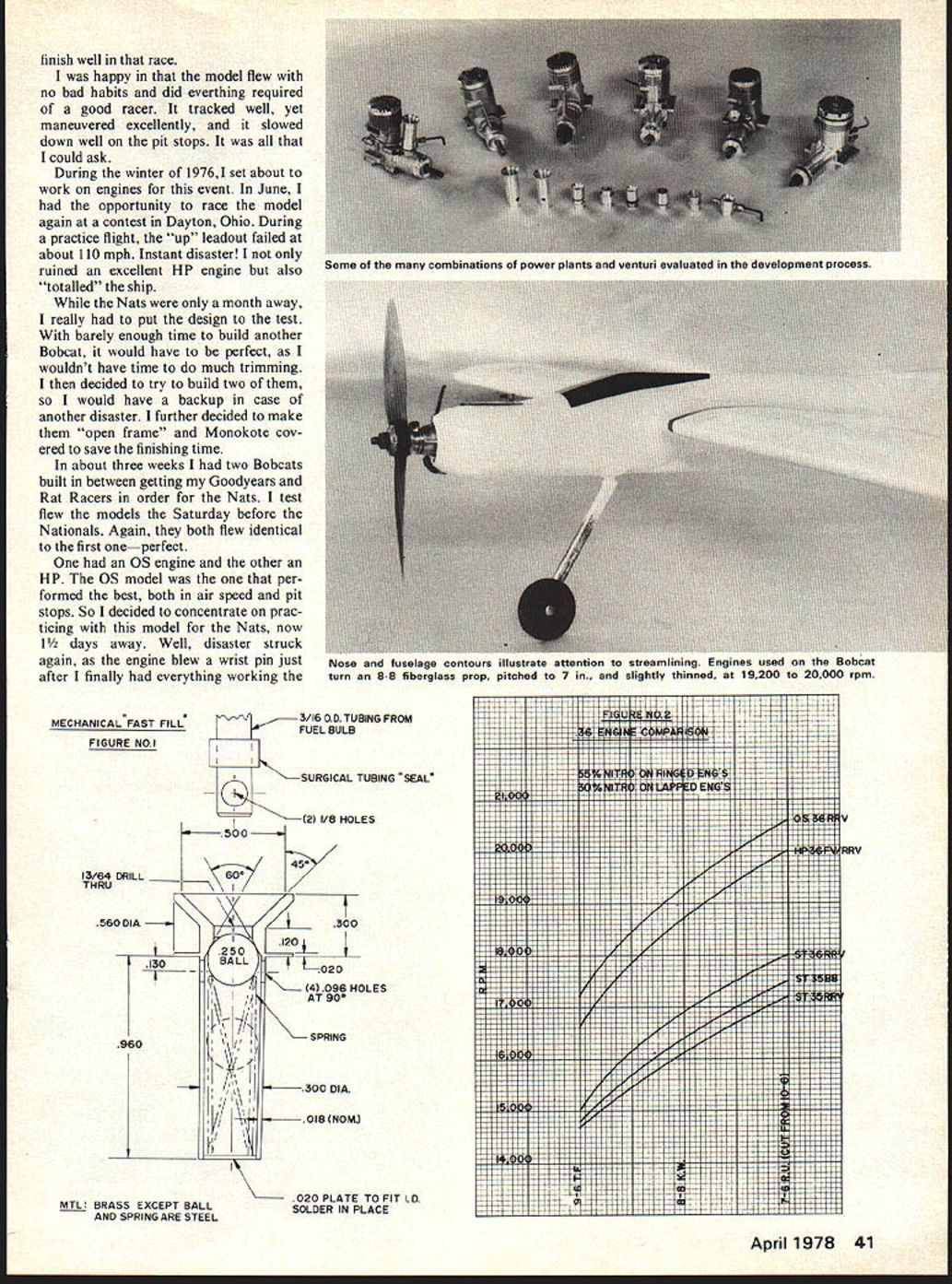
A completed Bobcat. It can be built with sheeted wing, covered with Silkspan and dope, finished with clear epoxy, or wing may be a Monokote-covered open frame. There are pros and cons. I was happy in that the model flew with no bad habits and did everything required of a good racer. It tracked well, yet maneuvered excellently, and it slowed down well on the pit stops. It was all that I could ask.
During the winter of 1976, I set about to work on engines for this event. In June, I had the opportunity to race the model again at a contest in Dayton, Ohio. During a practice flight, the "up" leadout failed at about 110 mph. Instant disaster! I not only ruined an excellent HP engine but also "totalled" the ship.
While the Nats were only a month away, I really had to put the design to the test. With barely enough time to build another Bobcat, it would have to be perfect, as I wouldn't have time to do much trimming. I then decided to try to build two of them, so I would have a backup in case of another disaster. I further decided to make them "open frame" and Monokote covered to save the finishing time.
In about three weeks I had two Bobcats built in between getting my Goodyears and Rat Racers in order for the Nats. I test flew the models the Saturday before the Nationals. Again, they both flew identical to the first one—perfect.
One had an OS engine and the other an HP. The OS model was the one that performed the best, both in air speed and pit stops. So I decided to concentrate on practicing with this model for the Nats, now 1½ days away. Well, disaster struck again, as the engine blew a wrist pin just after I finally had everything working the night. I rebuilt the engine, spent Sunday afternoon getting the broken one going right again. Monday, Nats week, Slow Rat thought ready. Now, nerves becoming frazzled, I got off really well in the first 70-lap qualifying heat. Everything was going fine until the pit stop; the pit pilot, John Ballard, brought Bobcat perfectly and hit a tool box other competitors had inadvertently left in the landing area. Disaster! The pit stop put a very large hole in the outboard wing and rendered the model unflyable. The judges conscientiously rescheduled the heat. Meanwhile, Dick Lambert and Paul Curtis helped rebuild the wing with Hot Stuff, Devcon, popsicle sticks and Fast-Cal. It turned out vain, since in the heat finally re-run I missed the needle setting and finished ninth place in qualifying. Only the top eight advanced to the finals. After three unpredictable disasters I definitely considered giving up Slow Rat. However, perseverance paid off. However, my perseverance paid off and at the Michigan Exchange Club's Annual State Meet Contest I finally got it all together and placed first with a time of 6:14, and that was with three pit stops as I ran out of fuel with two laps to go. The OS was really running well as it was clocked consistently at 14.8-15.0 secs (120 mph). Incidentally, Dave Admasin placed second in that contest with an HP-powered Bobcat with a 6:20 time. At this point, I was very gratified as almost one solid year of model and engine development finally paid off.
OK, let's get down to building the model. First, you must decide which wing construction you will use. Both are shown on the plans. After building Bobcats both ways, I must say that there are only slight advantages to either. The fully sheeted wing takes longer to finish, and is about one ounce heavier using Silkspan and dope, covered with clear epoxy. However, it is marginally more durable. If you're in a hurry or don't like to paint, go with the open-frame construction and Monokote. Remember, you will still have to paint the fuselage, stab and rudder, and the wing is signed with a no-nonsense airfoil that, when sheeted, meets the one-inch wing thickness rule. You need two of each rib, except for No. 1. Glue the ribs to the 1/8 x 3/16 bottom spar and the leading edge. Any of the new cyanoacrylates (Hot-Stuff, Zap, etc.) are recommended for the entire wing construction. If you are building the open-frame construction, glue on the trailing edge sheeting, followed by the L.E., center section, and the rib cap strips.
The fully sheeted wing is completely sheeted on the bottom side, the bellcrank is installed along with the wing tip skid mounts and the blind nuts, and then the entire top is sheeted. Don't forget to install the pushrod(s) before installing the center top section of the sheeting.
The wing tips can be made from either 1/8" balsa or a double thickness of scrap 1/8" balsa left over from the fuselage plank. The tips are carved and hollowed out as shown. Glue them on with Titebond or epoxy. No wing tip weight is required. Finish sand all sheeted surfaces with 150-220 grit garnet paper, and the wing is done.
The fuselage, stab, and rudder are very straightforward. If you use the tank recessed in the fuselage as shown, install the outboard plywood doubler first, then cut out the slot for the tank. Then install the inboard doubler, and the landing gear. I use blind nuts on the engine mount and fuel shut-off mount, and coat-hanger wire with rubberbands for the fuel tank hold-down. I also prefer the hardwood tail skid mount and blind nuts as shown on the plans. After all of this is completed, the fuselage is glued on the wing, using either Titebond or epoxy, making sure that the fuselage is in the exact center of the wing and perpendicular to the L.E.
The cheek cowl, rudder, and stabilizer are glued in place, again with either Titebond or epoxy. Make sure that the tail surfaces are parallel and square as required.
I use 1/4 oz. fiberglass cloth around the cheek cowl and K&B surfacing resin on all surfaces to be painted, followed by a coat or two of Hobbypoxy color. The open areas then are covered with Monokote or Solarfilm. The fully sheeted wing uses the same techniques; however, it is heavier than the "old-fashioned" method of dope and Silkspan, clear dope and talcum powder, followed by colored dope and one coat of clear epoxy.
The fuel shut off shown is similar to those used on my Goodyears, and can be fabricated easily from 3/8" aluminum plate. If you are lazy or in a hurry, a commercial (W-K or Kustom Kraft) can be substituted. The plans show a "pusher" type shutoff, which is what I prefer, because there are no solder joints; however, a "puller" type may be used, as used on the two models I built quickly for the Nats. Whichever method you prefer, it should be actuated only at full down elevator.
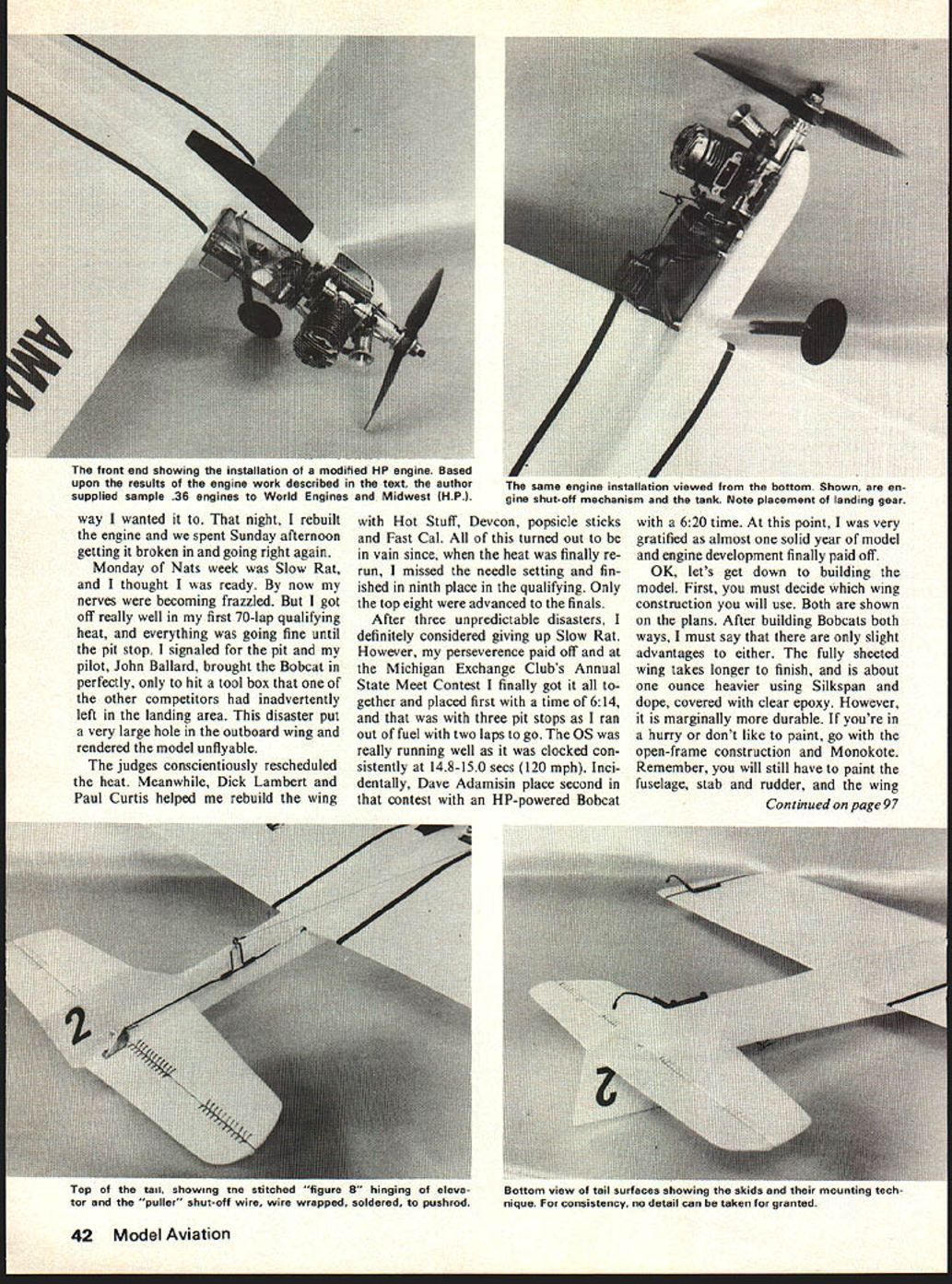
The Bobcat was designed around the 3-oz. old Veco T-21C tank, which is now manufactured by Fox. The tank is modified for either a Don's fast-fill or, if you use a "Uniflow" vent arrangement like I do, you will have to fabricate a mechanical fast-fill from brass bar stock, as shown on Fig. No. 1. The mechanical type provides a positive seal irrespective of tank pressure. The uniflow tank has been described many times, especially in Stunt columns, so I will not go into it here. However, it is far superior to conventional assemblies in engine consistency throughout the flight.
One of the problems we encountered with the event was the restart on pit stops, due to fuel starvation in the engine because pressurization is not allowed. A prime in either the exhaust or intake would work, but proved to be inconsistent and time consuming. To overcome this, we developed the fueling system shown. By sliding a piece of surgical tubing over the fuel fill pipe on the fuel bulb to act as a seal, when the bulb is pushed down into the mechanical fast-fill, all of the escapes, either through the single tank vent or the line, therefore escapes through the same lines. Since the fuel is being pushed through a 5/32 ID pipe in the bulb, it cannot all be vented through a 3/32" ID (1/8" OD) overflow line (tank vent), and hence, some must go through the fuel supply line to the engine. With a little practice you will develop a "touch" to know how hard to squeeze the bulb during this period to deliver the proper prime to the engine. It probably sounds complicated but it really isn't, and it does work dependably.
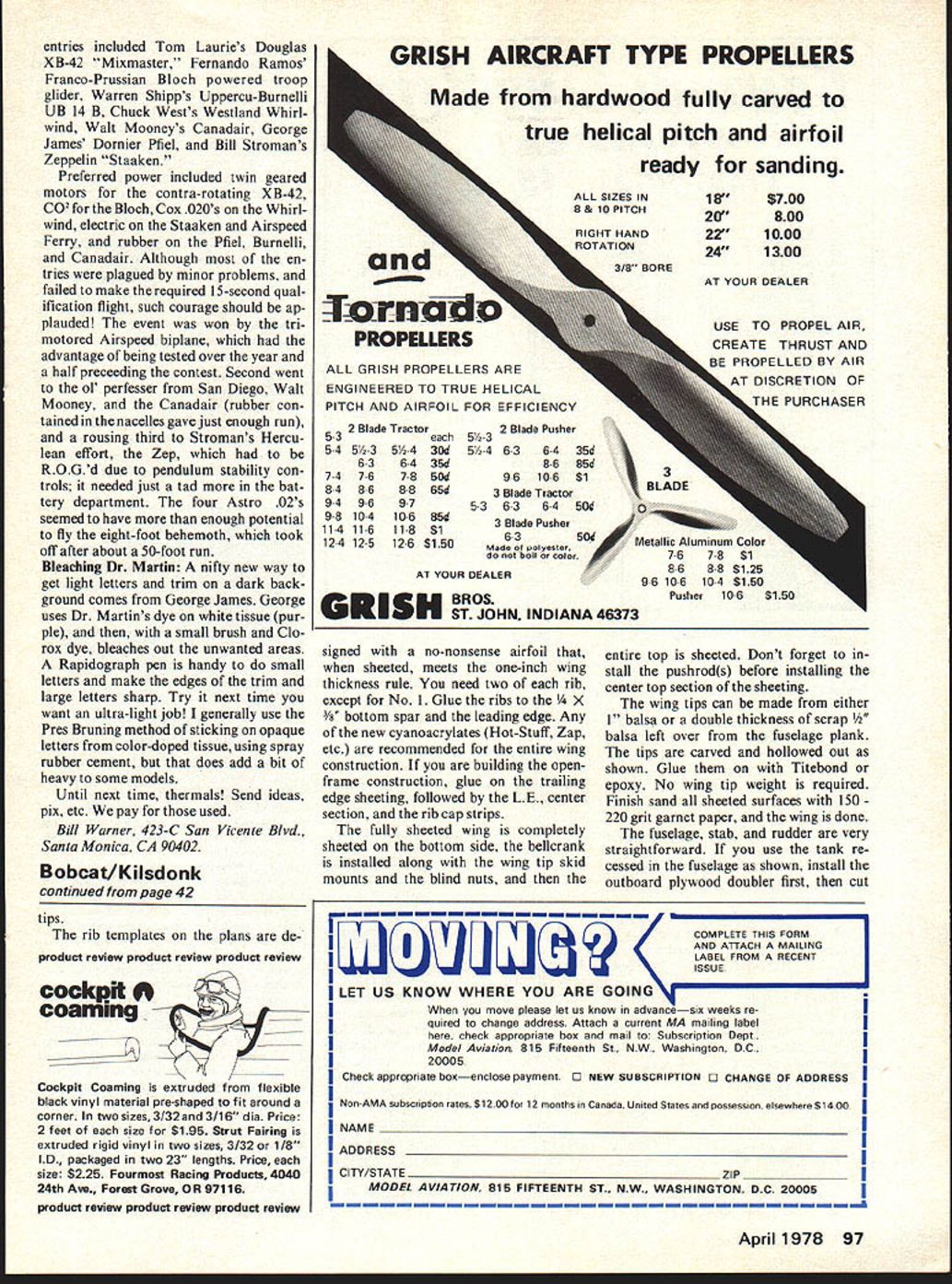
The most complicated part of the Slow Rat project was the engine. We had tried most of the existing 35's and 36's in the course of flying and observing the many midwestern Sport Race events over the past years. Also, with our experiences in both Rat Race and Goodyear, it was obvious that we needed a .36 displacement engine that incorporated a ringed piston (for restarts), ball bearings (for durability), and Schnuerle porting (for maximum power). Obviously, nothing was commercially available at the time, so we had to develop something on our own.
The first approach was to use a basic Super Tiger G-21-40 RRV engine that we had used with much success 9-10 years ago in Rat Race. While it wasn't Schnuerle ported, it did have the other two requirements. Whatever engine you use either now or in the future, I think that you will find the Bobcat to be a very efficient no-nonsense model capable of winning performances for years to come.
The Bobcat model presented in this article is the result of that effort. The aircraft fully meets the new rules and, both in practice and intent, has features with no fancy frills. Basically both functional and practical, yet leaves little desired in streamlining. The ship can be built either way — two wing construction techniques are shown on the plans. The first Bobcat, flown at the 1975 King Orange Contest, Jacksonville, Florida, was built with the planked wing option and used an OS-35 PB. It performed excellently in the 100-mph range. However, the engine did not restart dependably and hence did not complete.
The Bobcat can be built with a sheeted wing covered with Silkspan and doped, or finished clear with epoxy; the wing may also be Monokote-covered open frame. Pros and cons of each: sheeted, doped wings finish well for racing; Monokote covering saves finishing time. The race-ready model flew with no bad habits, did everything required of a good racer, tracked well yet maneuvered excellently and slowed down well for pit stops — everything you could ask.
During the winter of 1976 I set about getting the engines ready for the event in June. At the opportunity to race the model again at a contest in Dayton, Ohio, during a practice flight the up leadout failed at about 110 mph. Instant disaster — it ruined an excellent HP engine and also totaled the ship. With the Nats a month away, this really put the design to the test. There was barely enough time to build another Bobcat that would be perfect; I wouldn't have time for much trimming. I decided to try to build two so I would have a backup in case of another disaster. Further, I decided to make them open-frame Monokote covered to save finishing time. In about three weeks two Bobcats were built between getting Goodyears and Rat Racers ordered. The Nats test-flew the models Saturday before Nationals. Again both flew identically; the first one was perfect on an OS engine, the other on HP. The OS model performed best in both airspeed and pit stops. So I decided to concentrate practicing with that model. The Nats were now 1½ days away.
Well, disaster struck again. An engine blew a wrist pin just after finally everything was working. One night I rebuilt the engine, spent Sunday afternoon getting the broken one going right again, and Monday — Nats week — Slow Rat thought ready. Now nerves were becoming frazzled. I got off really well in the first 70-lap qualifying heat; everything was going fine until the pit stop was signaled. Pit pilot John Ballard brought the Bobcat in perfectly but hit a tool box another competitor had inadvertently left in the landing area. Disaster — it put a very large hole in the outboard wing and rendered the model unflyable. The judges conscientiously rescheduled the heat. Meanwhile Dick Lambert and Paul Curtis helped rebuild the wing. Hot Stuff Devcon and popsicle sticks and Fast Cal turned out vain since when the heat was finally re-run I had missed needle setting and finished ninth place in qualifying. Only the top eight advanced to the finals.
After three unpredictable disasters I definitely considered giving up Slow Rat. However, perseverance paid off.
Transcribed from original scans by AI. Minor OCR errors may remain.

