
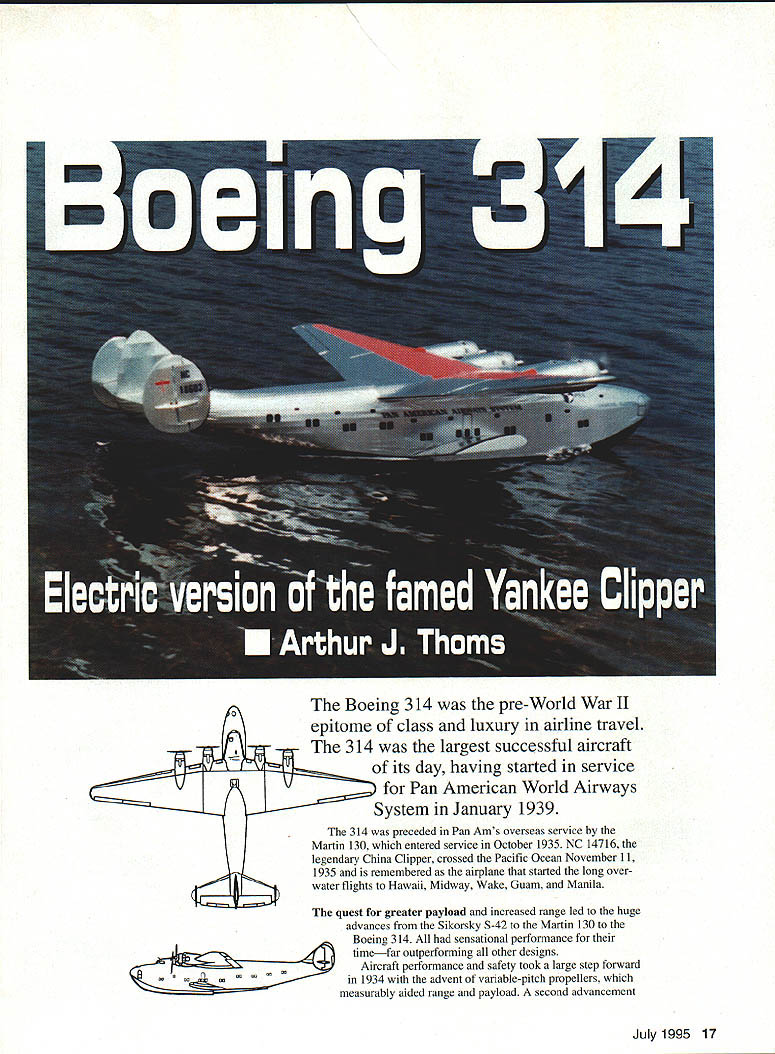
Boeing 314
Electric version of the famed Yankee Clipper
Arthur J. Thoms
The Boeing 314 was the pre–World War II epitome of class and luxury in airline travel. It was the largest successful aircraft of its day, entering service with Pan American World Airways in January 1939. The 314 was preceded in Pan Am's overseas service by the Martin M-130, which entered service in October 1935. NC 14716, the legendary China Clipper, crossed the Pacific on November 11, 1935, and is remembered as the airplane that inaugurated long over-water flights to Hawaii, Midway, Wake, Guam, and Manila.
The quest for greater payload and increased range led to major advances from the Sikorsky S-42 to the Martin M-130 to the Boeing 314. All had sensational performance for their time—far outperforming most other designs. Aircraft performance and safety took a large step forward in 1934 with the advent of variable-pitch propellers, which measurably aided range and payload. A second advancement was the ability to feather propellers, reducing drag from a malfunctioning engine.
Charles Lindbergh was on the Pan Am payroll as a technical consultant. He test-flew routes and assisted in the design and testing of new aircraft for Pan Am. In company with Juan Trippe (Pan Am's founder) and chief engineer and operations manager Andre Priester, they decided in 1931 on the types of aircraft needed for the most daring routes: westward flights to the Orient over the Pacific. As Priester remarked, "a seaplane carries its airport on its hull."
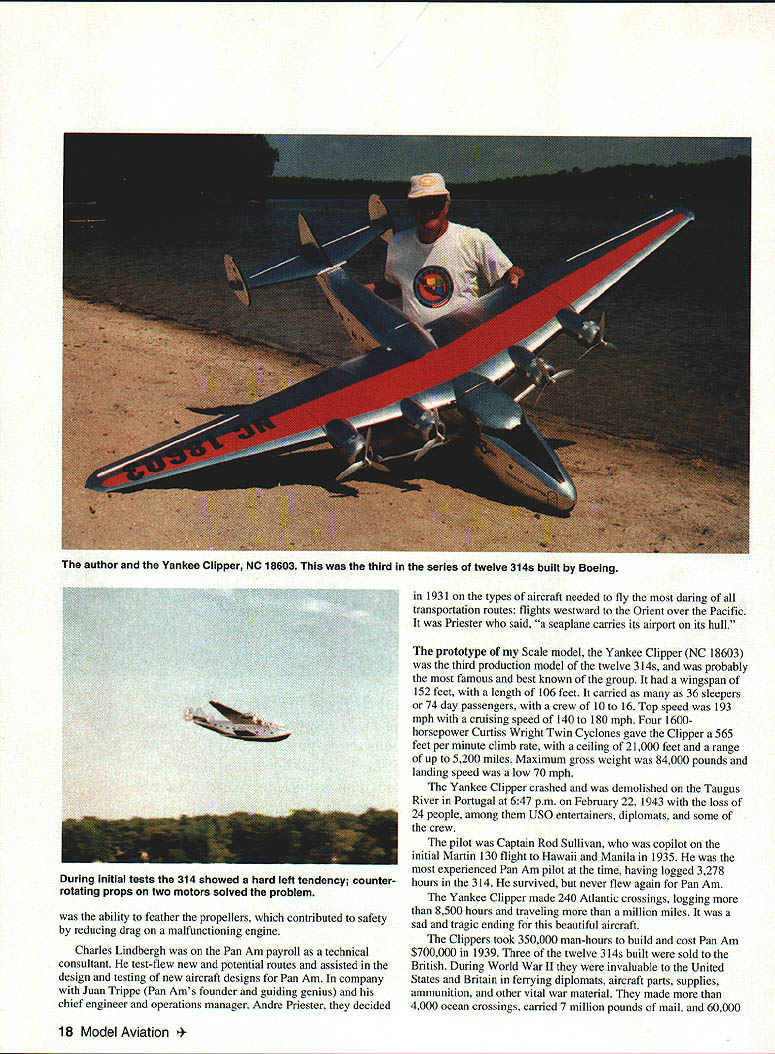
The full-size Yankee Clipper (NC 18603) was the third production example of twelve Boeing 314s and was probably the most famous of the group. Specifications and performance for the full-size 314:
- Wingspan: 152 ft
- Length: 106 ft
- Capacity: up to 36 sleepers or 74 day passengers; crew 10–16
- Top speed: 193 mph; cruising speed 140–180 mph
- Power: four 1,600-hp Curtiss-Wright Twin Cyclone engines
- Climb rate: 565 ft/min; service ceiling ~21,000 ft
- Range: up to 5,200 miles
- Maximum gross weight: 84,000 lb
- Landing speed: about 70 mph
The Yankee Clipper crashed and was demolished on the Tagus River in Portugal at 6:47 p.m. on February 22, 1943, with the loss of 24 people, among them USO entertainers, diplomats, and some crew. The pilot, Captain Rod Sullivan, a veteran Pan Am pilot, survived but never flew again for Pan Am. The Yankee Clipper had logged 240 Atlantic crossings, more than 8,500 hours, and over a million miles prior to its loss — a sad ending for a beautiful aircraft.
The Clippers took about 350,000 man-hours each to build and cost Pan Am approximately $700,000 apiece in 1939. Three of the twelve were sold to the British. During World War II they were invaluable in ferrying diplomats, aircraft parts, supplies, ammunition, and other vital war material. Collectively they made more than 4,000 ocean crossings, carried some 7 million pounds of mail and about 60,000 passengers. None was lost to enemy action. The 314s used by the U.S. government during the war were crewed by Pan Am personnel. Sadly, none survive today.
The scale model
Overview
The prototype of my scale model of the Yankee Clipper (NC 18603) was built primarily to fly rather than be a static display or competitive scale model. It was my first scratch-built effort, although I had built many kit models previously. Construction drew from three-view drawings and about 700 "happy hobby hours."
Model scale and dimensions:
- Scale: 3/4 in = 1 ft (1/16 scale)
- Wingspan: 114 in
- Wing area: 112 sq ft
- All-up flying weight: 14.4 to 15.64 lb (depending on batteries)
- Wing loading: ~22 oz/ft²
Construction and materials
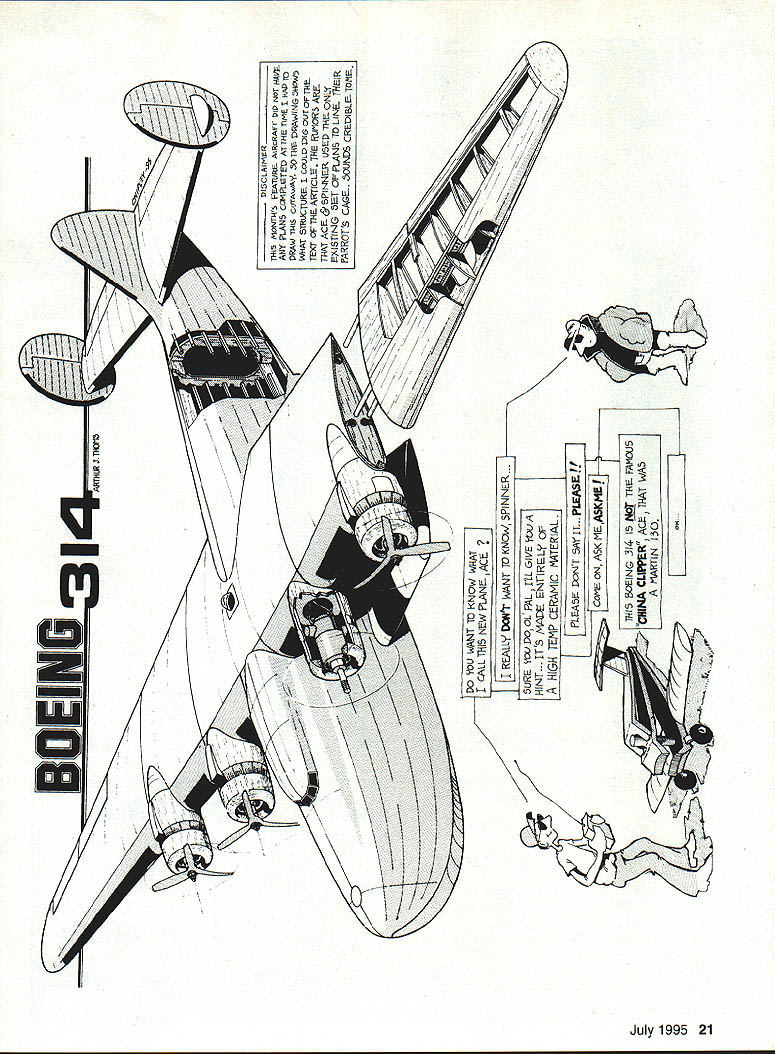
The model is built primarily of balsa, with plywood used for the battery box, dihedral braces, motor bulkheads, and a few other small pieces.
- Adhesives: mainly cyanoacrylate (CyA) and aliphatic-resin glue, with very sparing use of epoxy. No foam was used.
- Spars and webs: medium-hard balsa upper and lower spars with 3/32" shear webs, tapering to 1/16" shear webs toward the outboard wing.
- Center wing: conventional aircraft plywood dihedral braces and 1/16" sheeting from the leading edge to the front main spar, forming a D-tube for a smooth leading edge and added strength.
- Ribs: all ribs except the center-section ribs are 1/16" C-grain balsa with 1/16" x 1/4" capstrips. The root rib is 22" long, tapering to 6" at the tip.
- Wingtips: laminated from four layers of 1/16" balsa around a plywood form — lighter and stronger than sheet tips. Fin and rudder outlines are also laminated from 1/16" balsa.
- Fuselage: built by the crutch method (formers mounted on upper and lower keel strips). One side was sheeted with 1/16" balsa, then the other; top decking is 1/8" balsa. A molded canopy was vacuformed from Lexan with a built-up deck for the windshield. After completing one fuselage half, the structure was removed from the plan and the other former halves added. The outer surface is finished with 1/16" sheet at the front and 1/8" square stringers at the rear.
- Hull and sea wings (sponsons): bottom planked with 1/8" balsa strips and finished with lightweight glass cloth and Z-Poxy resin, then painted black. Cowls were fabricated over a balsa form using fiberglass cloth and Z-Poxy resin.
- Covering and graphics: silver Micafilm covering; realistic graphics by Sign Works of Wharton, New Jersey.
Airfoil and control surfaces
- Airfoil: NACA 2412 (not scale) chosen to improve slow-speed lift and stall characteristics compared to the prototype's symmetrical section.
- Control surfaces: scale sizes used for elevators, ailerons, and rudders; proved adequate in flight.
Wing assembly and transport
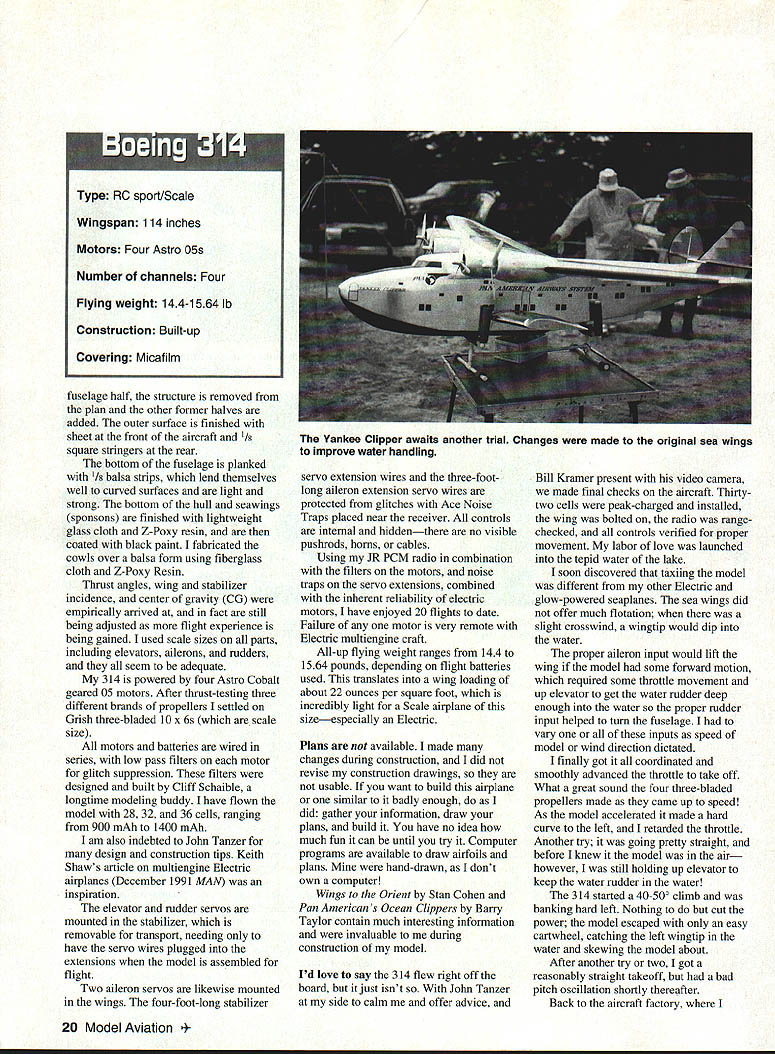
- The wing separates into three pieces: a center section (just under 4 ft) housing the four motors and wiring, and two outer panels (just under 3 ft each).
- Outer panels attach to the center section with Gator RC aluminum and phenolic tubing.
- Each outer wing section carries its aileron servos with extension plugs for easy assembly.
- The stabilizer is removable for transport; elevator and rudder servos are mounted in the stabilizer.
Power and electronics
- Motors: four Astro Cobalt geared 05 motors.
- Propellers: three-bladed 10 x 6s (scale size).
- Batteries: flown with 28, 32, and 36 cells; capacities 900–1,400 mAh.
- Wiring and filters: all motors and batteries are wired in series, with low-pass filters on each motor for glitch suppression (filters designed and built by Cliff Schaible). Ace Noise Traps protect long servo extension runs near the receiver.
- Radio: JR PCM transmitter; noise traps on servo extensions and motor filters helped achieve reliable flights.
Servos, controls, and protection
- Elevator and rudder servos mounted in the stabilizer (removable for transport).
- Two aileron servos mounted in the wings.
- Servo extension wires: stabilizer extensions ~4 ft; aileron extensions ~3 ft. Noise traps placed near the receiver protect against interference.
- All controls are internal and hidden—no visible pushrods, horns, or cables.
Flight testing and handling
Initial flights were challenging and required several adjustments:
- Taxiing: sea wings provided limited flotation; in slight crosswinds a wingtip would dip into the water. Proper coordination of aileron, throttle, and up elevator (to get the water rudder deep enough) was required.
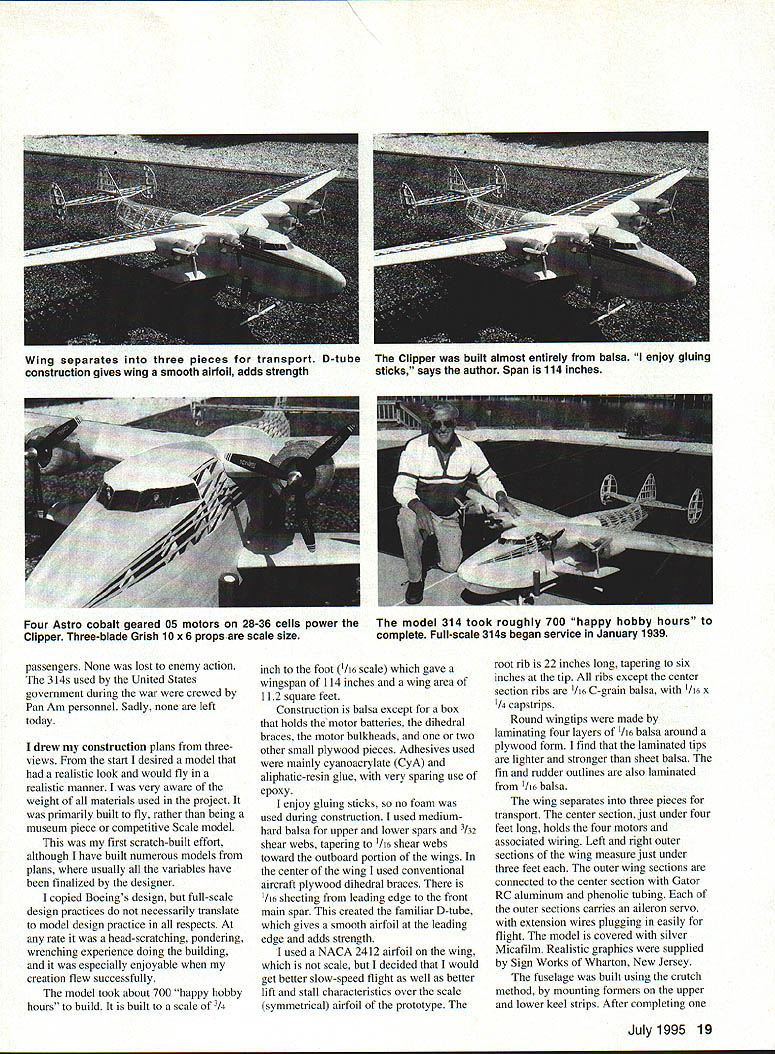
- Takeoff behavior: early flights showed a left-turning tendency and pitch oscillations. Lateral balance, control throws, and exponential on the elevator were adjusted. The center of gravity was set at 25% of the mean aerodynamic chord (MAC) initially and retained while making incremental changes.
- Torque/P-factor solution: the model had a persistent left-turning tendency at liftoff. To counteract this, I reversed rotation on the outer motors to create counter-rotating propellers (outer motors reversed, inner pair left as tractor). This reduced the strong turning tendency without complex rigging.
- Thrust angle: added about 1/4" of up thrust to the motors to prevent the nose from dropping when power was applied; this cured the nose-drop problem.
- Handling: with the counter-rotating setup and further trim adjustments the 314 became much more manageable. It is not fully hands-off, but small changes continued to improve handling. Several smooth water landings were achieved.
Crosswind water handling remains a challenge. Pan Am and Boeing tried various fixes to the sea wings on the full-scale design with mixed results. Sea wings (sponsons) were used rather than tip floats because they produced lift, accommodated fuel, reduced drag at the wing tips, and aided passenger access. I made some changes to the model's sea wings to improve water handling and continue to refine them.
Performance and durability
- Flights to date: about 20 recorded flights with the electric setup.
- Reliability: electric multiengine propulsion and the installed filters make failure of any single motor very unlikely.
- All-up weight and wing loading listed above make this an exceptionally light scale airplane for its size and for an electric multiengine craft.
Plans and resources
- Plans are not available; many changes were made during construction and drawings were not revised. If you want to build a similar airplane, gather three-views, draw your own plans, and adapt as you go. Computer programs exist to draw airfoils and plans; my drawings were hand-drawn.
- Useful references: Wings to the Orient by Stan Cohen and Pan American's Ocean Clippers by Barry Taylor provided invaluable information during construction.
Acknowledgments
I am indebted to many friends and colleagues:
- Charles Lindbergh, Juan Trippe, and Andre Priester (historical context and inspiration)
- Cliff Schaible (motor glitch-suppression filters)
- John Tanzer (design and construction tips)
- Keith Shaw (inspiration from his article on multiengine electric airplanes, Model Aviation, Dec. 1991)
- Bill Kramer (flight video)
- Bob Scarsdale and Hank Anholzer (advice on sea-wing handling)
- My wife, for encouragement and help.
It's been a great pleasure building and flying this model. I believe the Boeing 314 is the most beautiful flying boat ever to take to the air, and building a scale electric version has been immensely satisfying.
Contact
If you are serious about building a model of the 314 and wish to correspond, please write to me and enclose a stamped, self-addressed envelope (SASE).
Art Thoms 33 Cambridge Dr. Berkeley Heights, NJ 07922
Transcribed from original scans by AI. Minor OCR errors may remain.

