
Born to Fly
Jim T. Graham | BillyH@RCSpotlight.com
Get ready to meet MA's new 3-D aerobatics columnist
Airplanes and the Backwoods
My name is Jim T. Graham. You might also know me as "Billy H." I'm going to tell you the story of how I became addicted to RC.
I grew up in the backwoods of northern Texas on a 30-acre exotic-animal ranch in the middle of nowhere. In the summer my mornings were spent feeding and taking care of the animals and my afternoons were spent with my grandpa.
How does this apply to RC, you may wonder? My grandpa and I spent a lot of time around airplanes. He would take me to my uncle's ranch that had a hangar and two or three airplanes in it at any given time. He also took me to every air show that came near our area.
I can still remember the first airplane that really got my attention, at the tender age of six: it was a red biplane. (I didn't know it then, but it was a Pitts S-2B.) After that, I was hooked.
Our ranch was just a few miles away from Paron Air Force Base. It had been closed in the 1960s, but once a year there was an aerobatic fly-in there. The airplanes would start to show up a week before the event, and every day that week I would lie on my back in the pasture for hours and watch the different aircraft go up and practice their routines. Then my grandpa would take me to the show. Can you imagine being able to do that as a kid? It almost seems too cool to be real.
My dad had a friend who was a local test pilot, and whenever possible he would take me up with him and let me fly. I was lucky enough to be able to do all these things until I was a teenager, but then the fateful day arrived: I had a truck of my own, a driver's license, and girls on the mind. The airplane part of my life started to fall away.
The Rock-Star Period
While in college at Baylor University in Waco, Texas, I would ride my motorcycle to an RC field by the lake and watch the guys fly for hours. Having my own RC model didn't seem like a reality at the time, so I was content to ride up and watch the show.
Somehow I landed in Los Angeles in the early 1990s as a special-effects person on music videos and movies. I was fortunate enough to work with such people as Bruce Springsteen, Neil Young, Madonna, and Mötley Crüe.
RC touched my life once again when I worked on a remote-control microphone stand for a rap video. The artist would rap and then the microphone would drive away. I also did many shows that involved RC helicopters with cameras. It just seemed too far out of my reach to ever do anything like that.
The great part about LA was that I had long hair, a chopper, and worked with rock bands, blowing things up for a living. The downside was that I was in the LA riots, a home invasion, the Malibu forest fires, an attempted robbery by an escaped convict, the Malibu mudslides, and the Northridge earthquake. I decided it was time for some new scenery.
A $5 Airplane
The video world finally took me to Nashville, Tennessee. I was an art director for music videos and ultimately ran a record label. I had a big 1976 Eldorado Cadillac and cool songwriting friends.
My wife and I had a baby on the way, and we had just purchased a new house—and then the bottom fell out. When the dot-com bomb hit, my investors got scared and pulled all their money.
Let's recap: I have no job, a new house, and a baby on the way. Can you feel the stress from where you're sitting?
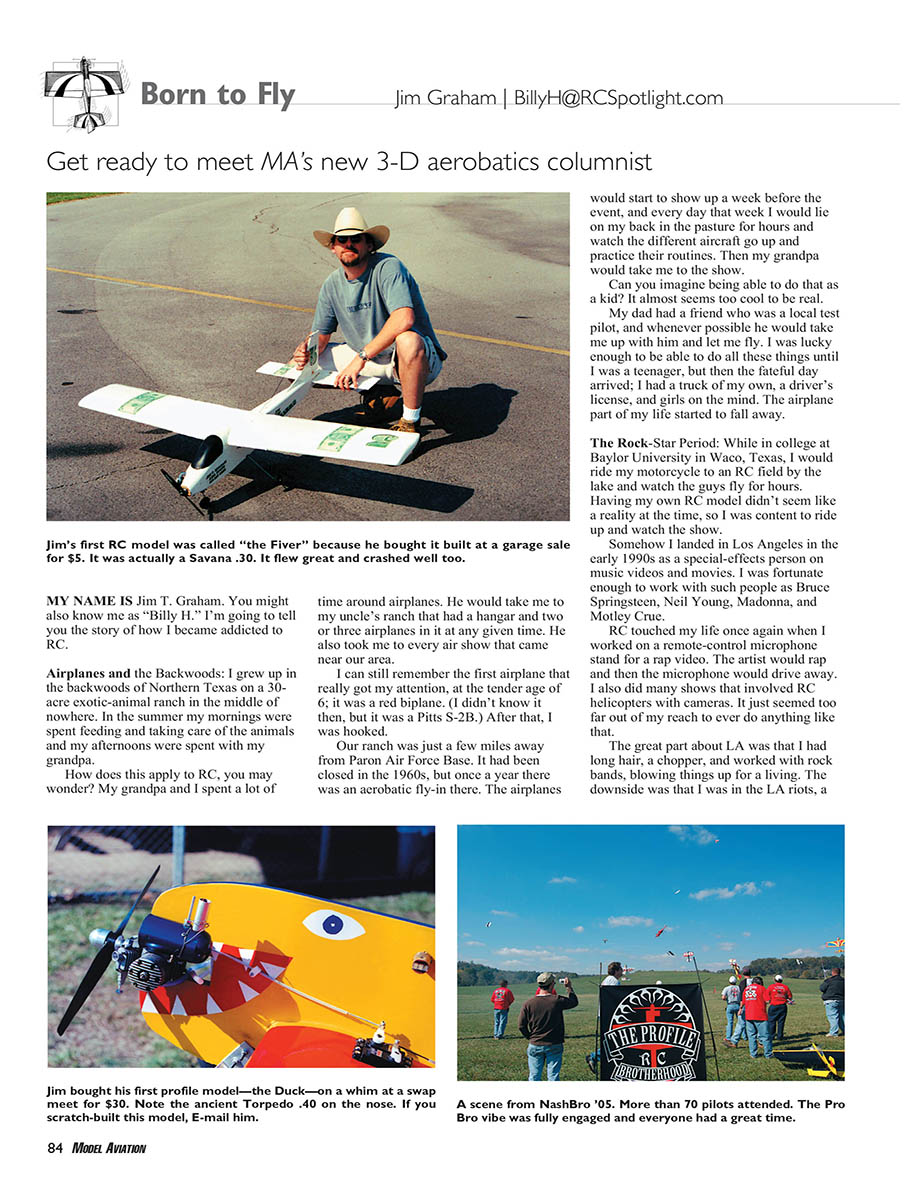
One day my wife and I walked across the street to a garage sale. There sat a white, low-wing airplane of some sort with a 48-inch wingspan. I didn't even realize it was an RC model, but with a $5 price tag I knew I had to have it. I took it home, and that night my father-in-law informed me that it was a Savana .30 and he was going to help me get it into the air.
I also found out that there was an AMA field and club only two miles away from my house. With the help of Charlie Funk and the Edwin Warner Modelers, my airplane was ready to fly.
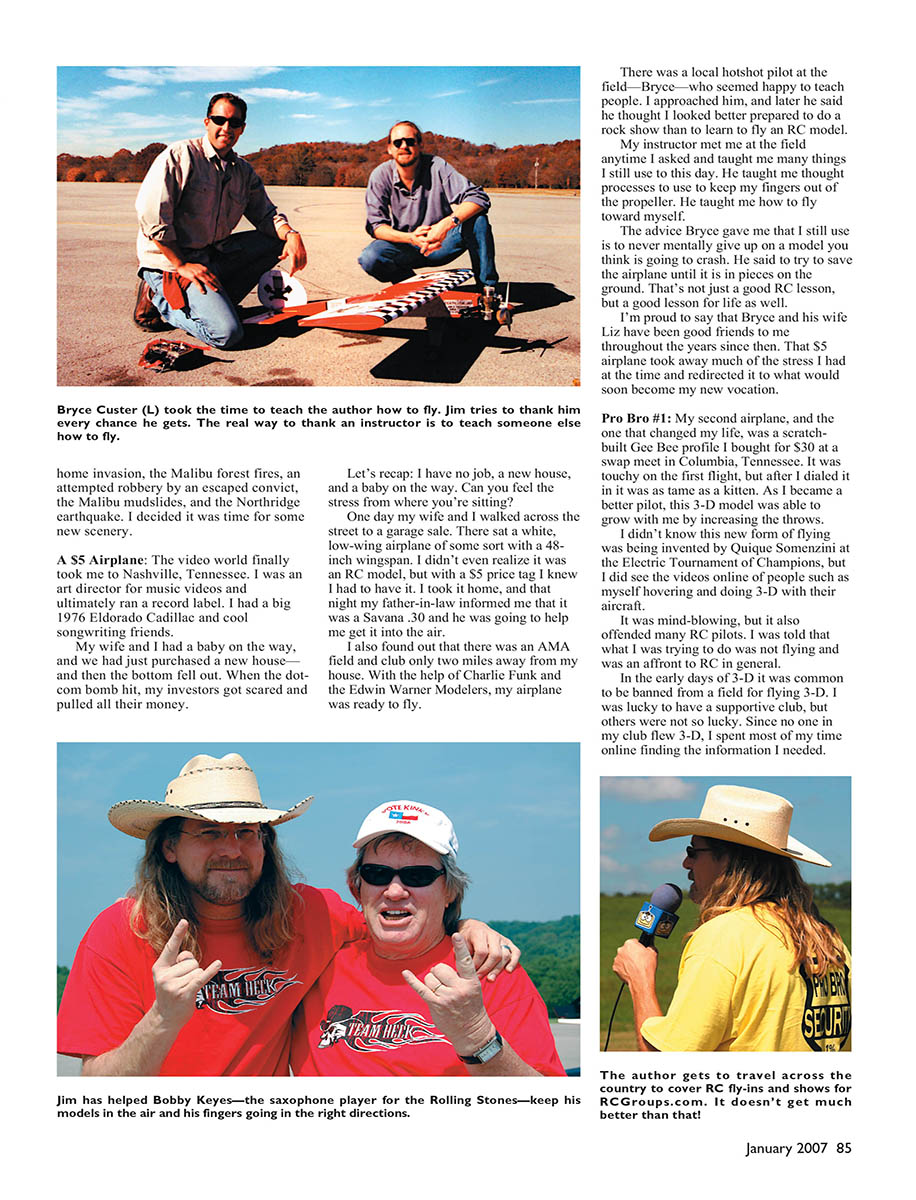
There was a local hotshot pilot at the field—Bryce—who seemed happy to teach people. I approached him, and later he said he thought I looked better prepared to do a rock show than to learn to fly an RC model.
My instructor met me at the field anytime I asked and taught me many things I still use to this day. He taught me thought processes to use to keep my fingers out of the propeller. He taught me how to fly toward myself.
The advice Bryce gave me that I still use is to never mentally give up on a model you think is going to crash. He said to try to save the airplane until it is in pieces on the ground. That's not just a good RC lesson, but a good lesson for life as well.
I'm proud to say that Bryce and his wife Liz have been good friends to me throughout the years since then. That $5 airplane took away much of the stress I had at the time and redirected it to what would soon become my new vocation.
Pro Bro #1
My second airplane, and the one that changed my life, was a scratchbuilt Gee Bee profile I bought for $30 at a swap meet in Columbia, Tennessee. It was touchy on the first flight, but after I dialed it in it was as tame as a kitten. As I became a better pilot, this 3-D model was able to grow with me by increasing the throws.
I didn't know this new form of flying was being invented by Quique Somenzini at the Electric Tournament of Champions, but I did see the videos online of people such as myself hovering and doing 3-D with their aircraft.
It was mind-blowing, but it also offended many RC pilots. I was told that what I was trying to do was not flying and was an affront to RC in general.
In the early days of 3-D it was common to be banned from a field for flying 3-D. I was lucky to have a supportive club, but others were not so lucky. Since no one in my club flew 3-D, I spent most of my time online finding the information I needed.
Who Is "Billy H."?
One of the things my grandpa would say is, "My brother and I raised 'Billy H.' in Callisburg, Texas." I always liked the term and wanted to use it, so when I went online in the RC forums I used that as my nickname. Now 80% of my RC friends call me Billy.
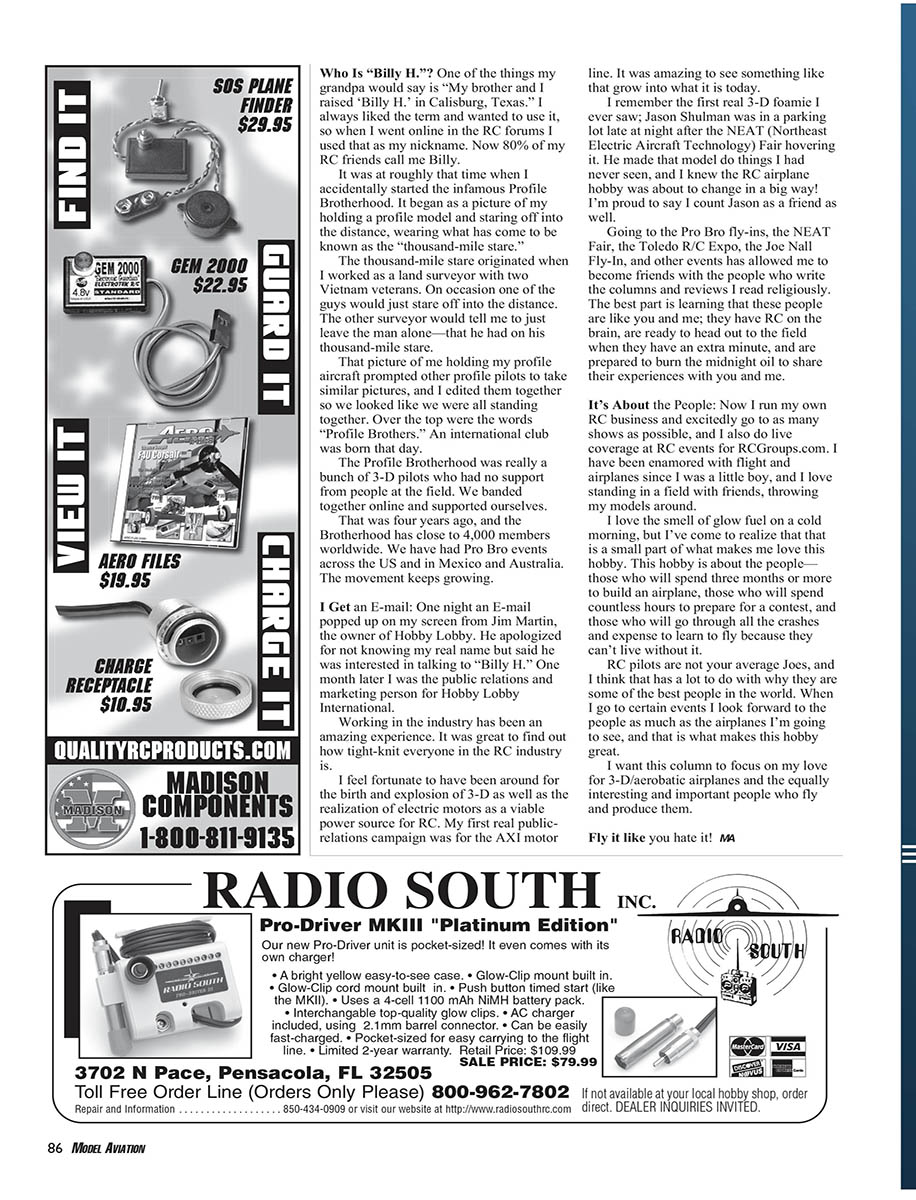
It was at roughly that time when I accidentally started the infamous Profile Brotherhood. It began as a picture of me holding a profile model and staring off into the distance, wearing what has come to be known as the "thousand-mile stare."
The thousand-mile stare originated when I worked as a land surveyor with two Vietnam veterans. On occasion one of the guys would just stare off into the distance. The other surveyor would tell me to just leave the man alone—that he had on his thousand-mile stare.
That picture of me holding my profile aircraft prompted other profile pilots to take similar pictures, and I edited them together so we looked like we were all standing together. Over the top were the words "Profile Brothers." An international club was born that day.
The Profile Brotherhood was really a bunch of 3-D pilots who had no support from people at the field. We banded together online and supported ourselves.
That was four years ago, and the Brotherhood has close to 4,000 members worldwide. We have had Pro Bro events across the U.S. and in Mexico and Australia. The movement keeps growing.
I Get an E-mail
One night an e-mail popped up on my screen from Jim Martin, the owner of Hobby Lobby. He apologized for not knowing my real name but said he was interested in talking to "Billy H." One month later I was the public relations and marketing person for Hobby Lobby International.
Working in the industry has been an amazing experience. It was great to find out how tight-knit everyone in the RC industry is.
I feel fortunate to have been around for the birth and explosion of 3-D as well as the realization of electric motors as a viable power source for RC. My first real public-relations campaign was for the AXI motor line. It was amazing to see something like that grow into what it is today.
I remember the first real 3-D foamie I ever saw; Jason Shulman was in a parking lot late at night after the NEAT (Northeast Electric Aircraft Technology) Fair hovering it. He made that model do things I had never seen, and I knew the RC airplane hobby was about to change in a big way! I'm proud to say I count Jason as a friend as well.
Going to the Pro Bro fly-ins, the NEAT Fair, the Toledo R/C Expo, the Joe Nall Fly-In, and other events has allowed me to become friends with the people who write the columns and reviews I read religiously. The best part is learning that these people are like you and me; they have RC in the brain, are ready to head out to the field when they have an extra minute, and are prepared to burn the midnight oil to share their experiences with you and me.
It's About the People
Now I run my own RC business and excitedly go to as many shows as possible, and I also do live coverage at RC events for RCGroups.com. I have been enamored with flight and airplanes since I was a little boy, and I love standing in a field with friends, throwing my models around.
I love the smell of glow fuel on a cold morning, but I've come to realize that that is a small part of what makes me love this hobby. This hobby is about the people—those who will spend three months or more to build an airplane, those who will spend countless hours to prepare for a contest, and those who will go through all the crashes and expense to learn to fly because they can't live without it.
RC pilots are not your average Joes, and I think that has a lot to do with why they are some of the best people in the world. When I go to certain events I look forward to the people as much as the airplanes I'm going to see, and that is what makes this hobby great.
I want this column to focus on my love for 3-D/aerobatic airplanes and the equally interesting and important people who fly and produce them.
Fly it like you hate it! MA
Transcribed from original scans by AI. Minor OCR errors may remain.

