
Brainstormer
Editor's Note
Occasionally, when space permits, MA publishes personality subjects — unusual people, of course, but it should be more than that. Heretofore, magazines have been preoccupied with the obviously famous people who, coincidentally perhaps, happen to be well-known manufacturers. But industry, and the hobby field, include many quiet achievers whose names we seldom, if ever, hear. One who has impressed us for a great many years is the subject of this issue's story. Rather than say how or why at this point, we've elected to let the text, the pictures, and the captions unfold his story. We say merely that this talented chap has profoundly affected the things we fly.
How many times while driving to work have you wished that you could have stayed home to putter with your new model? Or better yet, wouldn't it be great to have a job that actually paid you to design, build and fly various types of airplanes and helicopters along with radio equipment, propulsion systems and accessories?
Well, for the last 16 years, this is what Dave Gray has been doing — making his hobby pay for itself and enjoying every minute of it.
We invite you to share with us his inspiring story. — Art Schmalz
Early Years and First Models
Dave recalls the first airplane he built back in 1943 when he was seven years old. It was a .25 version of the famous Hellcat, then making quite a name for itself overseas. Unfortunately, balsa wood was scarce, so manufacturers resorted to cardboard and hardwood substitutions. The little rubber-powered planes were fun to build, but discouraging, since the glide angle resembled that of a brick. Dave took to carving "solid models," forerunners of today's plastic shelf models and kits — usually nothing more than several blocks of wood and a 3-view drawing.
As he became more proficient with balsa gliders and rubber-powered models, Dave found that he could design and build his own models and achieve as good or better results than what was offered. This was the beginning stage of a uniquely interesting design career in modeling.
After the war, his family moved to Clayton, Michigan. In the garage he found a huge cardboard box loaded with over 20 built-up rubber-powered airplanes and an old Rodgers engine. One of these was a well-used 36-in. Stuka which he rebuilt and flew with great success. That, he claims, is what really got him "hooked" on modeling.
Growing Interest in Radio Control and Other Projects
In the forties he was satisfied with building and flying gliders and other free-flight models until he came across a comic strip called "Tim Tyler's Luck." The episode involved two boys and an inventor who had built a radio-controlled plane. To be able to fly an airplane without wires and to control it with radio signals seemed like science fiction then. To have one became Dave's ultimate dream.
His family was very poor, so modeling was a good, inexpensive form of entertainment. Small rubber model kits could be purchased for 10¢ to $3.50. By conserving scraps, or by not using all the parts on one airplane, Dave could squeeze out one or two more planes from the same kit.
As his school years passed, he became proficient with cars and boats as well. His desire to build a remote-controlled model led to several electric-powered boats about 30 in. long. They could be steered left or right from shore with an actuator and escapements. Power for the escapement was supplied by a hand-carried lantern battery through two extremely fine enamel-covered copper wires about 30 feet long twisted together to form one long "extension cord." This system worked so well that he tried the same method with airplanes — the only problem being the airplane had to keep turning continuously or risk running out of wire.
Around 1953 his interest in free-flight helicopters began to grow. The first one he built from a magazine article didn't work as expected, so he designed his own ultra-light indoor helicopters that could fly across a room, hover inches from the ceiling, and then lightly touch down. Rotor blades, rubber motors, tubes and interchangeable body designs worked well in tandem.
Successful projects reinforced his ability to design and build his own creations.
Early Adult Life and First Radio-Controlled Flights
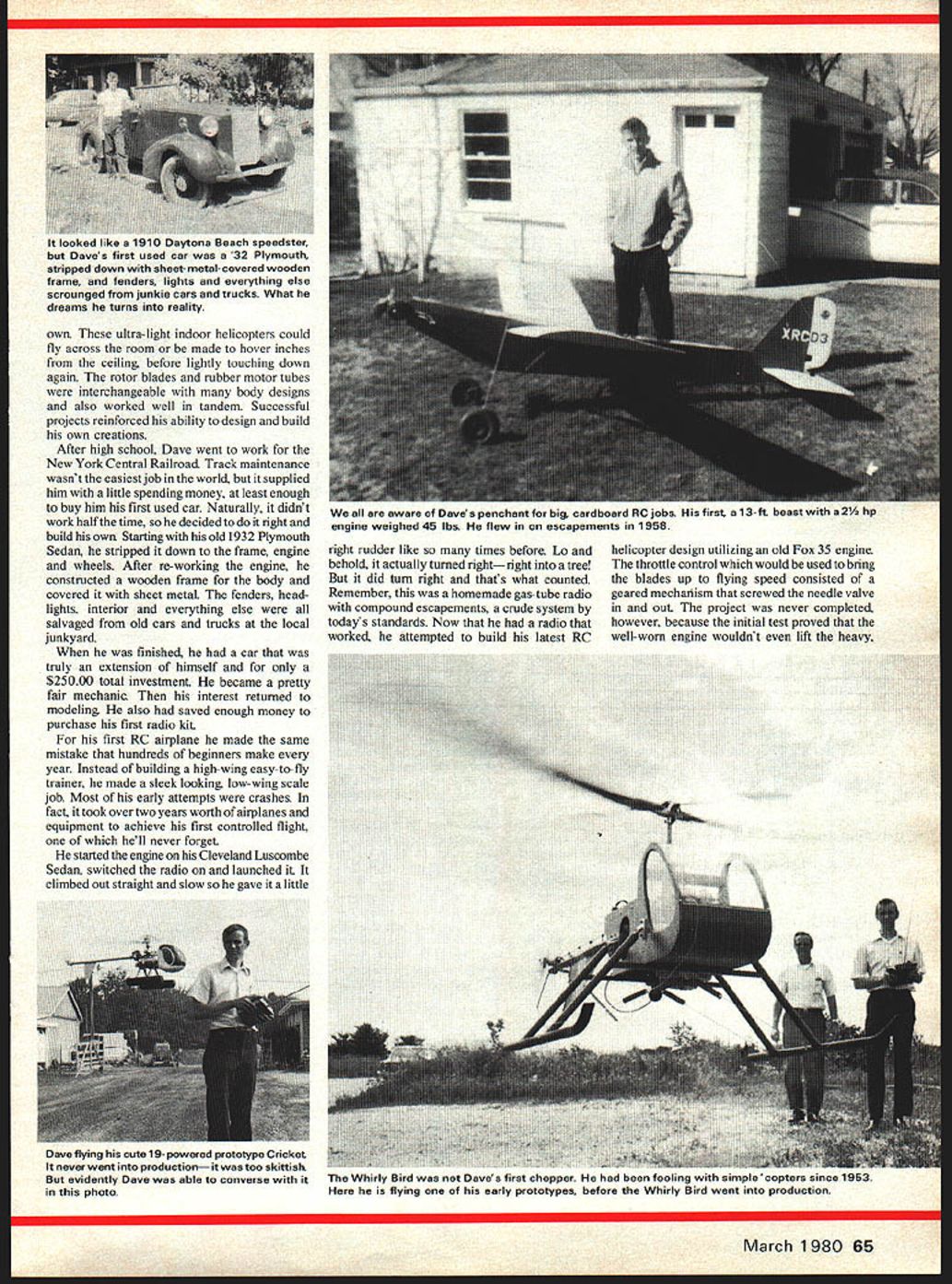
After high school Dave went to work on New York Central Railroad track maintenance; it wasn't the easiest job, but it supplied a little spending money — enough to buy his first used car. Naturally, it didn't work half the time, so he decided to do it right and build his own. Starting with a 1932 Plymouth Sedan, he stripped it down to the frame, engine and wheels. After reworking the engine, he constructed a wooden frame for the body and covered it with sheet metal. Fenders, headlights, interior and other parts were salvaged from old cars and trucks at the local junkyard. When he was finished, he had a car that was truly an extension of himself for only about $250. He became a pretty fair mechanic.
He soon returned to modeling and had saved enough money to purchase his first radio kit. For his first RC airplane he made the common beginner's mistake: instead of building a high-wing trainer, he built a sleek-looking low-wing scale job. Most early attempts ended in crashes. It took over two years of airplanes and equipment before he achieved his first controlled flight — a memorable one.
He started the engine on his Cleveland Luscombe Sedan, switched the radio on and launched it. It climbed out straight and slow so he gave it a little right rudder. It actually turned right — right into a tree! But it did turn right, and that was what counted. This was a homemade gas-tube radio with compound escapements, a crude system by today's standards.
He then attempted an RC helicopter design using an old Fox .35 engine with a throttle control that geared the needle valve in and out. The engine was too worn to lift the heavy machine; the project was put aside for life events — getting married and raising a family.
Dave married Pat Pendleton in 1958 and moved to Bowling Green, Ohio, where he worked for several electrical supply houses. He began to learn the finer points of electricity, wiring and repairing electric motors. It was also in Ohio that he achieved his first complete radio-controlled flight with a Berkeley kit powered by a Fox .07 engine and his own gas-tube radio. Unfortunately, his early flights often went unwitnessed or the planes flew away — a common hazard in those days.
Moving into the Business of Modeling
In 1963 the Grays moved back to Michigan, where Dave's hobby started to pay for itself. He took a part-time job with Glass City Models, fabricating parts and assembling pulse radio equipment. Two years later, with a lot of good ideas and a financial backer, Dave left Glass City Models and started a company called Airtron. He worked in his garage for the first year designing an electronic pulse-radio system intended to work better than what was available while still being reasonably priced. Within the next year, the product was on the market.
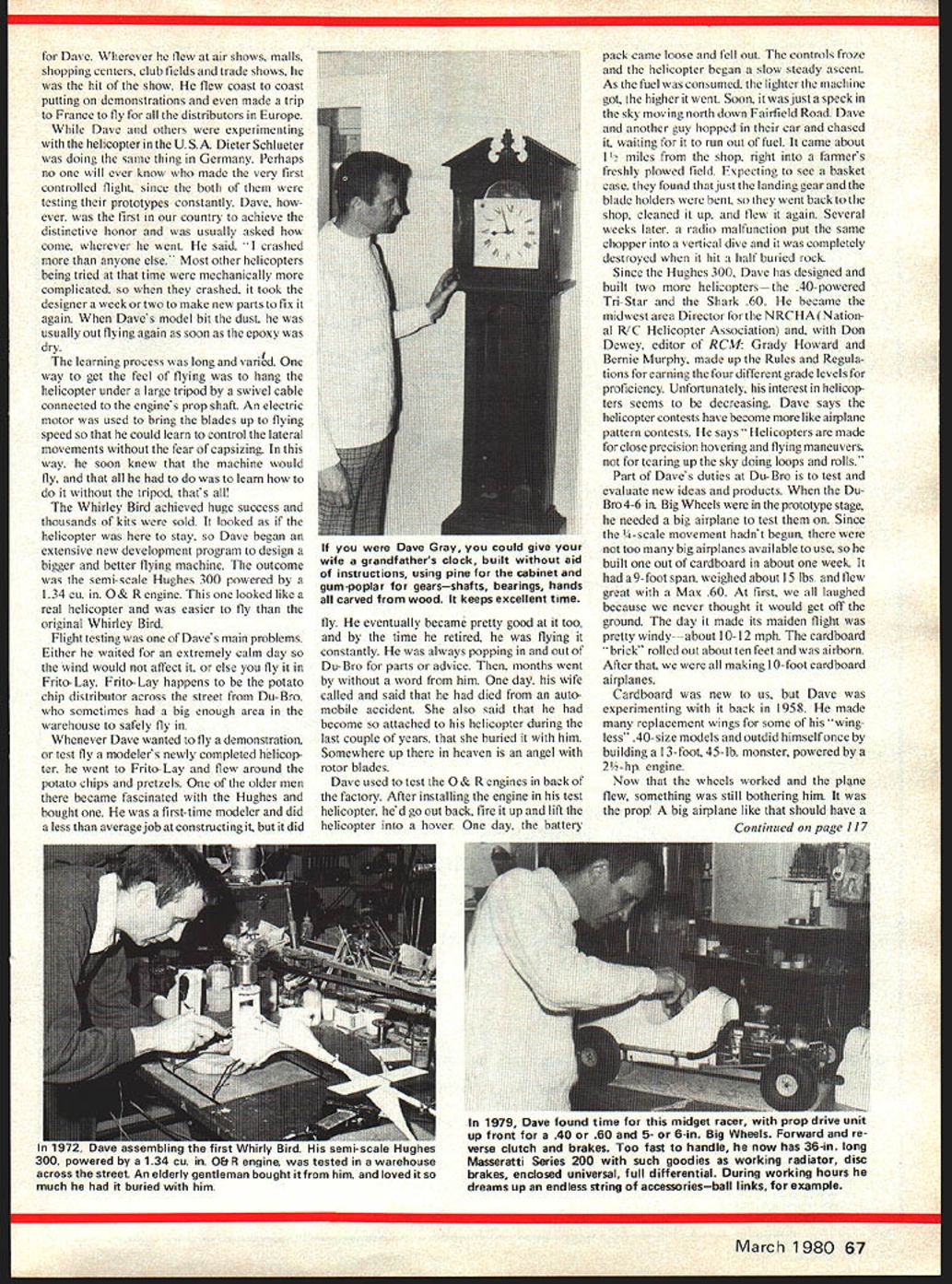
All during these years Dave experimented with all phases of modeling, from RC cars to autogiros. When helicopters began to interest more people worldwide, he returned to the challenge. More prototypes were made, but due to difficulties and setbacks, other projects were also pursued — projects that demonstrated his wide-ranging skills. He built a grandfather clock for his wife's birthday, scratch-built without plans, using pine for the cabinet and wood for gears, shafts and hammers — it stands about 6 feet tall, chimes on the hour and keeps excellent time. He also built a 9-foot exact-scale replica of the famous Pietenpol Air Camper from the original plans, with built-up ribs, wire-spoked wheels, metal fittings and cable controls.
At Airtron, Dave began experimenting with foam and plastics and eventually built his own vacuum-forming machines. Seeing the potential in foam construction, he left Airtron to form Gramer Plastics, a partnership with Jim Merritt that produced a line of airplane kits: three sailplanes, one Volksplane and a Twin Engine Bomber that was very successful. The business also formed foam blocks and packaging products for the auto industry.
Unfortunately, the 1969 auto strikes stopped production. That setback gave Dave more time to work on his pet project — the helicopter.
Helicopter Development and the Whirley Bird
By now Dave's prototypes were beginning to show promise. He worked on the theory that the simpler the design, the easier it would be to build, attempt to fly, and then repair after inevitable crashes. Instead of building a complicated gear train to connect the engine to the main rotors, he mounted the engine directly on top of the rotor head for torque-reaction drive. The tail rotor rotated via a simple string-and-pulley system. The body was a pine and balsa wood frame.
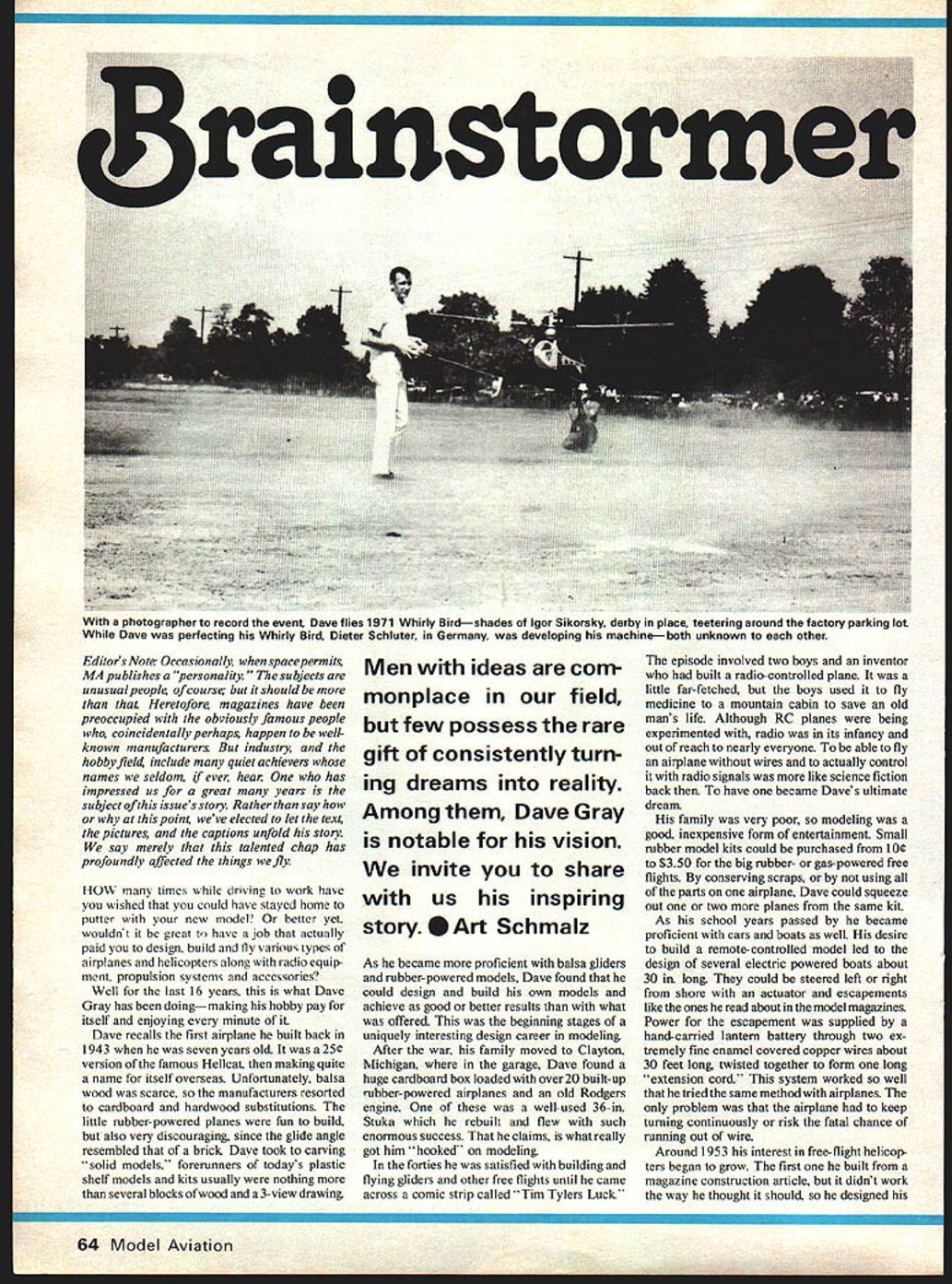
By the summer of 1970 he was making consistent 20- and 30-second flights. Word spread that an RC helicopter had been developed that could be controlled. This was proven publicly at the 1970 RC show in Cincinnati, Ohio, where Model Airplane News ran a cover photograph of Dave flying his .40-powered, yellow-and-gray hovering machine (the photo appeared in the January 1971 issue). That original machine is still in flyable condition and was slated to be donated to the Smithsonian Air and Space Museum.
Dave's business fortunes soon changed. Dewey Dobrow, president of Du-Bro, saw the potential of model helicopters and asked to buy the manufacturing rights from Dave. Within several months, Dave dissolved Gramer Plastics and went to work for Du-Bro to further develop the helicopter. In 1971 he and his family moved to Mundelein, Illinois, near the Du-Bro factory.
When he built another helicopter at Du-Bro, he initially couldn't make it fly like the original. It would pitch nose-up and flip over. He discovered he couldn't get two rotor blades to be perfectly identical in shape, size and weight — and only perfectly identical blades worked. Out of desperation he tried simple flat blades, and it worked. After a year of work and more R&D, the Du-Bro Whirley Bird 505 was produced.
The Whirley Bird was a sensation. Dave flew at air shows, malls, shopping centers, club fields and trade shows — coast to coast — and even in France for European distributors.
Meanwhile, German designer Dieter Schlueter was experimenting with helicopters as well. Perhaps no one will ever know who made the very first controlled flight, but Dave was the first in the U.S. to achieve this distinctive honor and was often asked how he did it. His reply: "I crashed more than anyone else." Dave emphasized simplicity: when his models crashed, they were usually repaired quickly and back in the air.
To get the feel of flying, Dave practiced by hanging the helicopter under a large tripod with a swivel cable connected to the engine's prop shaft. An electric motor brought the blades up to flying speed so he could learn lateral control without fear of capsizing. This method convinced him the machine would fly; he just had to learn to do it without the tripod.
Further Helicopter Designs and Involvement
The Whirley Bird sold thousands of kits. Dave then designed the semi-scale Hughes 300, powered by a 1.34 cu. in. O&R engine. This model looked like a real helicopter and was easier to fly than the Whirley Bird. He later designed the .40-powered Tri-Star and the Shark .60.
Dave became the Midwest area Director for the NRCHA (National R/C Helicopter Association). With Don Dewey (editor of RCM), Grady Howard and Bernie Murphy, he helped develop the rules and regulations for earning four different grade levels of proficiency. Over time his interest in helicopters decreased; he felt helicopter contests had become more like airplane pattern contests, while helicopters are meant for close precision hovering and maneuvers.
Anecdotes and Test Flights
- Dave often tested at a nearby Frito-Lay warehouse across the street from Du-Bro, using the large area to safely fly indoors when the weather was unsuitable. One enthusiastic employee became very attached to his Hughes model; after the man's death in an automobile accident, his wife said she had buried the helicopter with him.
- In another incident, while testing an O&R engine, a battery pack fell out of the test helicopter, freezing the controls. The machine climbed as it became lighter on fuel and eventually drifted about 1½ miles before landing in a farmer's field with only minor damage. On another occasion a radio malfunction put a chopper into a vertical dive where it hit a half-buried rock and was destroyed.
Other Projects and Skills
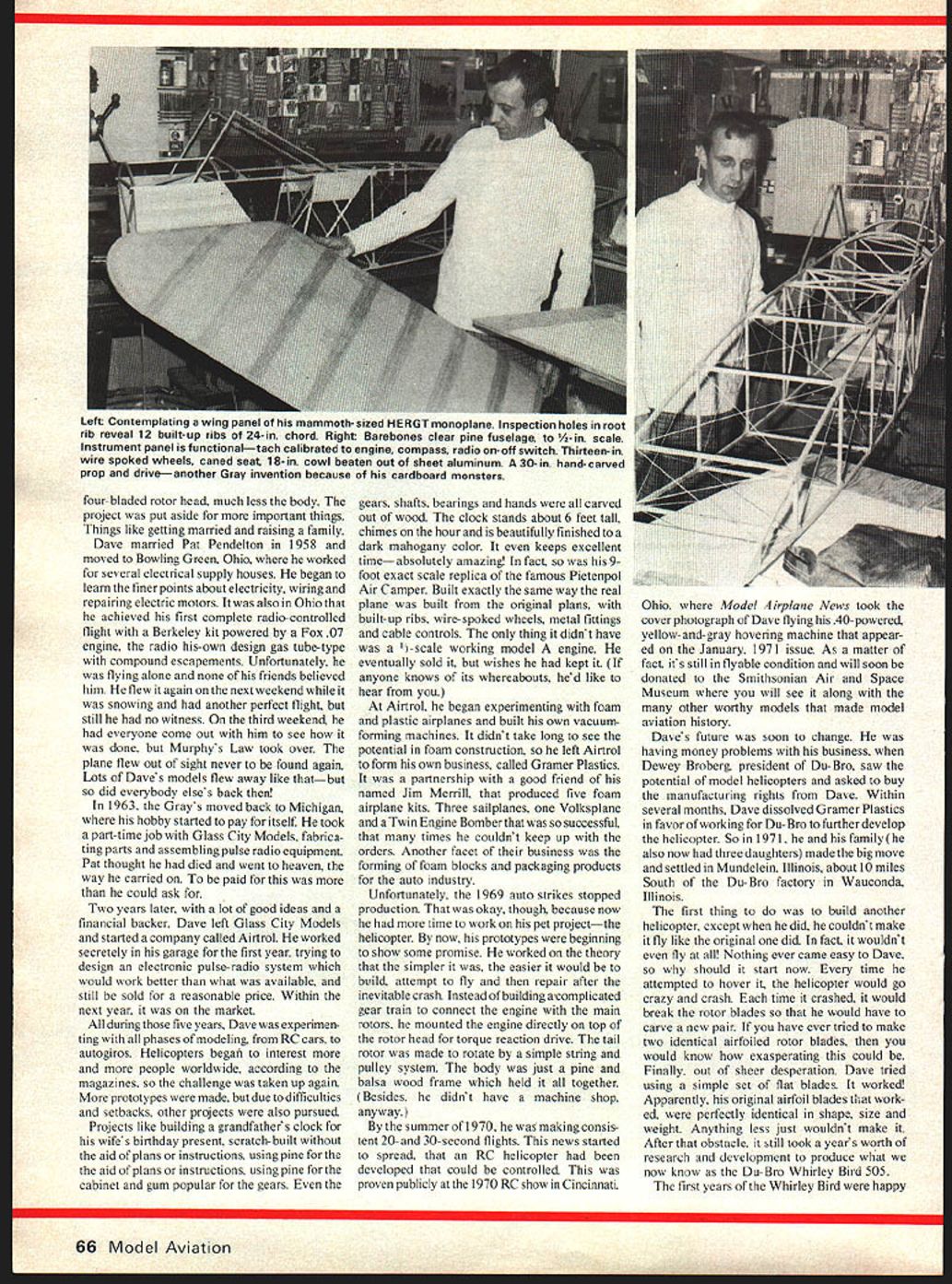
Dave's inventiveness was not limited to helicopters. To test Du-Bro's 4–6 in. Big Wheels, he built a large test airplane out of cardboard in about a week: a 9-foot span, about 15 lbs, powered by a Max .60. It flew well despite initial skepticism. He had experimented with cardboard as early as 1958, making replacement wings and even building a 13-foot, 45-lb. monster powered by a 2½ hp engine.
He also built:
- a 1/2-scale 1918 HERGT monoplane from clear white pine with intricate wing construction (24-in. root rib revealing 12 built-up ribs and realistic rib stitching),
- R/C race cars using a Prop Drive Unit (a modified gear train from the Shark .60 helicopter that reduces engine speed 2½ times and uses an 8-in. prop),
- a Maserati 250 Series R/C car with disk brakes, enclosed universal, full differential, radiator and fully cambered front end.
Dave makes wood molds for bodies and vacuum-forms them out of ABS plastic, a benefit of working at Du-Bro.
Inventions and Contributions
Part of Dave's duties at Du-Bro was to test and evaluate new ideas and products. Among items he dreamed up and helped develop are:
- Ball Links
- Kwik-Switch Mount
- Final Filter
- V-Tail Mixer
- Prop Drive Unit
- 4-Turn Hatch Latch
He also helped popularize Du-Bro Big Wheels and other accessories widely used by modelers.
Skills and Character
Dave is an accomplished R/C pilot, builder and designer. He is a competent mechanic, machinist, electrician and carpenter. He is one of those rare types who can use both his head and his hands to solve a problem.
There's only one thing he can't do very well: he can't ride in an airplane — he gets airsick.
Keep those ideas and outstanding pictures coming.
Transcribed from original scans by AI. Minor OCR errors may remain.

