
Bücker — Jungmann and Jungmeister
Connie L. McClure
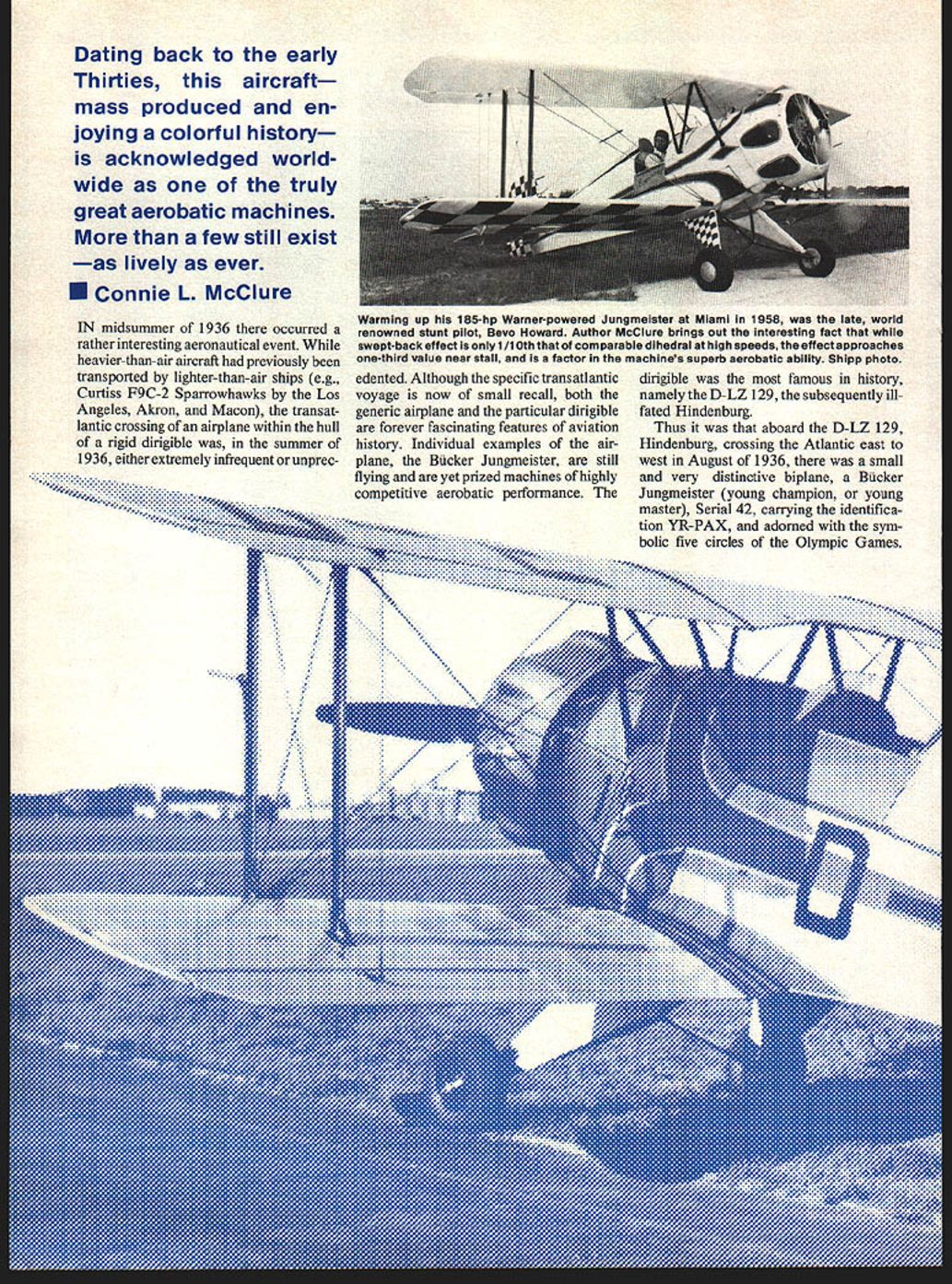
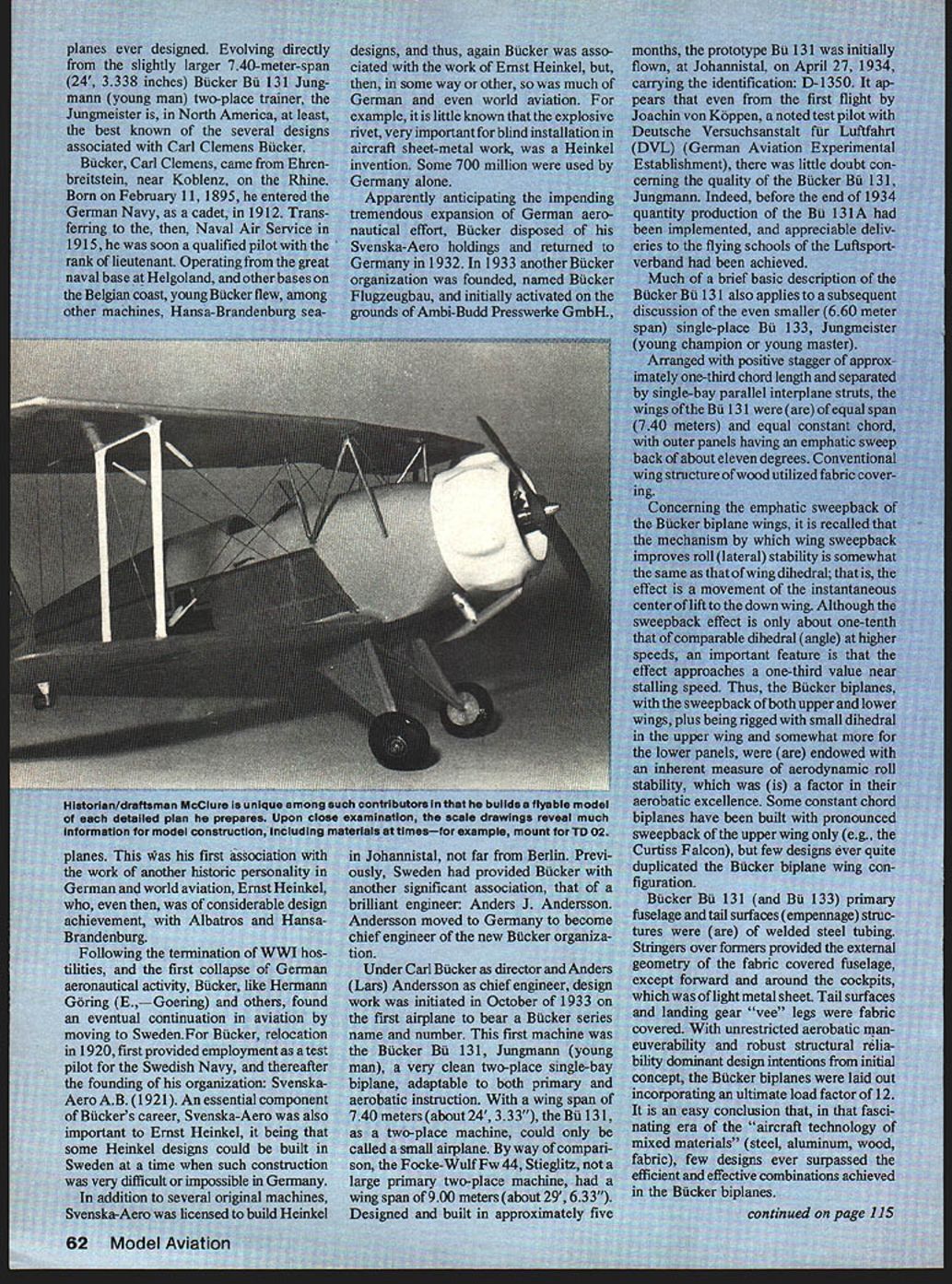
Dating back to the early 1930s, the Bücker Jungmann (Bu 131) and Jungmeister (Bu 133) are celebrated worldwide as among the finest aerobatic biplanes ever produced. Mass produced and enjoying a colorful history, many examples remain alive and active in aerobatic flying today.
Historic transatlantic transport
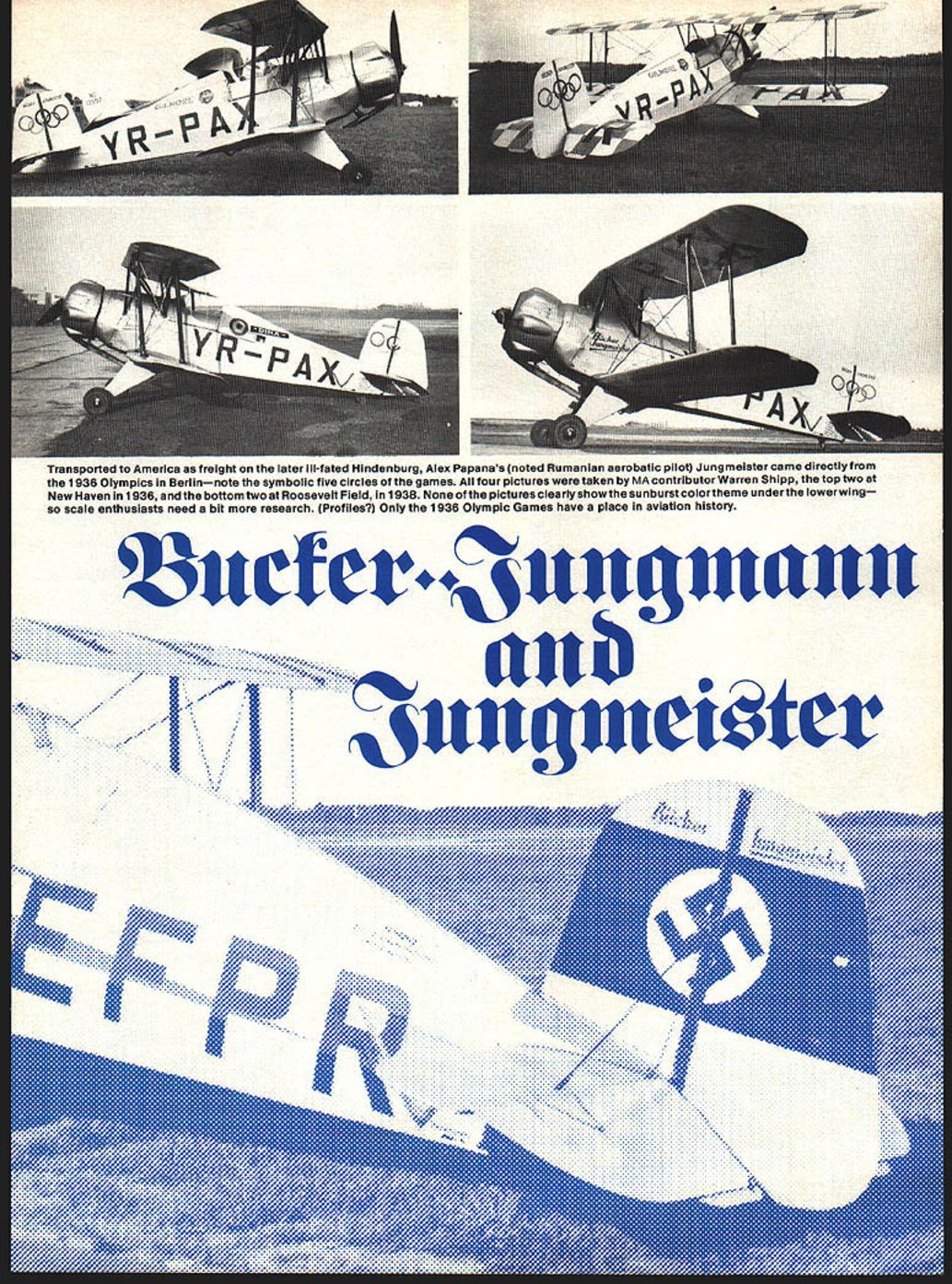
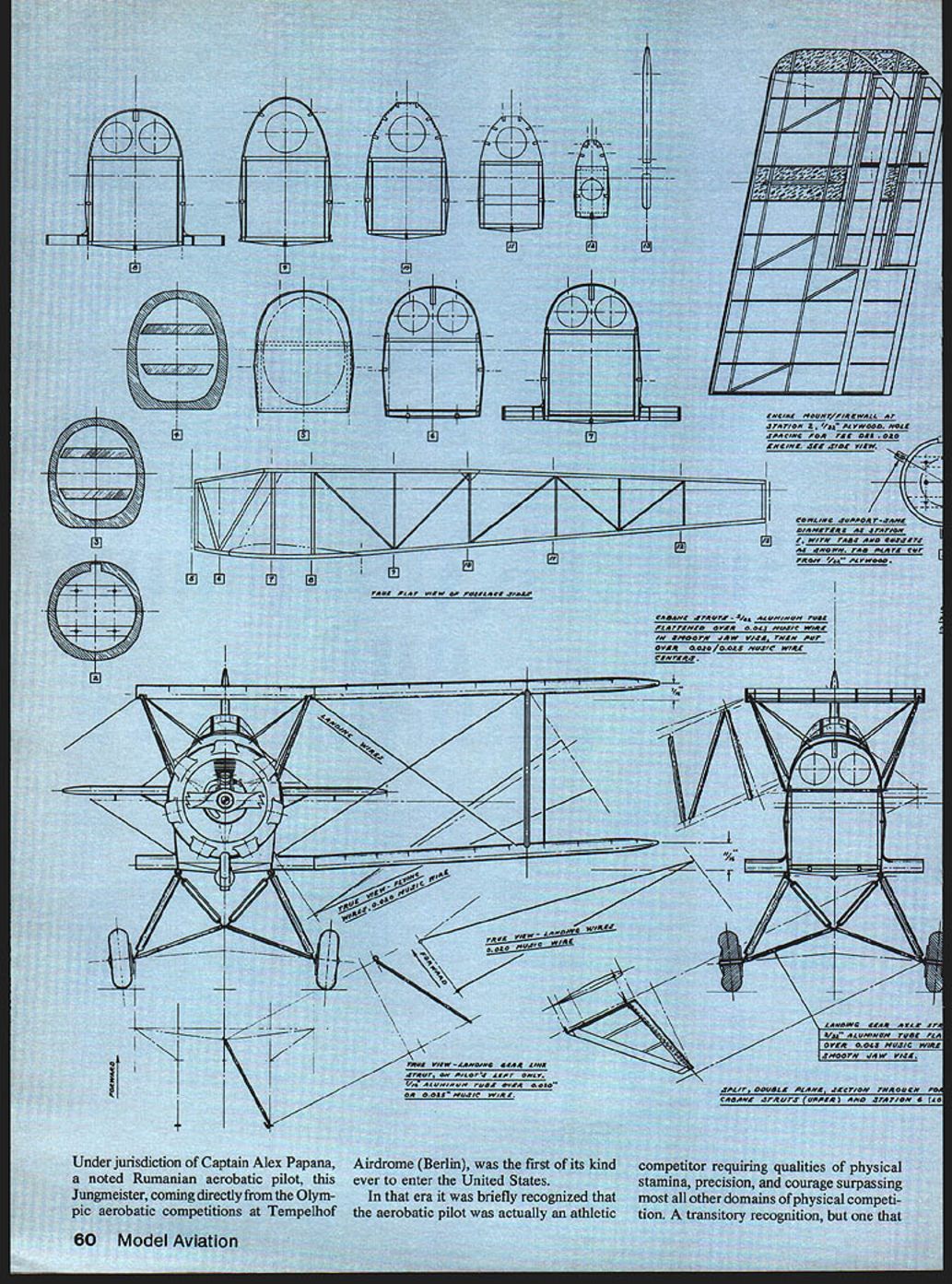
In midsummer 1936 an unusual aeronautical event occurred: a heavier-than-air airplane crossed the Atlantic inside the hull of a rigid dirigible. Aboard the famous D‑LZ 129 Hindenburg, crossing east to west in August 1936, was a small and very distinctive biplane — a Bücker Bü 133 Jungmeister, serial 42, identification YR‑PAX, proudly adorned with the five Olympic rings. The Jungmeister on that flight came directly from the Olympic aerobatic competitions at Tempelhof and was under the jurisdiction of Captain Alex Papana, a noted Romanian acrobatic pilot. It was the first Jungmeister to enter the United States.
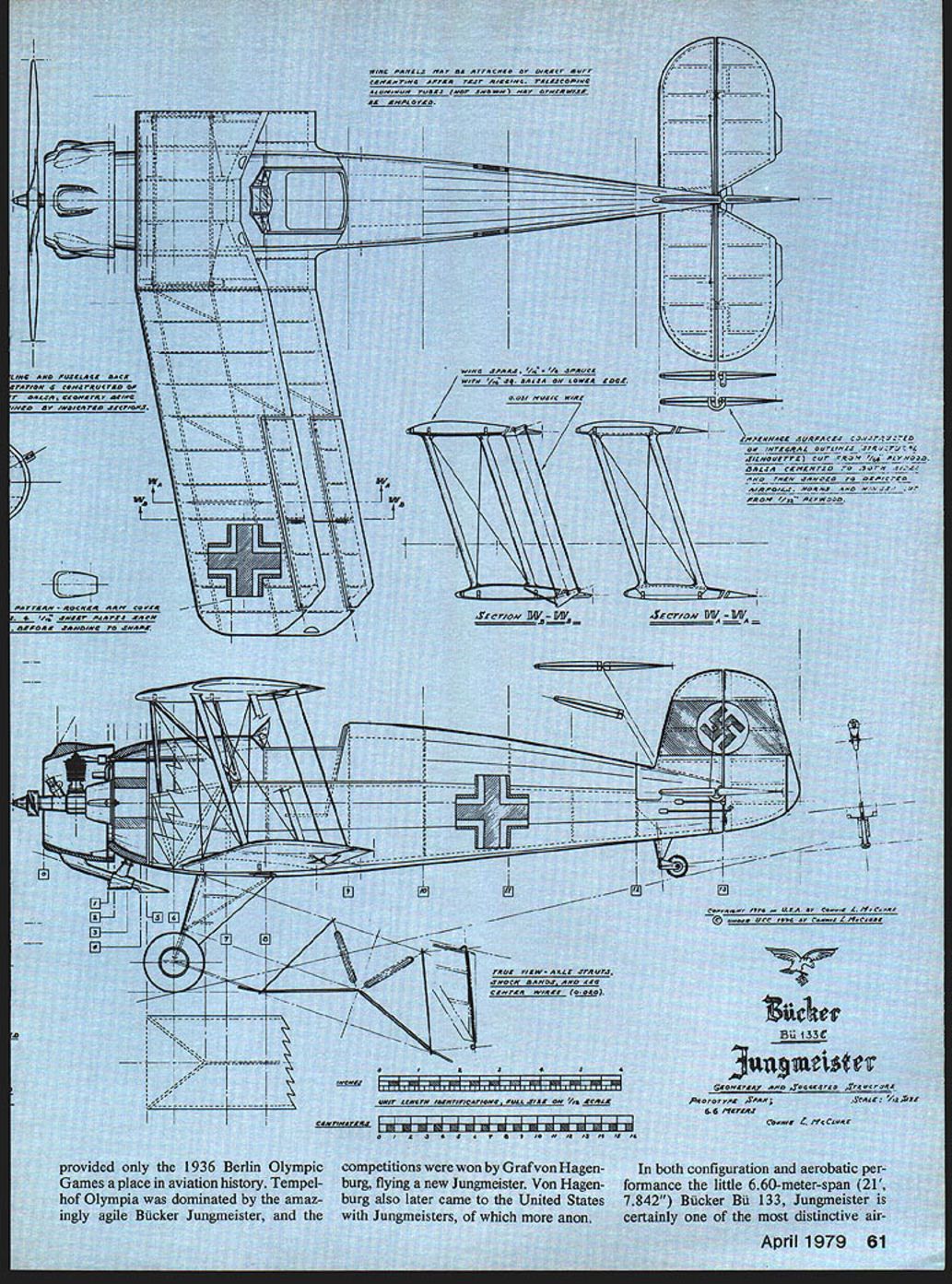
Only the 1936 Berlin Olympic Games hold this particular place in aviation history; Tempelhof was dominated by the agile Jungmeister and the competitions were won by Graf von Hagenburg, flying a new Jungmeister.
Origins: Carl Clemens Bücker and Anders J. Andersson
Carl Clemens Bücker was born in Ehrenbreitstein, near Koblenz, on February 11, 1895. Entering the German Navy as a cadet in 1912 and transferring to the Naval Air Service in 1915, he became a qualified pilot during World War I and flew Hansa‑Brandenburg seaplanes. Early in his career he worked alongside Ernst Heinkel.
After the war Bücker moved to Sweden in 1920. There he flew as a test pilot for the Swedish Navy and founded Svenska‑Aero A.B. in 1921. Svenska‑Aero built original machines and also produced Heinkel designs under license, and it was during this Swedish period that Bücker met the brilliant engineer Anders J. Andersson, who later became chief engineer of Bücker Flugzeugbau when Bücker returned to Germany.
In 1933 Bücker founded Bücker Flugzeugbau near Berlin, with Andersson as chief engineer. Design work on the Bu 131 Jungmann began in October 1933.
Design and development
Bü 131 Jungmann (two‑place)
- Purpose: clean two‑place single‑bay biplane for primary and aerobatic instruction.
- Wingspan: 7.40 m (about 24 ft 3 in).
- First prototype flown: April 27, 1934 (D‑1350) by test pilot Joachim von Koppen.
- Structure: welded steel tube fuselage with stringers and formers; fabric covering except light metal sheet forward and around cockpits; wooden wings with fabric covering; fabric‑covered tail surfaces and landing‑gear “vee” legs.
- Wing arrangement: positive stagger (~1/3 chord), single‑bay parallel interplane struts, equal span and constant chord; outer panels have sweepback ≈ 11°; small dihedral on upper wing and somewhat more on lower.
- Aerodynamic note: sweepback contributes to roll (lateral) stability in a manner similar to dihedral. The sweepback effect at higher speeds is about one‑tenth the comparable dihedral effect and approaches about one‑third near stall, contributing to the aircraft’s aerobatic handling.
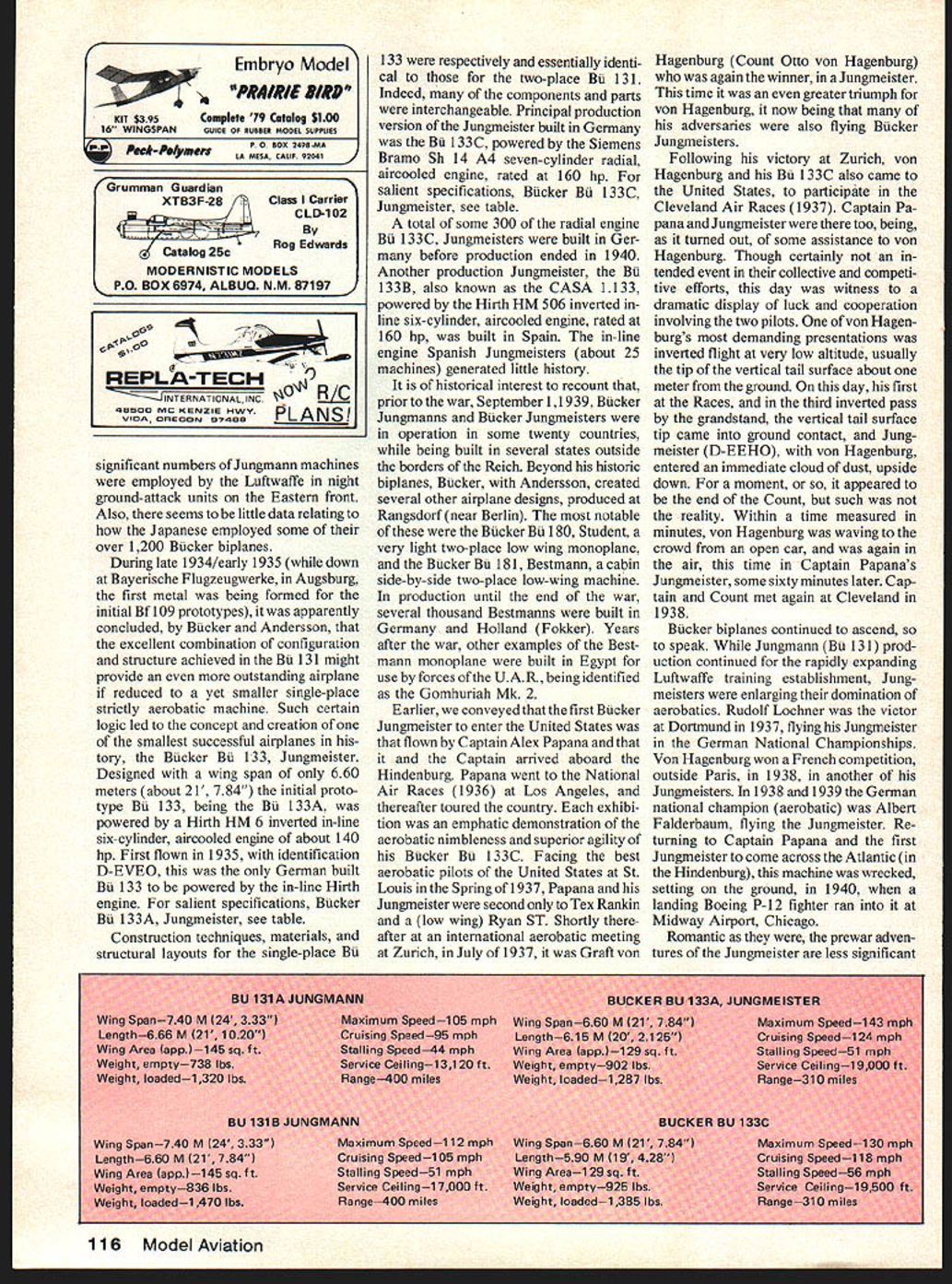
- Prototype and Bu 131A engine: Hirth HM 60R inverted in‑line four‑cylinder air‑cooled, 80 hp.
- Bu 131B engine change: Hirth HM 504 inverted in‑line four‑cylinder air‑cooled, 105 hp.
The Jungmann prototype was designed and built rapidly (in roughly five months), and by the end of 1934 quantity production was underway with appreciable deliveries to flying schools.
Bü 133 Jungmeister (single‑place)
- Concept: a smaller, single‑place, strictly aerobatic development of the Bu 131.
- Wingspan: 6.60 m (about 21 ft 7.8 in).
- Initial prototype: Bü 133A, first flown in 1935 (D‑EVEO), powered by a Hirth HM 6 inverted in‑line six‑cylinder air‑cooled engine (~140 hp). This was the only German-built Bü 133 powered by that in‑line Hirth.
- Principal German production version: Bü 133C, powered by Siemens‑Bramo Sh 14A4 seven‑cylinder radial air‑cooled engine, 160 hp.
- Spanish production: Bü 133B (CASA 1.133), powered by Hirth HM 506 inverted in‑line six‑cylinder, 160 hp — about 25 Spanish-built in‑line Jungmeisters were constructed.
- Construction: techniques, materials, and structural layout were essentially identical to the Bu 131; many components were interchangeable.
Structure, strength and materials
Bücker biplanes exemplified the “mixed materials” era: welded steel‑tube fuselage, wooden wings, fabric coverings, and selective use of light metal sheet. They were designed for unrestricted aerobatic maneuverability with robust structural reliability — an ultimate load factor of 12 was incorporated into the layout. Few contemporary designs matched the efficiency of these material combinations.
Production, variants and numbers
- German production of Bu 131 Jungmann began in late 1934 and continued into 1940. Several thousand Jungmanns and Jungmeisters were built in Germany alone.
- Additional units were built under license in Spain and Japan; hundreds more were produced outside Germany.
- Japan: approximately 200 Jungmanns were used by the Japanese Navy, while over 1,000 Bücker biplanes were produced for the Japanese Army.
- Bü 133C: about 300 radial‑powered Jungmeisters were built in Germany before production ceased in 1940.
- Bü 133B / CASA 1.133: roughly 25 Spanish in‑line Jungmeisters; they left little historic impact compared with the radial versions.
Beyond the bu 131/133, Bücker and Andersson also designed the Bü 180 Student (very light two‑place low‑wing monoplane) and the Bü 181 Bestmann (two‑place side‑by‑side low‑wing). The Bestmann was produced until the end of World War II, with several thousand built in Germany and Holland (Fokker). Postwar production continued in other countries (e.g., Egypt, where versions served as the Gomhuriah Mk. 2).
Operational history and wartime use
- Prewar: by September 1, 1939, Jungmanns and Jungmeisters were operating in some twenty countries and being built in several states outside the Reich.
- Military: although generally not thought of as armed combat aircraft, from 1942 significant numbers of Jungmanns served with the Luftwaffe in night ground‑attack units on the Eastern Front. Details of Japanese wartime employment remain sparse in available records.
- Noteworthy incidents: the first Jungmeister to reach the U.S. with Captain Alex Papana (transported aboard the Hindenburg) was later wrecked in 1940 when a landing Boeing P‑12 fighter collided with it at Midway Airport, Chicago.
Competition, exhibitions and pilots
- Tempelhof Olympia (1936): the Jungmeister dominated the Olympic aerobatic appearances; Graf von Hagenburg won flying a Jungmeister.
- International competitions: von Hagenburg, Rudolf Lochner, and Albert Falderbaum were among the champions flying Jungmeisters in the late 1930s across Europe.
- U.S. exhibitions: Captain Alex Papana toured the U.S. after arriving with the Hindenburg. Papana’s Jungmeister showed emphatic aerobatic nimbleness; at St. Louis in spring 1937 he finished second only to Tex Rankin flying a Ryan ST.
- Famous episode: at the Cleveland Air Races (1937) Graf von Hagenburg damaged his Jungmeister (D‑EEHO) by touching the vertical tailto the ground during a low inverted pass. He emerged unhurt and, within an hour, was flying again — this time in Captain Papana’s Jungmeister. Von Hagenburg and Papana met again at Cleveland in 1938.
Aerobatic qualities and handling
The Jungmann and Jungmeister’s wing geometry (sweepback on both wings, small dihedral on the upper wing and more on the lower) produced a unique combination of roll stability and agility favorable for aerobatics. The designers exploited sweepback’s stabilizing effect (particularly valuable near stall) along with conventional dihedral to yield superb lateral control and predictable handling in aggressive maneuvers.
Legacy
The Bücker Jungmann and Jungmeister occupy a distinguished place in aerobatic aviation history. Mass produced and fielded worldwide before and during World War II, they set standards for aerobatic performance and pilot training. Many survivors remain prized by collectors and aerobatic pilots for their responsiveness, structural robustness, and historical significance.
Transcribed from original scans by AI. Minor OCR errors may remain.

