
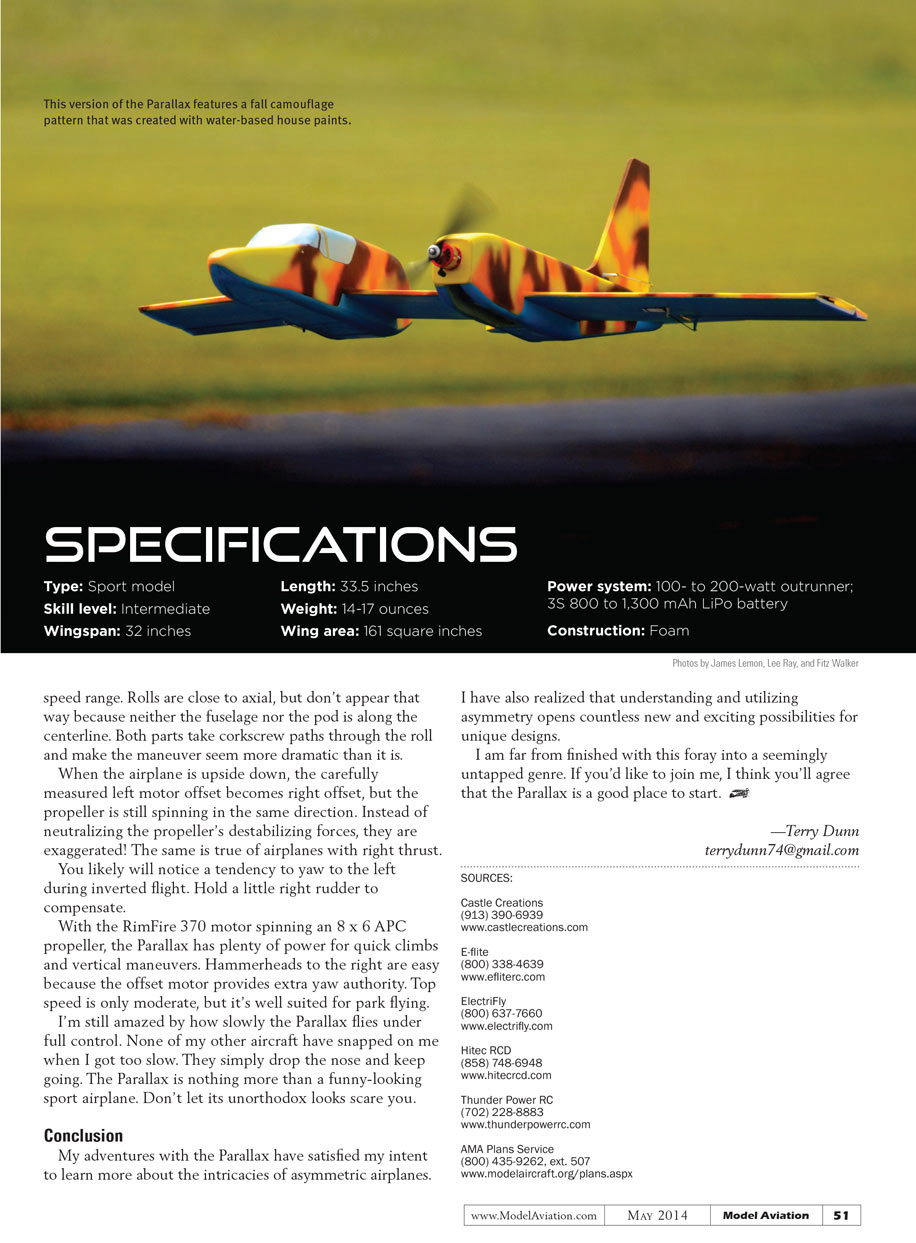
BUILD THE PARALLAX
Exploring asymmetry with an unconventional configuration
by Terry Dunn
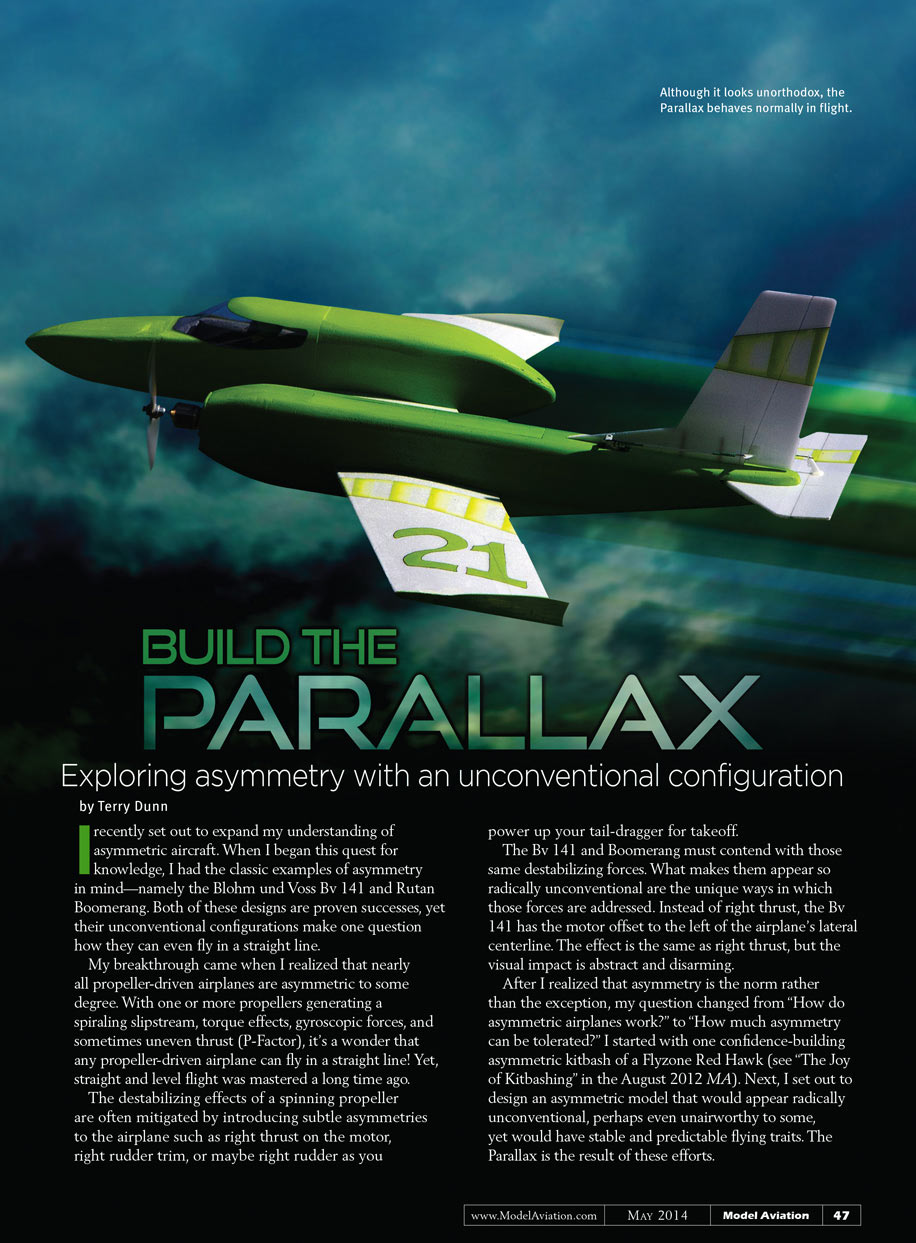
I recently set out to expand my understanding of asymmetric aircraft. When I began this quest for knowledge, I had the classic examples of asymmetry in mind—namely the Blohm & Voss Bv 141 and the Rutan Boomerang. Both of these designs are proven successes, yet their unconventional configurations make one question how they can even fly in a straight line.
My breakthrough came when I realized that nearly all propeller-driven airplanes are asymmetric to some degree. With one or more propellers generating a spiraling slipstream, torque effects, gyroscopic forces, and sometimes uneven thrust (P-factor), it’s a wonder that any propeller-driven airplane can fly in a straight line! Yet straight-and-level flight was mastered long ago.
The destabilizing effects of a spinning propeller are often mitigated by introducing subtle asymmetries to the airplane such as right thrust on the motor, right rudder trim, or maybe right rudder as you power up your taildragger for takeoff.
The Bv 141 and Boomerang must contend with those same destabilizing forces. What makes them appear so radically unconventional are the unique ways in which those forces are addressed. Instead of right thrust, the Bv 141 has the motor offset to the left of the airplane’s lateral centerline. The effect is the same as right thrust, but the visual impact is abstract and disarming.
After I realized that asymmetry is the norm rather than the exception, my question changed from “How do asymmetric airplanes work?” to “How much asymmetry can be tolerated?” I started with one confidence-building asymmetric kitbash of a Flyzone Red Hawk (see “The Joy of Kitbashing,” August 2012 MA). Next, I set out to design an asymmetric model that would appear radically unconventional, perhaps even unairworthy to some, yet would have stable and predictable flying traits. The Parallax is the result of these efforts.
The Parallax is slightly more than a modern adaptation of the Bv 141. I make no claims that any aspect of the airplane’s performance is enhanced by its asymmetry. My position is that little is compromised despite its asymmetry. This airplane is the foam-and-LiPo embodiment of the notion that airplanes don’t necessarily have to look right to fly well.
The checkmark-shaped wing is an unnecessary deviation that I felt would add character to the design without presenting much more complexity. My prototype Parallax and one of the subsequent test models use a canard for pitch control. After testing the canard versions and those with a standard horizontal stabilizer and elevator, I prefer and recommend the standard tail configuration.
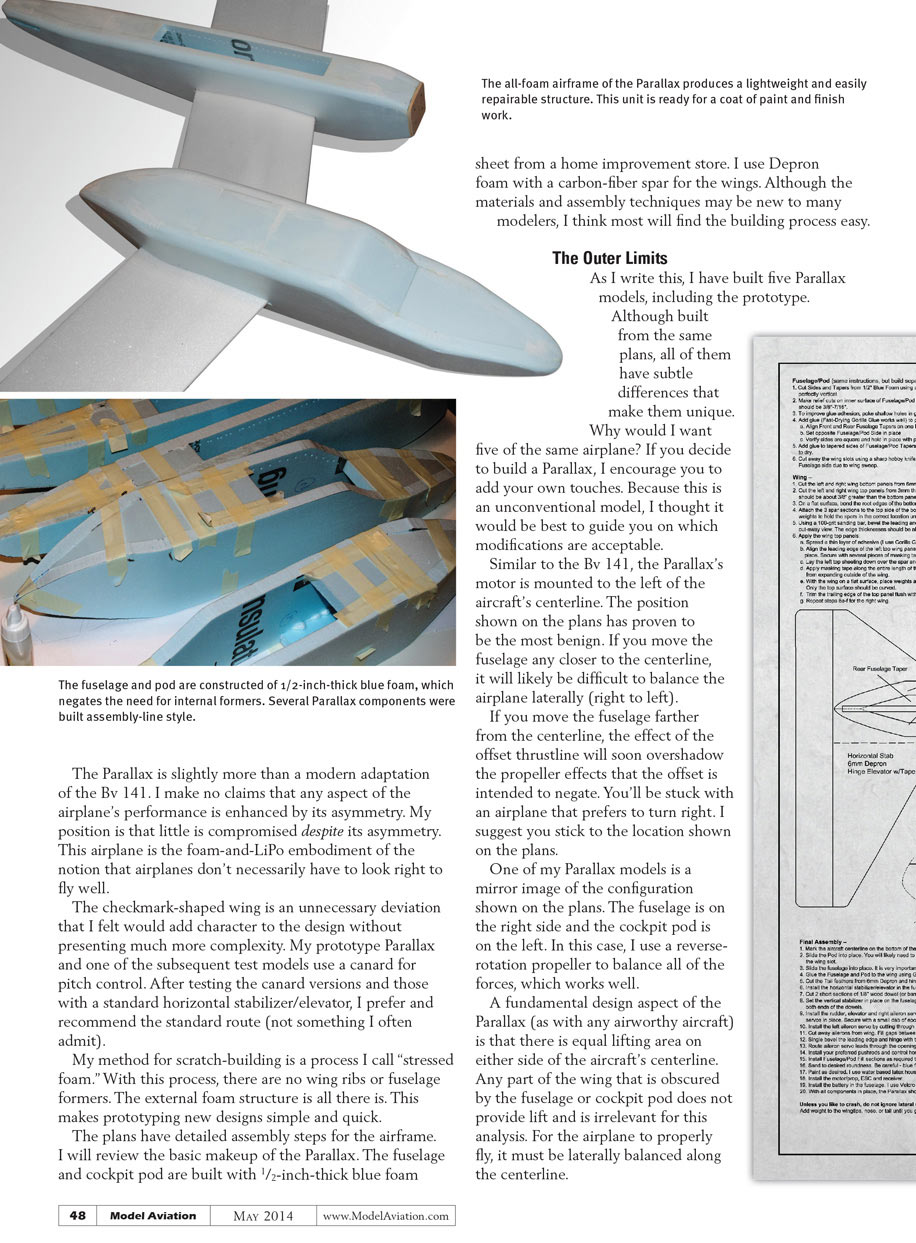
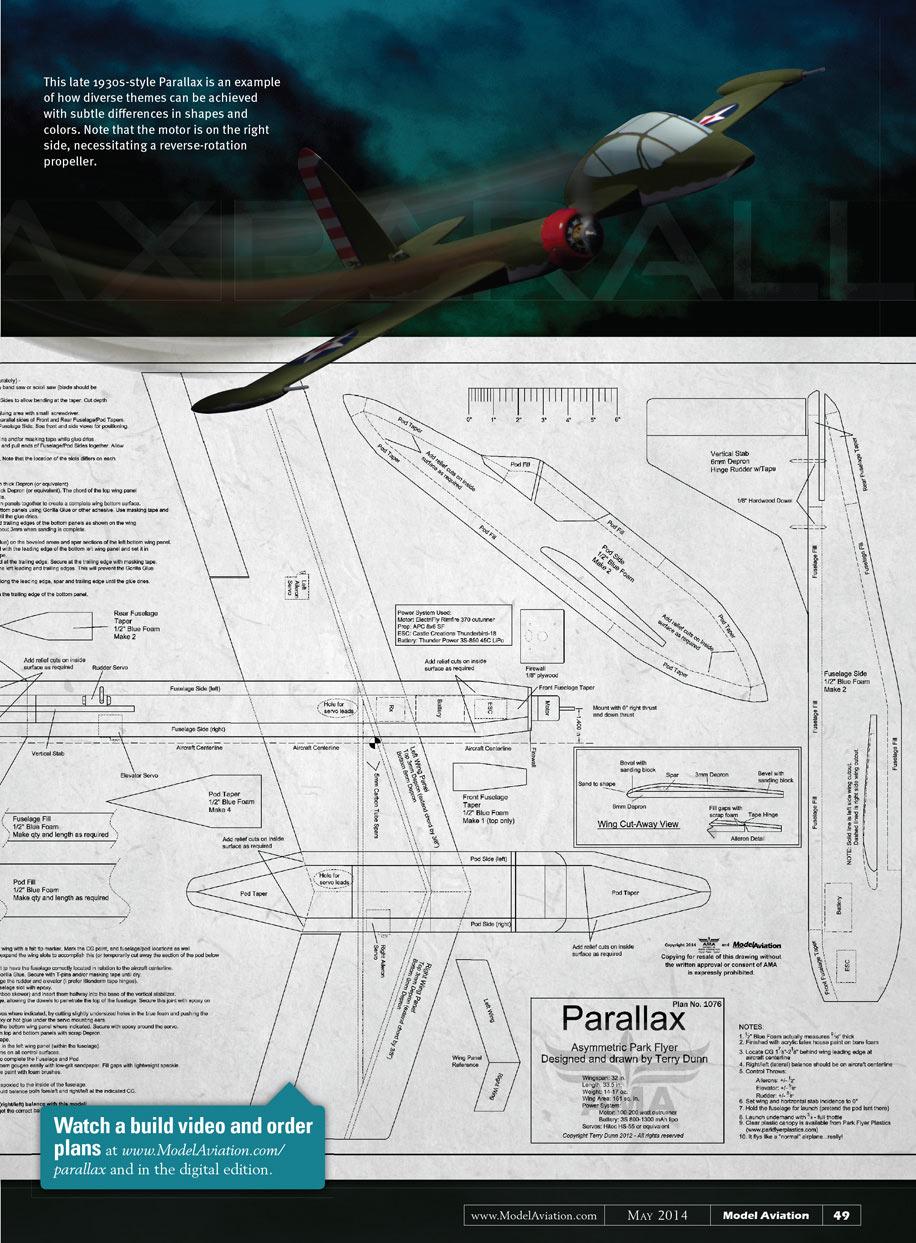
My method for scratch-building is a process I call “stressed foam.” With this process there are no wing ribs or fuselage formers. The external foam structure is all there is. This makes prototyping new designs simple and quick. The plans include detailed assembly steps for the airframe. I will review the basic makeup of the Parallax:
- The fuselage and cockpit pod are built with 1/2-inch thick blue foam sheet from a home improvement store.
- The wings are made from Depron foam with a carbon-fiber spar.
- Materials and assembly techniques may be new to many modelers, but the building process is straightforward.
The Outer Limits
As I write this, I have built five Parallax models, including the prototype. Although built from the same plans, all of them have subtle differences that make them unique. If you decide to build a Parallax, I encourage you to add your own touches. Because this is an unconventional model, I thought it would be best to guide you on which modifications are acceptable.
Similar to the Bv 141, the Parallax’s motor is mounted to the left of the aircraft’s centerline. The position shown on the plans has proven to be the most benign. If you move the fuselage any closer to the centerline, it will likely be difficult to balance the airplane laterally (right to left). If you move the fuselage farther from the centerline, the effect of the offset thrustline will soon overshadow the propeller effects that the offset is intended to negate. You’ll be stuck with an airplane that prefers to turn right. I suggest you stick to the location shown on the plans.
One of my Parallax models is a mirror-image configuration of the plans: the fuselage is on the right side and the cockpit pod is on the left. In that case I use a reverse-rotation propeller to balance the forces, which works well.
A fundamental design aspect of the Parallax (as with any airworthy aircraft) is that there is equal lifting area on either side of the aircraft’s centerline. Any part of the wing that is obscured by the fuselage or cockpit pod does not provide lift and is irrelevant for this analysis. For the airplane to properly fly, it must be laterally balanced along the centerline.
If you alter the width of the fuselage or the pod, you will also alter the effective wing area and centerline. The fuselage location must reflect this change as well. Although lateral balance of the Parallax is not any more critical than on other airplanes, this model’s unique configuration means it can easily get out of whack if you aren’t paying attention.
You may want to add details to the cockpit pod. If you do, keep it light. Because the pod is offset from the centerline, any weight you add to the pod must be offset by weight in the opposite wingtip.
You can alter the shape of the tail feathers, as long as you maintain approximately the same proportions and area. You also have many choices when it comes to finishing the model. I prefer to paint mine with water-based latex house paint. It’s inexpensive, goes on well with a foam brush, and can be thinned with water for airbrushing.
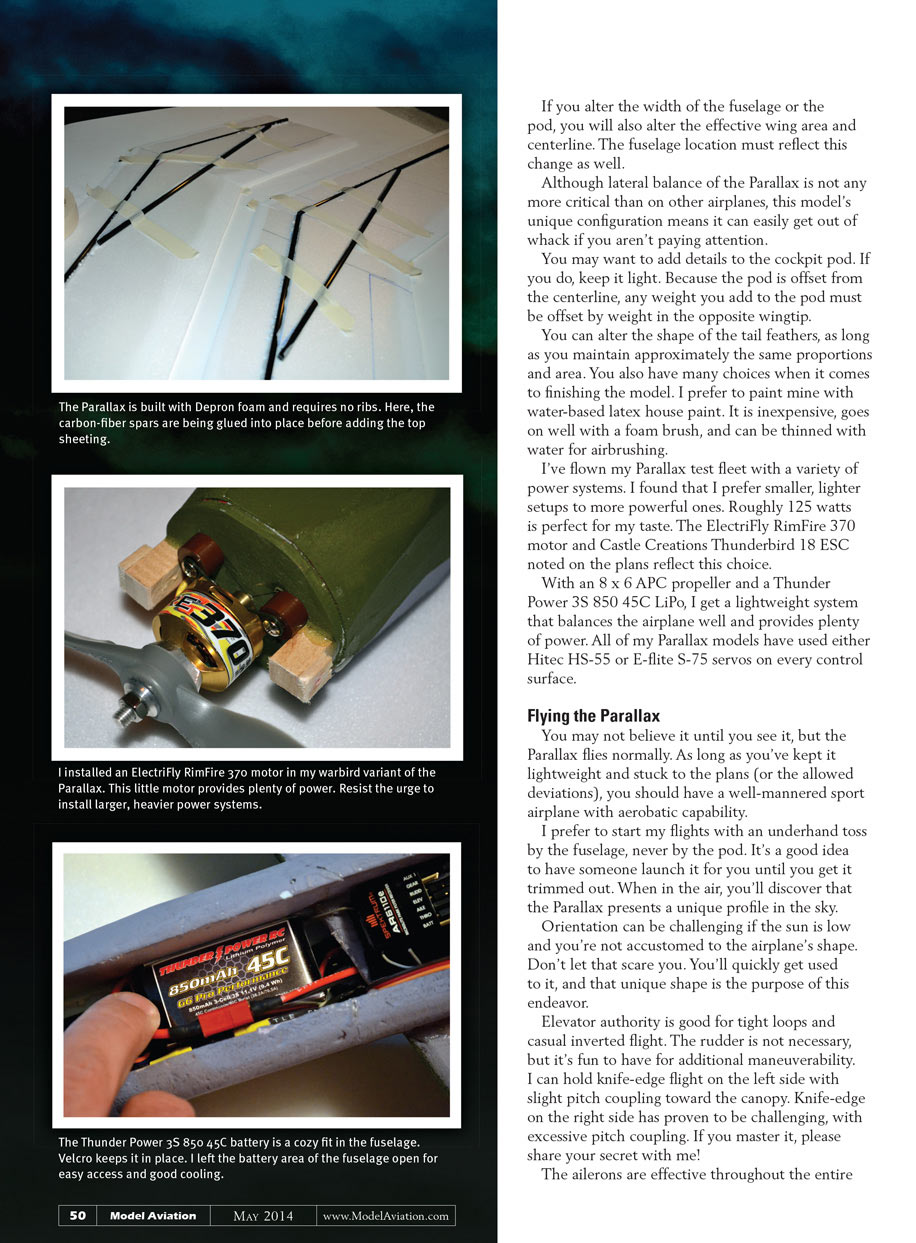
I’ve flown my Parallax test fleet with a variety of power systems. I found that I prefer smaller, lighter setups to more powerful ones. Roughly 125 watts is perfect for my taste. The ElectriFly RimFire 370 motor and Castle Creations Thunderbird 18 ESC noted on the plans reflect this choice.
With an 8 x 6 APC propeller and a Thunder Power 3S 850 45C LiPo, I get a lightweight system that balances the airplane well and provides plenty of power. All of my Parallax models have used either Hitec HS-55 or E-flite S-75 servos on every control surface.
Flying the Parallax
You may not believe it until you see it, but the Parallax flies normally. As long as you've kept it lightweight and stuck to the plans (or the allowed deviations), you should have a well-mannered sport airplane with aerobatic capability.
I prefer to start my flights with an underhand toss by the fuselage, never by the pod. It’s a good idea to have someone launch it for you until you get it trimmed out. When in the air, you’ll discover that the Parallax presents a unique profile in the sky. Orientation can be challenging if the sun is low and you’re not accustomed to the airplane’s shape. Don’t let that scare you — you’ll quickly get used to it.
Elevator authority is good for tight loops and casual inverted flight. The rudder is not necessary, but it’s fun to have for additional maneuverability. I can hold knife-edge flight on the left side with slight pitch coupling toward the canopy. Knife-edge on the right side has proven challenging, with excessive pitch coupling. If you master it, please share your secret.
The ailerons are effective throughout the entire speed range. I fly with a little down trim on the starboard aileron to help overcome P-factor and keep roll coupling in check. Landing is straightforward: slow it down with power and hold a little up elevator to bleed off speed. The canopy interferes with forward view, so a low-and-slow approach works best. Use a little power on final to keep the nose up and the sink rate gentle.
Rolls are close to axial, but they don’t appear that way because neither the fuselage nor the pod is along the centerline. Both parts take corkscrew paths through the roll and make the maneuver seem more dramatic than it is.
When the airplane is upside down, the carefully measured left motor offset becomes a right offset relative to the pilot, but the propeller is still spinning in the same direction. Instead of neutralizing the propeller’s destabilizing forces, they are exaggerated. The same is true of airplanes with right thrust. You’ll likely notice a tendency to yaw left during inverted flight. Hold a little right rudder to compensate.
With the RimFire 370 motor spinning an 8 x 6 APC propeller, the Parallax has plenty of power for quick climbs and vertical maneuvers. Hammerheads to the right are easy because the offset motor provides extra yaw authority. Top speed is only moderate, but the airplane is well suited for park flying.
I’m still amazed by how slowly the Parallax flies under full control. None of my other aircraft have snapped on me when I got too slow — they simply drop the nose and keep going. The Parallax is nothing more than a funny-looking sport airplane. Don’t let its unorthodox looks scare you.
Conclusion
My adventures with the Parallax have satisfied my intent to learn more about the intricacies of asymmetric airplanes. I have also realized that understanding and utilizing asymmetry opens countless new and exciting possibilities for unique designs.
I am far from finished with this foray into a seemingly untapped genre. If you’d like to join me, I think you’ll agree that the Parallax is a good place to start.
—Terry Dunn terrydunn74@gmail.com
SOURCES
- Castle Creations
(913) 390-6939 www.castlecreations.com
- E-flite
(800) 338-4639 www.eflite.com
- ElectriFly
(800) 637-7660 www.electrifly.com
- Hitec RCD
(858) 748-6948 www.hitecrcd.com
- Thunder Power RC
(702) 228-8883 www.thunderpowerrc.com
- AMA Plans Service
(800) 435-9262, ext. 507 www.modelaircraft.org/plans.aspx
Transcribed from original scans by AI. Minor OCR errors may remain.

