
Building Effective Dive Flaps
Ivan Munninghoff
The first time I saw a set of what I call "dive flaps," they were installed on a Curare, and they did a superb job of slowing down that slick Pattern model. I tried a set on my own Pattern airplane and I immediately fell in love with their capabilities.
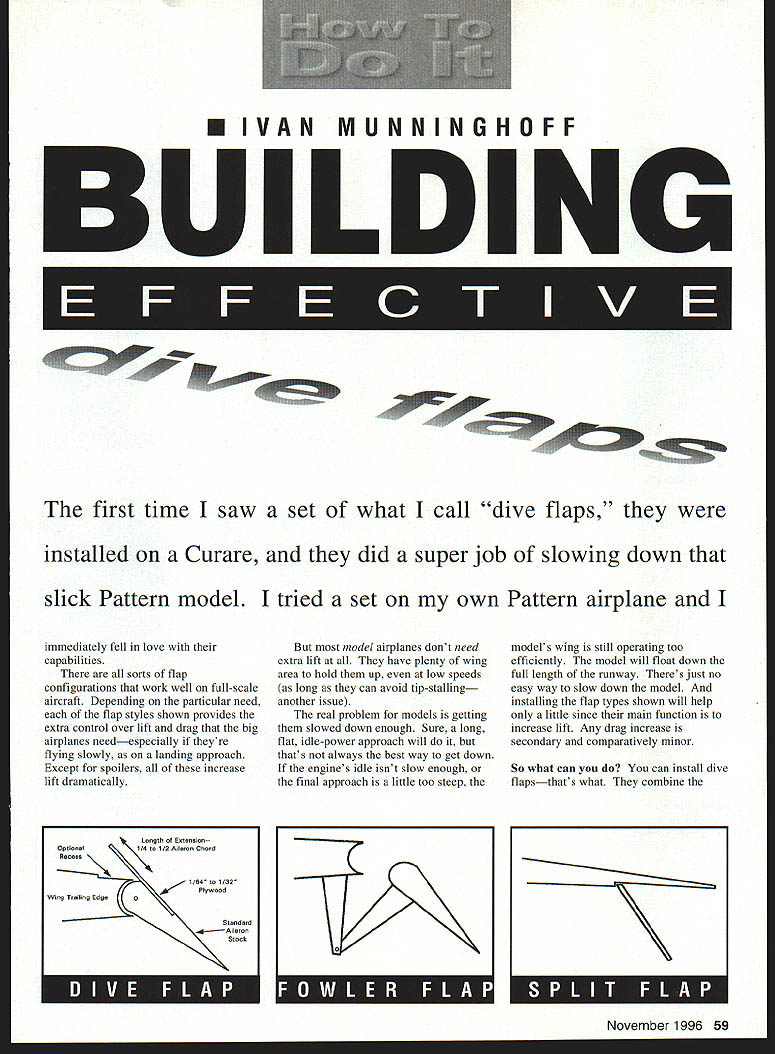
There are all sorts of flap configurations that work well on full-scale aircraft. Depending on the particular need, each of the flap styles shown provides the extra control over lift and drag that the big airplanes need—especially if they're flying slowly, as on a landing approach. Except for spoilers, all of these increase lift dramatically.
But most model airplanes don't need extra lift at all. They have plenty of wing area to hold them up, even at low speeds (as long as they can avoid tip-stalling—another issue). The real problem for models is getting them slowed down enough. Sure, a long, flat, idle-power approach will do it, but that's not always the best way to get down. If the engine's idle isn't slow enough, on the final approach a little too steep, the model's wing is still operating too efficiently. The model will float down the full length of the runway. There's just no easy way to slow down the model. And installing the flap types shown will help only a little since their main function is to increase lift. Any drag increase is secondary and comparatively minor.
So what can you do? You can install dive flaps—that's what. They combine the efficient drag-increasing aspects of the plain flap and the spoiler. The simple device can stop an airplane dead in its tracks. As the device is deployed, the aft portion goes down, providing a small increase in lift, while the top part goes up, providing a dramatic decrease in lift. The combination generates a huge increase in the wing's cross-sectional area, which in turn creates a huge increase in overall drag. Hence, deployed dive flaps will rapidly slow down a model. They're easy to build.
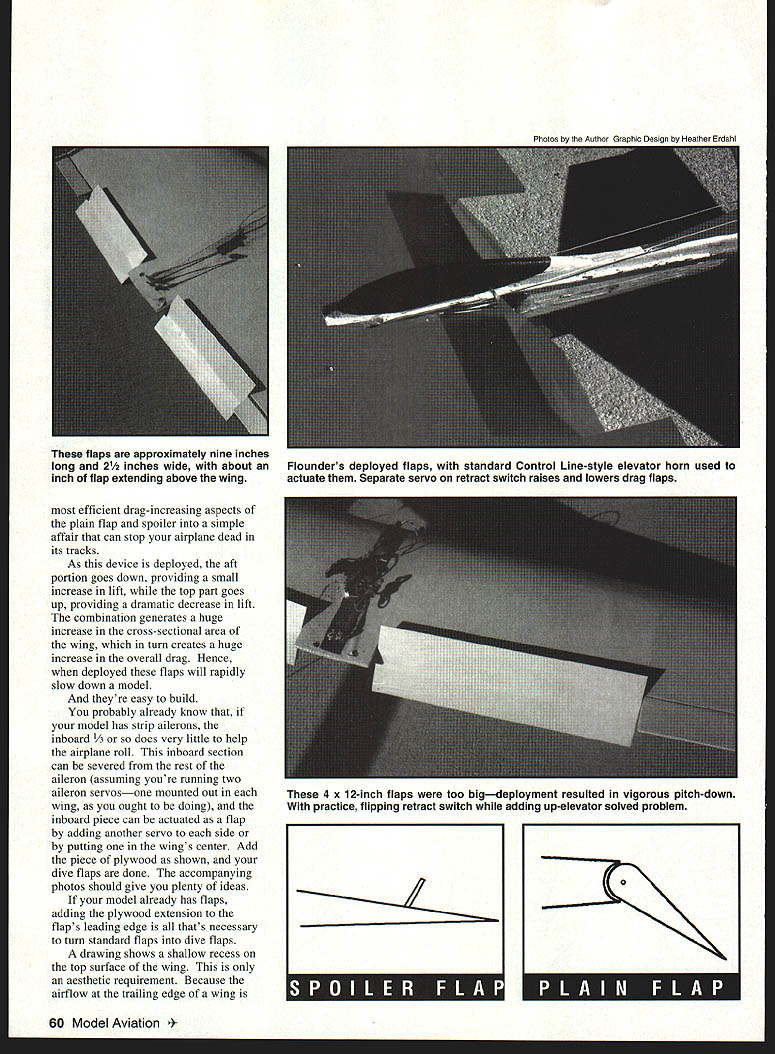
You probably already know that if a model has strip ailerons, the inboard portion does very little to help the airplane roll. The inboard section can be severed from the rest of the aileron, assuming you're running two aileron servos—one mounted outboard in each wing. The inboard piece can be actuated as a flap by adding another servo and putting the linkage into the wing center. A piece of plywood as shown in the dive-flap photos should give plenty of ideas. If your model already has flaps, adding plywood extension flaps to the trailing edge is all that's necessary to turn standard flaps into dive flaps. The drawing shows a shallow recess on the top surface of the wing as an aesthetic requirement; airflow over the trailing edge will never notice there's a thin piece of plywood laying on top. Don't believe it? Simply tape a piece onto the trailing edge of your current airplane and try it—you'll never know.
One word of caution: almost all flaps, regardless of type, will cause some sort of pitching tendency when deployed. The major effect a flap creates is extra lift; the nose will usually pitch up. Flaps also tend to blank out the stabilizer and the nose will usually pitch down. Seldom is the pitching tendency severe enough to be a problem if you're ready. Some radios have the capability to trim out changes.
Before first use of dive flaps on the low final approach, try deploying them at high altitude to see what happens and to prepare yourself for the actual landing. With bigger dive flaps, the drag can create problems. Be careful: if a flap is too large (a span greater than the stabilizer span), it might blank out the stabilizer and the airplane will rapidly point straight down. I've done it—it's an unpleasant surprise.
Limit dive-flap span to 2/3 of the stabilizer span and the pitching problems will be minimized. The latest model dive flaps can fly an idle, straight-down approach over the end of the runway at about 50 feet. I begin the pullout, and the landing is stopped less than 100 feet down the runway.
These dive flaps are very effective, and they're a blast to experiment with. Your friends won't believe the vertical four-point rolls on final approach!
Ivan Munninghoff 7815 Mallard Dr. Falcon, CO 80831
Transcribed from original scans by AI. Minor OCR errors may remain.

