
Building with Kids
By Dave Haught
Introduction
Introducing a group of kids into the world of modeling can be one of the most challenging, fun, educational, and rewarding aspects of your modeling career.
Every time I move to a new town I'm faced with a real dilemma at the new flying field. If I don't attract a bunch of kids when getting my model out of the car, starting the engine always does it. Suddenly, out of nowhere come zillions of kids. Curious kids. Kids full of questions. How is a person to fly in peace?
It happened again after our most recent move. One would hardly think that a small town of 500 souls would have so many kids—but out they came. The small size of the town made it even worse; the youngsters followed me home, pied-piper fashion. And my wife told me I couldn't keep them!
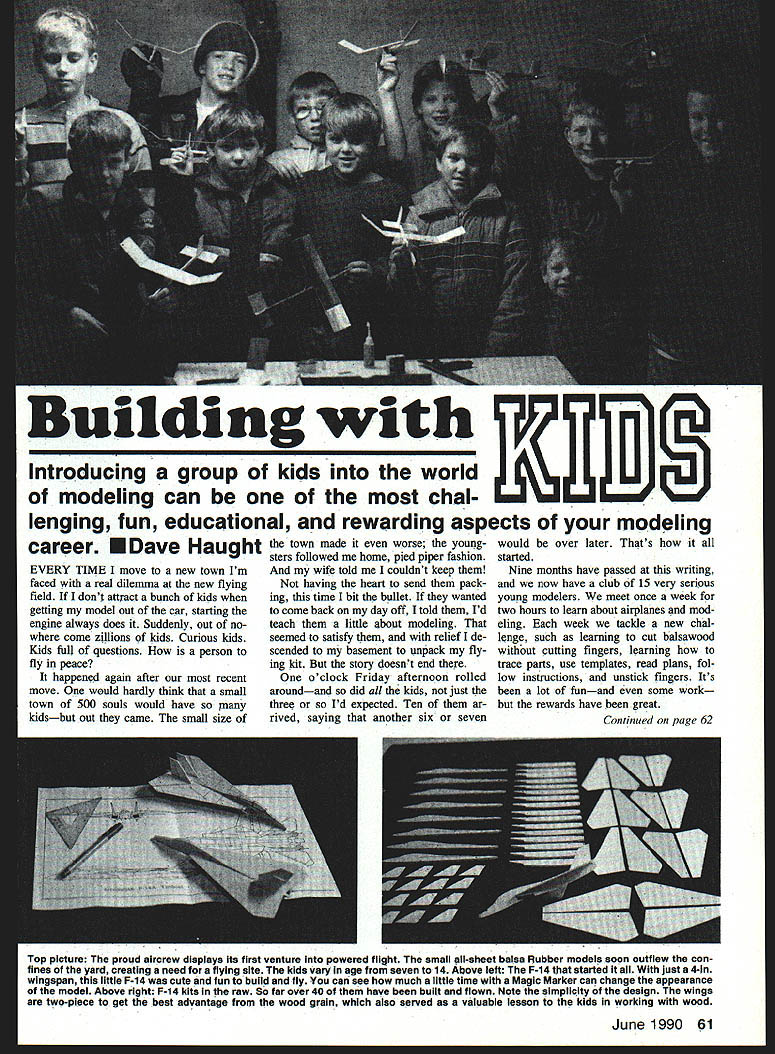
Not having the heart to send them packing, this time I bit the bullet. If they wanted to come back on my day off, I told them, I'd teach them a little about modeling. That seemed to satisfy them, and with relief I descended to my basement to unpack my flying kit. But the story doesn't end there.
One o'clock Friday afternoon rolled around—and so did all the kids, not just the three or so I'd expected. Ten of them arrived, saying that another six or seven would be over later. That's how it all started.
Nine months have passed at this writing, and we now have a club of 15 very serious young modelers. We meet once a week for two hours to learn about airplanes and modeling. Each week we tackle a new challenge, such as learning to cut balsa without cutting fingers, learning how to trace parts, use templates, read plans, follow instructions, and unstick fingers. It's been a lot of fun—and even some work—but the rewards have been great.
In what follows, I'll share some insights that emerged as my young builders' program took shape, not give you step-by-step directions on "how to build with kids." I'm convinced that the potential crop of young modelers is untapped. So many young people today are left without supervision. Planted in front of a television set much of the time, most of them are probably unaware that modeling exists. Very few are given the opportunity to learn about building and flying models, skills which can be extremely helpful to them both now and in the future.
Patience, planning, coordination, design, sense of accomplishment, even good behavior are just some of the many valuable lessons to be learned amid the balsa and shavings. The list is endless; I'm sure you can make up your own. Modeling taught me more than I could ever relate. It's helped me in my work and in my life.
Like many other seasoned modelers (has it really been 26 years?), I learned the fundamentals from my dad. He helped me. I built several models before I started one of my own. Today there simply aren't enough modeling dads and moms to go around.
Finding Interest
The recent advent of RC cars, and the quickness with which they've saturated the market, has helped spark a lot of interest in other RC fields. I believe that out there among those car drivers are a lot of interested and anxious kids who would really like to build and fly a model airplane. They're simply not exposed to those who can help them get started.
I had fifteen-plus eager youngsters for two hours a week in one basement, with no idea of what it takes to build a model but lots of enthusiasm. Now that I had them, what did I do with them? To start with, I fell back on my library. After handing each kid a stack of modeling magazines to look through, my mind raced over all the available beginner series kits I could think of. Comet used to have a neat set in which the beginner began with a hand-launched glider and progressed to a cabin rubber job. I remembered that it had cost about $20. But then I also remembered that these kids didn't see $20 very often, let alone $5.
As I was ruminating, suddenly a picture of a ducted-fan F-14 was thrust into my face. "I want to build one of these!" the would-be aviator announced, my anxiety mounting with his excitement.
"It'll take a few years to build one like that," I had to tell him, scrambling frantically through my Sig catalog for some alternatives. When I found what I was looking for, the pictures of free-flight hand-launched gliders and other simpler models didn't exactly bring down the house with oohs and aahs. Which wasn't too surprising.
That's the first hurdle I had to surmount. Kids want a model that looks like the real thing—and unfortunately, to them that means jets, F-14s, Blackbirds, and B-1 bombers. This was going to be a bigger challenge than I'd imagined. We spent the afternoon looking at books, magazines, and a video of Byron's World War II demonstration. That held them for the first day. Day two would have to be good to keep them interested.
Designing a Bridge: The F-14 Glider
How was I going to bridge the gap between a beginner's hand-launched glider and an F-14? I'd have to sleep on it. In the meantime, my 10-year-old was quicker than I. "Dad," he asked, "why not make F-14 gliders?"
My immediate reaction was, "Be quiet and eat your oatmeal, kid." My next reaction was, "Hmmm, why not build F-14 gliders?"
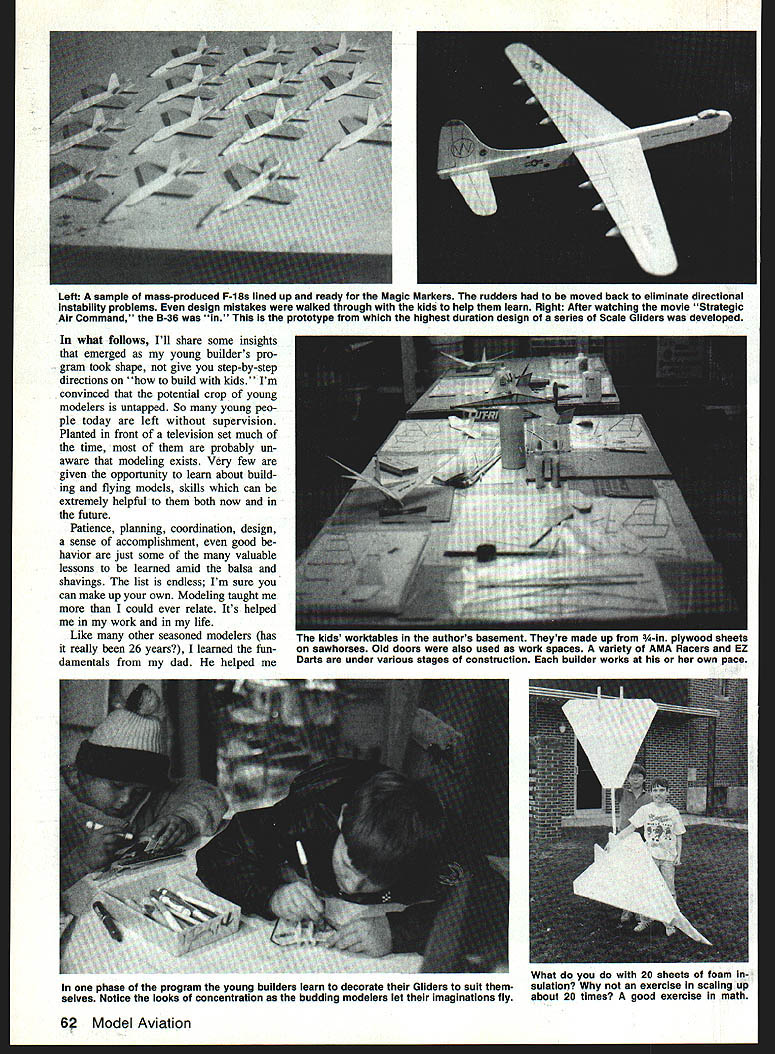
Down to the basement think tank for a serious session. An F-14 three-view—yeah, there's a set around here someplace. Hmmm, if I made a profile of the fuselage and the engines, a single-sheet wing, swept-back configuration, incorporated the stabilators ... yes, it just might work.
The balsa began to fly, and within 30 minutes the first F-14 glider was going through its paces among the basement boxes. It flew great! With a rubber band on a stick it would make a terrific catapult glider. That's it, a catapult! After all, an aircraft carrier has two of them.
A piece of 1 x 12-in. wood stacked in the corner was attacked by the bandsaw and quickly became a carrier deck. The ship's center tower was swiftly hewn from a chunk of 2 x 4, and two eyebolts from the "bow" became the catapult anchors. Clothespins were spirited from the clothesline for triggers, and with a quick coat of black and gray paint the carrier was ready for "sea trials." My oldest son immediately took over the testing, and the F-14 program was born.
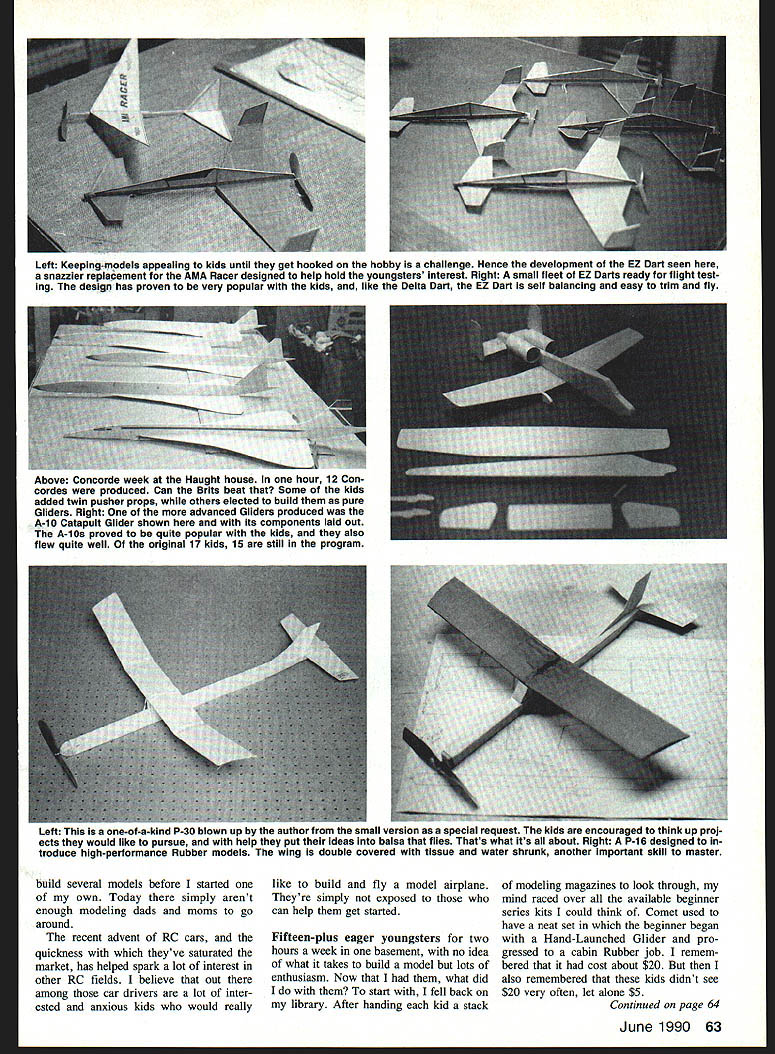
Engineering the F-14 for kid construction was the next priority. I decided to make "zap kits"—all precut parts, ready to assemble with CA (cyanoacrylate) glue. The bandsaw made quick work out of producing 20 kits. We were ready for our first session with eager kids the next Friday after school. Seventeen showed up. The kids learned the names of the parts, how to sand, detail, and even color with markers. Using the color views in the books as inspiration, quite a few of them came up with some pretty exotic F-14s. The models were balanced—another important lesson—and test gliding commenced. We saw stalls, dives, good tosses, and not-so-good tosses.
I had no idea how excited my young fliers would be about the carrier. On a cold, breezy October day, 18 F-14s and pilots (I had to build one, too) were out for the launching. We set the deck, loaded the carrier catapults with two F-14s, turned our ship into the wind, and launched.
That session lasted over three hours. The unrestrained enthusiasm and the joy in those kids' eyes was the best paycheck I ever had. They were hooked. The F-14s led to F-18s. Then a longer flight time was desired, and the hand-launched glider finally made the "Let's build one of these!" list.
Progressing Skills and Projects
All winter long, each week brought a new design and new lessons. Neither the bandsaw nor my imagination got a break. A rubber ROG introduced powered flight to the kids. At week six, we collected 75 cents from each member and bought a bundle of AMA Cubs, their first real kits.
Building the bigger and more complex models began to take two Friday sessions, which helped ease the pressure I was under to come up with something new each week. Also, with the growing complexity of construction the young builders learned new patience. They became accustomed to taking more and more time to finish a given model.
The sequel to building, of course, is flying—and with flying inevitably comes breakage. That was a real nemesis for me at first, since the kids were often upset by having to repair their prize creations. But they slowly got used to the idea that models crash and break. They learned about repairing and rebuilding—and realized, finally, that what got broken could be fixed. That relieved a lot of tension.
Our models were built to fly. That was our goal. Each prototype I developed for the kids to build was a little more complex. I began to challenge their imaginations and technical skills by making them look for simpler solutions—ways to make the models stronger or build them lighter. Now most of them can think and build for themselves.
When you have a group of youngsters that's open to all ages, you'll notice the vast difference that a year or two can make in development. You have to learn to meet each kid at his or her level and bring him up to speed with the others. That's where a good helper comes in handy. I recruited my most experienced member to become a helper in exchange for access to my scrapbox. He loved it; and it freed me up to spend more time with the members who most needed help.
Money, Materials, and Community Help
Money was another problem right from the beginning. After the first F-14, I priced each model at 50 to 75 cents. I did this more to create a sense of value in the kids and to make them feel they had an investment in their work, though, than to cover costs; and kids without funds were never turned away. Those who couldn't pay were given little jobs to work off the cost of their models. Imagine not having to mow my lawn for a whole year!
As the models got more expensive for me, I found that buying balsa in bulk helped. Bundles of balsa became the rule, and fellow modelers who'd heard about our group were quick to help. Some sent stacks of balsa and left them in my car, others mailed rolls of tissue paper at no charge. Thanks, Greg!
The owner of a hobby shop in St. Cloud that I visited on a business trip gave us a box of old Cox .049s, props, and wheels. That was a gold mine. It helped the kids who couldn't afford an engine get into control-line flying.
The big project for the spring was a series of control-line Top Fun models. So far, 12 have been finished and flown. After 20 flights, the pilots earn Ace status and receive an AMA medal. They then get to choose a model of their own to build.
Of the 17 kids who started on that day last fall, 15 have stuck it out. They're already skilled modelers and control-line and free-flight fliers. Much to my surprise, the two girls in our club are still with us and enjoy it as much as the boys.
Our game plan now is to get accustomed to flying with two pilots in the circle, leading up to mouse racing and, by the fall, 1/2A combat. All of us have had a wonderful time and learned a lot.
Advice for Others
For others who think they might be willing to tackle a project of this sort, let me offer some pointers:
- Plan on having fun. Don't be too intent on making it mainly a learning experience; try to keep it loose and fun.
- Discipline is important—the kids need to learn to respect you and the tools and materials they're working with.
- Keep it affordable.
- Keep the projects and objectives simple and reasonable.
- Try to assemble a file of potential projects well ahead of time.
- Use the natural leaders and faster builders as helpers.
- Make up a workbox for each modeler. Use a shoebox or the like, and fill it with a knife, emery board, pins, glue, etc.
- Share the fun. If you have a similarly inclined modeling friend, do it together.
- Meeting at a regular time and place is essential.
Most important, relax, have fun—and remember what you're giving these kids!
I'd be glad to answer any questions that you might have.
Dave Haught 302 West Main Ceylon, MN 56121
Good luck, and keep 'em building!
Transcribed from original scans by AI. Minor OCR errors may remain.

