
To Buy a Field
GOOD FLYING SITES are becoming increasingly difficult to find, and the problem is certain to get worse. As a result, more and more clubs are beginning to wonder if it is possible to purchase their own field in order to solve this problem permanently. If your club is starting to think along those lines, perhaps you can benefit from some of the things we learned and from our experiences (both good and bad) in buying a field. They may help you to avoid some of the mistakes we made in earlier attempts.
Our club is the WRAM (Westchester Radio Aero Modelers) of New York. In 1978 we were successful in purchasing an excellent site and obtaining a special use permit for the purpose of flying RC models. The techniques we used should apply equally as well in other locations, and to control-line or free-flight fields. Before this success, we had a bad time in a previous attempt to purchase a field, but we learned a great deal from that experience.
Preconditions
Although money is the first thing that comes to mind when you think of purchasing a field, there are several other factors that you should resolve before you even need to consider the method of financing. Among these:
- You must be incorporated. In general, a club cannot own land or borrow money; a corporation can. If you are already incorporated, check your charter to see if it permits this.
- You need to have a clear idea of what you are looking for in a site before you start to look—otherwise you won't be able to recognize it if you find it. This includes, for instance, how much land you need (in acres), how far away it can be from some fixed point (probably expressed in terms of travel time), etc.
- The membership really must be dedicated to purchasing a field.
- Professional financial advice is needed. This can be from a banker or the treasurer/controller of a corporation or institution who can advise you on the viability of your financial plan and help you arrange necessary loans.
- A lawyer should be engaged who is knowledgeable in local real estate law and has had experience in obtaining local permits. Do not select this individual until you have picked the site, because local really means local.
Financing
You probably are still concerned about where the money is to come from, so let's look at several options for financing a flying field. Here are several points of general information for you to consider in your preliminary evaluation of whether or not to buy.
- In general, banks do not like to loan money on unimproved land. You can get around this by having some of your members guarantee the note (in effect they become co-signers). This is the way we did it.
- Frequently the seller will finance the deal himself, and he may only want a small amount down (generally less than 30%) with the rest spread out over a number of years. In some cases this brings him some tax advantages.
- Borrow the money from yourselves. This can probably best be done by selling bonds to members. These bonds may be retired (paid off) at future staggered dates. Bonds may also be held permanently by each active member until he or she leaves the club, then be sold to an incoming member. This method becomes, in effect, an initiation fee.
- Perhaps several affluent members of the club could form a separate corporation and purchase the site, then lease it to the club for an amount equal to the taxes plus reasonable interest on their investment.
- A combination of two or more of these methods.
Your financial advisor may think of some others, and he can recommend the one that is best for you. One thing that you will certainly need for your own information, even if the lender doesn't require it, is a financial statement of the club's income, expenses, assets, and liabilities for the past several years — and a projection of the next several years. It should show estimates of the field purchasing and carrying costs, regular expenses, and the source of the funds to cover all of these expenses. Your financial advisor will be able to help put this together.
Our Club and Background
Before we start to discuss our experiences, a few words about our club will help you understand our circumstances. Our center of membership is about 35 miles north of Times Square in a hilly, wooded, heavily developed, expensive real estate area; this is hardly ideal for locating a potential site. During the 20-year history of the club we had found (and lost) 11 different flying sites. On the positive side, we have been holding the WRAM's Jamboree each year since 1968, which provides us with a source of income beyond our dues. Hence, we had a small nest egg dedicated to purchasing a site.
1975 Attempt — Initial Failure
In early 1975 we located an acceptable site, hired a local lawyer, and applied to the Town Board for a permit to use the site for flying RC airplanes. We were required to advertise our motion in the local paper prior to the meeting. On the night of the meeting two of us (the then-club president and I) attended in order to answer any questions which might arise. A few local residents who had seen our notice in the paper also attended and asked a number of questions that centered on noise, safety, and traffic. Our president (who, fortunately, was a lawyer) did an excellent job of handling the questions. After the questions and some negative comments by the residents, the Board tabled consideration of our motion until the next monthly meeting.
At this next meeting the few residents from last month had grown into a very large group which overflowed the meeting room. They were represented by their own lawyer and appeared with a lengthy petition. Although our president did a masterful job of answering their questions and countering their objections, the final outcome was never really in question. The Board flatly denied our motion, unanimously.
What went wrong? What should we have done differently? In reviewing the situation one failure on our part seems clear—we had not done our homework. We had allowed the board and residents to form their own untrue conclusions about us and our activities, then we attempted to counter those conclusions during the meetings. The effect was that we went to the meetings ill prepared and asked, "May we fly our planes in your territory?" We had not presented to the board or residents any advantage to them if they approved our permit. Viewed in this light, the result was not surprising.
Finding a New Site and Negotiations
We now had to start looking for another suitable site. Finding land can be done by looking around yourselves or by contacting real estate agents who specialize in "acreage." We did both, plus trying several other techniques. The site that we finally purchased was in Patterson, NY (a different area than our previous attempt). It was located by one of our most loyal members who was searching on his own one rainy Sunday afternoon. It was perfect!
The WRAM appointed a team of Tom Moore and me (at that time treasurer and president) to represent the club in all matters concerning this purchase attempt. We made an opening offer to the owners through their real estate agent on February 25, 1977.
After you have selected a site, the next step is to negotiate the price, terms and conditions (and perhaps the boundaries) with the current owner(s). Before you begin this process, I suggest that you go back to your financial advisor and review this specific situation with him.
Customs vary in different locations, but in many areas you give the owner a small sum of money with the opening offer (earnest money or a deposit). This check should be accompanied by a letter of transmittal, stating its purpose (to bind the offer) and instructing that the same be returned if the offer is not accepted (and a purchase contract signed by both parties) by a specific upset date.
There may be a series of offers and counteroffers between you and the owner. When you finally agree on the price, you will need to engage a local lawyer to represent you. Either your lawyer or the seller's lawyer will draw up the purchase contract, and the other will review it. Be sure to have your financial advisor review it, also.
When all are in agreement, both you and the seller will sign. At this time the seller will normally expect to receive a down payment of about 10% of the purchase price, unless you have some other agreement with him. The signer for your club must be an officer, and he will need the club's corporate seal. Your lawyer will have several points that he may wish to include in the contract for your protection, but be sure that these three are included:
- That the contract is contingent on obtaining a suitable permit by some specific upset date.
- That the contract is contingent on obtaining suitable financing by the same upset date.
- That interest on the down payment will be paid to you in the event the contract is nullified.
In March a series of meetings began between our negotiating team and the owners. After some progress in the negotiations, it was decided that we should go to the Patterson Town Board to get its feeling about our intended use of the land. A request was sent to the board asking for a spot on the agenda; in the meantime I began to gather the documents which we would use in presenting our case. Copies of these documents were sent to various town officials. The negotiations continued, and by early April we were getting close enough to an agreement with the owners to hire a lawyer experienced in local real estate law and permits.
Working with the Town — Presentations and Demonstration
On April 13, 1977 Tom, the owner's lawyer and I went to the Patterson Town Board meeting. The owner's lawyer briefly explained to the board that the WRAM wanted to subdivide an old farm and fly model airplanes over a 75-acre portion of it. I distributed a packet of documents to each board member which contained the following:
- A letter listing our plan for the site (a football-field-size grass runway, a dirt road and parking area, a Port-A-John, etc.), and pointing out the advantages to the town ("...no services such as schools, water, electricity, sewer, or garbage pickup are required").
- A two-page write-up which described the WRAM club itself, a typical RC plane, and the flying activity. Responsibility, maturity, and safety were emphasized.
- A technical report prepared by two of our members on noise levels with an excellent non-technical recap.
I reviewed our plans for the board and audience, and emphasized the advantages to the town. A good number of questions were asked on noise, traffic, safety, TV interference, and the planes themselves. The board members and the audience seemed interested in the whole subject, so we asked them if they would like to see one of the planes (fortunately, Tom had brought a beautiful scale model along in his car). They were interested, so we brought his Waco biplane in, put it on the table in the center of the meeting room, and wiggled its surfaces. Then we let the board members give it a try.
Bringing that model was a stroke of genius on Tom's part—we never went to another meeting without a scale model, and it generally was brought in and "wiggled." We answered any and all questions as honestly as we possibly could.
There still was some concern about the noise and the activity in general, and the town supervisor (who was the board chairman) asked if we could do a flying demonstration on the property so that they could judge for themselves. We immediately agreed and set a date. The board also asked for, and received, copies of our flying rules. In summary, it went very well, quite in contrast to our 1975 experience. This time we had done our homework!
We conducted a flying demonstration on the site in early May. This was a carefully organized affair from our standpoint. We had about a dozen selected members present, each with an assigned task. There were three or four pilots, the best fliers we had in the club; five or six mechanics to help the pilots and to hand-launch the planes (the site was knee-deep in hay at that time); and five or six talkers.
Pilots were instructed to fly slow and steady with maximum precision and control. Mechanics (typically the owners of the stable, solid planes that we used in the demo) were to assist with the planes. Talkers were to explain to the guests what was happening and to answer all questions; these members were selected for their communicative skills.
We took our decibel meter along. The guests were the members of the Town Board, the Zoning Board, the Planning Board, the city engineer, and the local residents. The talkers instructed some of the guests on using the decibel meter, and they took readings at various points during the flights. The pilots flew one, two, and three planes simultaneously. We even flew three .60-powered models at one time (which our club rules do not allow) at the request of the town officials. At the conclusion of this flying demonstration, the guests were satisfied that neither noise nor safety were a problem.
We met with each of these groups, many of them several times. We made our presentation to them, answered their questions, showed them our plans, ran an AMA movie on RC, demonstrated one of Tom's planes, and came back the next month with whatever additional information they requested. Among the data we were asked to supply at various times to various boards were:
- A contour map of the entire site with engineering drawings of the construction work we proposed.
- An engineering/environmental report to be done by a licensed engineer.
- Many copies of our club flying rules.
- Many copies of the two-page write-up we gave out at the first meeting.
In every case we were treated in a friendly and helpful manner. The various boards were in favor of our becoming neighbors, but they were very careful that all interested residents had an opportunity to hear about the proposal and to express their views. It took a lot of hours and many, many presentations. During this time the zoning ordinance of the town was amended to "permit the granting of Special Use Permits" to model airplane clubs who are purchasing not less than 50 acres.
Success, Closing, and Construction
Success. On January 27, 1978 our special use permit was passed by the board unanimously.
Our flying rules were made a part of the permit. On April 7, 1978 we closed on the property — it was finally ours. (It had taken 14 months from the time we made our opening offer!) We had a party for all members and their wives that night to celebrate.
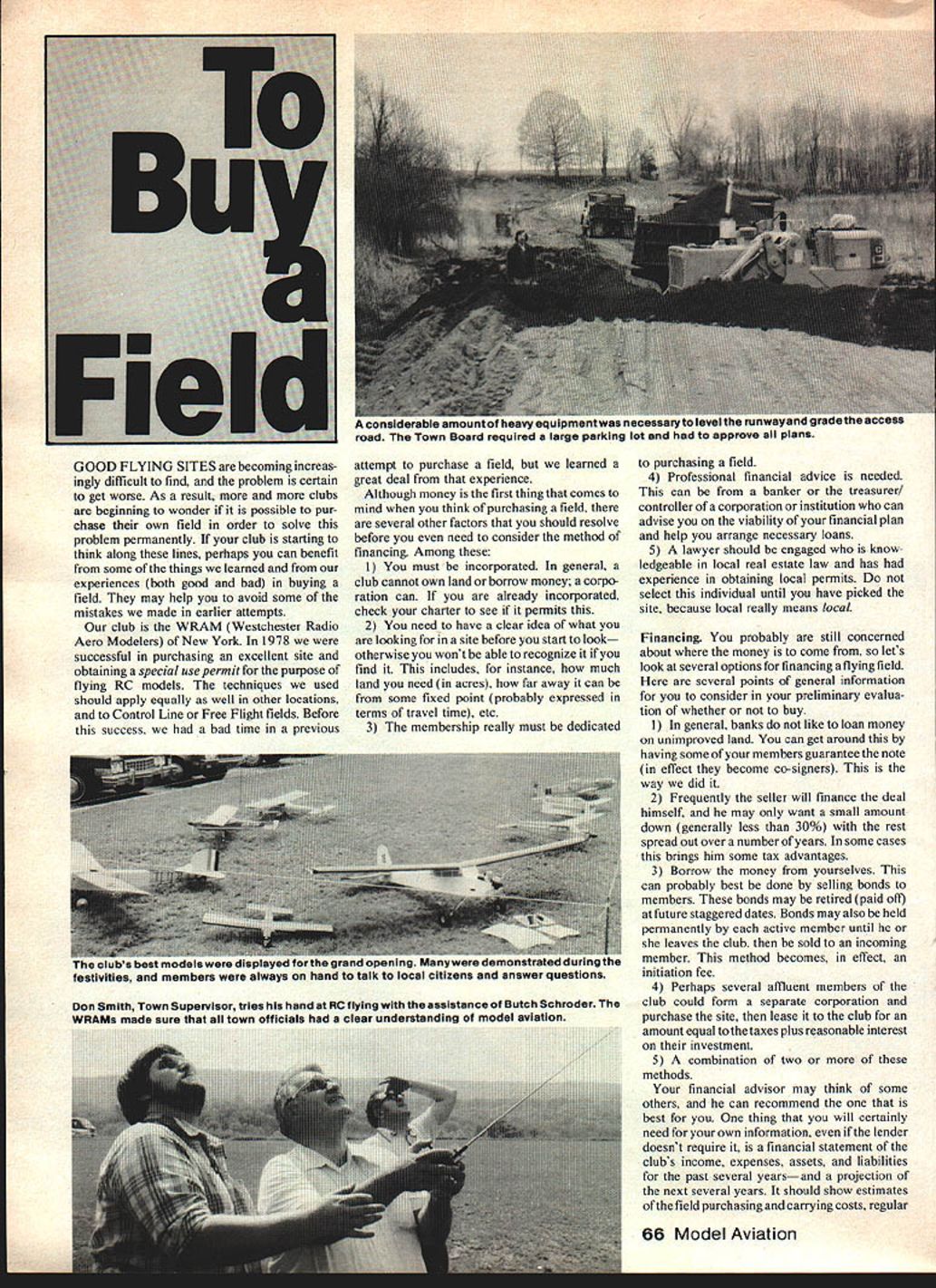
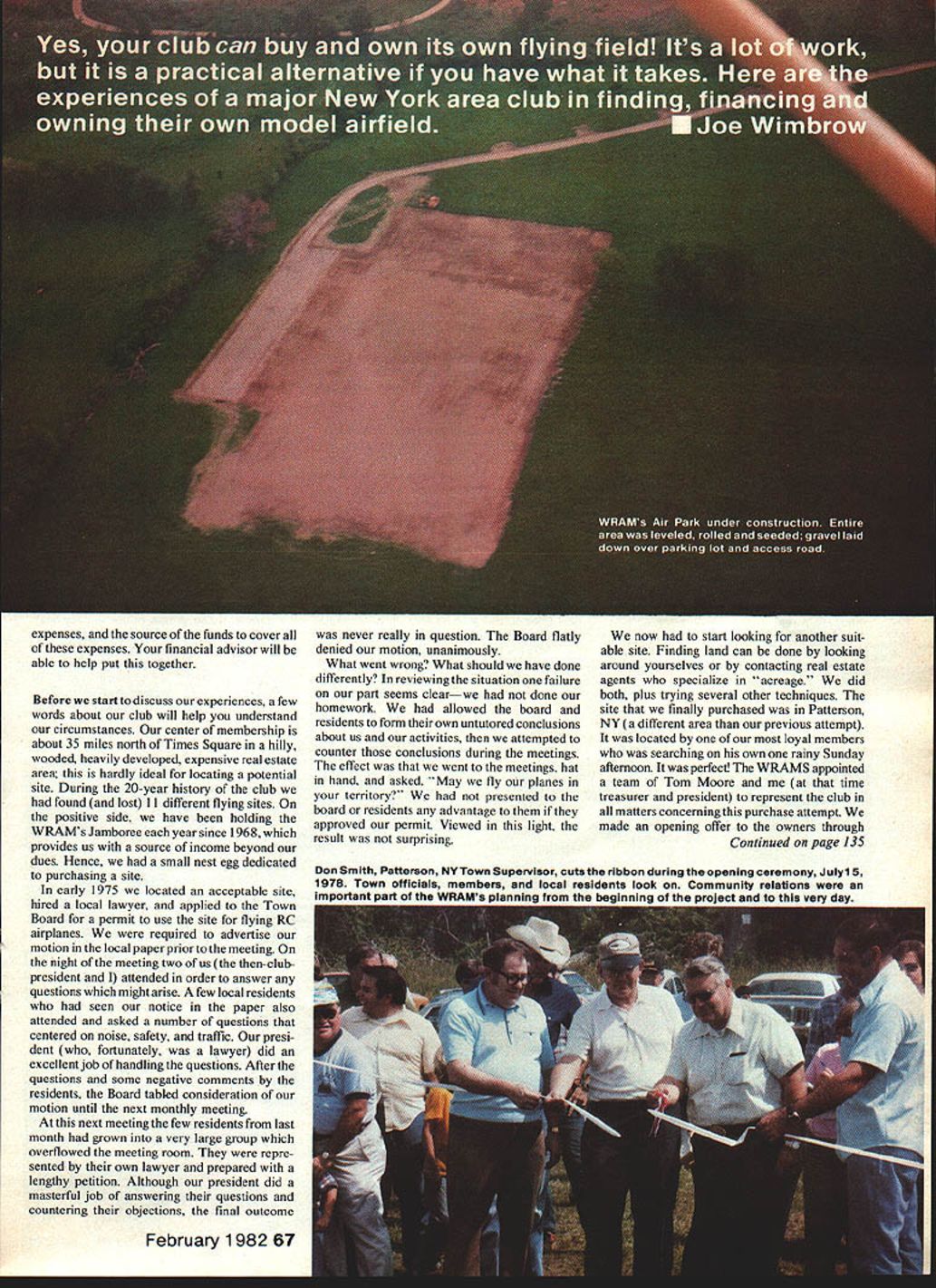
We started construction work on the field as soon as possible afterwards. We needed to:
- Build a gravel road about half a mile long.
- Put up some fences and gates.
- Make a 25-car parking lot (a requirement of the Zoning Board).
- Level and seed a runway.
- Connect our road to the state highway.
We expect to be in the Town of Patterson for a long time, and we recognize that good public relations with the town officials and the residents is critical to a happy relationship. A dedication and grand opening was held on July 15, 1978. The Town Supervisor cut the ribbon to officially open WRAM Air Park. He also flew an RC plane for the first time. We contacted all of the local papers and radio stations and got excellent response. They helped make a lot of good public relations for us.
Operation and Public Relations
At the time this article appears, we WRAM have owned our own field for four flying seasons. To date we have experienced no major problems, only a few minor irritations. I believe that our relationship with neighbors and the town officials is good.
We continue to emphasize good public relations by inviting residents to visit the field. We make it a point to talk to every spectator that we see in order to make him or her feel welcome. We enforce our flying rules vigorously, and we try not to fly outside our own airspace.
In conclusion, owning your own field is great, but you have to keep working at it.
Conclusion and Further Information
To those of you about to embark on a similar project, let me wish you all possible good luck and success. A detailed, 56-page document with copies of all the significant papers that we used to obtain our permit and to purchase/finance the property was sent to AMA HQ several months ago as requested. This article has been extracted from that document. If you would like a complete copy, contact Geoffrey Syles, Flying Site Director, at AMA HQ. There is a $5 charge to cover the cost of copying and postage.
Transcribed from original scans by AI. Minor OCR errors may remain.

