
Carl V. Carlson: Gas Model Pioneer
Dave Ritchie
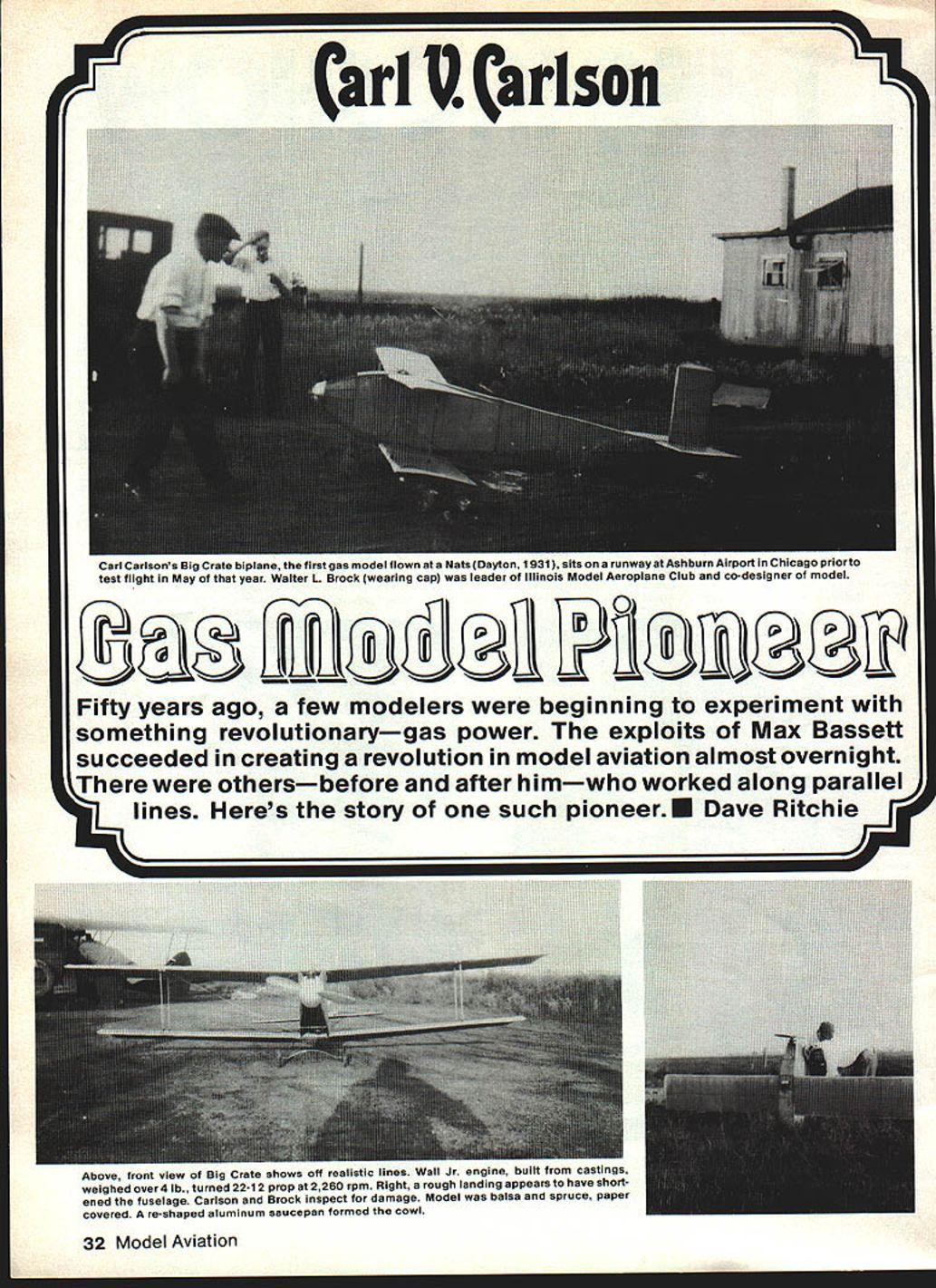
"In 1931 it is known that Carl Carlson of Chicago entered a gas model plane for a record flight, even though there was no event scheduled in that year's Nationals. His plane had a span of 11 ft. and weighed 9½ lb. Unfortunately, it crashed shortly after takeoff, so no record was established."
Introduction
Fifty years ago, a few modelers began experimenting with gas power. The exploits of Maxwell B. Bassett helped create a revolution in model aviation almost overnight. There were others who worked along parallel lines. This is the story of one such pioneer, Carl V. Carlson of Chicago.
Earliest records and the 1934 Nationals
A brief notice in The History of the Academy of Model Aeronautics records Carlson's 1931 appearance at the Nationals but gives few details. Further research turned up a 1934 listing of official NAA model flight duration records in Victor R. Fritz's How to Build Model Airplanes. That listing shows Carl V. Carlson (Chicago, Ill.) and Maxwell B. Bassett (Philadelphia) as the only two record holders in the Class B (gasoline engine) category.
- Bassett's time: 21:57 (Senior division—then under 21), corresponding to his Texaco Trophy win at the 1934 Akron Nationals.
- Carlson's time: 6:48.5 (Open division—contestants 21 or over), recorded at the 1934 Akron Nationals.
Newspaper accounts of the Akron meeting confirm that Carl V. Carlson, age 21, made several official flights; his longest (6:48.5) won the Open class competition. The 1934 Nationals was the first to allow contestants 21 or older, making Carlson's mark the first National Open Gas Free Flight record.
The Big Crate series
Carlson began designing large models around 1930–31 and built a series he called Big Crate.
- Big Crate (early biplane): Designed to provide sufficient wing area in a manageable span to support the heavy engines then available. Carlson made three flights in the Big Crate; each resulted in some damage. One flight was at the 1931 Nationals in Dayton—the first known attempt to fly a Free Flight gas model at a National contest.
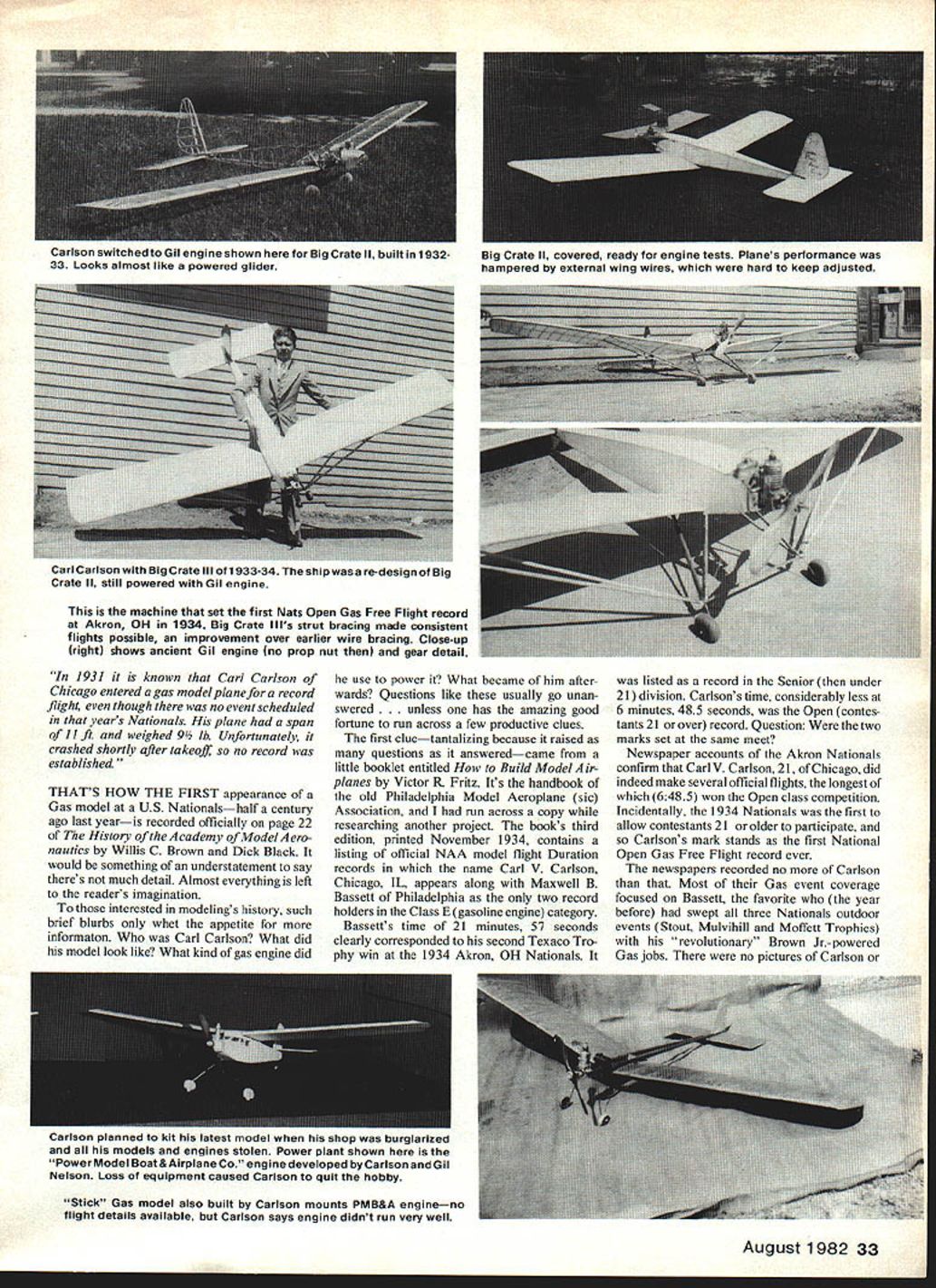
- Big Crate II (1932–33): A sleek, wire-braced low-wing model of about 9 ft. span. Wire bracing proved difficult to keep in adjustment and limited the model's success.
- Big Crate III (fall 1933 redesign): Rebuilt with strut bracing, which proved far more reliable. Powered by a Gil engine, Big Crate III was the machine that set the first Nationals Open Gas Free Flight record at Akron in 1934. The strut bracing made consistent flights possible—an improvement over earlier wire-braced designs.
Engines and technical work
Carlson experimented with several engines and collaborated with other local modelers and inventors.
- Wall engine: Elmer Wall of Chicago designed a successful small engine sold as kits of drawings and rough castings. Carlson was able to borrow one for use in the early Big Crate tests.
- Gil engine: Developed by Gilbert (Gil) Nelson of Chicago; Carlson obtained a Gil engine in 1932 and designed Big Crate II around it. The Gil worked "fairly well" by the standards of the time.
- PMB&A engine (Power Model Boat & Airplane Co.): Carlson and Gil Nelson developed an engine sold under PMB&A; Carlson called one early PMB&A engine a Power Model Boat & Airplane Co. unit and commented that it "didn't run very well."
- Brown Jr.: By the mid-1930s Carlson had acquired a Brown Jr. engine, commonly used by others such as Bassett.
Carlson and Nelson attempted to develop a smaller, lighter engine than the Gil. A few examples were sold by the Power Model Boat & Airplane Co. around 1934–35, but the smaller engine was not a commercial success.
Kit business and the burglary
Between college and engine work, Carlson owned and operated a small model-airplane kit manufacturing business, selling mostly solid and rubber-powered kits. He designed a high-wing cabin model intended to be marketed as a kit for the smaller engine, but the engine's failure prevented that model from being flown.
Late in 1934 Carlson's shop was burglarized; all his model kits and gas engines were stolen and never recovered. The theft ended his active involvement in the hobby. Carlson returned to school full time and graduated with an aeronautical engineering degree.
Professional career
Carlson graduated from the University of Michigan with an AE degree in 1937 and embarked on a long career in aviation and related engineering fields.
- Early job: Chief Engineer at Howard Aircraft Corporation, St. Charles, IL.
- 1940s–1950s: Operated his own steel products company and began specializing in design and construction of aircraft hangars, maintenance docks, fueling docks, and other support systems for commercial and military airfields in the U.S. and abroad.
- 1960s: As head of his own engineering firm, managed installation of environmental control systems at 10 Minuteman missile bases in the Midwest.
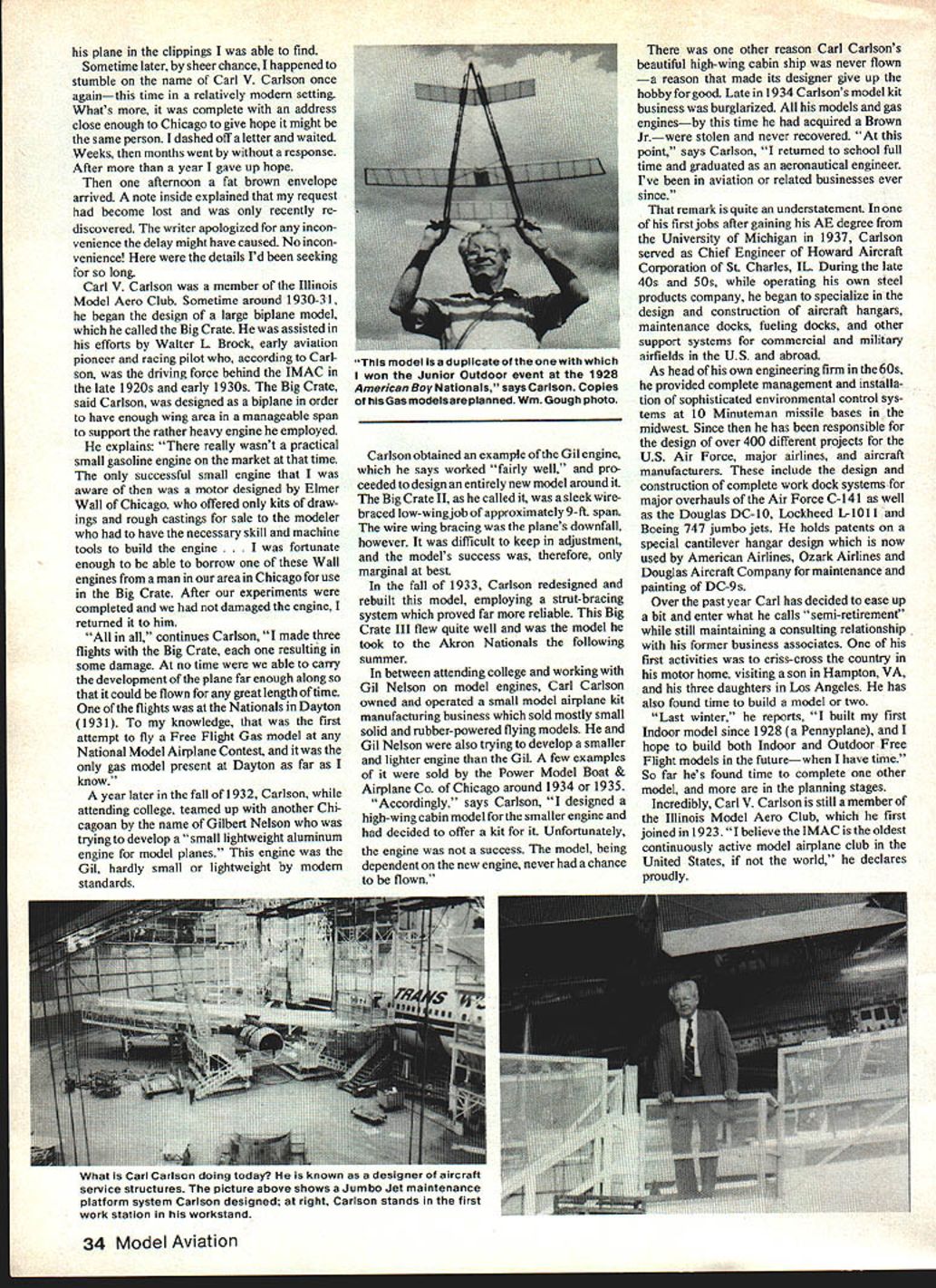
- Subsequent projects: Responsible for more than 400 projects for the U.S. Air Force, major airlines, and aircraft manufacturers. Designed complete work-dock systems for major overhauls of the Air Force C-141, Douglas DC-10, Lockheed L-1011, and Boeing 747.
- Patents and designs: Holds patents on a special cantilever hangar design used by American Airlines, Ozark Airlines, and Douglas Aircraft Company for maintenance and painting of DC-9s.
Later years and return to modeling
In semi-retirement, Carlson maintained consulting relationships and traveled the country in a motor home visiting family. He has occasionally returned to model building:
- Winter project: Built his first indoor model since 1928 (a Pennyplane).
- Plans: Hopes to build both indoor and outdoor Free Flight models when time permits.
Carlson remained a member of the Illinois Model Aero Club (IMAC), which he first joined in 1923. He believes IMAC is the oldest continuously active model airplane club in the United States, if not the world.
Transcribed from original scans by AI. Minor OCR errors may remain.

