
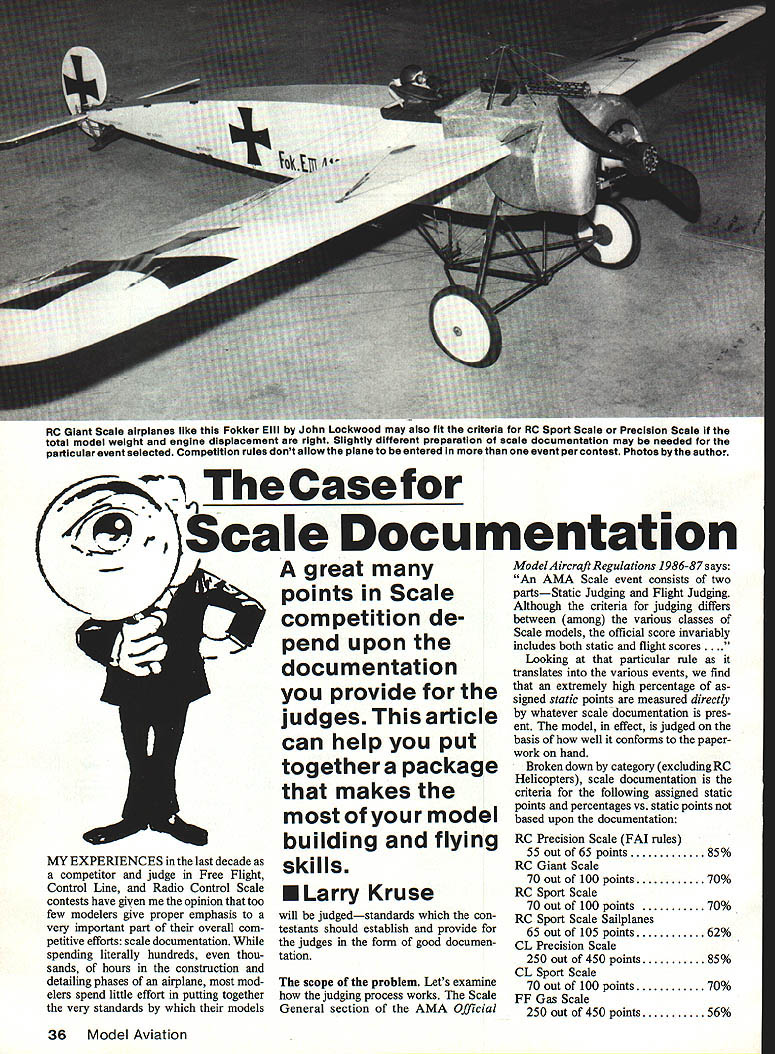
The Case for Scale Documentation
A great many points in scale competition depend upon the documentation you provide for the judges. This article can help you put together a package that makes the most of your model building and flying skills.
Larry Kruse
My experiences in the last decade as a competitor and judge in Free Flight, Control Line, and Radio Control Scale contests have given me the opinion that too few modelers give proper emphasis to a very important part of their overall competitive efforts: scale documentation. While spending literally hundreds, even thousands, of hours in the construction and detailing phases of an airplane, most modelers spend little effort in putting together the very standards by which their models will be judged—standards which the contestants should establish and provide for the judges in the form of good documentation.
The Scope of the Problem
Let's examine how the judging process works. The Scale General section of the AMA Official Model Aircraft Regulations 1986–87 says: "An AMA Scale event consists of two parts—Static Judging and Flight Judging. Although the criteria for judging differs between (among) the various classes of Scale models, the official score invariably includes both static and flight scores ..." Looking at that particular rule as it translates into the various events, we find that an extremely high percentage of assigned static points are measured directly by whatever scale documentation is present. The model, in effect, is judged on the basis of how well it conforms to the paperwork on hand.
Broken down by category (excluding RC Helicopters), scale documentation is the criteria for the following assigned static points and percentages vs. static points not based upon the documentation:
- RC Precision Scale (FAI rules) — 55 out of 65 points — 85%
- RC Giant Scale — 70 out of 100 points — 70%
- RC Sport Scale — 70 out of 100 points — 70%
- RC Sport Scale Sailplanes — 65 out of 105 points — 62%
- CL Precision Scale — 250 out of 450 points — 56%
- CL Sport Scale — 70 out of 100 points — 70%
- FF Gas Scale — 250 out of 450 points — 56%
- FE Rubber Scale — 80 out of 100 points — 80%
- FE Peanut Scale — 18 out of 27 points — 67%
As the table indicates, clearly over half the static points in some categories and three-quarters of the static points in some categories are tied directly to scale documentation effort. Scale documentation thus comes into sharp focus as a major determinant of who ends up in the winners circle.
In examining the scale documentation found typically at any contest, a judge will find any combination of the following variables in three major areas:
Written Documentation
- Nonexistent.
- Minimal. Gives only historical background of the aircraft.
- Good. Gives documentation sources and support data, including a statement of the scale to which the model is built (if applicable).
- Excellent. Gives documentation sources, support data, statement of the scale used in construction (if applicable), and verified comment on color and markings.
- Extraneous. Gives a lengthy and tedious history of the craft but offers no verified data or information useful to the judging process.
Photo Documentation
- Nonexistent.
- Minimal. Meets one photo requirement.
- Fair. Shows subject from several angles in black-and-white.
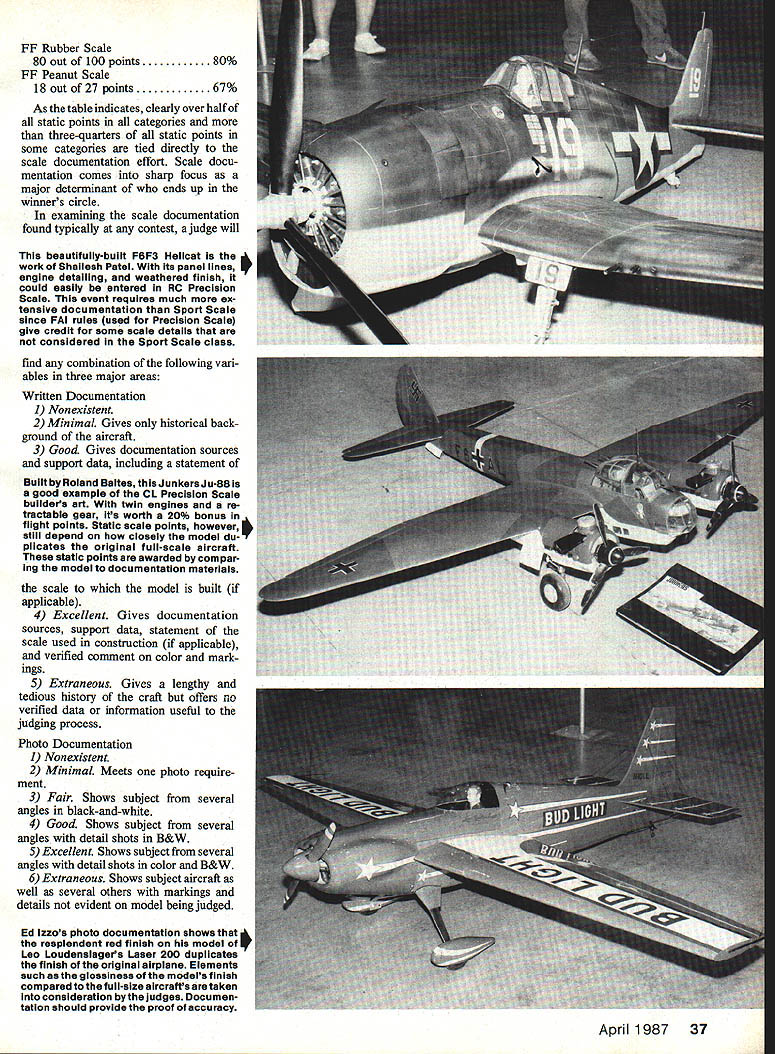
- Good. Shows subject from several angles with detail shots in B&W.
- Excellent. Shows subject from several angles with detail shots in color and B&W.
- Extraneous. Shows subject aircraft as well as several others with markings and details not evident on the model being judged.
Three-View Drawing (or Equivalent)
- Nonexistent.
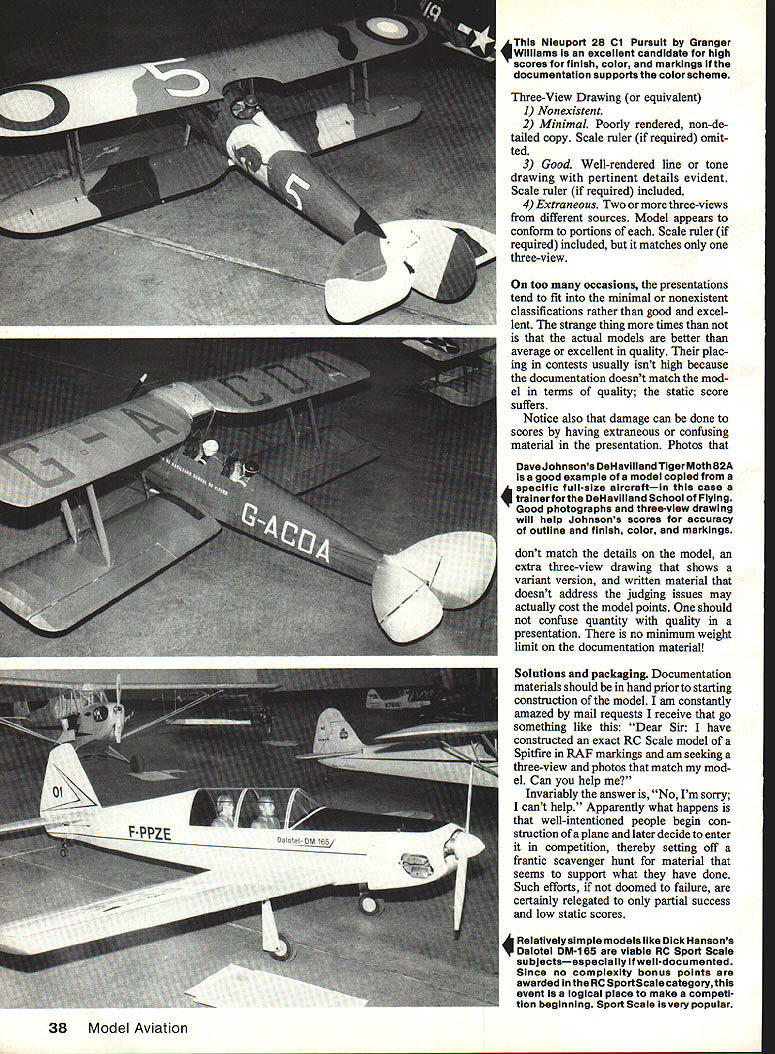
- Minimal. Poorly rendered, non-detailed copy. Scale ruler (if required) omitted.
- Good. Well-rendered line or tone drawing with pertinent details evident. Scale ruler (if required) included.
- Extraneous. Two or more three-views from different sources. Model appears to conform to portions of each. Scale ruler (if required) included, but it matches only one three-view.
On too many occasions, the presentations tend to fit into the minimal or nonexistent classifications rather than good and excellent. The strange thing more times than not is that the actual models are better than average or excellent in quality. Their placing in contests usually isn't high because the documentation doesn't match the model in terms of quality; the static score suffers.
Notice also that damage can be done to scores by having extraneous or confusing material in the presentation. Photos that don't match the details on the model, an extra three-view drawing that shows a variant version, and written material that doesn't address the judging issues may actually cost the model points. One should not confuse quantity with quality in a presentation. There is no minimum weight limit on the documentation material!
Solutions and Packaging
Documentation materials should be in hand prior to starting construction of the model. I am constantly amazed by mail requests I receive that go something like this: "Dear Sir: I have constructed an exact RC Scale model of a Spitfire in RAF markings and am seeking a three-view and photos that match my model. Can you help me?"
Invariably the answer is, "No, I'm sorry; I can't help." Apparently what happens is that well-intentioned people begin construction of a plane and later decide to enter it in competition, thereby setting off a frantic scavenger hunt for material that seems to support what they have done. Such efforts, if not doomed to failure, are certainly relegated to only partial success and low static scores.
Documentation material must be gathered prior to making the decision to build a model. Collecting data during the construction process is risky at best, and it may result in wholesale overhaul of already-finished components if things are a bit out of synch. In truth, the completeness of the documentation should help you make the build/no-build decision. I personally have several aircraft that have been in a holding pattern for over a year because I’ve been unable to collect pertinent documentation. It often is a slow process and one that requires a great amount of patience and persistence. It is also a rewarding process once the material is collected and a three-dimensional flying model arises from the flat pages and often faded photos at hand.
There are probably more good sources for scale documentation now than there ever have been in the past. Without citing specific sources, which could be the material for a separate article, begin by looking at your local library. That step will put you in touch with their inter-library loan which can get almost anything from any part of the country (given enough time). Other good sources are the various local, regional, and national air museums, the Experimental Aircraft Association, aviation manufacturers and distributors, commercial photo and documentation services, aviation magazines, etc. The list seems almost endless when you look at it in true perspective. It does, however, require effort and time to collect everything you need.
Once collected, packaging the material to make a favorable impression on the judges is important. If you’ve taken the time to patiently collect the material and exercised the self-discipline required to complete a detailed scale model, it makes little sense to cram your documentation paperwork helter-skelter into a folder in the vain hope the judges will recognize your intent. Organize your material in a cogent and logical format—one that’s easy for the judges to read and examine and gives them the feeling that you have researched your model thoroughly and presented complete documentation evidence. The following format outline might be one of several you could select:
- I. Cover Sheet.
- II. Written Commentary.
a. Scale and documentation sources. b. Scale outline and structure commentary. c. Scale deviations. d. Color and marking commentary.
- III. Three-View (or equivalent).
a. Include scale ruler if applicable.
- IV. Color and Marking Documentation.
- V. Photos and Support Materials.
Some discussion of each element may be appropriate to help tie it all together.
Cover Sheet
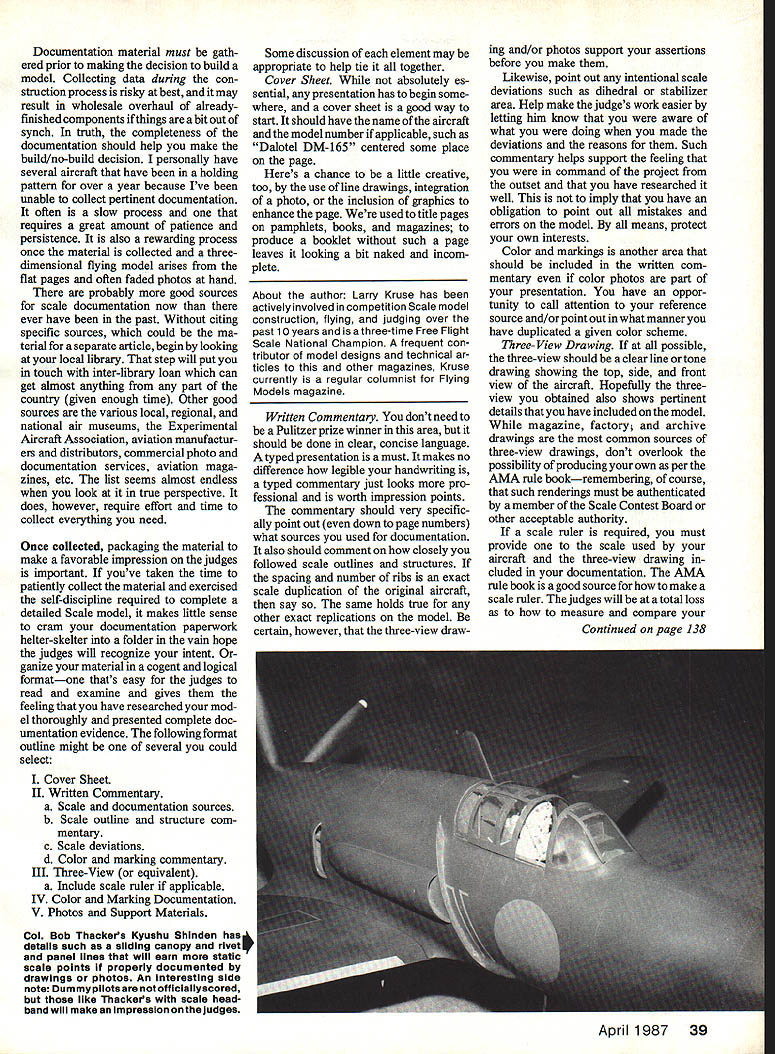
While not absolutely essential, any presentation has to begin somewhere, and a cover sheet is a good way to start. It should have the name of the aircraft and the model number if applicable, such as "Dalotel DM-165" centered some place on the page.
Here’s a chance to be a little creative, too, by the use of line drawings, integration of a photo, or the inclusion of graphics to enhance the page. We’re used to title pages on pamphlets, books, and magazines; to produce a booklet without such a page leaves it looking a bit naked and incomplete.
About the author: Larry Kruse has been actively involved in competition scale model construction, flying, and judging over the past 10 years and is a three-time Free Flight Scale National Champion. A frequent contributor of model designs and technical articles to this and other magazines, Kruse currently is a regular columnist for Flying Models magazine.
Written Commentary
You don’t need to be a Pulitzer Prize winner in this area, but it should be done in clear, concise language. A typed presentation is a must. It makes no difference how legible your handwriting is; a typed commentary just looks more professional and is worth impression points.
The commentary should very specifically point out (even down to page numbers) what sources you used for documentation. It also should comment on how closely you followed scale outlines and structures. If the scaling and number of ribs is an exact duplicate of the original aircraft, then say so. The same holds true for any other exact replications on the model. Be certain, however, that the three-view drawing and/or photos support your assertions before you make them.
Likewise, point out any intentional scale deviations such as dihedral or stabilizer area. Help make the judge’s work easier by letting him know that you were aware of what you were doing when you made the deviations and the reasons for them. Such commentary helps support the feeling that you were in command of the project from the outset and that you have researched it well. This is not to imply that you have an obligation to point out all mistakes and errors on the model. By all means, protect your own interests.
Color and markings is another area that should be included in the written commentary even if color photos are part of your presentation. You have an opportunity to call attention to your reference source and/or point out what manner you have duplicated a given color scheme.
Three-View Drawing
If at all possible, the three-view should be a clear line or tone drawing showing the top, side, and front view of the aircraft. Hopefully the three-view you obtained also shows pertinent details that you have included on the model. While magazine, factory, and archive drawings are the most common sources of three-view drawings, don’t overlook the possibility of producing your own as per the AMA rule book—remembering, of course, that such renderings must be authenticated by a member of the Scale Contest Board or other acceptable authority.
If a scale ruler is required, you must provide one to the scale used by your aircraft and the three-view drawing included in your documentation. The AMA rule book is a good source for how to make a scale ruler. The judges will be at a total loss as to how to measure and compare your model to its drawings if the scale ruler is omitted; your loss of points will be disastrous.
Color and Markings Documentation
If you have a separate authenticated statement on color and markings, paint chips, or photos specifically included to show color and markings, here is the place to include these things. Also include some sort of labeling system or brief commentary on the intent and purpose of the display so the judges will know what you're trying to show.
Photos and Other Supporting Materials
This last area, along with the three-view, is probably the most critical as far as securing good static points. The photos displayed should be of the aircraft you have modeled. Photos which do not support your efforts should be discarded unless there is some specific logical reason for their inclusion. If possible, a brief caption line under each photo is also useful to help the judges see what you want them to see. Good crisp black-and-white photos, no smaller than 4 x 5 in., are very useful. Color pictures are even better, unless the colors are not those of your chosen aircraft.
All of the documentation material should be placed sequentially in a binder of some sort. I prefer a three-ring, loose-leaf binder, preferably in a color complimentary to the model. Since several people will be handling your material during the course of a contest session, it's best to place each page inside a clear acetate page protector available from any office supply house. The scale ruler should also be placed within the binder. If possible, it should be attached in some way to prevent it from being lost. If it is made of card stock, holes may be punched so it will fit in the three-ring binder. If it is a plastic ruler, try attaching Velcro to it and the inside cover of the binder.
As stated in the FAI RC and CL Scale rules, "Proof of scale is the responsibility of the contestant." Hopefully, by exercising the same diligence in collecting, organizing, and packaging scale documentation that is typically evident in the construction of a model, any builder will find himself in the winner's circle far more consistently.
Good luck on your next scale project.
Transcribed from original scans by AI. Minor OCR errors may remain.

