
CBA-123: New in the Sky
Background
Coffee and vanishing rain forests, Rio's beaches and carnival—if you're like most people, those are the images that come to mind when you think of Brazil. It certainly isn't a country readily associated with aircraft manufacturing. Yet, with limited fanfare, Brazil is becoming one of the world's major builders of ultramodern, locally designed airplanes, particularly commuter airliners and military trainers.
EMBRAER (Empresa Brasileira de Aeronáutica), the country's solitary major manufacturer, got its start in 1969 by assembling Piper Cherokees, Senecas, and other aircraft under license. It made a smooth transition to producing its own designs and began to achieve major success in the early 1980s with the Bandeirante feeder liner, the larger Brasilia airliner, and the Tucano turboprop trainer.
Design and production cooperation
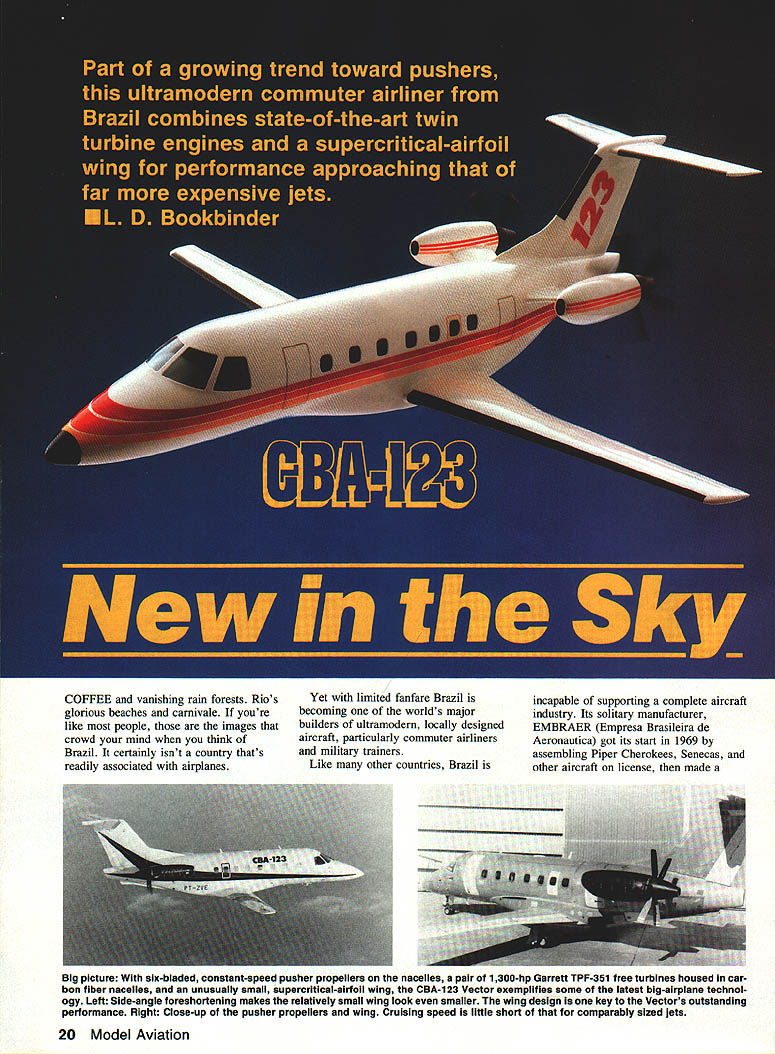
The latest product from EMBRAER's factory at São José dos Campos is the CBA-123 Vector: a genuinely 1990s 19-passenger, pressurized regional airliner and executive airplane. As part of growing industrial cooperation among South American nations, 20 percent of the CBA-123 is built by FMA (Fábrica Militar de Aviones) of Argentina. (CBA stands for Cooperation Brazil Argentina.) Such multinational efforts are increasingly common as the cost of developing new designs exceeds the financial capabilities of individual companies.
To date, partners EMBRAER and FMA have logged paid-option contracts from 18 customers in 13 countries for a total of 150 of these state-of-the-art airliners.
Design features
At first glance the Vector appears similar to many other medium-size passenger airplanes—such as the Gulfstream IV and the Canadair Challenger—but closer inspection reveals six-bladed, constant-speed pusher propellers on the nacelles. While pusher configurations date back to the Wright brothers, recent popularity of Burt Rutan's Vari-Eze and LongEZ has given the concept a boost. The Vector joins other well-publicized unconventional executive aircraft like Beechcraft's Starship and Piaggio's Avanti in this growing design trend.
Performance and specifications
- Cruising speed: 400 mph.
- Long-range cruise: about 360 mph at 40,000 ft.
- Maximum range (full passenger load): 900 miles.
- Projected cost: under $5 million.
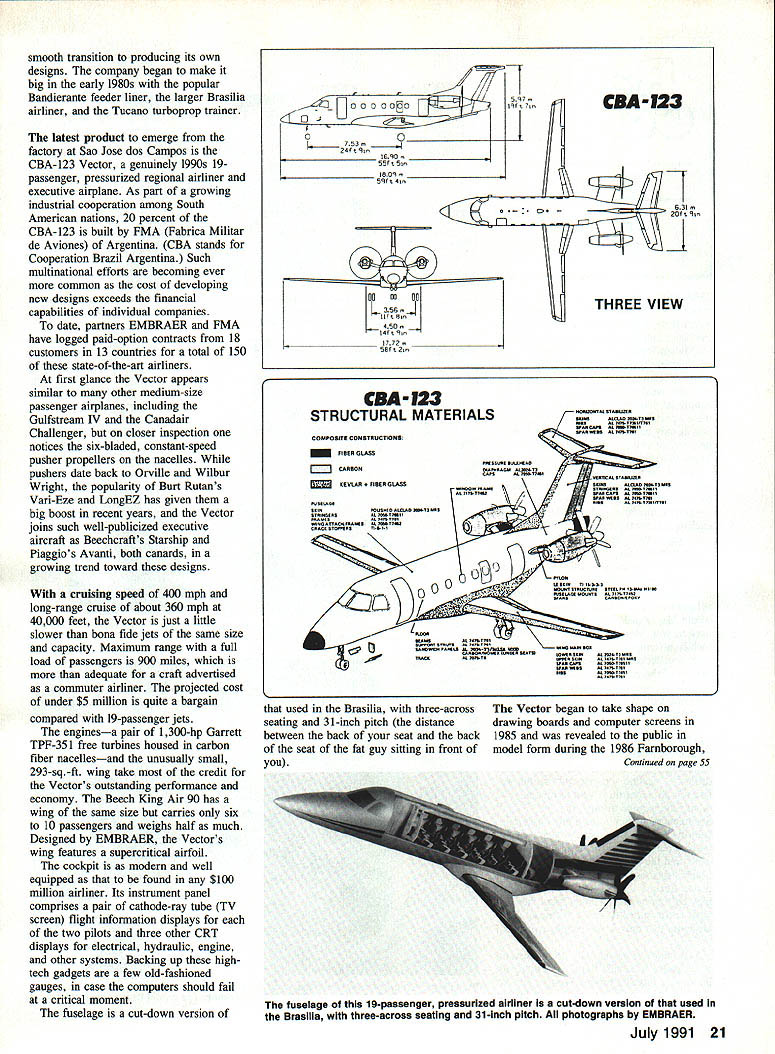
The Vector's outstanding performance and economy are largely due to its engines and unusually small wing. It is powered by a pair of 1,300-hp Garrett TPF-351 free-turbine engines housed in carbon-fiber nacelles. The wing has an area of 293 sq ft and features a supercritical airfoil designed by EMBRAER. For comparison, the Beech King Air 90 uses a wing of similar size but carries only six to ten passengers and weighs about half as much.
Cockpit and cabin
The cockpit is as modern and well equipped as that found on much larger airliners. The instrument panel includes a pair of cathode-ray-tube (CRT) flight information displays for each pilot, plus three additional CRTs for electrical, hydraulic, engine, and other systems. These high-tech displays are backed up by conventional gauges in case of computer failure.
The fuselage is a scaled-down version of that used on the Brasilia, with three-across seating and 31-inch pitch (the distance between the back of one seat and the back of the seat in front).
Development and debut
The Vector began to take shape on drawing boards and computer screens in 1985 and was revealed to the public in model form during the 1986 Farnborough Airshow.
CBA-123 Structural Materials
- Composite construction: fiberglass and carbon fibers.
Transcribed from original scans by AI. Minor OCR errors may remain.

