
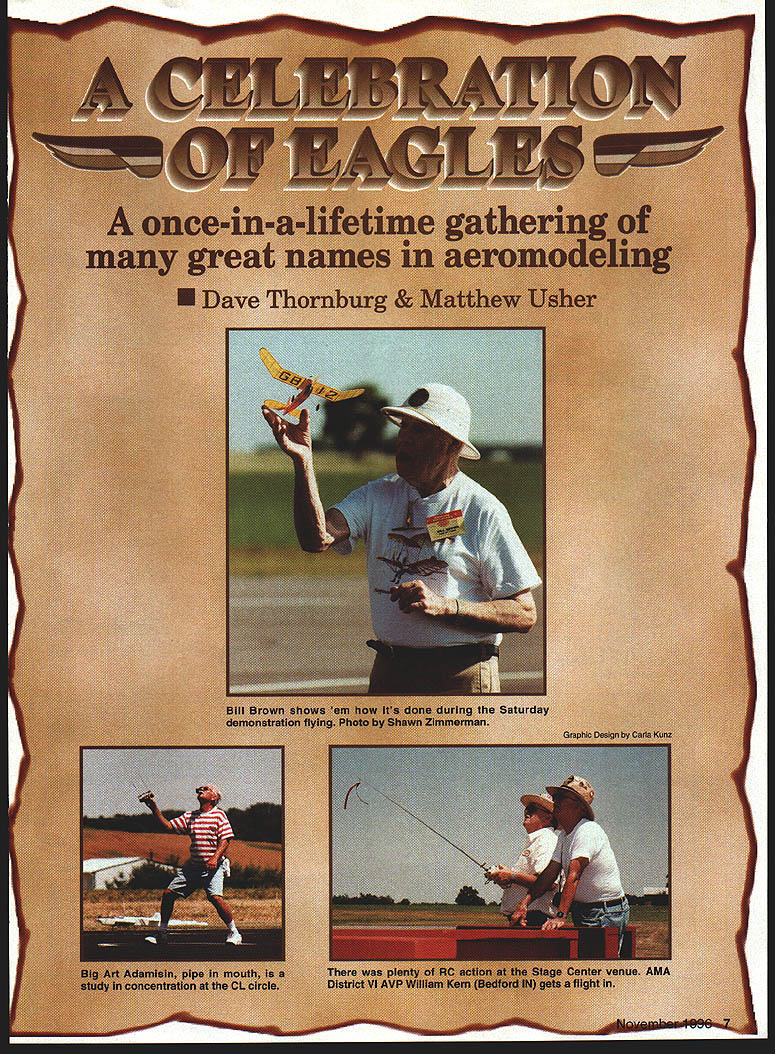
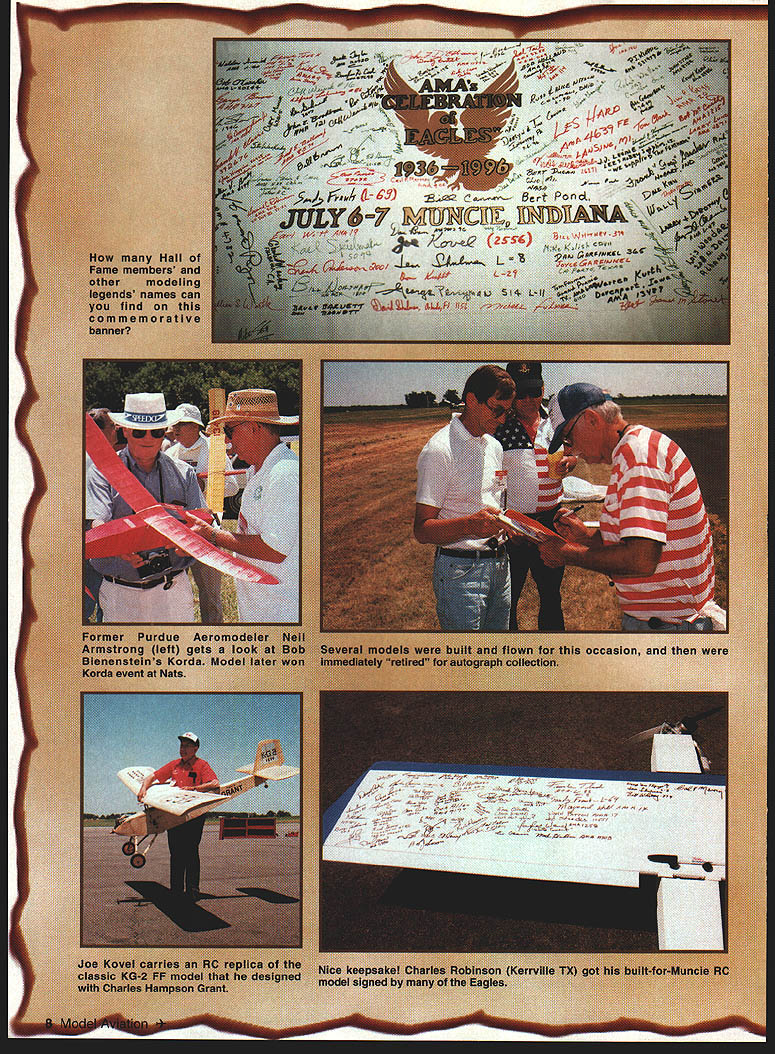
A CELEBRATION OF EAGLES
Dave Thornburg & Matthew Usher
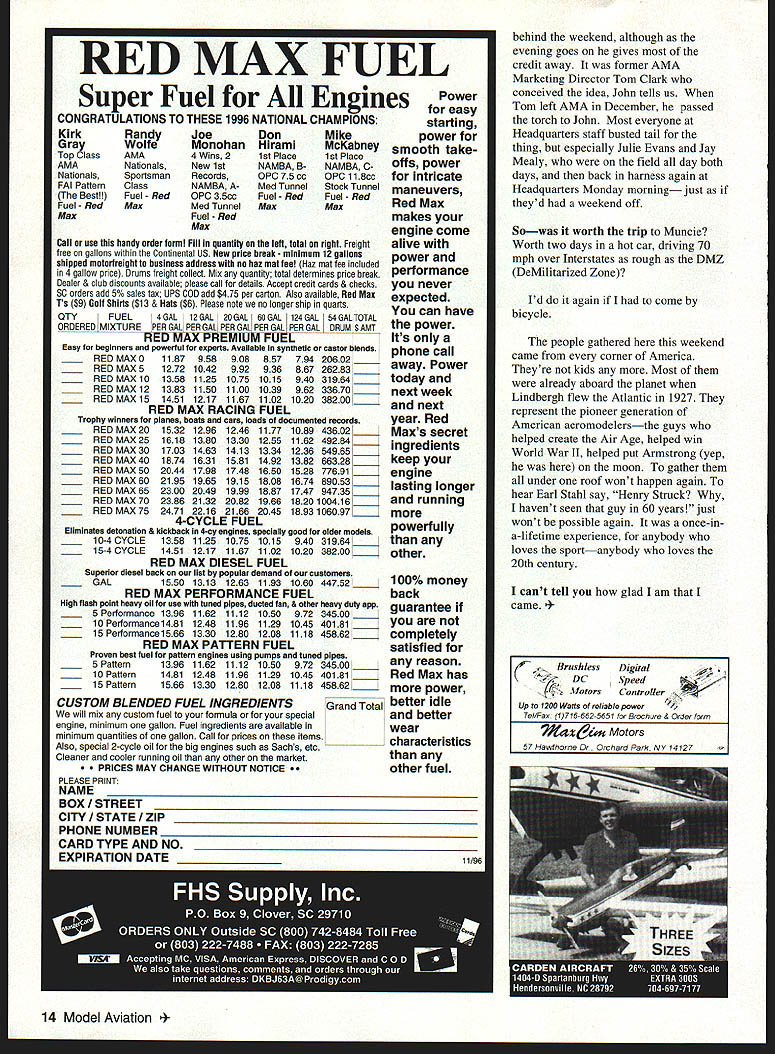
Muncie, 6 July: It's eight p.m.—cocktail hour all across the Midwest—and I'm standing directly under Carl Goldberg's 1937 Valkyrie, gazing out over a sea of people. A noisy, turbulent sea of people, sloshing about under a low sky of model aircraft.
This is the Frank V. Ehling Museum at AMA Headquarters—eight thousand square feet jammed to the rafters with the history of our sport. And the people? Oh, lucky day! These are the men who were the boys who created that sport.
The occasion is the 1996 Celebration of Eagles, and just look at that crowd! Almost every living legend in American aeromodeling is within fly-casting distance of where I'm standing.
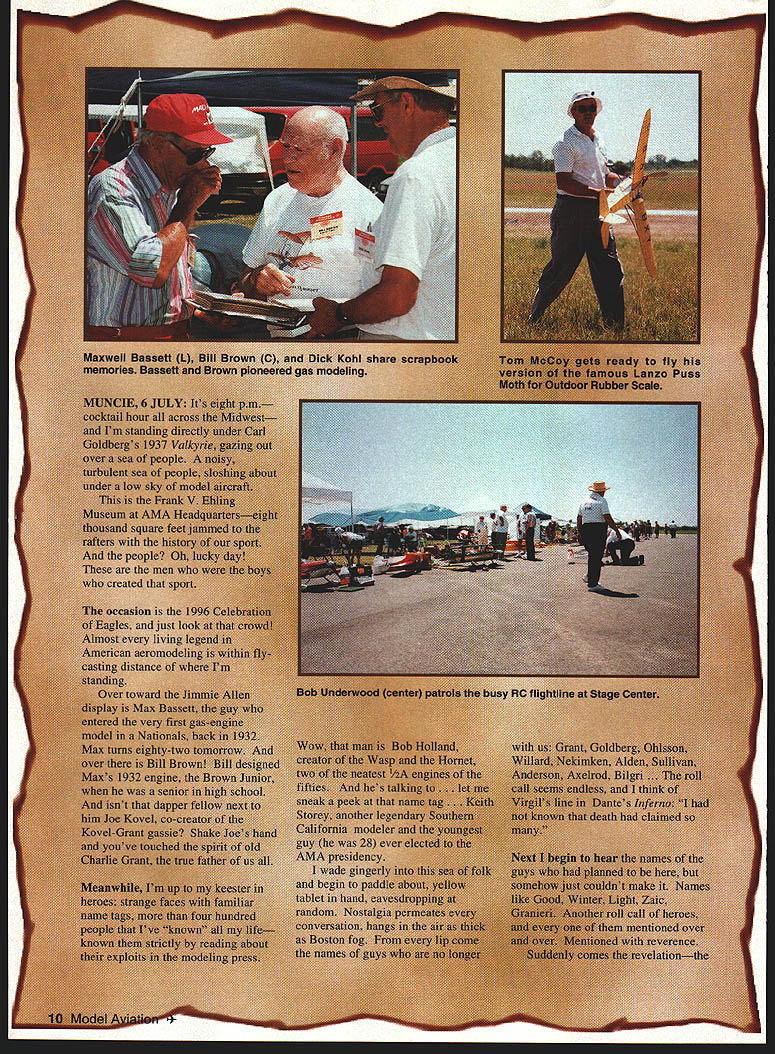
Over toward the Jimmie Allen display is Max Bassett, the guy who entered the very first gas-engine model in a Nationals, back in 1932. Max turns eighty-two tomorrow. And over there is Bill Brown! Bill designed Max's 1932 engine, the Brown Junior, when he was a senior in high school. And isn't that dapper fellow next to him Joe Kovel, co-creator of the Kovel-Grant cassette? Shake Joe's hand and you've touched the spirit of old Charlie Grant, the true father of us all.
Meanwhile, I'm up to my keister in heroes: strange faces with familiar name tags, more than four hundred people that I've known all my life—known them strictly by reading about their exploits in the modeling press.
Wow, that man is Bob Holland, creator of the Wasp and the Hornet, two of the neatest 1/2A engines of the fifties. And he's talking to... let me sneak a peek at that name tag... Keith Storey, another legendary Southern California modeler and the youngest guy (he was 28) ever elected to the AMA presidency.
I wade gingerly into this sea of folk and begin to paddle about, yellow tablet in hand, eavesdropping at random. Nostalgia permeates every conversation, hangs in the air as thick as Boston fog. From every lip come the names of guys who are no longer with us: Grant, Goldberg, Ohlsson, Willard, Niekimken, Alden, Sullivan, Anderson, Axelrod, Bilger. The roll calls seem endless, and I think of Virgil's line in Dante's Inferno—"I had not known that death had claimed so many."
Next I begin to hear the names of the guys who had planned to be here, but somehow just couldn't make it. Names like Goodell, Winter, Light, Zaic, Graneri. Another roll call of heroes, and every one of them mentioned over and over. Mentioned with reverence.
So now I know that all my heroes have heroes, too—each other! What a shock that discovery is. I stop paddling completely, flounder about, almost drown. Fortunately, Mike Fulmer comes steaming by just then, parting the sea like Aaron's rod, brow furrowed like the prow of an icebreaker, muttering about how the Museum was never designed to hold such a large crowd, about how you never, never allow food or drink inside a proper museum. "The damage, the damage," he keeps repeating darkly.
No wonder he worries. Mike is the mastermind behind the new museum here at Muncie. Almost every display bears his touch. And every one is marvelous, from the full-size, fully stocked 1950s hobby shop in the middle, to all those heart-tweaking dioramas along the west wall. But it's still far too small for Mike's dream—he can't wait to see it expanded into the entire 25,000 square feet of the building, after the business and magazine offices are moved out. (Incidentally, all the displays came through unscratched. Not even a permanent stain on the carpet. So—do my heroes have finesse, or what?)
By noon Saturday the Eagles weekend had already taken on its own character: it had begun to feel something like an old-time Navy Nationals. In fact, it felt like just about every Nationals I ever read about rolled into one. Meaning: the thing was a ten-ring circus, with no possibility of catching every act.
Out on the field this morning were models and designers and contest winners and manufacturers from just about every Nats since the mid-1930s. By the time sign-in opened at nine, vintage Ukies had already been humming lazy circles out behind the registration pavilion for more than two hours. After a short wait in a long line (and what's a Nats without lines?) I grabbed my name tag and had just time enough to see former Flying Models editor Bob Hunt put his beautiful Mackey Lark through the pattern before galloping off across the street to the RC area, where Rudderbugs and Stormers and Smog Hogs patrolled the sky with nary a glitch or a flyaway. "C'mon, guys—where's the realism? You need to load those things down with zinc batteries and spin 'em in!" And then off upwind to the free flight site, where Sal Taibi had posted three flights with his .020 Starduster before eight a.m.—and this ain't even a contest!
"Where's Henry Struck?" I ask everybody in sight. I gotta meet Henry Struck. He designed the New Ruler, the Sinbad—probably half the kits Berkeley Models ever produced. "Where's Henry Struck?" And the answer is always the same: "Henry? He was just here. Musta left."
This goes on for two days. I never do get to meet Henry Struck. Or Bill Effinger, who owned Berkeley. Or Wally Simmers, of Gollywock fame. I ask for them everywhere, but they've always "just left." It even happens in reverse: "Al Lehmberg's been looking for you all afternoon." "Me? You gotta be kidding. Nobody looks for me—I'm just a journalist." Whereas Al Lehmberg is an authentic hero: he designed the Feather Merchant old-time gassie, and writes for Model Builder. "Al Lehmberg's looking for you." "I'm flattered to death." I try hard, and finally get to meet him the next day.
Back to the radio area, out in the center of the field, where most of the crowd has gathered. Along comes Phil Greenberg, who wrote the "Getting Started in RC" columns for the early Flying Models. And there goes Claude McCullough, an Iowa farmer who, according to an old American Modeler cover blurb, once built himself a Remote Controlled Model Plane. (Was that before or after you were AMA president, Mac?)
I stagger down the RC flightline under a suspiciously blue sky, wafted along by a suspiciously light breeze. (I was born just east of here. I don't trust this Midwestern weather.)
Wowie! Look at that lovely little Strader Chicken Hawk! I built one in the 1950s—but not half that well. Ah, no wonder—that's Ted Strader himself, sitting there beside it! Glad to see the sport fliers represented so ably, Ted. I built your South Wind Ten, too. And your Snoopy free flight biplane.
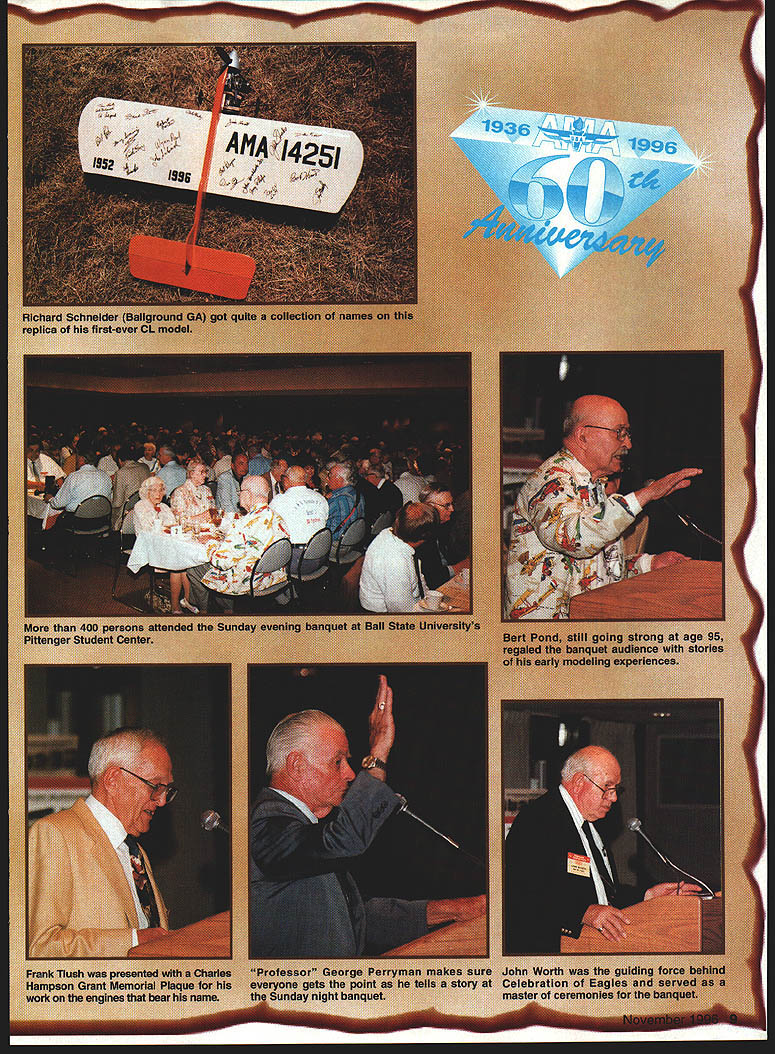
There's simply no end to the famous names. At the awards banquet Sunday night I wind up between Joe Wagner (Veco Dakota, Sioux, Brave, Comanche, Chief, etc.) and John Brodak of Brodak Manufacturing, the man who turns out, as we speak, all those lovely vintage stunt kits. Across the table are Larry and Ginger Scarinzi. Larry designed every Stunt and Combat model I got dizzy trying to fly in the junior high gym. So why does he look younger than me? Why do half the people here look younger than me? I know they're not—blast them!
Over there is Lew Mahieu. His Zeek came out when I was still in elementary school. And Lee Shulman—he looks like my kid brother. Then there's Carl Schmajdak and Bill Northrop—both with less gray hair than me. It's just not fair what kept them young and not me?
The banquet is exactly like a Nats banquet of yore. Huge. Noisy. Too long, and yet too short at the same time. I pinpoint a dozen people out there in the flotilla of white tables—people I just gotta meet before things break up. But, of course, it doesn't happen. Joe Dallaire slips through my fingers. Ditto Charles Mackey.
John Worth emcees the program. As he should. John was the moving force behind the weekend, although as the evening goes on he gives most of the credit away. It was former AMA Marketing Director Tom Clark who conceived the idea, John tells us. When Tom left AMA in December, he passed the torch to John. Most everyone at Headquarters staff busted tail for the thing, but especially Julie Evans and Jay Mealy, who were on the field all day both days, and then back in harness again at Headquarters Monday morning—just as if they'd had a weekend off.
So—was it worth the trip to Muncie? Worth two days in a hot car, driving 70 mph over Interstates as rough as the DMZ (Demilitarized Zone)?
I'd do it again if I had to come by bicycle.
The people gathered here this weekend came from every corner of America. They're not like most of the people seen at other meets. Most of them were already aboard the planet when Lindbergh flew the Atlantic in 1927. They represent the pioneer generation of American aeromodelers—the guys who helped create the Air Age, helped win World War II, helped put Armstrong (yep, he was here) on the moon. To gather them all under one roof won't happen again. To hear Earl Stahl say, "Henry Struck? Why, I haven't seen that guy in 60 years!" just won't be possible again. It was a once-in-a-lifetime experience, for anybody who loves the sport—anybody who loves the 20th century.
I can't tell you how glad I am that I came. ✦
Photo captions
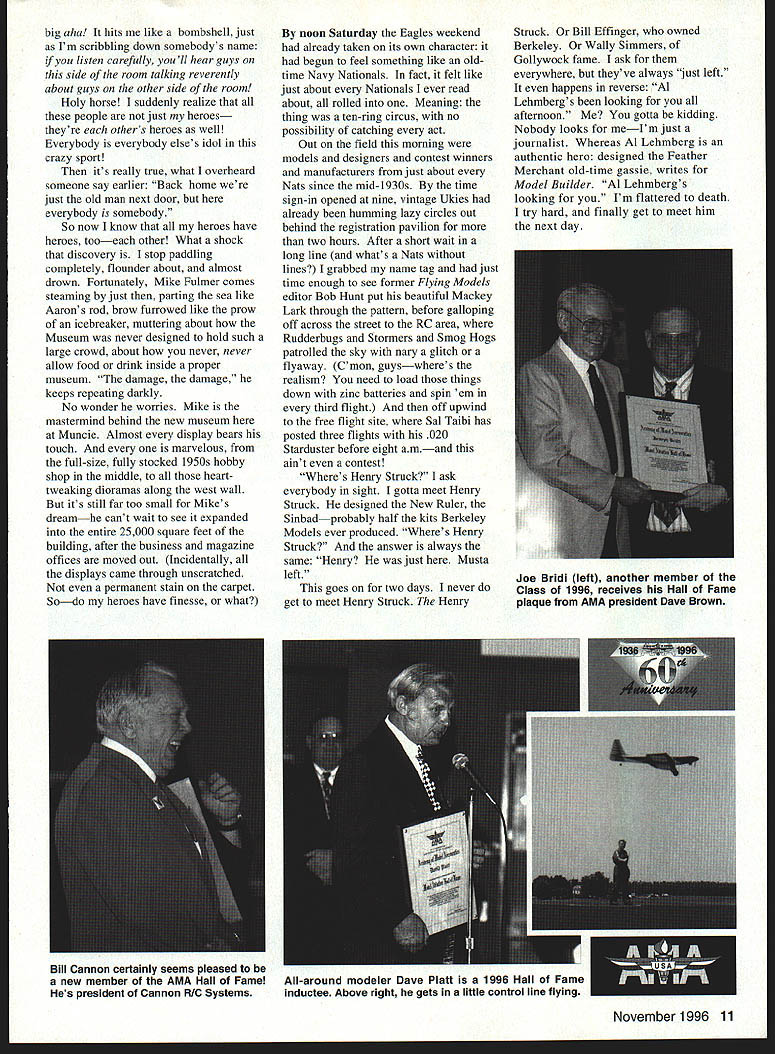
- Smiles were the order of the day for the Eagles. Art Laneau grins as he is inducted into the AMA Hall of Fame.
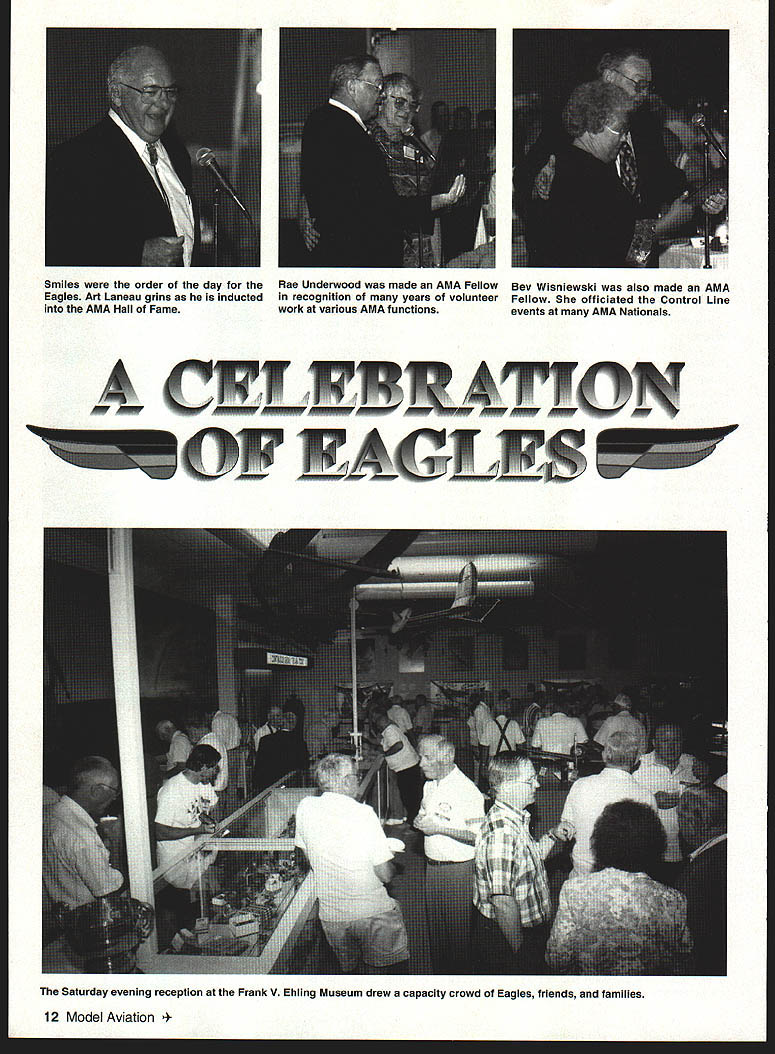
- Rae Underwood was made an AMA Fellow in recognition of many years of volunteer work at various AMA functions.
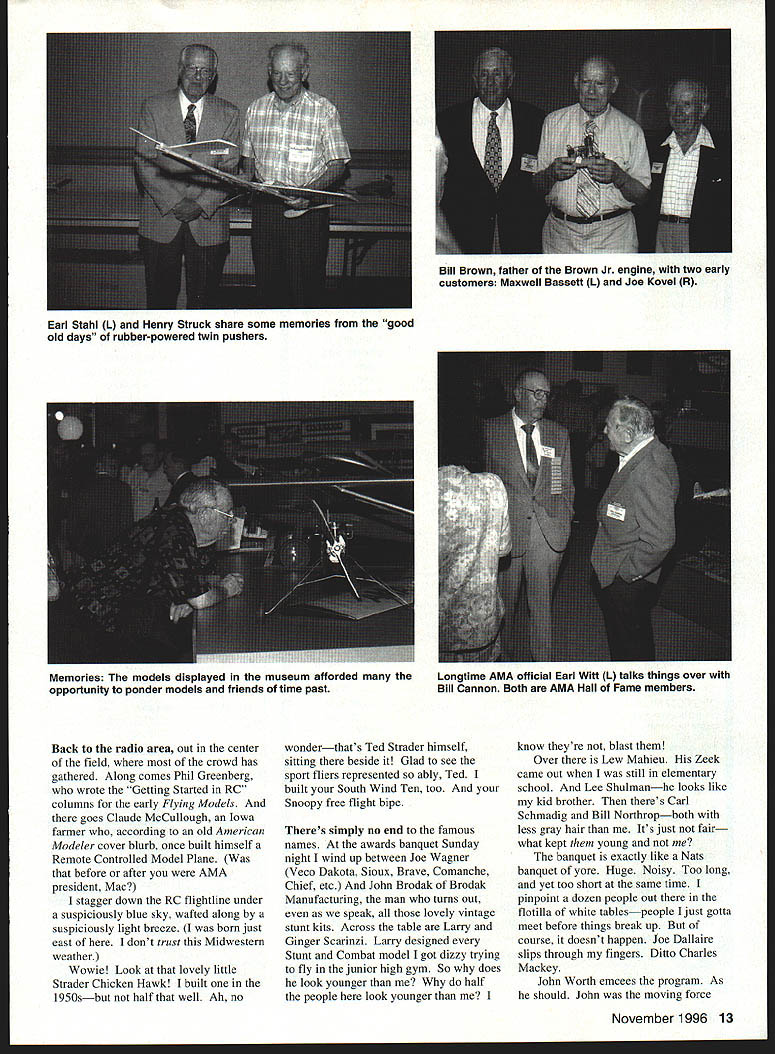
- Bev Wisniewski was also made an AMA Fellow. She officiated the Control Line events at many AMA Nationals.
- The Saturday evening reception at the Frank V. Ehling Museum drew a capacity crowd of Eagles, friends, and families.
Transcribed from original scans by AI. Minor OCR errors may remain.

