
Charles Hampson Grant
A legend in our time—the one and only Charles Hampson Grant: 1894–1987.
By John Worth
He didn't go quietly. Charlie Grant was a fighter, literally and figuratively. He fought for what he believed in and against what he didn't believe in. In his younger days he was a top-notch amateur boxer and believed in working to stay in shape. He carried that discipline through his life and was remarkably healthy for his age. The immediate cause of his passing, after over 90 years of vigorous activity, was an automobile accident. Even so, in his last hours Charlie resisted conventional medical treatment; he often said he was in better shape than most doctors and had outlived many of them.
Aviation and engineering contributions
Charlie fought for recognition within the aviation industry and made many technical contributions, including:
- Early work on pilotless aircraft and designs for radio-controlled aerial torpedoes, including delta-wing concepts.
- Employment as an aircraft engineer at the Army Air Corps' Wright Field, Ohio (1918–1919).
- Development work on Vertical Take-Off aircraft designs.
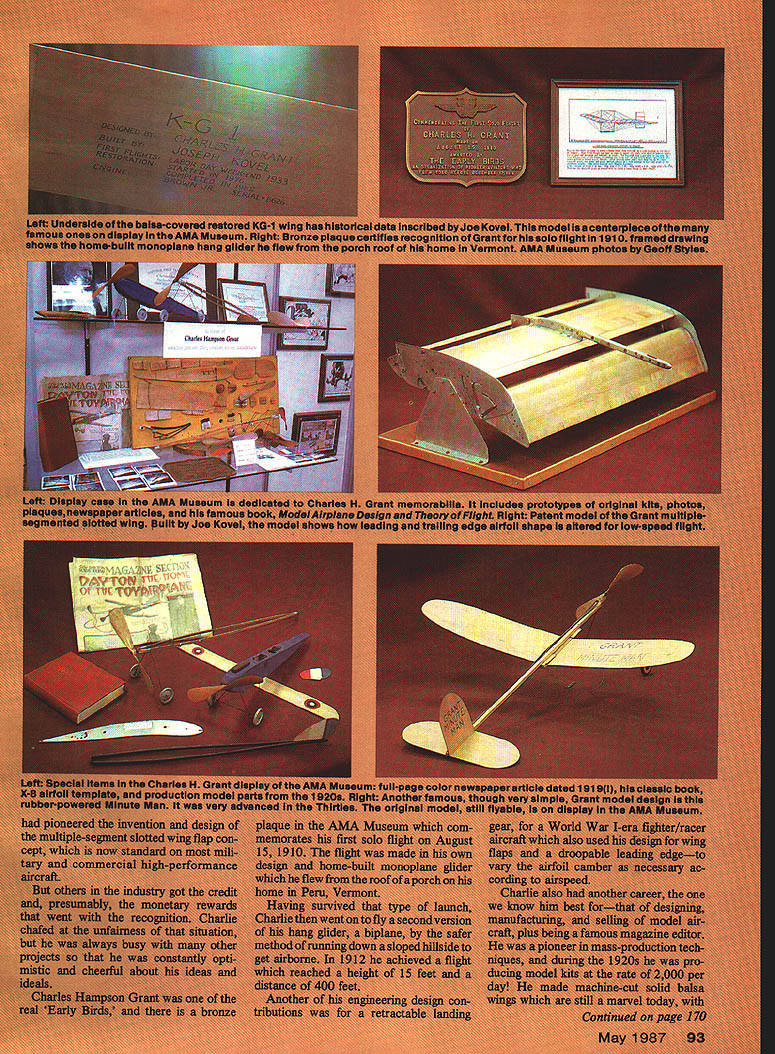
- Pioneering the multiple-segment slotted wing flap concept, now standard on many military and commercial high-performance aircraft.
- Design concepts for retractable landing gear for World War I–era fighter/racer aircraft, incorporating flaps and a droppable leading edge to vary airfoil camber with airspeed.
Although others later received credit (and likely monetary rewards) for some of these ideas, Grant remained optimistic and continued to pursue many projects.
Early flying and the "Early Birds"
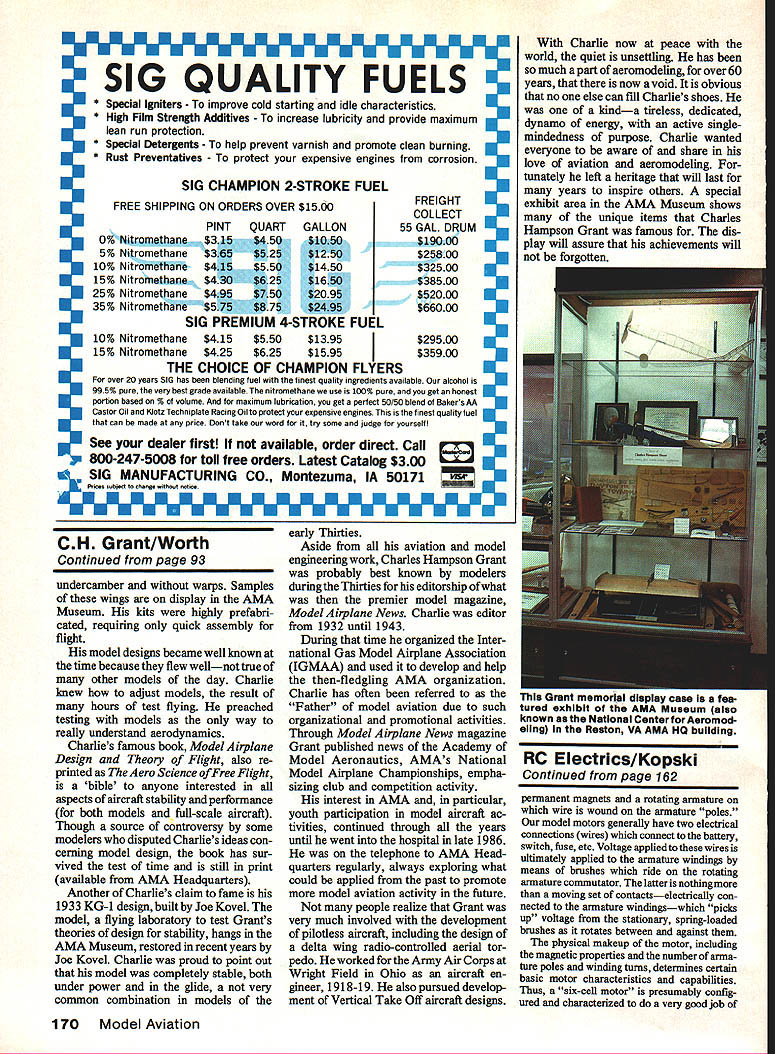
Charles Hampson Grant was one of the real "Early Birds." A bronze plaque in the AMA Museum commemorates his first solo flight on August 15, 1910. The flight was made in a monoplane glider of his own design and construction, launched from the roof of a porch on his home in Peru, Vermont.
After that launch, he built and flew a second hang-glider version (a biplane), using the safer method of running down a sloped hillside to become airborne. In 1912 he achieved a flight that reached about 15 feet in height and 400 feet in distance.
Model aircraft design, manufacturing, and publishing
Charlie is perhaps best known to many for his work in model aircraft design, manufacturing, and publishing:
- He was a pioneer in mass-production techniques for model kits. During the 1920s he produced kits at rates up to 2,000 per day.
- He made machine-cut solid balsa wings with undercamber and without warps; samples are on display in the AMA Museum. His kits were highly prefabricated and required only quick assembly for flight.
- His models flew well compared with many contemporaries, the result of extensive test flying and careful adjustment. He preached testing as the only way to truly understand aerodynamics.
- His famous book, Model Airplane Design and Theory of Flight (also reprinted as The Aero Science of Free Flight), is considered a bible for aircraft stability and performance, for both models and full-scale aircraft. Though controversial to some modelers at the time, it has endured and remains available.
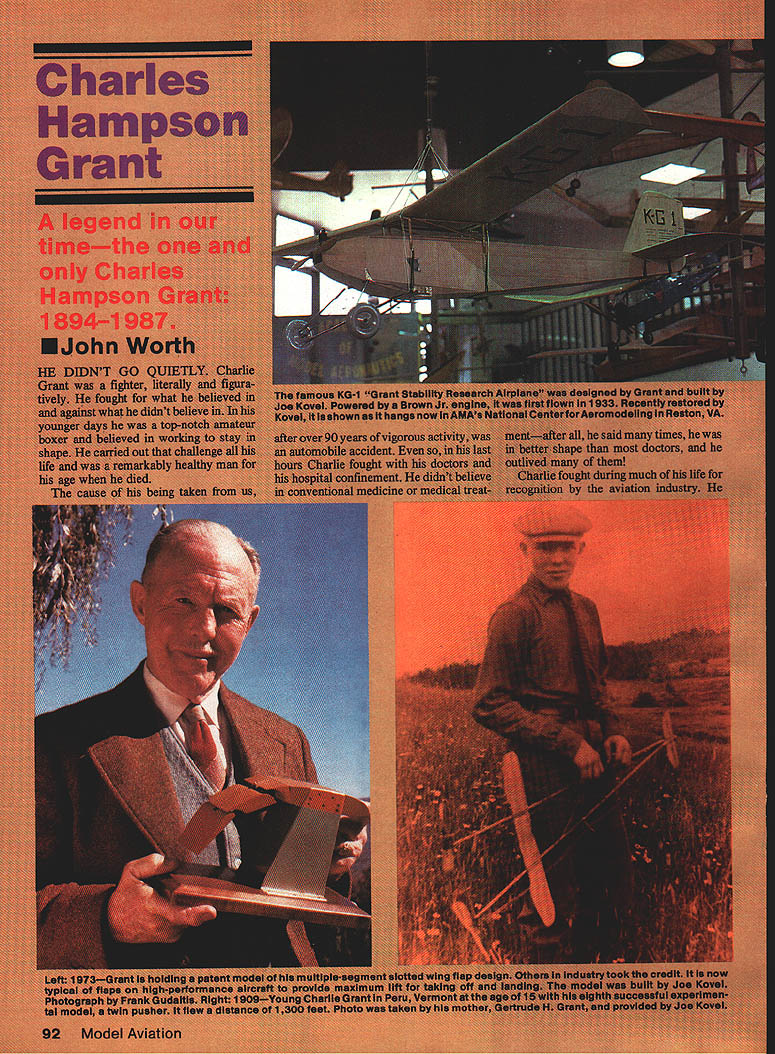
- His 1933 KG-1 design, built by Joe Kovel as a flying laboratory to test Grant's stability theories, is restored and hangs in the AMA Museum. Grant took pride that the model was completely stable both under power and in the glide — a rare combination in the early 1930s.
Editorial and organizational work
- Grant edited Model Airplane News, then the premier model magazine, from 1932 until 1943.
- He organized the International Gas Model Airplane Association (IGMAA) and used it to support and develop the fledgling Academy of Model Aeronautics (AMA).
- Through his editorial work he publicized AMA activities and national championships, emphasizing club and competition activity.
- Due to his organizational and promotional efforts, Grant has often been referred to as the "Father" of model aviation.
- He remained interested in AMA and youth participation in model aviation through all his years, staying in regular contact with AMA Headquarters and exploring ways to apply the past to promote future activity until he went into the hospital in late 1986.
Personal character and legacy
Charlie was a tireless, dedicated dynamo—full of energy, active, and single-minded in purpose. He wanted everyone to share his love of aviation and aeromodeling. With his passing there is a clear void: no one could truly fill Charlie's shoes.
Fortunately, he left a substantial heritage:
- A special exhibit area in the AMA Museum displays many unique items from Charles Hampson Grant's work and ensures his achievements will not be forgotten.
- His designs, writings, and organizational contributions continue to inspire modelers and aviators.
Not everyone agreed with all his ideas, and not all of his contributions received the recognition he deserved, but his influence on aeromodeling and aviation engineering is lasting.
Transcribed from original scans by AI. Minor OCR errors may remain.

