
Charlie's Bird Flies Again
By Dick Sarpolus
Like a favorite melody, a model you're especially fond of can linger in your memory long after the crash. Charlie Williams decided to do something about it.
BACK IN the mid-1930s, modelers were pioneers. Each new design was an experiment. There was always something new to learn: stability, balance-point location, area relationships, airfoils, overall proportions, structural requirements, and wing loading. Almost-ready-to-fly models didn't exist, and few commercial kits were available; you made your own from scratch and learned as you went. These were the men and women who got our hobby going.
Free Flight was the standard. Gas engines had only recently been introduced, so engine-powered flight was a major event. Control line had yet to be invented, and radio control was in its infancy.
The efforts and successes of such early RC greats as Walt and Bill Good and Chet Lanzo have been well documented. Old-Timer flying is popular, and the Society of Antique Modelers (SAM) has chronicled early activities and notables.
But the countless modelers who pursued the hobby away from the limelight have stories to tell, too. Many of these men and women are still designing, building, and flying today.
Charlie Williams, from Point Pleasant, New Jersey, is among them. Charlie's latest project is an RC update of a model he built in the 1930s. When Charlie told me the story of that airplane I wanted to share it with the readers of Model Aviation.
Charlie belonged to the Kresge Aero Club, sponsored by a large New Jersey department store. One of the leaders of that group was Ben Shereshaw, whose fame endures as the designer and manufacturer of the Bantam engine. Charlie also was a member of the AMLA, a national modeling group and the forerunner of the AMA.
Charlie flew at Hadley Airport near New Brunswick, New Jersey, in those days—one of the best flying sites in the Northeast. Hadley was large enough for the Free Flight activity of the day and hosted many contests. Ben Shereshaw and Charlie Kinney flew there, too. Others Charlie recalls seeing included:
- Bill Brown with early Brown Jr. engines
- Frank Tilush, who produced the engine bearing his name
- Bill Effinger of Berkeley Models fame
- Frank Ebling
- Leon Lanzo
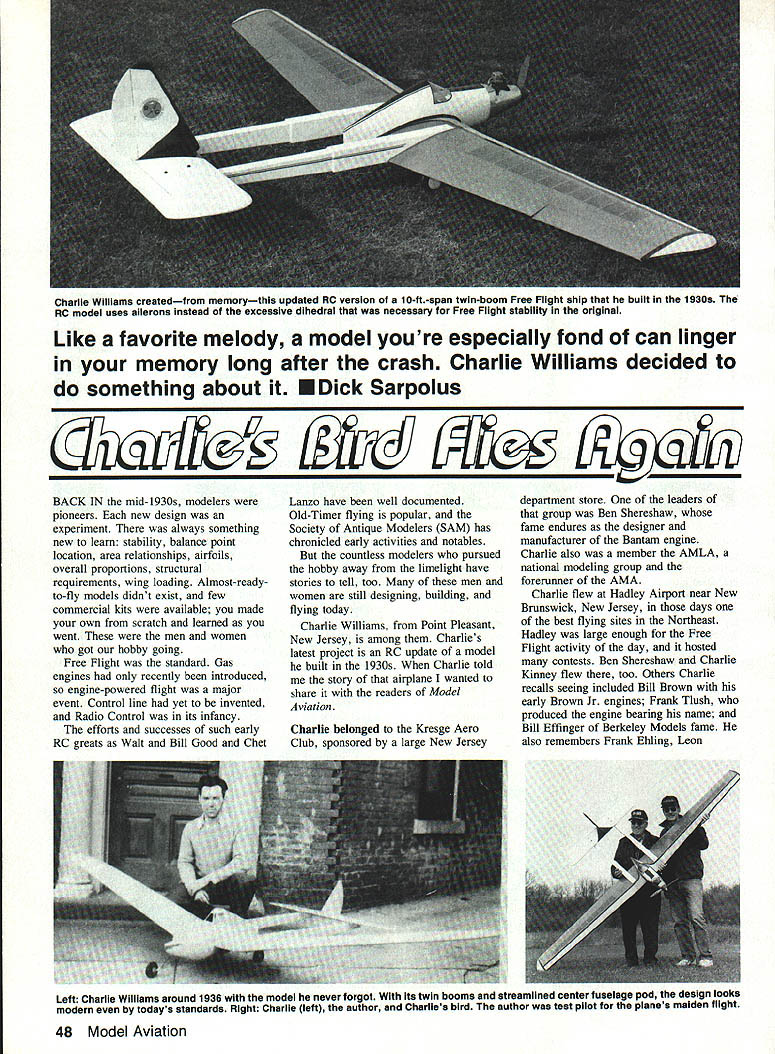
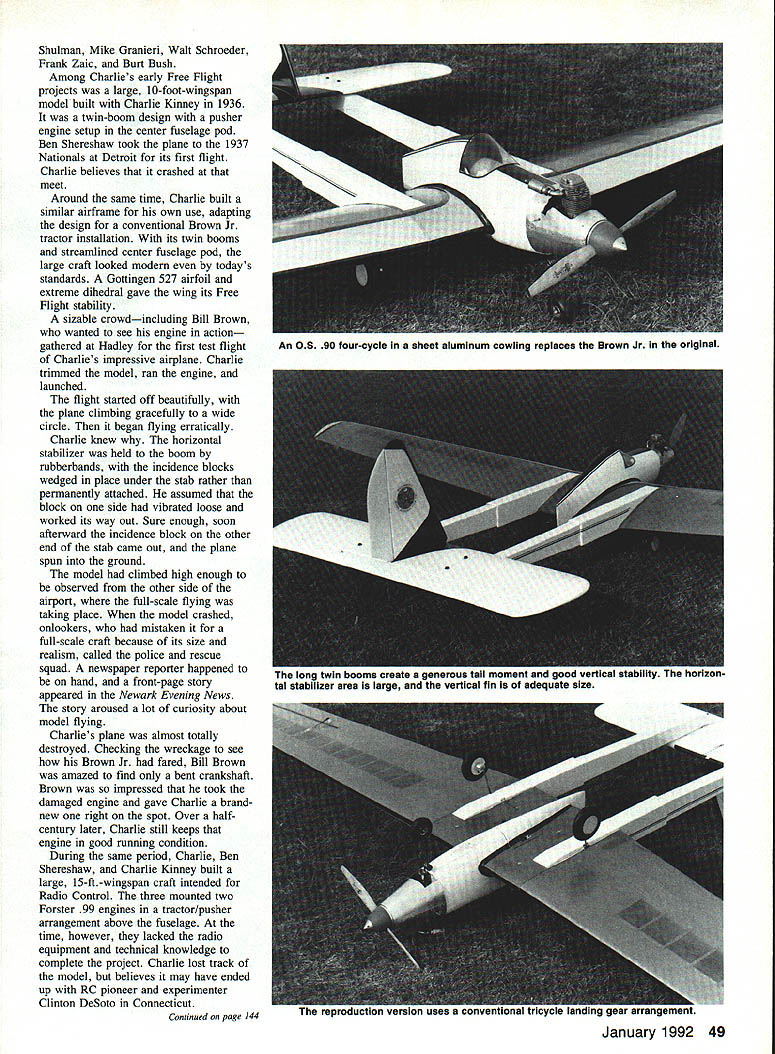
Among Charlie's early Free Flight projects was a large, 10-foot-wingspan model built in 1936 from a twin-boom design with a pusher engine and a center fuselage pod. Ben Shereshaw took the plane to the 1937 Nationals in Detroit for its first flight; Charlie believes it crashed at the meet. Around the same time Charlie built a similar airframe for his own use, adapting the design to a conventional Brown Jr. tractor installation. Its twin booms and streamlined center fuselage pod made the large craft look modern even by today's standards.
The Göttingen 527 airfoil and the extreme dihedral gave the wing its Free Flight stability. A sizable crowd—including Bill Brown, who wanted to see engine action—gathered at Hadley for the first test flight of Charlie's impressive airplane. Charlie trimmed the model, ran the engine, and launched it. The flight started off beautifully; the plane climbed gracefully in a wide circle, then began flying erratically. Charlie knew the horizontal stabilizer was held to the booms with rubber bands and that incidence blocks wedged in place under the stabilizer were not permanently attached. He assumed a block on one side had vibrated loose and worked its way out.
Sure enough, soon afterward the incidence block at the other end of the stabilizer came out and the plane spun into the ground. The model had climbed high enough that observers on the other side of the airport, where full-scale flying was taking place, mistook it for a full-scale craft. Because of its size and realism, police and a rescue squad were called; a newspaper reporter happened to be on hand and a front-page story appeared in the Newark Evening News. The story aroused a lot of curiosity about model flying.
Charlie's plane was almost totally destroyed. Checking the wreckage to see how the Brown Jr. engine fared, Bill Brown was amazed to find only a bent crankshaft. Brown, impressed, took the damaged engine and gave Charlie a brand-new one right on the spot. Over half a century later Charlie still keeps that engine in good running condition.
During the same period Charlie, Ben Shereshaw, and Charlie Kinney built a large 15-foot-wingspan craft intended for radio control with three engines mounted—two Forster 99s in a tractor/pusher arrangement above the fuselage. At the time, however, they lacked radio equipment. Charlie lost track of the model but believes it may have ended up with RC pioneer and experimenter Clinton DeSoto in Connecticut.
Charlie's Bird / Sarpolus
Later, when practical RC equipment became available, Charlie began building radio-controlled models, mostly scale projects from commercial kits and magazine plans. But he never forgot that early Free Flight project. About five years ago, Charlie made up his mind to recreate the large twin-boom design and adapt it for radio control. Though he didn't have the plans, the design details were in his memory bank.
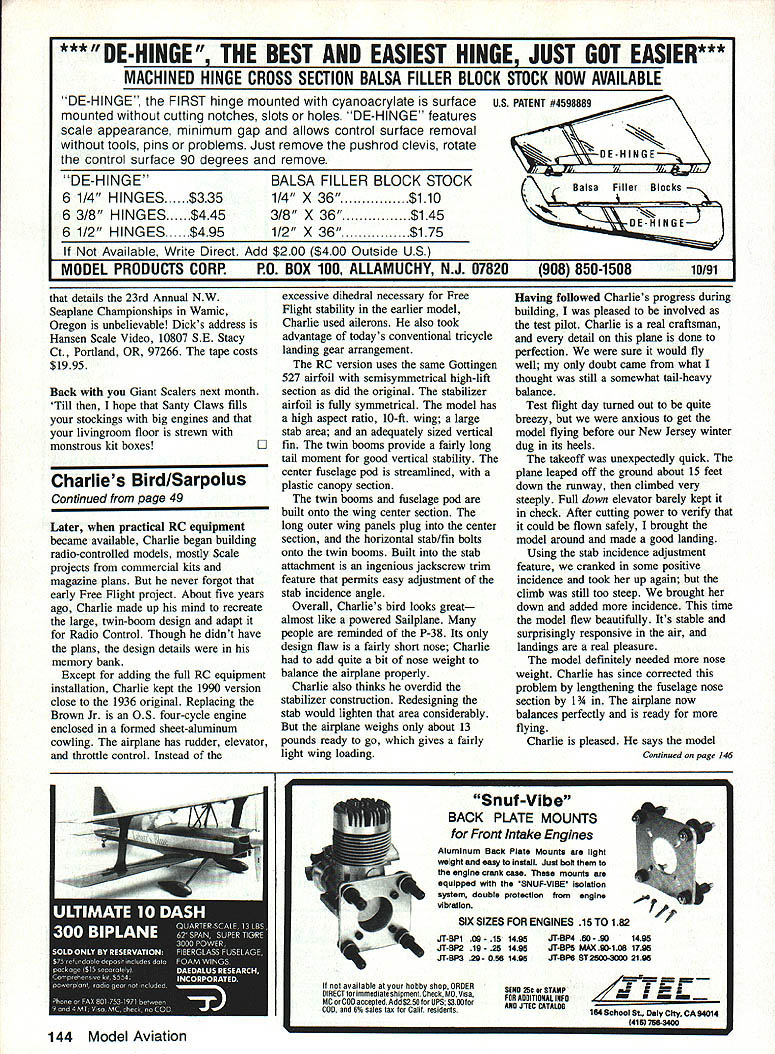
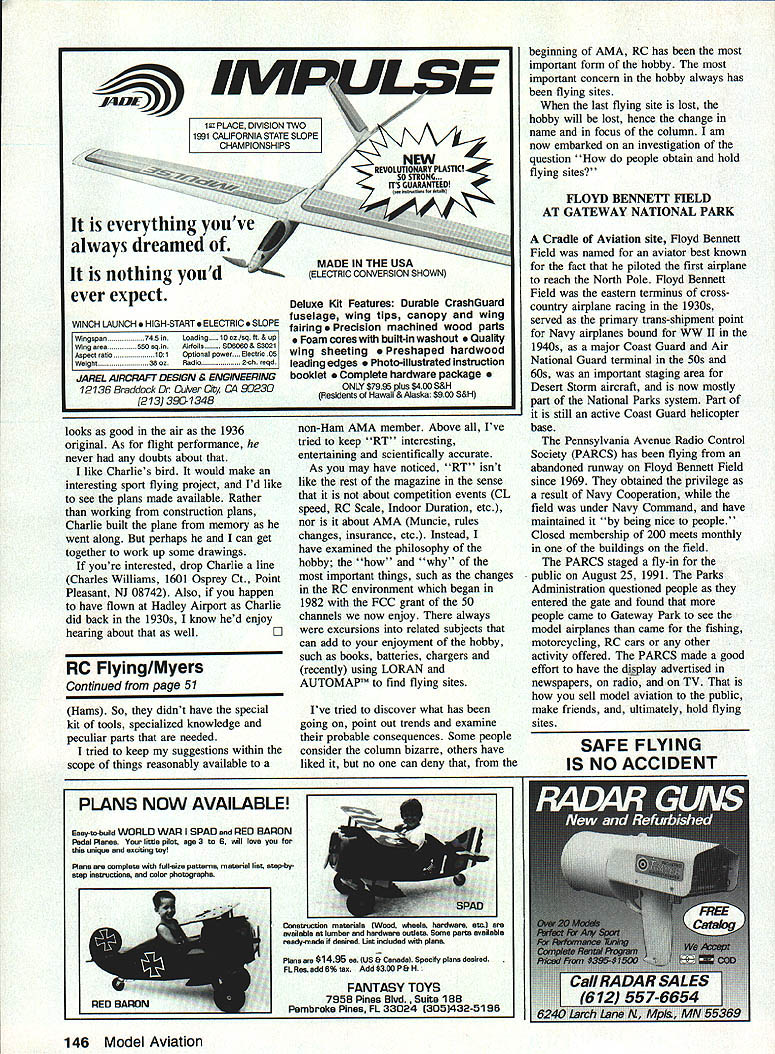
Except for adding the full RC equipment installation, Charlie kept the 1930s version close to the 1936 original. Replacing the Brown Jr. is an O.S. four-cycle engine enclosed in a formed sheet-aluminum cowling. The airplane has rudder, elevator, and throttle control. Instead of the excessive dihedral necessary for Free Flight stability in the earlier model, Charlie used ailerons. He also took advantage of today's conventional tricycle landing gear arrangement.
The RC version uses the same Göttingen 527 airfoil with a semisymmetrical high-lift section as did the original. The stabilizer airfoil is fully symmetrical. Other notable features:
- High-aspect-ratio 10-ft. wing with long outer panels that plug into a center section
- Large stabilizer area and adequately sized vertical fin
- Twin booms providing a long tail moment for good vertical stability
- Streamlined center fuselage pod with a plastic canopy section
- Horizontal stabilizer/fin that bolts onto the twin booms
- Built-in jack-screw trim feature in the stabilizer attachment for easy incidence adjustment
Overall, Charlie's bird looks great—almost like a powered sailplane. Many people are reminded of the P-38. Its only design flaw is a fairly short nose; Charlie had to add quite a bit of nose weight to balance the airplane properly. He also thinks he overdid the stabilizer construction—redesigning the stabilizer would lighten that area considerably. Still, the airplane weighs only about 13 pounds ready to go, which results in fairly light wing loading.
Having followed Charlie's progress during building, I was pleased to be involved as the test pilot. Charlie is a real craftsman, and every detail on this plane is done to perfection. We were sure it would fly well; my only doubt came from what I thought was a somewhat tail-heavy balance.
Test flight day turned out to be quite breezy, but we were anxious to get the model flying before our New Jersey winter dug in its heels. The takeoff was unexpectedly quick. The plane leaped off the ground about 15 feet down the runway, then climbed very steeply. Full down elevator barely kept it in check. After cutting power to verify that it could be flown safely, I brought the model around and made a good landing.
Using the stabilizer incidence adjustment feature, we cranked in some positive incidence and locked it up again; but the climb was still too steep. We brought her down and added more incidence. This time the model flew beautifully. It's stable and surprisingly responsive in the air, and landings are a real pleasure.
The model definitely needed more nose weight. Charlie has since corrected this problem by lengthening the fuselage nose section by 1 3/4 inches. The airplane now balances perfectly and is ready for more flying.
Charlie is pleased. He says the model looks as good in the air as the 1936 original. As for flight performance, he never had any doubts about that.
I like Charlie's bird. It would make an interesting sport-flying project, and I'd like to see the plans made available. Rather than working from construction plans, Charlie built the plane from memory as he went along. Perhaps he and I can get together to work up some drawings.
If you're interested, drop Charlie a line: Charles Williams 1601 Osprey Ct. Point Pleasant, NJ 08742
Also, if you happened to fly at Hadley Airport as Charlie did back in the 1930s, I know he'd enjoy hearing about that as well.
Transcribed from original scans by AI. Minor OCR errors may remain.

