
Chic-Ah-Dee
By Ernie Heyworth
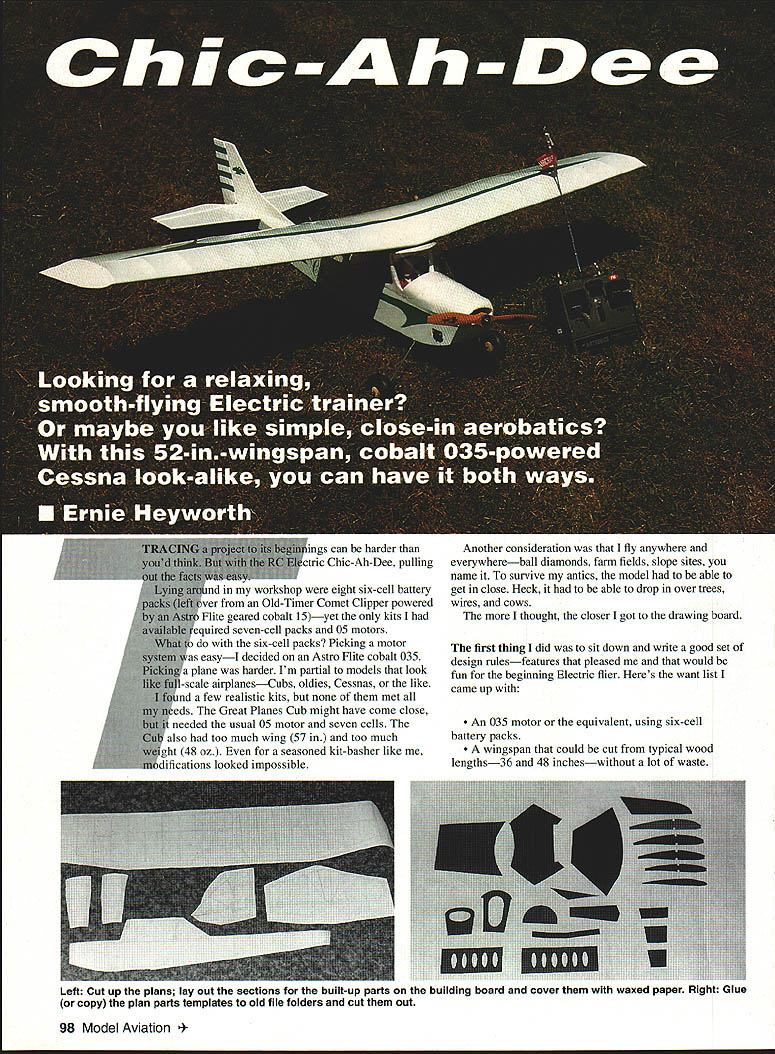
Looking for a relaxing, smooth-flying electric trainer? Or maybe you like simple, close-in aerobatics? With this 52‑in. wingspan, .035 cobalt‑geared Cessna look‑alike, you can have it both ways.
Tracing a project to its beginnings can be harder than you'd think. But with the RC electric Chic‑Ah‑Dee, pulling out the facts was easy.
Lying around in my workshop were eight six‑cell battery packs (left over from an Old‑Timer Comet Clipper powered by an Astro Flite geared cobalt .15)—yet the only kits I had available required seven‑cell packs and .05 motors.
What to do with the six‑cell packs? Picking a motor system was easy—I decided on an Astro Flite cobalt .035. Picking a plane was harder. I'm partial to models that look like full‑scale airplanes—Cubs, oldies, Cessnas, or the like.
I found a few realistic kits, but none met all my needs. The Great Planes Cub might have come close, but it needed the usual .05 motor and seven cells. The Cub also had too much wing (57 in.) and too much weight (48 oz.). Even for a seasoned kit‑basher like me, modifications looked impossible.
Another consideration was that I fly anywhere and everywhere—ball diamonds, farm fields, slope sites, you name it. To survive my antics, the model had to be able to get close. Heck, it had to be able to drop in over trees, wires, and cows.
The more I thought, the closer I got to the drawing board.
The first thing I did was to sit down and write a good set of design rules—features that pleased me and that would be fun for the beginning electric flier. Here's the want list I came up with:
- An .035 motor (or equivalent), using six‑cell battery packs.
- A wingspan that could be cut from typical wood lengths—36 in. and 48 in.—without a lot of waste.
- A wing loading of around 12 oz. per sq. ft. or less.
- The model should look like a specific full‑scale airplane.
- Landing gear for touch‑and‑goes and capability for ground takeoffs.
- Easy to build and rebuild.
- Easy to transport or load in one piece into a small car.
- Easy to load and reload the battery pack.
- Simple to fly and smooth‑flying even on windy days.
- Access to radio and motor controls.
- A backyard or small‑field flier so you can fly close in and see the plane.
Could I achieve all that in one model? I decided to build a few to find the right compromise. At the time this was written, six Chic‑Ah‑Dees had been built—no two alike. The variations are shown on the plans, so you can choose any that sound like fun.
A quick note on options: the motor mounting varies with different builders. I like the Sonictronics #160 motor mount bolted to the rear firewall.
RC Chic‑Ah‑Dee — Specifications
- Type: Semiscale electric
- Wingspan: 52 in.
- Recommended motor: .035 Astro Flite geared cobalt with six‑cell battery pack
- Recommended RC channels: 3 (rudder, elevator, motor control)
- Expected flying weight: ~37 oz.
- Construction: Built‑up
- Covering/finish: Lighter‑weight plastic films — UltraCote, Solarfilm, EconoKote, etc. Balsarite on wing rib bottoms and edges.
- Wing mounting: 1/16 in. dowel‑tongue front / plastic bolt rear or conventional rubber‑band method.
- Tail: Cessna style — civilian or military L‑19 Birddog.
Construction
General
Think light. Keep model weight to a minimum; weight control counts.
- Covering: Use lighter plastics (UltraCote, Solarfilm, EconoKote, or equivalent). No fabrics, no paint.
- Servos/controllers: Small servos such as the Airtronics 94831. Use an auto‑cutoff (Kyosho) or a controller like Jomar's SM5 if needed.
- Wood: Selected balsa and spruce from a quality supplier.
- After installing corner gussets, use a 1 in. sanding drum in a Dremel to grind radii where needed.
- Tail wheel: not recommended.
- CyA (cyanoacrylate) glue: use it, but select the right type. Some CyAs don't permeate wood well and can produce weak joints—do a little sanding before gluing.
- Use softer woods and lighter glues in the rear structure and wing tips; use stronger woods, spars, and longerons forward around the center‑of‑gravity and crash zones.
- Wheels: Trexler Balloon Wheels #8 or Dave Brown 2‑1/2 in. wheels cut in half.
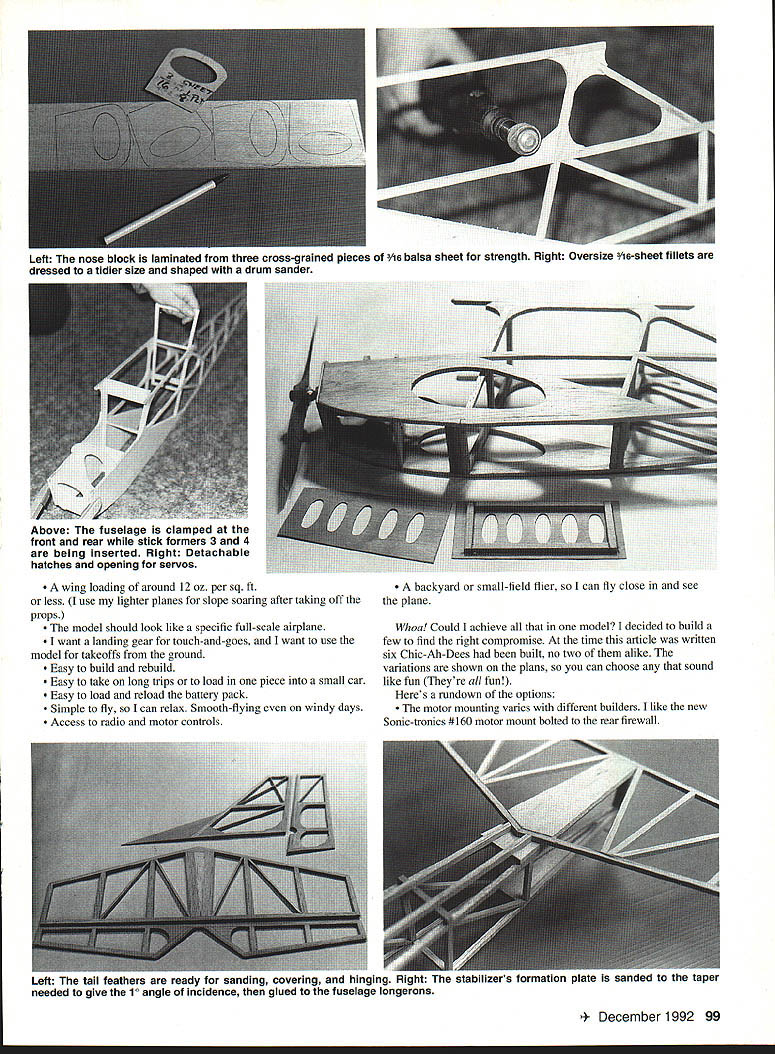
- Study the plans and cut templates at the indicated scales (1/16, 1/8, 1/32, 3/8, and .030 in.). Cut carefully on the line and modify fits as necessary.
- Locate the center‑of‑gravity (CG) 2‑1/2 in. behind the leading edge of the wing, or up to 3/4 in. forward of that point. Make the model nose‑heavy for the first few flights, then remove weight as you gain feel.
- Carry the main battery pack on the CG so swapping packs won't affect balance.
- Use the centerline of the fuselage center longeron as a reference for incidence angles. Stabilizer at +1° (positive) to give a tail‑high attitude and alter thrust angle by kicking the nose down. Wing at +2° to the centerline and +1° to the stabilizer for a flat glide. Use a Robart incidence meter for final checks and warp detection.
- Control throws: For test flights set elevator and rudder to about 1/2 throw each way (1¼ in. total left‑and‑right and 1¼ in. total up‑and‑down is a starting point). Use an experienced test pilot for advice but rely on your judgment.
- Power: Geared .035 provides adequate power. With more power the Chic‑Ah‑Dee becomes sporty and may hang on the prop rather than stall.
- Propellers: 10 x 7 or 10.5 x 6 recommended.
- Battery packs: five‑cell or six‑cell packs acceptable; use the mAh rating you prefer. Flight duration depends on battery condition and flying style.
- Motor control: you can use a speed controller or a simple on/off switch depending on style. The on/off switch worked fine for me.
Wing
The wing and stabilizer are built as light as practical. Check the wing for warps after covering.
- If you fly in very strong winds, consider reducing the 13% airfoil to 10% or 11% for better penetration; the thicker airfoil gives better slow‑speed performance.
- You may saw notches for gussets in the trailing edge instead of gluing them as shown on the plan. Reinforce or double the tip ribs if desired. Use all webbing shown on the plans.
- Dihedral: raise one wing tip 5 in. above the worktable and place the opposite wing flat on the table to achieve the correct dihedral.
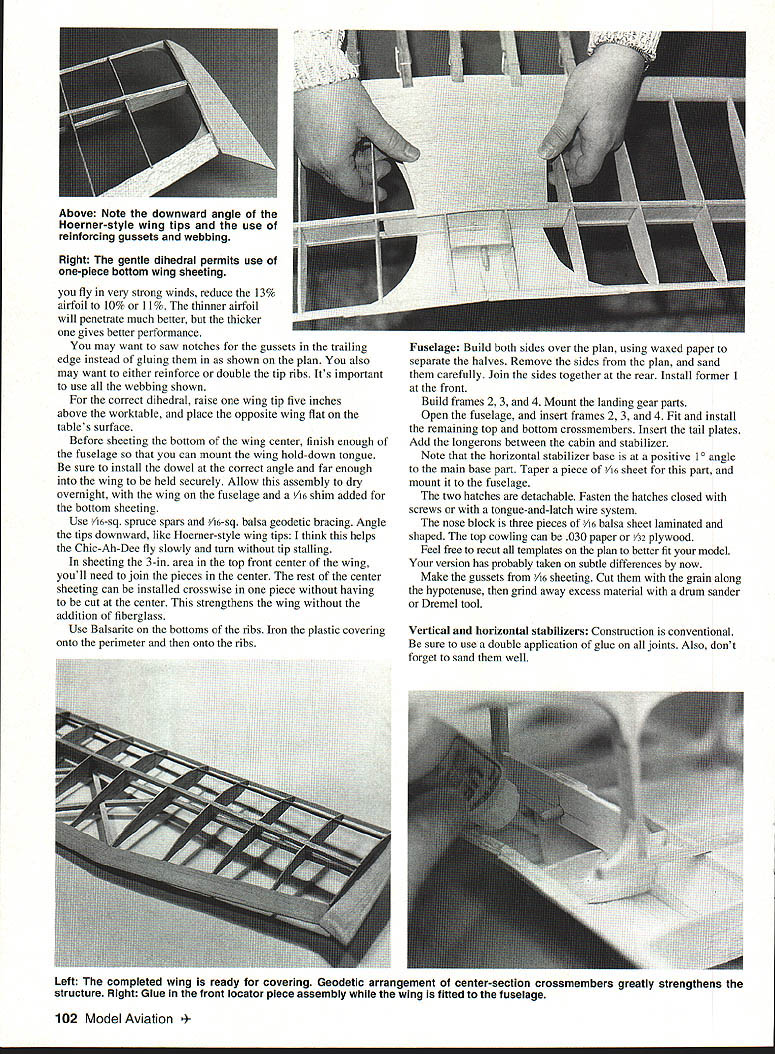
- Before sheeting the bottom of the wing center, finish enough of the fuselage to mount the wing hold‑down tongue. Install the dowel at the correct angle and deep enough into the wing for security. Allow the assembly to dry overnight with the wing on the fuselage and a 1/16 in. shim added for bottom sheeting.
- Spars and bracing: use 1/16 in. square spruce spars and 1/16 in. square balsa geodetic bracing.
- Tip shaping: angle the tips downward (Hoerner‑style) to help slow flight and prevent tip stalling.
- Center sheeting: sheet the top front center area (3 in.) by joining pieces at the center; the remainder can be sheeted crosswise in one piece for strength without adding fiberglass.
- Use Balsarite on rib bottoms. Iron the plastic covering onto the perimeter and onto the ribs.
Fuselage
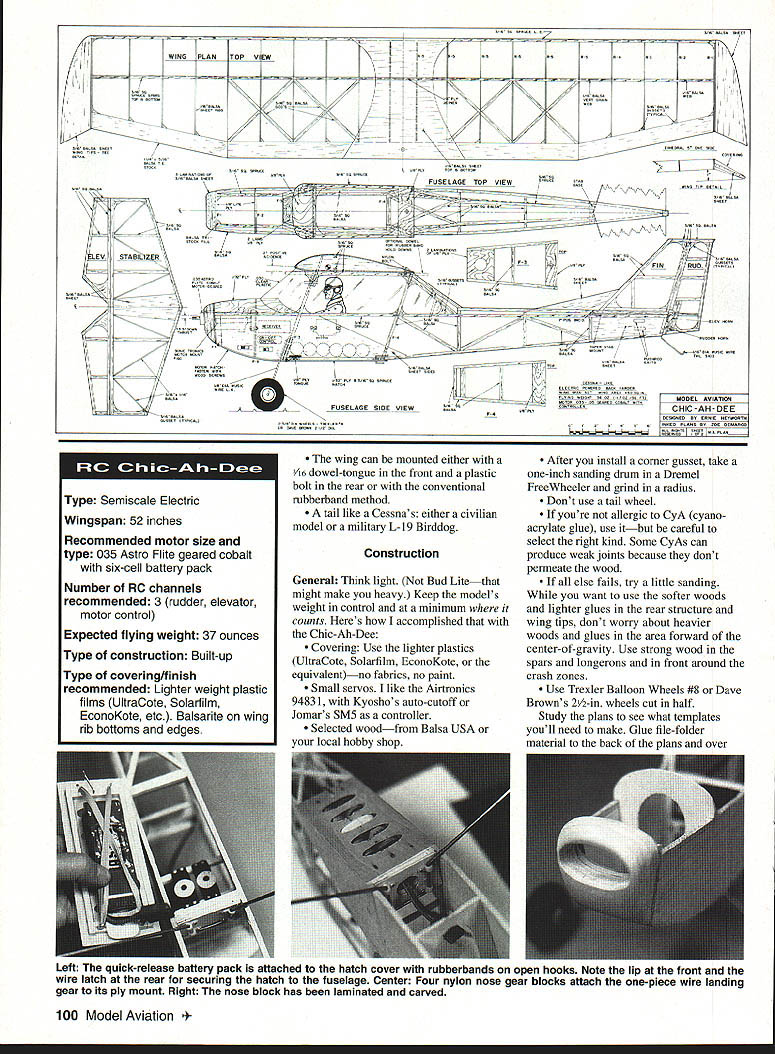
- Build both fuselage sides over the plan using waxed paper to separate halves. Remove, sand carefully, and join the sides together at the rear. Install former 1 at the front.
- Build frames 2, 3, and 4 and mount the landing gear parts.
- Open the fuselage and insert frames 2, 3, and 4. Fit and install remaining top and bottom crossmembers. Insert tail plates and add longerons between the cabin and stabilizer.
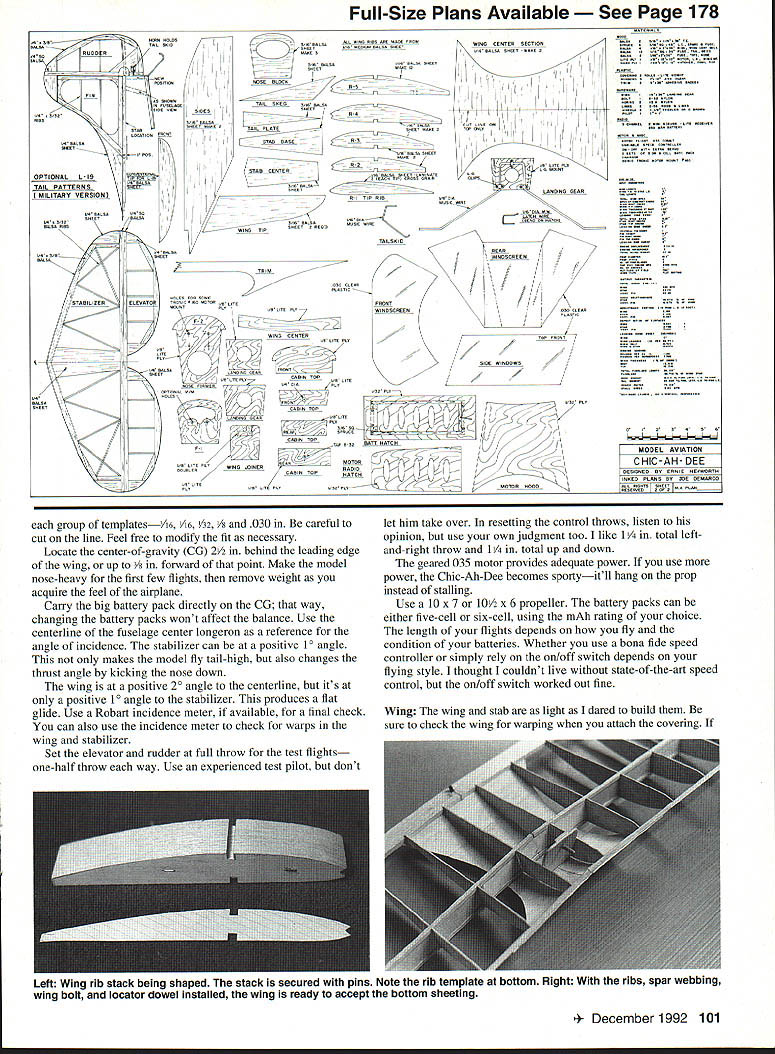
- The horizontal stabilizer base is at +1° to the main base part. Taper a piece of 1/16 in. sheet for this part and mount it to the fuselage.
- Hatches: two detachable hatches; fasten with screws or a tongue‑and‑latch wire system.
- Nose block: three pieces of 1/16 in. balsa sheet laminated and shaped. Top cowling can be .030 in. paper or 1/32 in. plywood.
- Make gussets from 1/16 in. sheeting. Cut them with the grain along the hypotenuse, then grind away excess material with a drum sander or Dremel tool.
- Feel free to cut templates from the plan to better fit your version of the model.
Vertical and Horizontal Stabilizers
Construction is conventional. Use a double application of glue on all joints and sand well.
- Thin stock can make hinge installation difficult. If using soft wood, reinforce areas or add gussets. Cloth hinges (installed with CyA) or iron‑on plastic‑covering hinges are viable alternatives.
- Check for warping when covering the stabilizers.
Finishing
Cessnas are easy to find as references. I used an overall base color with arrowhead decoration in a highly contrasting color. This is a quick, simple method that looks realistic.
Flying
Refer to the "General" subsection for angle of incidence and control throw settings.
- Flight characteristics: the Chic‑Ah‑Dee picks up its tail quickly, giving instant rudder control. Watch for torque turn to the left if too much downthrust is built in.
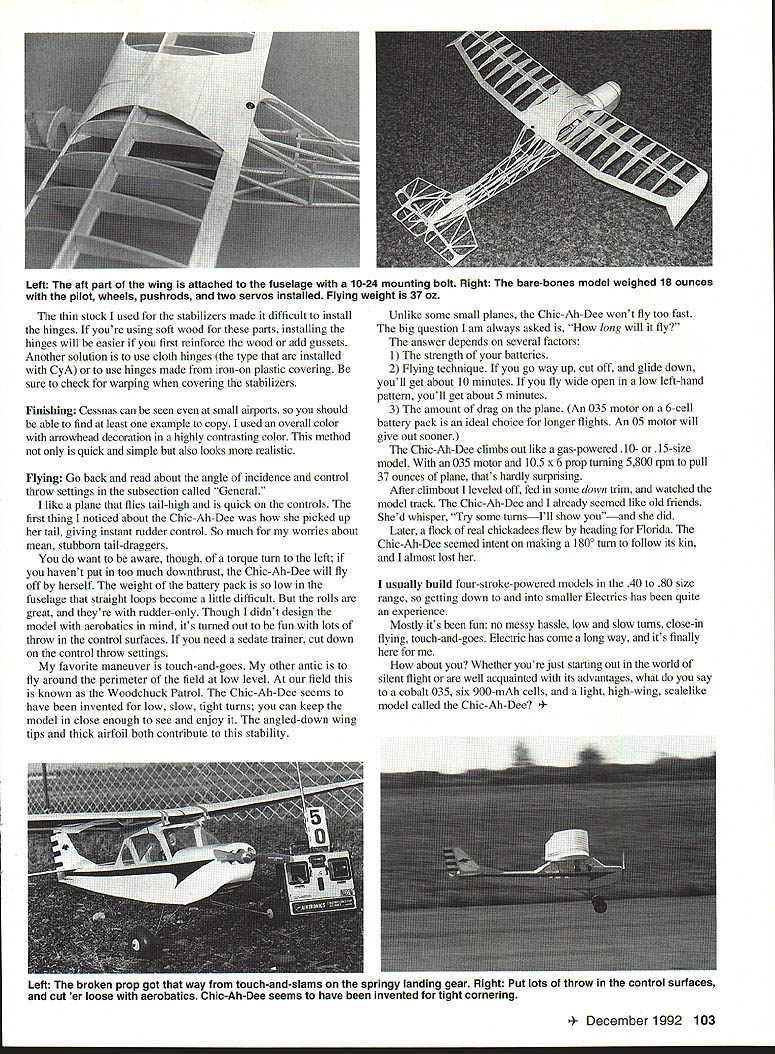
- Handling notes: battery pack weight is low in the fuselage; straight loops can be a bit more difficult, but rolls and rudder‑only maneuvers work well. If you want a sedate trainer, reduce control throws.
- Favorite maneuvers: touch‑and‑goes and low, tight perimeter flying (my "Woodchuck Patrol"). The angled‑down wing tips and thicker airfoil provide stability for low, slow, tight turns.
- Speed and climb: the Chic‑Ah‑Dee won't fly excessively fast. With an .035 motor and a 10.5 x 6 prop turning ~5,800 rpm pulling 37 oz., it climbs like a gas .10–.15 model.
How long will it fly? The answer depends on several factors:
- The strength and capacity of your batteries.
- Flying technique. If you climb high, cut off, and glide down, expect about 10 minutes. If you fly wide open in a low pattern, expect about 5 minutes.
- The amount of drag on the plane. An .035 on a six‑cell pack is ideal for longer flights; an .05 will deplete sooner.
After climbout, I leveled off, fed in some down trim, and watched the model track. The Chic‑Ah‑Dee already seemed like an old friend—responsive, forgiving, and fun.
Whether you're just starting in the world of silent flight or are well acquainted with its advantages, what do you say to a cobalt .035, six 900‑mAh cells, and a light, high‑wing, scale‑like model called the Chic‑Ah‑Dee?
Transcribed from original scans by AI. Minor OCR errors may remain.

