
Chicago Expo
Radio control expositions are enjoying success everywhere as they increase in size and numbers. The Ninth Annual Greater Chicago Radio Controlled Model Show, otherwise known as Chicago Expo, is an example of this growth, with an estimated 10% increase in exhibitors and attendance each year.
Location and growth
Like some other shows, Chicago Expo has outgrown its original buildings. For the second time in recent years it was held at the DuPage County Fairgrounds in Wheaton, a distant suburb of Chicago, where it has expanded into three buildings. A move to even larger quarters is rumored. The present fairgrounds location has one feature that may not be easy to duplicate: flying demonstrations are carried out adjacent to the main building on a paved strip with a grassy slope serving as a natural spectator grandstand.
Organization
Unlike most other shows, Chicago Expo is staged by a coalition, the Association of Greater Chicago Radio Control Clubs. This consists of 32 organizations with interests in powered planes, sailplanes, racing and scale boats, sail yachting, and cars. Cooperation is the key word here.
Youth activities
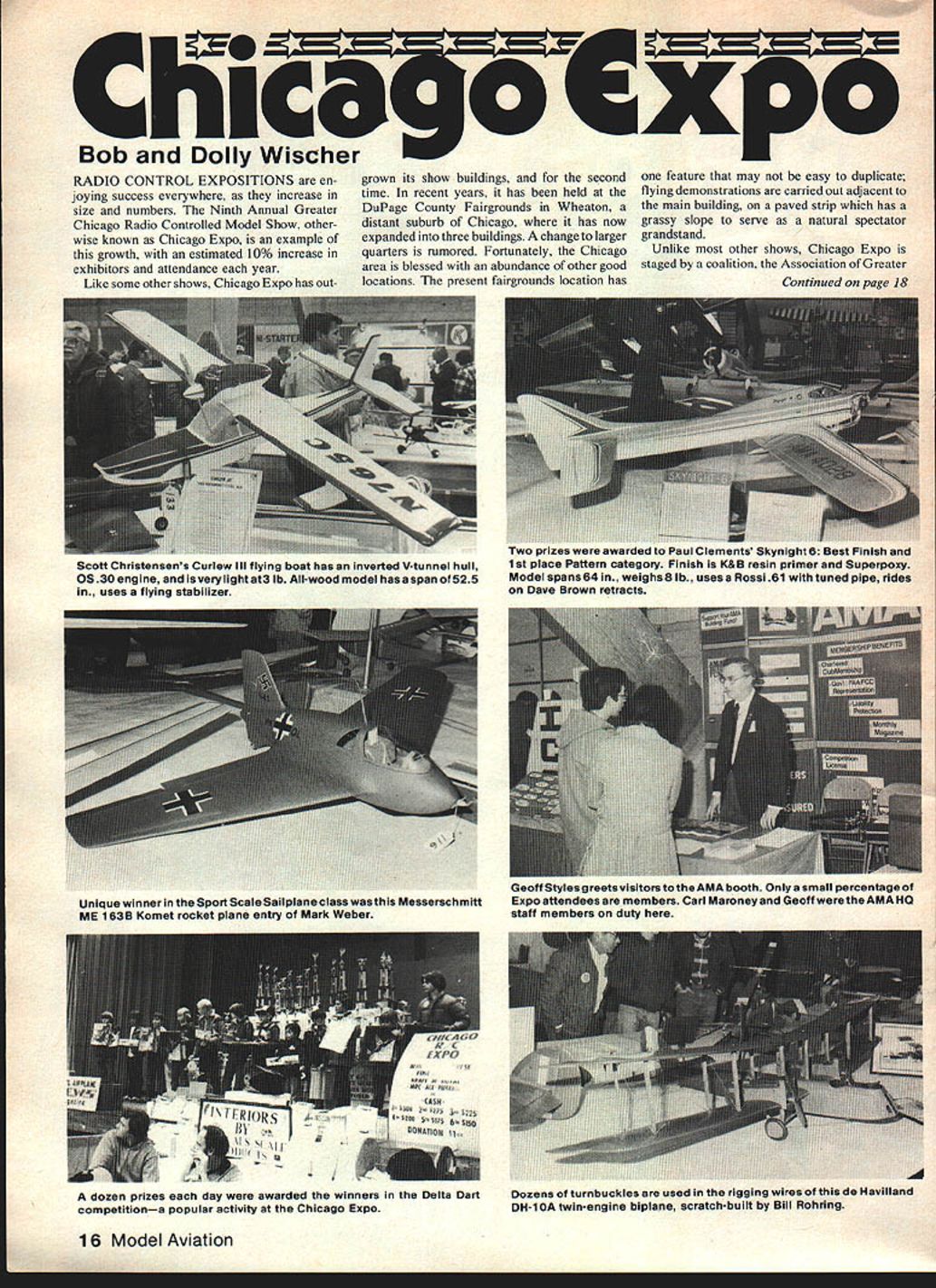
While parents visited manufacturers' booths, children were kept busy constructing and flying Delta Darts, a unique Expo feature among RC shows. A dozen prizes were awarded each day to the enthusiastic kids. The same building also featured attractions for the young, such as a car track, boat demonstrations, and a concession stand.
Scale models and awards
All present-day shows seem to be dominated by scale model exhibitions, and Chicago Expo was no exception. Pattern and sport models were in the minority, and giant scale was not as overwhelming in quantity as in the past. Fifty trophies were awarded in 20 categories, with individual awards for best finishes.
Winners and notable entries:
- First place, Military Sport Scale: Bell RP-63G target plane — Weldon Smith. Since it was last seen, the Kingcobra has had its engine changed to a Rossi .90 with special head and fins for adequate cooling. The engine is buried deep in the rear fuselage, as on the prototype, with a long extension shaft running beneath the cockpit to a belt reduction in the nose. (See the August 1981 issue of Model Aviation for a detailed description of the model.)
- First place, Non-Military Sport Scale: Beechcraft Bonanza E — Robert Walker (modified from a Byron kit), showing that kit airplanes can win.
- Best Pattern plane and best finish trophy: Skynight 6 — Paul Clements. This well-finished model has many hundreds of competition flights, disproving the myth that well-finished models never fly.
- First place, Helicopter class: Kavan OH-58A — Richard Quinlan.
- First place, Giant class: Piper J-3 Cub — Richard Quinlan.
- Sport Scale Sailplane class (unusual winner): Messerschmitt ME-163 Komet rocket plane — Mark Weber.
- General Sailplane class: Sagitta 900 — Scott Christensen.
Exhibitors
Contributing to the success of Chicago Expo was the prominence of the local hobby industry among commercial exhibitors. Notable local and regional names included:
- Midwest
- Du-Bro
- Bridi
- Robart
- Goldberg
- Top Flite
- Sig Mfg.
- Bud Nosen
- Byron Originals
- Kitty Hawk
- Flite Glas
Exhibitors from greater distances helped lift the show out of the strictly local class, including:
- Kraft
- Royal Electronics
- Ace R/C
- Eastcraft Specialty Products
- Circus Hobbies
- MRC
The AMA was one of six organizations with displays.
Note to advertisers
When writing advertisers, mention that you read about them in Model Aviation.
Transcribed from original scans by AI. Minor OCR errors may remain.

