
CHINA NATS
Clarence Haught
Background
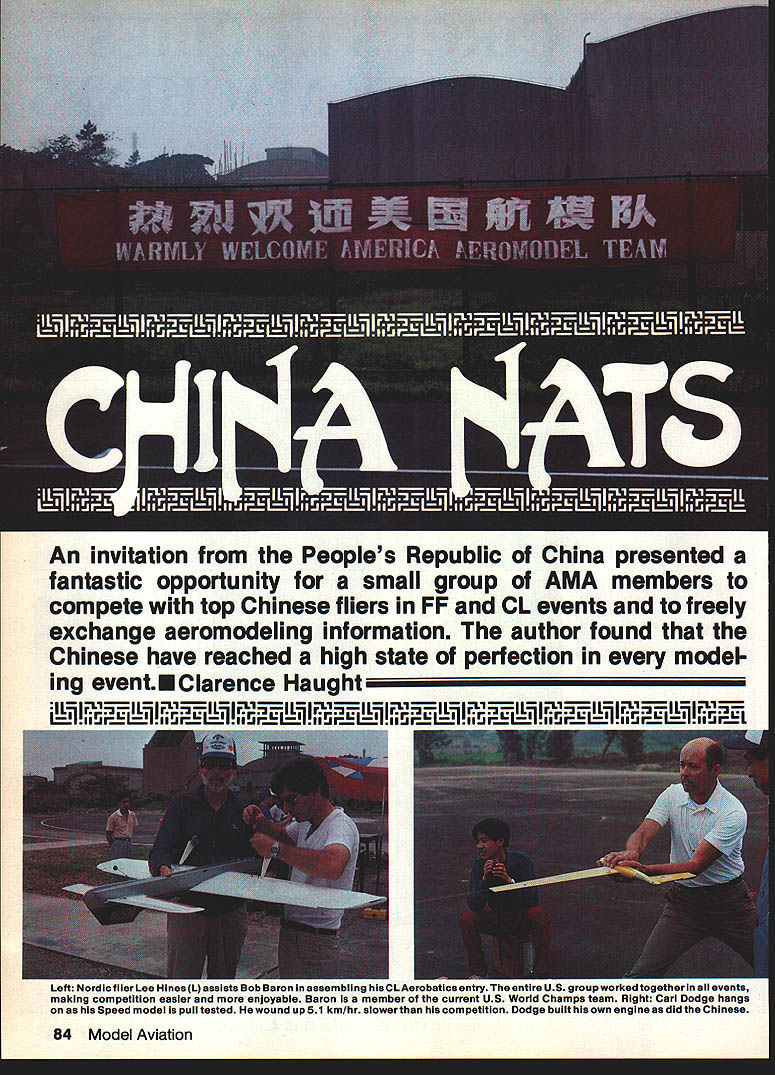
In April 1984 the Chinese Aeronautical Sports Association (People's Republic of China) issued an unprecedented invitation to the Academy of Model Aeronautics (AMA) to send a U.S. aeromodeling team to China. The invitation covered Free Flight (F1A Nordic, F1B Wakefield, F1C Power) and Control Line (F2A Speed, F2B Aerobatics, F2C Team Race) competitions. The Chinese ASA would cover in-country costs for a two-week stay (June 14–30); team members paid their own travel. Each event allowed two fliers (except Speed), plus two officials.
Because there was insufficient time for formal team trials and no official AMA-sanctioned team procedure, the invitation was publicized to known FAI participants; interested parties contacted AMA headquarters. Screening and selection were carried out by AMA with help from special-interest groups (NFFS, PAMPA, etc.).
Team Selected
- F1A (Nordic): C. Wayne Drake, Lee Hines
- F1B (Wakefield): George Schroedter, Bob White
- F1C (Power): Bob Sifleet, Clarence Haught
- F2A (Speed): Carl Dodge
- F2B (Aerobatics): Bob Whitely, Robert Baron
- F2C (Team Race): John McCollum, Tom Knoppi
- Free Flight official: C. C. Johnson
- Team selector: AMA President John Grigg
Hospitality and Arrival
From arrival in Beijing (Peking) through departure from Shanghai the team was accompanied by Chinese ASA officials, including Secretary General Xu Guoan; Huang Yonghang, Deputy Director, Judges Committee (also editor of Chinese Model Airplane magazine); and guide Chow Jian-xiong. The Chinese hosts treated the team with extensive courtesy and made extraordinary efforts to accommodate needs.
Sightseeing (Great Wall, Summer Palace, Ming Tombs, Palace Museum, etc.) was exceptional, but the focus here is on the competitions and Chinese aeromodeling.
Chinese Aeromodeling Structure
Since about 1978 the Chinese government has encouraged aeromodeling in schools as part of building technical skills and healthy attitudes. Programs exist across roughly 30 provinces, with materials and coaches provided locally. Top modelers—mostly students in their late teens to early 20s—devote much spare time to the sport and are often effectively sponsored; older coaches no longer competing guide the younger teams. This provincial system produced high overall quality and some provincial stylistic similarities in models and boxes.
The Chinese are fast learners and serious competitors; their models displayed state-of-the-art workmanship and international influences.
Free Flight (Zibo, Shandong Province)
Site and Format
Free Flight competition was held at Zibo Airfield, a training base with a 2,000-meter-diameter circle of flat sod—one of the best FF sites in the world. All operations at the base were shut down for two weeks to host the Nationals. Motorcycle sidecar chasers were provided for retrieval.
Competition format: each U.S. entrant competed individually against the top three Chinese finishers from the 1983 Nationals, creating a five-man contest per class. Flying followed FAI rules in seven one-hour rounds plus flyoffs.
The official opening featured demonstrations (Control Line Aerobatics and Combat, Radio Control Pattern) and parachute jumps for local officials and, astonishingly, over 100,000 spectators.
F1A (Nordic) — Highlights
- Weather early in the event provided strong lift and many maxes; later rounds brought drizzle and weaker lift.
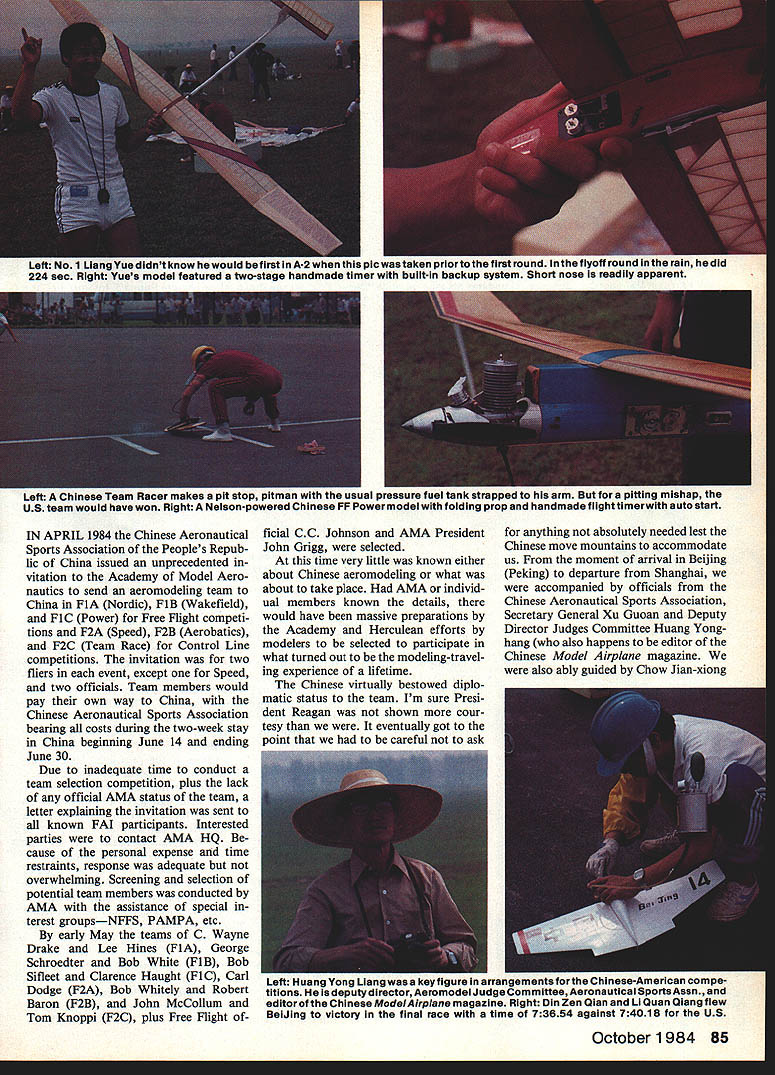
- Lee Hines reached the flyoff; Liang Yue won the flyoff convincingly (224 vs. Hines' 109), giving the Chinese first place and Hines a strong second.
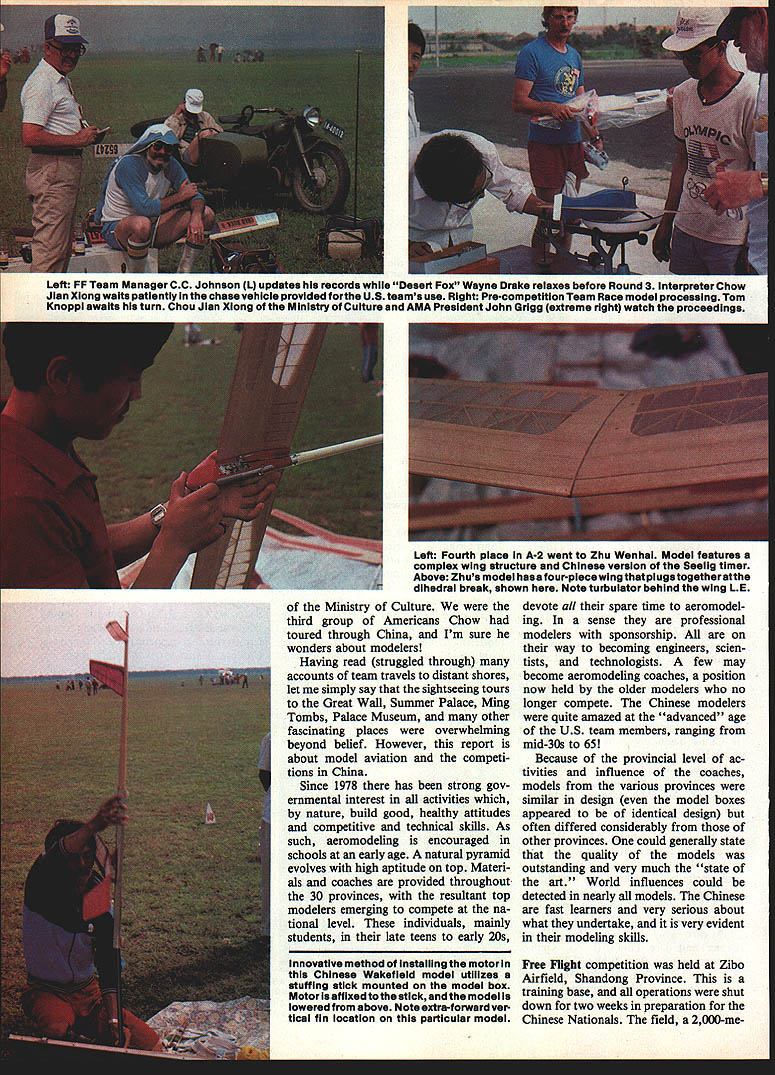
- Observations: lightweight high-quality tow hooks using low unlatching tension; some wings joined at the dihedral break allowing shorter model boxes (four-piece wing with aluminum joiners plugging into reinforced spars).
F1B (Wakefield) — Highlights
- Bob White had early bad luck (down in 149 sec and again in Round 4). George Schroedter maxed all seven rounds and made the flyoff.
- Flyoff: Schroedter posted 240 and 249; Wang Chaorong posted 240 and 257, giving the Chinese victory and Schroedter second.
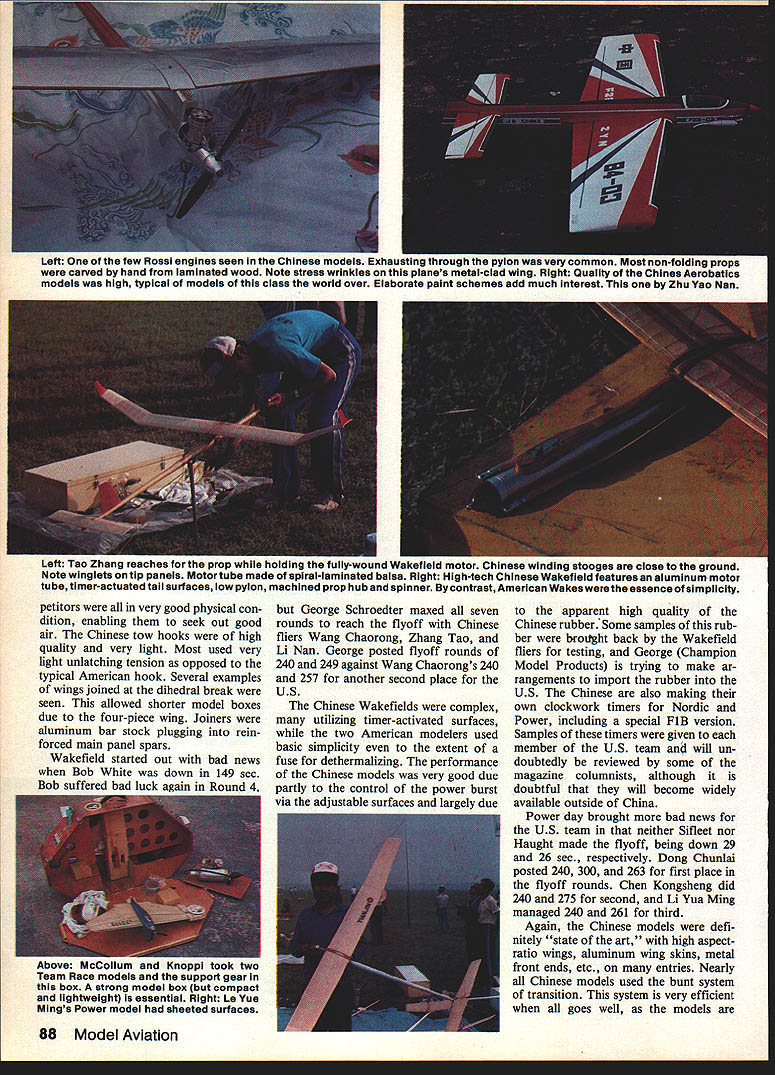
- Chinese Wakefields were often complex (timer-activated surfaces) and used high-quality rubber; American Wakefields tended toward simplicity. Wakefield fliers brought back samples of Chinese rubber and timers for evaluation and possible import. China is also making its own clockwork timers for Nordic and Power.
F1C (Power) — Highlights
- Neither U.S. entrant (Sifleet or Haught) made the flyoff (down at 29 and 26 sec).
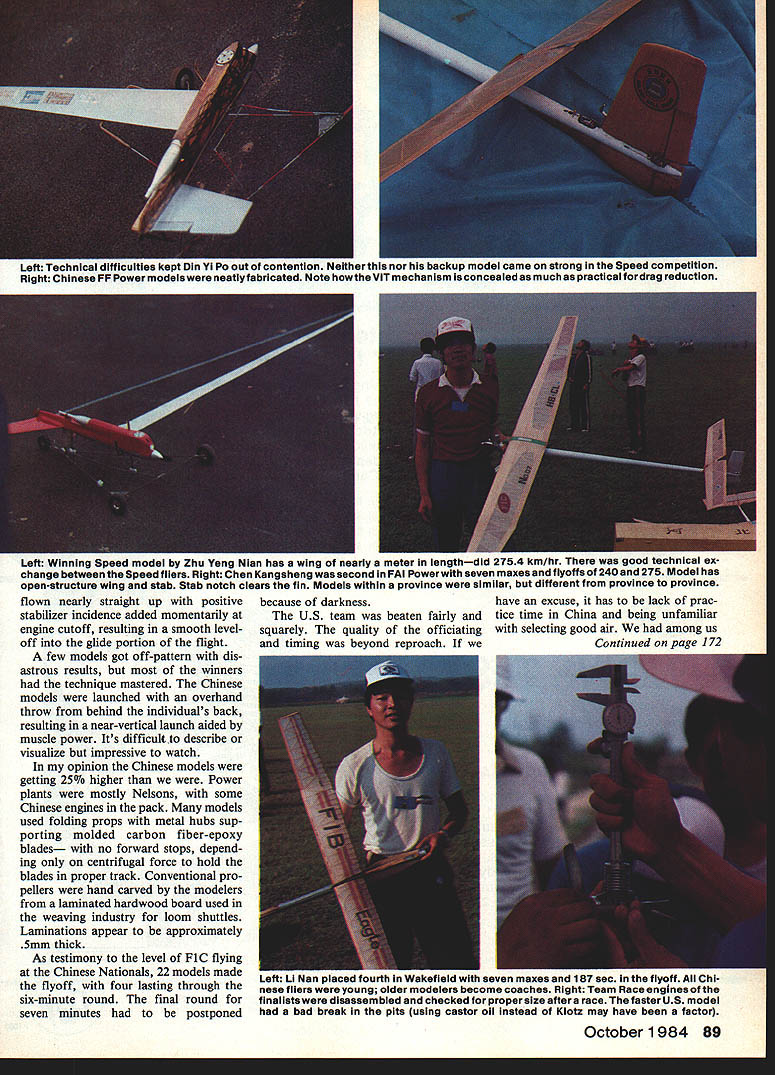
- Flyoff winners: Dong Chunlai (240, 300, 263); Chen Kongsheng (240, 275); Li Yua Ming (240, 261).
- Chinese entries showed advanced construction: high-aspect wings, aluminum wing skins, metal front ends; most used the bunt transition system (near-vertical climb with positive stabilizer incidence at cutoff for smooth level-off).
- Launch technique: overhand throw from behind the back producing near-vertical launches.
- Powerplants: mostly Nelson engines, some Chinese-built engines. Many models used folding props with metal hubs and molded carbon-fiber blades relying on centrifugal force (no forward stops). Conventional props were hand-carved from laminated hardwood used in loom shuttles (laminations ~0.5 mm).
- Depth of field: 22 models made the flyoff; only four lasted through a six-minute round. The final seven-minute round had to be postponed because of darkness.
General FF Observations
- The U.S. team was beaten fairly and squarely; Chinese officiating and timing were excellent.
- A likely reasons for U.S. shortfall: limited practice time in China and unfamiliarity with local air and thermalling conditions.
- The Chinese models appeared to achieve significantly higher altitude (est. ~25% higher) and benefitted from high-quality rubber and refined techniques.
A formal awards ceremony on the field closed the Free Flight portion; winners received commemorative China plates.
Control Line (Shanghai Aeromodelling Center)
Facilities and Schedule
The Shanghai aeromodelling center had well-arranged CL facilities: a main competition circle with a three-meter-high chain-link fence and shaded spectator area, plus a practice circle and parking/practice area. Host: LeChung Yie.
Monday, June 25, was set aside for practice, model processing, and judge training. Fuel ingredients were supplied and mixed on-site. Model processing for Speed and Team Race was thorough and efficient.
Events were flown in the fenced circle: F2A (Speed) first, F2B (Aerobatics) next, followed by F2C (Team Race). The Chinese Control Line team comprised members of their World Championships team.
F2A (Speed)
- Asymmetric models (one inboard wing, half stabilizer outboard) reached incredible speeds.
- Timing began when the competitor placed the control handle in the pylon and continued for 10 laps.
- Results: Shu Yang Ninan won at 275.4 km/h; Carl Dodge (U.S.) recorded 269.7 km/h; Din Yi Po had technical difficulties but managed 244 km/h.
F2B (Aerobatics)
- Aerobatics is judged; five judges are used with high/low discarded and the middle three averaged.
- Judges in Shanghai favored a larger, more open pattern emphasizing smooth corners rather than tight radii, which initially disadvantaged U.S. pilots.
- Bob Baron adapted his routine and finished second with 5,974 points.
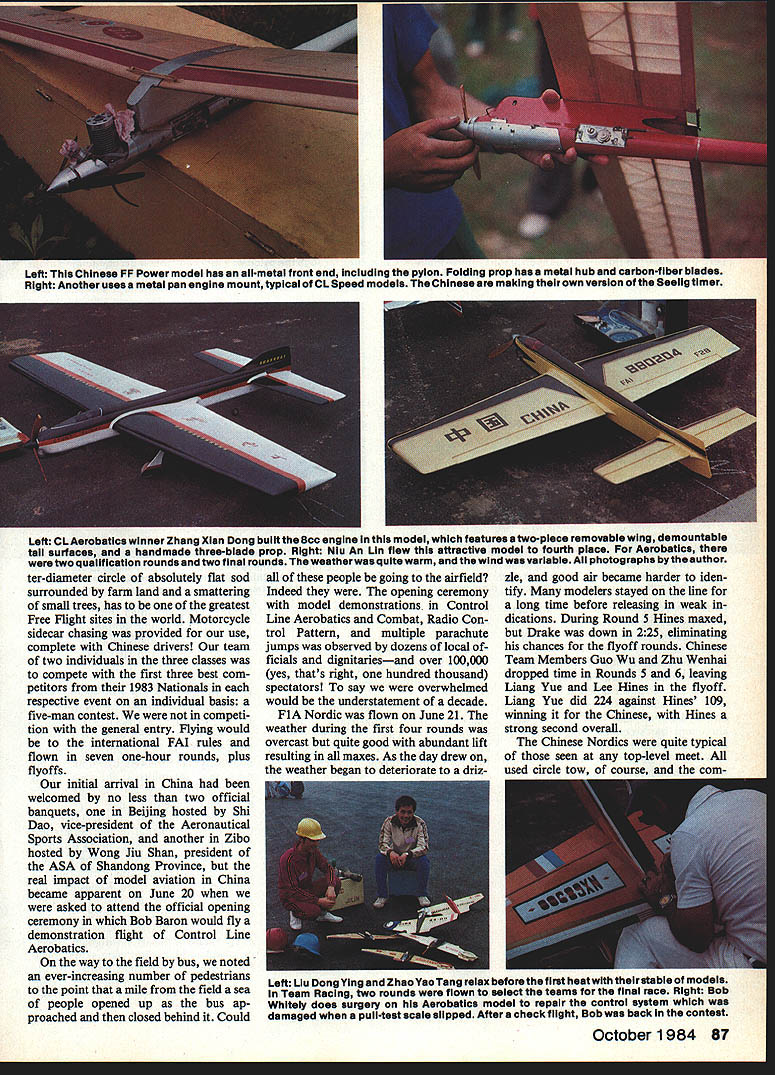
- Results: Zhang Xian Dong won with 6,021; Zhu Yao Nan third with 5,892; Niu An Lin fourth with 5,830; Bob Whitely scored 5,676.
- Models were of very high quality; the winning model featured two-piece removable wings, detachable fin/stabilizer assembly, a handcrafted three-blade wooden prop, and an 8 cc engine built by the pilot. The whole model packed into a small suitcase-type box.
F2C (Team Race)
- Team Race requires a skilled pilot, an efficient pitman, and excellent teamwork for quick pit stops and precise landings.
- China fielded four teams; the U.S. effectively had two teams by flying twice with different models.
- Preliminary rounds reduced the field to two Chinese teams and the U.S. "A" team. The U.S. prelim times were competitive, but a bad break during a pit stop in the final cost the faster model critical time and a shot at the win.
- Awards on the field included beautiful vases presented to the winners.
Symposium, Workshops, and Farewell
On June 27 an informal symposium and technical exchange was held at the Shanghai Aeromodelling Center. Despite language barriers, a great deal of technical information passed between modelers as models were dismantled and examined. The day included:
- Tours of modelers' machine shops and labs where engines were built
- Demonstrations of ship modelers constructing metal scale models from photos and drawings
- RC power-boat demonstrations of speed and maneuverability
- A banquet and the cementing of new friendships
Conclusion
The trip was, for many participants, the modeling experience of a lifetime. The Chinese displayed exceptional skill, craftsmanship, and organization; their modelers are often young, intensely focused, and on pathways to engineering and technical careers. The quality of Chinese models, rubber, timers, and techniques was impressive and in many cases state-of-the-art.
A clear hope expressed by the team is that the U.S. will reciprocate by hosting Chinese teams at major events so that these friendships and the exchange of technical knowledge can continue. Aeromodeling, indeed, proved to be a universal language bringing nations together.
Transcribed from original scans by AI. Minor OCR errors may remain.

