
Chinese Friendship Tournament
- Travis McGinnis
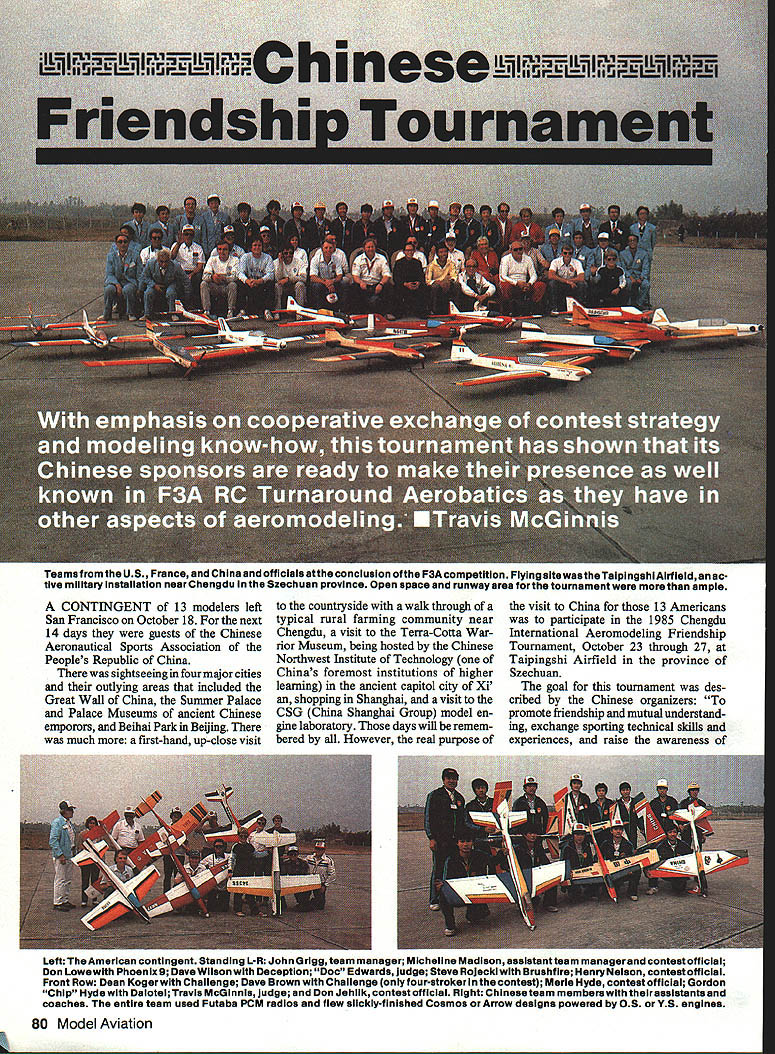
With emphasis on cooperative exchange of contest strategy and modeling know-how, this tournament showed that its Chinese sponsors are ready to make their presence as well known in F3A R/C aerobatics as they have in other aspects of aeromodelling.
Itinerary and visit
A contingent of 13 modelers left San Francisco on October 18. For the next 14 days they were guests of the Chinese Aeronautical Sports Association of the People's Republic of China.
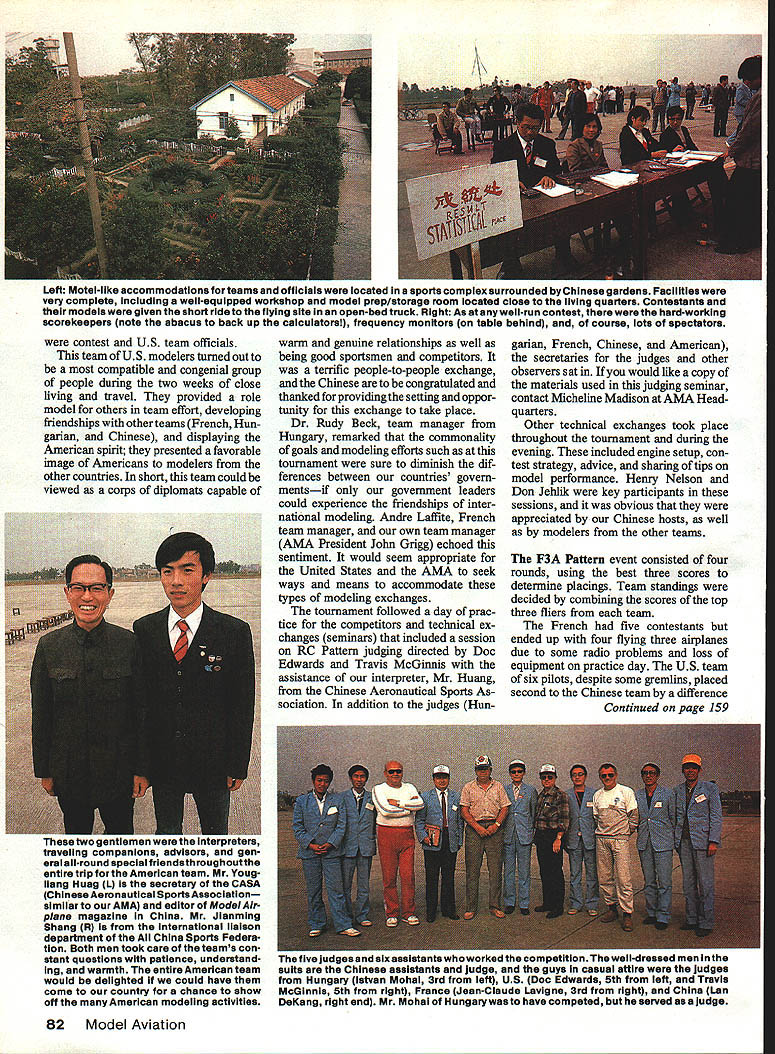
There was sightseeing in four major cities and their outlying areas, including the Great Wall of China, the Summer Palace and Palace Museums of ancient Chinese emperors, and Beihai Park in Beijing. There was much more: a first-hand, up-close visit to the countryside with a walk-through of a typical rural farming community near Chengdu; a visit to the Terra-Cotta Warrior Museum; being hosted by the Chinese Northwest Institute of Technology (one of China's foremost institutions of higher learning) in the ancient capital city of Xi'an; shopping in Shanghai; and a visit to the CSG (China Shanghai Group) model engine laboratory. Those days will be remembered by all.
The real purpose of the visit for the 13 Americans was to participate in the 1985 Chengdu International Aeromodeling Friendship Tournament, held October 23–27 at Taipingshi Airfield in the province of Szechuan.
Tournament goal
The goal described by the Chinese organizers was: "To promote friendship and mutual understanding, exchange sporting technical skills and experiences, and raise the awareness of aeromodeling activities." The Chinese hosts made their best effort to achieve this and were successful in providing an opportunity to develop friendships that are special among modelers around the world.
Events and organization
Concomitant contests
The Friendship Tournament was conducted under the F3A section of the FAI Sporting Code. In conjunction with it, the Chinese Control Line National Contest was held on the same dates. A five-man team from Hungary was invited to participate in the control-line meet.
U.S. delegation and staff
The American team participating in the F3A aerobatics event included:
- Dave Brown (Ohio)
- Dean Koger (Ohio)
- Dave Wilson (California)
- Steve Rojecki (Nevada)
- Don Lowe (Florida)
- Gordon "Chip" Hyde (Arizona)
Attending for technical exchanges were Don Jehlik (control-line team racing authority) and Henry Nelson (engine manufacturer). James "Doc" Edwards and Travis McGinnis were F3A judges and conducted a seminar on judging techniques. Also attending were Micheline Madison, Merle Hyde, and John Grigg.
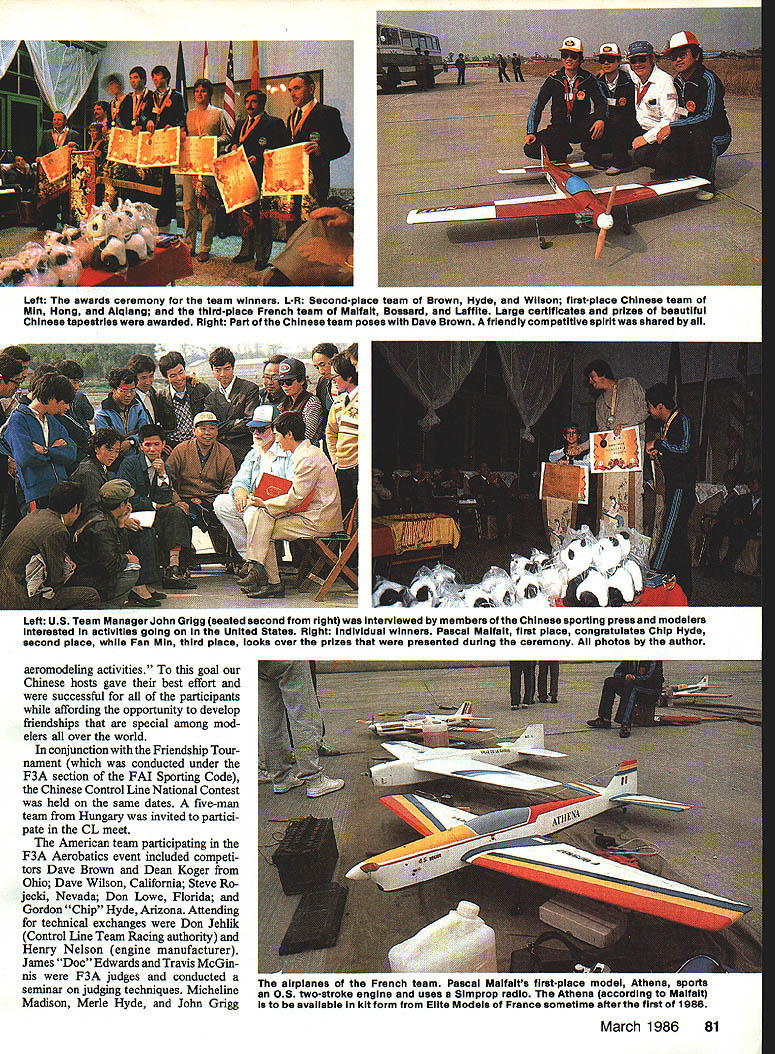
This team of U.S. modelers proved to be a most compatible and congenial group during two weeks of close living and travel. They provided a role model for others in team effort, developed friendships with the French, Hungarian, and Chinese teams, and displayed the American spirit. In short, they served as informal diplomats—warm, genuine, and good sportsmen. The exchange was terrific, and the Chinese are to be congratulated and thanked for providing the setting and opportunity.
Dr. Rudy Beck, team manager from Hungary, remarked that common modeling goals such as these tournaments help diminish differences between countries' governments—if only government leaders could experience these friendships. Andre Laffite, French team manager, and AMA President and U.S. team manager John Grigg echoed this sentiment. It would seem appropriate for the United States and the AMA to seek ways to accommodate similar modeling exchanges in the future.
Seminars and technical exchanges
The tournament followed a day of practice for competitors and technical exchanges (seminars), including a session on R/C Pattern judging directed by Doc Edwards and Travis McGinnis with assistance from interpreter Mr. Huang of the Chinese Aeronautical Sports Association. Judges from Hungary, France, China, and the United States participated, and the secretaries for the judges and other observers also attended. Copies of the materials used in the judging seminar are available from Micheline Madison at AMA Headquarters.
Other technical exchanges occurred throughout the tournament and during the evenings, covering engine setup, test strategy, advice, and sharing of tips on model performance. Henry Nelson and Don Jehlik were key participants in these sessions and were clearly appreciated by both the Chinese hosts and modelers from other teams.
Competition
Format
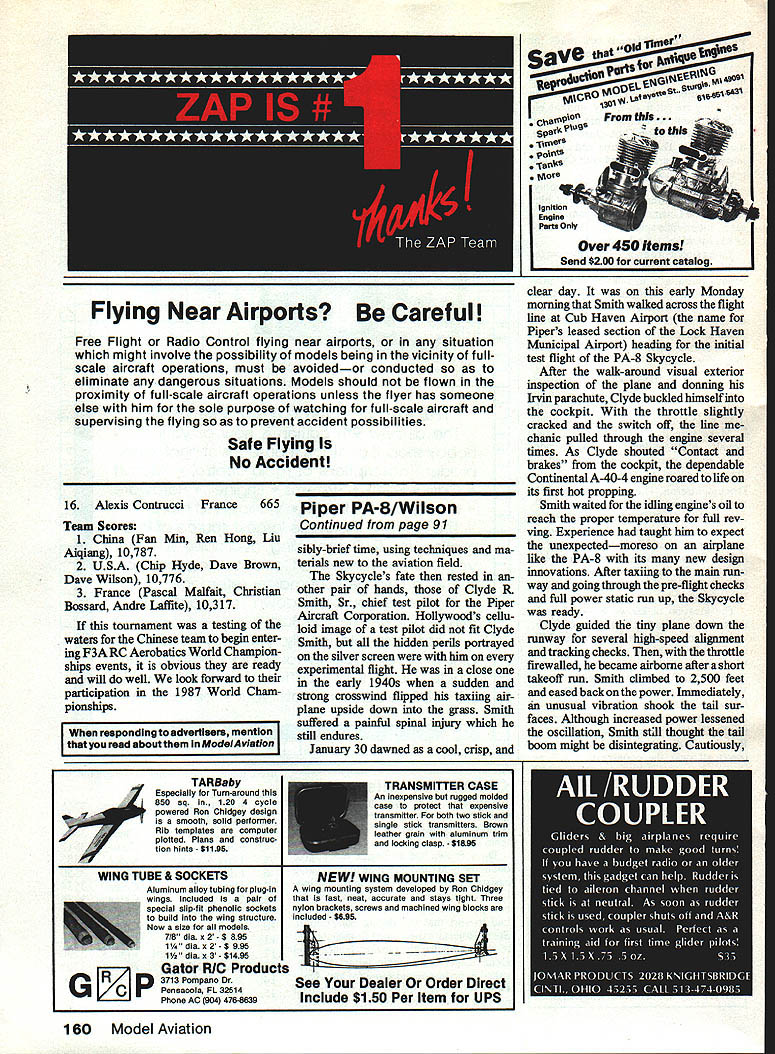
The F3A Pattern event consisted of four rounds, using the best three scores to determine individual placings. Team standings were decided by combining the scores of the three fliers from each team.
Competition notes
The French had five contestants but ended up with four flying three airplanes due to radio problems and loss of equipment on practice day. The U.S. team of six pilots, despite several gremlins, placed second to the Chinese team by only 11 points out of the Chinese winning total of 10,787.
Mechanical and equipment problems affected several U.S. pilots:
- Dave Brown suffered an engine mount failure midway through the contest; the Chinese hosts and Don Jehlik assisted in its replacement.
- Don Lowe lost his best-performing prop early in practice and had to address that during competition.
- Steve Rojecki experienced flameouts that lowered his placing.
- Dean Koger had a radio failure that resulted in no last-round score.
Only Dave Wilson and Chip Hyde had no mechanical problems with their well-used, finely tuned planes and equipment.
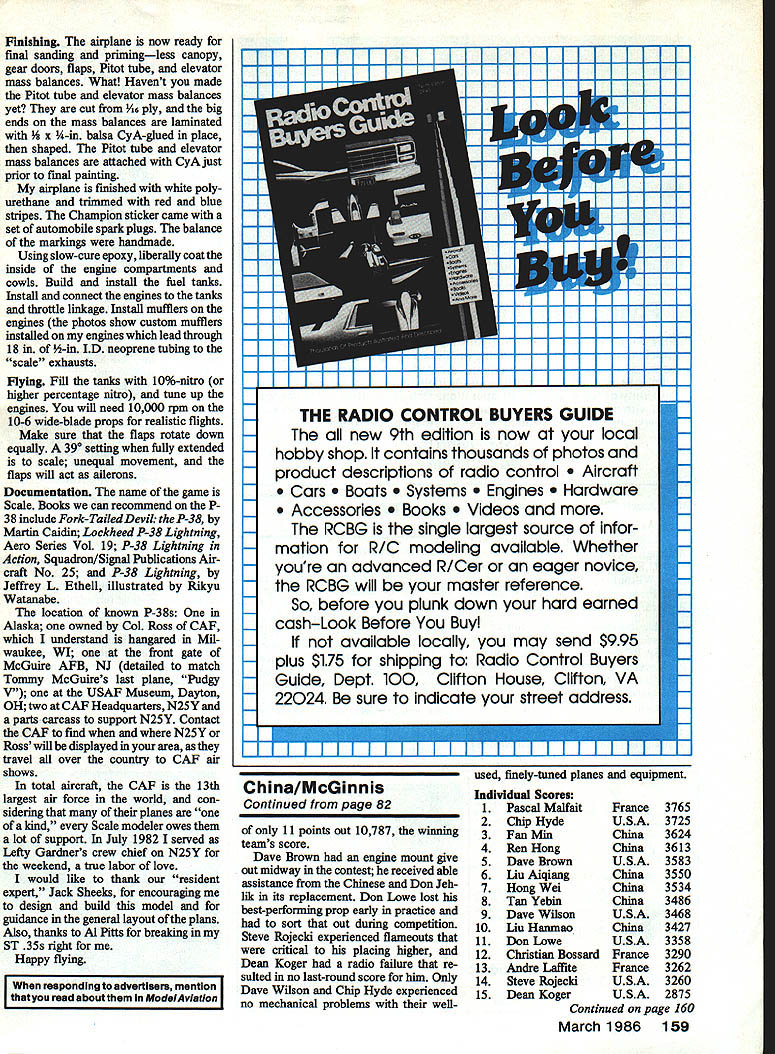
Individual scores
- Pascal Malfait, France — 3765
- Chip Hyde, U.S.A. — 3725
- Fan Min, China — 3624
- Ren Hong, China — 3613
- Dave Brown, U.S.A. — 3583
- Liu Aiqiang, China — 3550
- Hong Wei, China — 3534
- Tan Yebin, China — 3486
- Dave Wilson, U.S.A. — 3468
- Lu Hanmao, China — 3427
- Don Lowe, U.S.A. — 3358
- Christian Bossard, France — 3290
- Andre Laffite, France — 3262
- Steve Rojecki, U.S.A. — 3260
- Dean Koger, U.S.A. — 2875
Closing remarks
If this tournament was a testing of the waters for the Chinese team to begin entering F3A R/C Aerobatics World Championship events, it is obvious they are ready and will do well. We look forward to their participation in the 1987 World Championships.
Transcribed from original scans by AI. Minor OCR errors may remain.

