
THE UP-CHUCK
You say modeling has lost touch with young people? Baloney! Show 'em this great new HLG and you won't be able to keep 'em off the flying field. It's got more angles than MTV, it breaks every rule it doesn't flat-out ignore, and that tight, flat left-hand turn will really keep them hopping. ■ Paul Gross
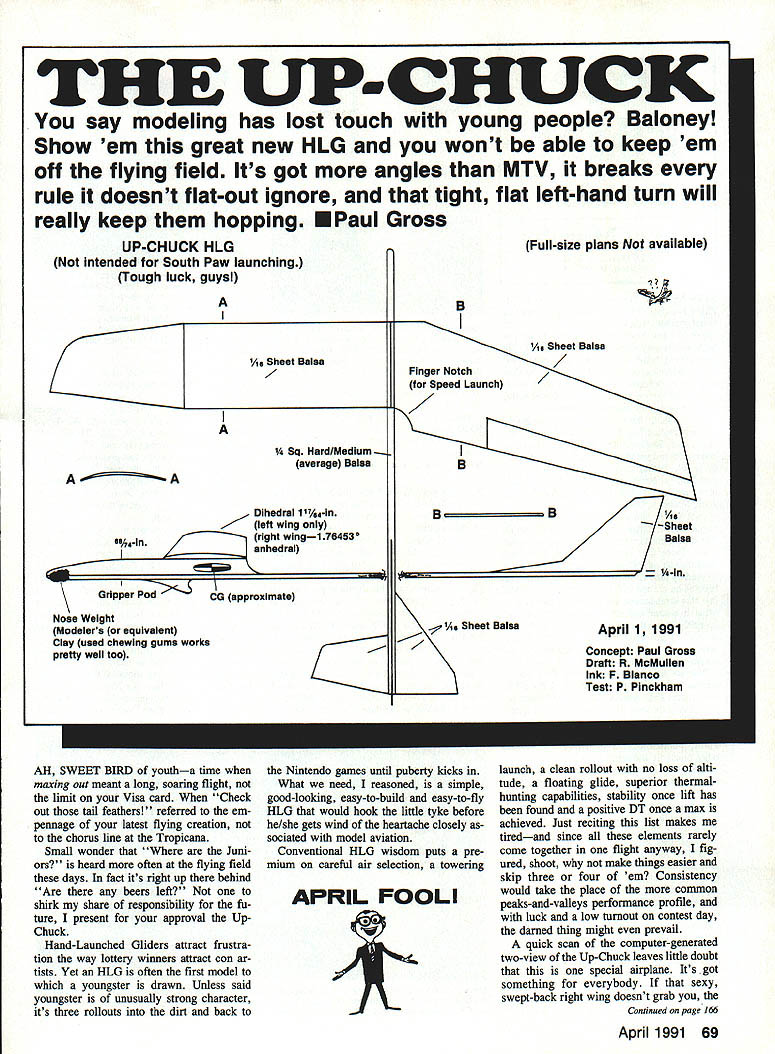
UP-CHUCK HLG (Not intended for South Paw launching.) (Tough luck, guys!)
(Full-size plans not available)
AH, SWEET BIRD of youth—a time when maxing out meant a long, soaring flight, not the limit on your Visa card. When "Check out those tail feathers!" referred to the empennage of your latest flying creation, not to the chorus line at the Tropicana.
Small wonder that "Where are the Juniors?" is heard more often at the flying field these days. In fact it's right up there behind "Are there any beers left?" Not one to shirk my share of responsibility for the future, I present for your approval the Up‑Chuck.
Hand‑Launched Gliders attract frustration the way lottery winners attract con artists. Yet an HLG is often the first model to which a youngster is drawn. Unless said youngster is of unusually strong character, it's three rollouts into the dirt and back to the Nintendo games until puberty kicks in.
What we need, I reasoned, is a simple, good‑looking, easy‑to‑build and easy‑to‑fly HLG that would hook the little tyke before he or she gets wind of the heartache closely associated with model aviation.
Conventional HLG wisdom puts a premium on:
- careful air selection,
- a towering launch,
- a clean rollout with no loss of altitude,
- a floating glide,
- superior thermal‑hunting capabilities,
- stability once lift has been found, and
- a positive DT once a max is achieved.
Just reciting this list makes me tired—and since all these elements rarely come together in one flight anyway, I figured, shoot, why not make things easier and skip three or four of 'em? Consistency would take the place of the more common peaks‑and‑valleys performance profile, and with luck and a low turnout on contest day, the darned thing might even prevail.
A quick scan of the computer‑generated two‑view of the Up‑Chuck leaves little doubt that this is one special airplane. It's got something for everybody. If that sexy, swept‑back right wing doesn't grab you, the classic old‑timer lines of the left wing will, for sure. Viewed from the right, the Up‑Chuck is a stand‑on‑your‑head scale F‑14 Tomcat; viewed from the left, it could pass for anything from a mown‑winged Fokker D‑7 to a Piper Cub.
A shameless gimmick designed to pander to the general public's lack of taste? Sure. Even more important, that unique airframe design really gets the Up‑Chuck turning left, no matter how warped the flying surfaces become between flights.
Before continuing, let me point out that, as with most HLG plans, the Up‑Chuck is shown for right‑handed fliers. Unlike other now‑fashionable right‑handed fliers, I strongly urge our southpaws to flip‑hand chuck gliders completely. It will save years of aggravation from flip‑flopping finger pads, stab tilts, wing‑tip weights and rudder offsets to fit your stubborn unwillingness to follow convention.
APRIL FOOL!
April 1, 1991 Concept: Paul Gross Draft: R. McMullen Ink: F. Blanco Test: P. Pinckham
Continued from page 69
Construction
Let's begin with wood selection. Better yet, let's don't and say we did. Methodical sitting through stacks of dusty balsa stock looking for that magic piece of wood while some redneck, beady‑eyed depot clerk fuss‑glares at you from behind the counter is for the birds. Slightly warped, medium‑weight, medium‑grain 1/16" stock is as ubiquitous as ... well, slightly warped, medium‑weight, medium‑grained 1/16" stock. Why in heck do you think they call it medium? Because it's average. It's everywhere. It's what you want. It's what you should use. For everything!
That includes the wing halves. Why have we been asked all these decades to laboriously carve and sand 1/4" balsa stock down to something that vaguely resembles an airfoil section, only to be told at the end of the construction article that "No HLG can max out by itself; it needs help from the air"? Hell's bells, darned near anything can max without help from the air. So that's what we'll build: darned near anything.
You'll need to transfer the respective wing outlines from the plans onto one of your sheets of 1/16" stock. Two time‑tested methods are:
- Lay the plan over the wood and poke small holes through the planform with a pin, thereby transferring the outline onto the wood.
- Lay the plan over the wood and trace the outline with a pencil, then cut out the wing halves.
With that thought in mind, I offer a third, more creative alternative. Find a neighborhood liquor store that carries Model Aviation. With two or three pals, casually enter the aforementioned establishment one afternoon on the way home from school. Have your chums begin thumbing feverishly through magazines in the section labeled "Please Do Not Read" while you hide your time by the modeling mags. Soon the proprietor will take notice of your accomplices and begin screaming, "Hey, you kids! Get away from there!" Make your move.
Tear a second, disposable set of Up‑Chuck plans from Model Aviation, stuff it in the front pocket of your jeans, and run like hell for at least five blocks. You now have a set of plans to cut up as templates.
As always, safety first: refrain from doing business at that particular venue for the remainder of the semester. And out of respect for the model industry, also refrain from pulling this stunt in hobby shops.
By hook or by crook, you should at this point have a pair of Up‑Chuck wings traced onto a piece of wood. Carefully cut around the outline with a modeling knife and bring it to final shape with a sanding block. Nice work! You're done. Set the wings aside and admire your work.
Fuselage
To a tenderfoot the fuse looks like nothing more than a stupid stick with a big wing glued on one end and a couple of baby wings glued at the other. Take heart. After a century of manned flight and untold millions of design hours to fall back on, an international board of aeronautical engineers recently voted unanimously to define fuselage as "nothing more than a stupid stick with a big wing glued on one end and a couple of baby wings glued at the other."
Find an average piece of medium 1/4" square balsa stock, and trim it to the length shown on the plans. Good job! You're done. Set the fuse aside and admire your work.
Stabilizer? Rudder?
With a tail moment arm the size of a vaulting pole (which, by the way, makes an excellent tail boom for you more advanced, high‑tech types), the necessary stabilizer/rudder area is reduced to the realm of science fiction. And so are the warpage problems long associated with conventional tail feathers. Trim the outline shapes from 1/16" stock just as you did with the wing. Way to go! You're done. Set both pieces aside and admire your work.
Final assembly
There are all sorts of ways to mess up the final assembly of any glider, but here's where you want to be especially careful building the Up‑Chuck. You must not mix up the right‑side/left‑side orientation of the two wing/stab combinations. Constantly refer to the two‑view drawing before bonding each piece to the fuselage. If for any reason you should transpose one side to the other, the Up‑Chuck will fly in a dead‑straight line for miles regardless of trim scheme.
Got all the parts glued together? You're getting there. In fact, you're done. Forget about putting any finish on your ship. Using dope on a glider is as overrated as sex.
Hack out the parts. Hot‑Stuff 'em together, and go flying. The way I see it, the darned thing is going to either:
- get crushed in the trunk of the car en route to the field,
- come screaming down out of the sky like a meteor three seconds after the first launch, or
- get rolled into splinters by a dust devil.
Hey, kid, why do you think they call it dope?
Launching and flying
Now comes the moment of truth. Find a flat, grassy area at least five miles square with no trees, dogs, power lines, or wind. Make certain the center‑of‑gravity is precisely where marked on the plans. Grasp the model by the outside edge of the wing, palming the fuselage in the crook of your thumb and forefinger. Keep your elbow tucked close to your side and flip the plane upward and forward with a sweeping motion. Don't try to "throw" it like a baseball—think of a smooth, underhand toss. The object is to launch the model with no roll and little or no pitch. A good launch makes the Up‑Chuck do a clean rollout with no loss of altitude, floating glide, superior thermal‑hunting capabilities, stability once lift has been found, and positive DT once max is achieved.
Hold the Up‑Chuck the way you'd grasp your little brother if he traded your VHS cassette of Paula Abdul videos a decade ago. Then throw it up and out. The model should climb steeply at a three‑quarter right bank and roll out smoothly before transitioning into a floating left glide. This may not occur at first. In fact, it may never occur. But keep chucking that puppy until all the elements come together or your arm comes off—whichever comes first.
After several months of flying experience you may want to start thinking about what really brings home the trophies. Winning in HLG comes down to this: you launch for show, but you max for dough.
Contest techniques
Built into the Up‑Chuck, as is obvious in the two‑view, is a tight, flat left‑hand turn. One of the many advantages of this left‑hand turn is that it allows the model to circle in small patches of lift. Very small patches of lift. Patches of lift no much bigger than the immediate area around a '73 Hondo 50. Listen up, Bucko, here's the drill.
The night before a contest, go to work on the carburetor of your scooter and get that baby running so rich and idling so high it's choking on its own exhaust fumes. The next morning, hit the flight line with your Hondo and your Up‑Chuck just as the other fliers are beginning to max. Slip on a gas mask, kick start the bike, and let it idle for a minute or two.
Okay, launch. Altitude is of absolutely no consequence, as all the lift you'll ever need is being generated at ground zero. The Up‑Chuck will soon be circling directly overhead, more than content to ride the Honda's rising column of carbon monoxide. As you become more adept at this procedure, you'll be able to slowly cruise along underneath the Up‑Chuck, giving everyone (including admiring members of the opposite sex) the impression that you are chasing a glider that locks onto lift like a magnet, when in fact you are the moving source of lift!
As if that weren't enough to put you in Free Flight Valhalla, there's an even more reliable technique that draws its inspiration from human nature. You can take this one to the bank, kid. There's nothing more reliable than human nature.
The morning of a contest, just as the CD's meeting is about to break up, throw a little high‑octane fuel onto the embers of discordant smoldering within every competitive flier. Say something simple as, "Hey, Bill, how come you let Joe Blow use his wife as a timer in that last contest he won?" Or better yet, stage a little more provocative, such as, "Hey, Bill, I've got a radio‑controlled DT system in my new gas job. Where do I get a frequency pin for Channel 38?" Then step back and watch the fireworks.
As the verbiage hits a fevered pitch and tempers soar, grab your Up‑Chuck and a timer and launch into the column of hot air rising from the CD's tent. Often you can milk two or three maxes from a single argument, possibly even four if the season point‑total championship is on the line that day.
Final word
If you follow the hints and techniques I've given you, success can be yours. But with that success come certain responsibilities: the responsibility to uphold sportsmanship at all times, and the responsibility to pass along the wonders of model aviation to the next generation.
So the next time some cynical wag asks, "Where are the Juniors?" don't chime in with the usual baloney about lousy kit instructions or arrogant, uncaring fliers. Just smile to yourself and slip a set of plans for the Up‑Chuck to the next kid you see with a blank look on his face. That'll give him plenty to think about.
Transcribed from original scans by AI. Minor OCR errors may remain.

