

CHUPP LITTLE BITTY
Wes DeLong
The year 1916 was important for Carl B. Chupp: he went to work for the Thomas Morse Aeroplane Factory of Ithaca, N.Y., after attending Georgia Tech, and he was married. At work he entered into a wager with a fellow engineer to see who could build and fly the smallest combustion engine and model airplane.
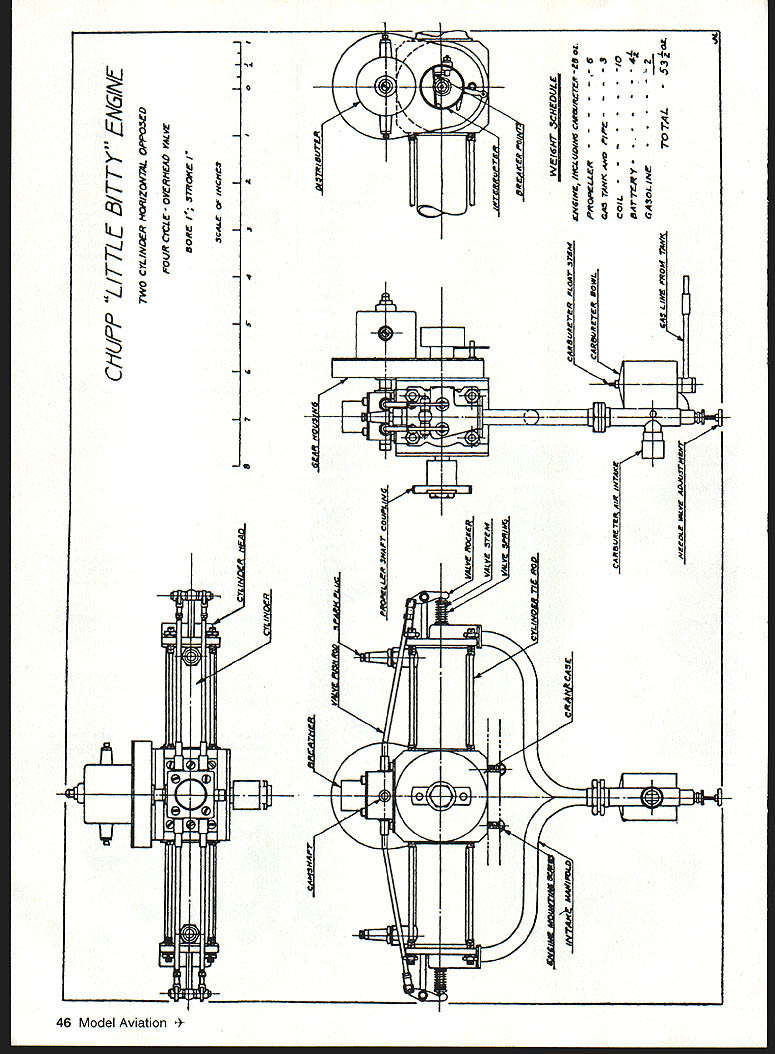
Chupp started the project in 1917. He first designed and built a one-inch bore, one-inch stroke, four-stroke, horizontally opposed gas engine. It was a true work of inventive genius.
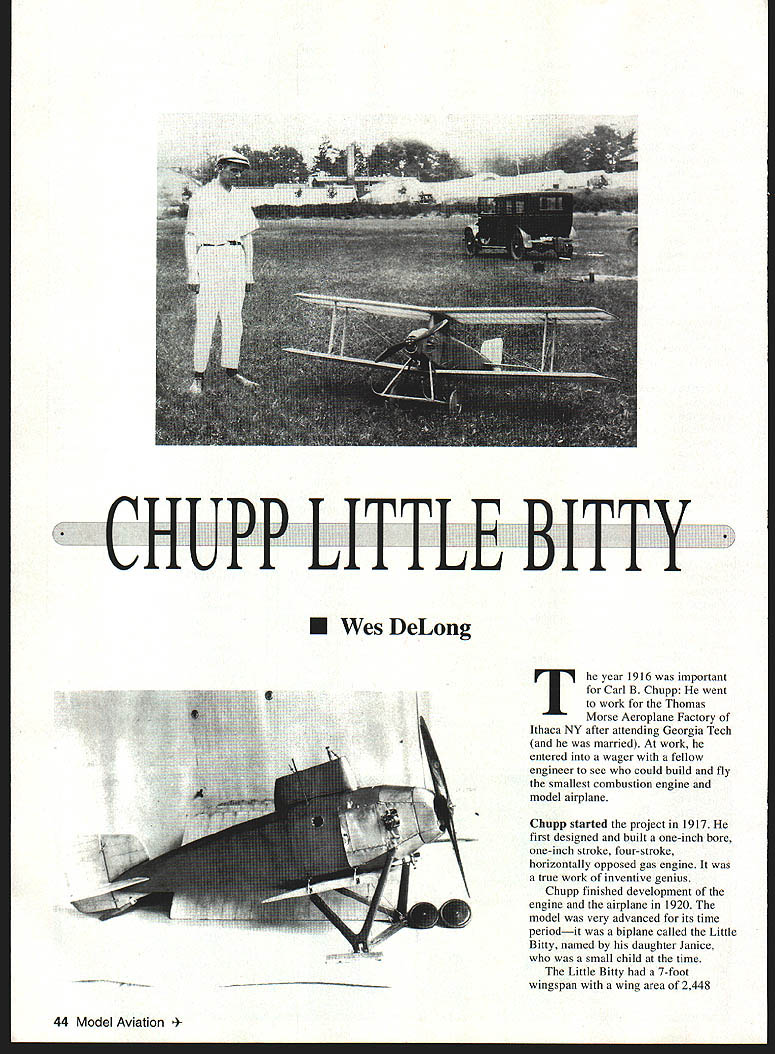
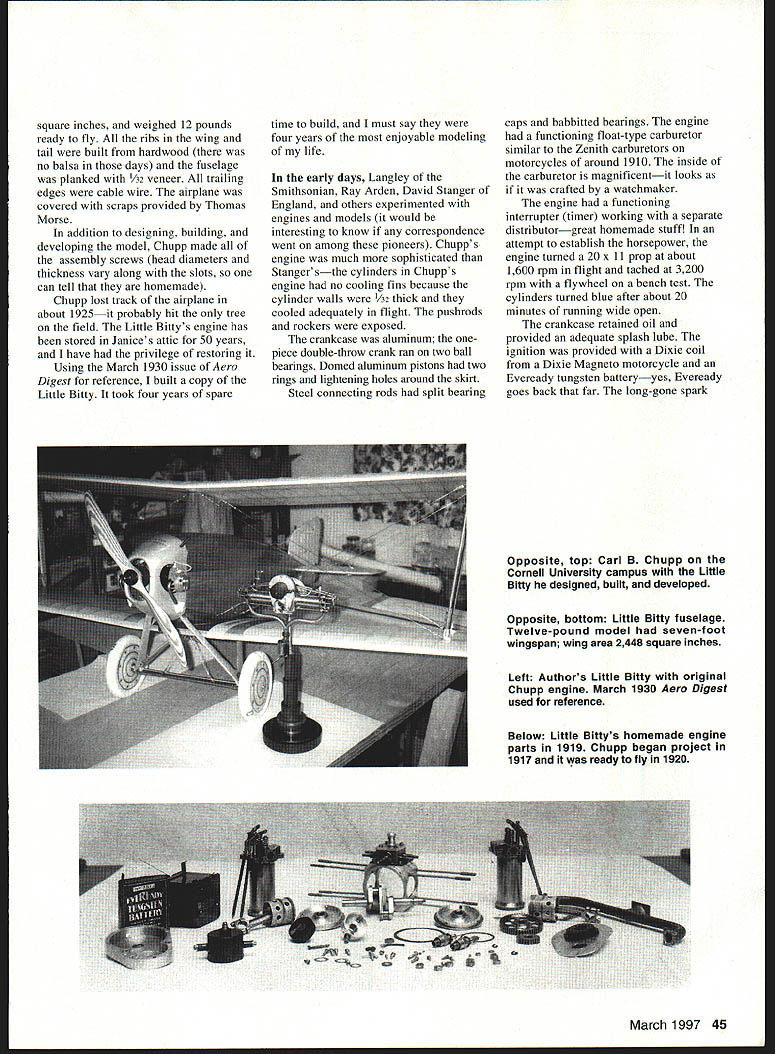
Chupp finished development of the engine and the airplane in 1920. The model was very advanced for its time — a biplane called the Little Bitty, named by his daughter Janice, who was a small child at the time.
Little Bitty specifications and construction
- Wingspan: 7 feet
- Wing area: 2,448 square inches
- Weight: 12 pounds, ready to fly
- Wing and tail ribs: hardwood (balsa was not used in those days)
- Fuselage: planked with 1/32" veneer
- Trailing edges: cable wire
- Covering: scrap material provided by Thomas Morse
In addition to designing, building, and developing the model, Chupp made all of the assembly screws (head diameters and thicknesses vary along with the slots, so one can tell they are homemade).
Chupp lost track of the airplane around 1925 — it probably hit the only tree on the field. The Little Bitty's engine has been stored in Janice's attic for 50 years, and I have had the privilege of restoring it.
Using the March 1930 issue of Aero Digest for reference, I built a copy of the Little Bitty. It took four years of spare time to build, and they were four of the most enjoyable years of modeling in my life.
Engine context and comparison
In the early days, Langley of the Smithsonian, Ray Arden, David Stanger of England, and others experimented with engines and models. Chupp's engine was much more sophisticated than Stanger's — the cylinders in Chupp's engine had no cooling fins because the cylinder walls were 1/32" thick and cooled adequately in flight. The pushrods and rockers were exposed.
Engine construction and features
- Crankcase: aluminum
- Crank: one-piece double-throw crank running on two ball bearings
- Pistons: domed aluminum pistons with two rings and lightening holes around the skirt
- Connecting rods: steel with split bearing caps and babbitted bearings
- Carburetor: functioning float-type carburetor similar to Zenith motorcycle carburetors of around 1910; the interior workmanship is exceptionally fine, like a watchmaker's work
- Ignition: functioning interrupter (timer) working with a separate distributor; Dixie coil from a Dixie Magneto motorcycle and an Eveready tungsten battery
- Spark plugs: long-gone plugs with homemade ceramic bodies provided by Corning Glass Works (pictures show transparent bodies with the center electrode visible)
- Lubrication: crankcase retained oil and provided adequate splash lubrication
Performance: the engine turned a 20 x 11 propeller at about 1,600 rpm in flight and tached at 3,200 rpm with a flywheel on a bench test. The cylinders turned blue after about 20 minutes of running wide open.
Flight history and recognition
Chupp regularly flew the Little Bitty on the Cornell University campus with great success from 1920 to 1923. Free-flight trim was performed with the ailerons, rudder, and elevator — each fully adjustable. A homemade flight timer limited engine run to keep the Little Bitty out of buildings and trees while skirting the campus athletic field.
Chupp was awarded the prestigious Silver Cup of the Aero Club of Ithaca. Janice brought the award down from the attic where the engine had been stored for 50 years. The engraving reads: "Aero Club of Ithaca Mechanical Driven Model Airplane Trophy — For Record Flight Mechanical Motor 1920."
The Chupp family moved to Bryn Athyn, Pa., a suburb of Philadelphia, in 1925 so he could work as factory manager for Pitcairn. A few years later Pitcairn moved to Willow Grove, another northeast Philadelphia suburb.
An article published in the Philadelphia Evening Public Ledger dated April 5, 1930 stated it took Chupp about 500 hours to build the engine, in addition to overcoming other problems, before the model was ready to fly in 1920. He had much difficulty getting the piston rings correct. The engine weighed 1-1/2 lb. To compare modern two-stroke horizontally opposed engines with this 1920 Chupp unit is to appreciate how cutting-edge his model engine technology was.
Articles about the Little Bitty appeared in the March and April 1930 issues of Aero Digest. Copies can be obtained from the Experimental Aircraft Association. Note: one page in the April 1930 issue contains only engine drawings, part labels, and captions (no continuation of article text). Notice that the last line on page 222 in the April 1930 issue says, "How about using radio control?" — that's definitely foresight!
Closing
I have the greatest respect for the pioneers of engine and airplane inventions, but I believe Chupp was so far ahead of his time that few could comprehend the significance of his work.
I have had the privilege of restoring what I consider the Hope Diamond of model airplane engines, and I cannot express my awe of the inventive, visionary genius that Carl B. Chupp possessed. He deserves to be recognized as one of the great pioneers of aviation.
Wes DeLong 710 Sandreale Dr. Toledo, OH 43612
Transcribed from original scans by AI. Minor OCR errors may remain.

