
John R. Walker
Chupp's Engine
Gas engines for models in the Twenties were big, heavy, and home-made. Pioneers such as Carl B. Chupp persevered and produced a splendid example for its day.
Background
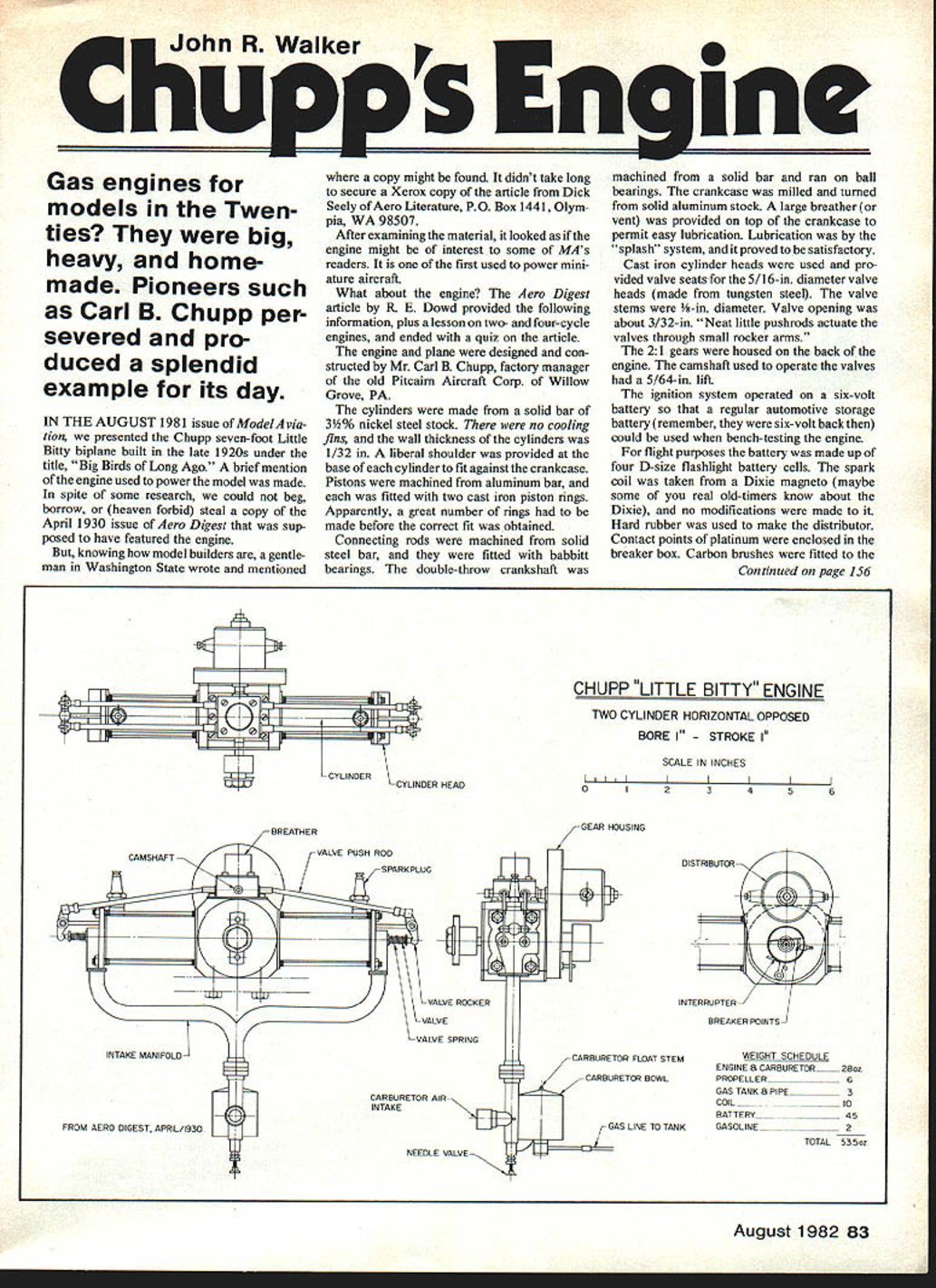
In the August 1981 issue of Model Aviation we presented the Chupp seven-foot Little Bitty biplane built in the late 1920s under the title "Big Birds of Long Ago." A brief mention of the engine used to power the model was made. Despite some research, a copy of the April 1930 issue of Aero Digest—supposed to have featured the engine—was not initially available. A reader in Washington State pointed to a source, and a Xerox copy of the article was secured from Dick Seely of Aero Literature, Olympia, WA.
The Aero Digest article by R. E. Dowd provided the following information, plus a lesson on two- and four-cycle engines, and ended with a quiz on the article. The engine and plane were designed and constructed by Carl B. Chupp, factory manager of the old Pitcairn Aircraft Corp. of Willow Grove, PA. It is one of the first engines used to power miniature aircraft.
Construction and Materials
- Cylinders
- Machined from solid 3 1/2% nickel-steel stock.
- No cooling fins.
- Wall thickness: 1/32 in.
- A liberal shoulder at the base of each cylinder to fit against the crankcase.
- Pistons
- Machined from aluminum bar.
- Each fitted with two cast-iron piston rings; many rings had to be made to obtain the correct fit.
- Connecting rods and crankshaft
- Connecting rods machined from solid steel bar, fitted with babbitt bearings.
- Double-throw crankshaft machined from solid bar and ran on ball bearings.
- Crankcase and lubrication
- Crankcase milled and turned from solid aluminum stock.
- Large breather (vent) on top to permit easy lubrication.
- Lubrication by the "splash" system, which proved satisfactory.
- Cylinder heads, valves, and valve gear
- Cast-iron cylinder heads providing valve seats for 5/16-in. diameter valve heads (made from tungsten steel).
- Valve stems: 3/16-in. diameter.
- Valve opening: about 3/32-in.
- Neat little pushrods actuated the valves through small rocker arms.
- 2:1 gears housed on the back of the engine.
- Camshaft lift: 5/64-in.
Ignition and Electrical
- Ignition system operated on six volts so a regular automotive storage battery (six-volt at the time) could be used for bench testing.
- For flight, the battery was made up of four D-size flashlight cells.
- Spark coil taken from a Dixie magneto (no modifications).
- Distributor made of hard rubber; carbon brushes fitted to the distributor.
- Contact points of platinum enclosed in the breaker box.
- Spark plugs (1/4 x 28 threads) apparently had to be made, because original insulators by Corning Glass Works were replaced by Mosier insulators.
Carburetion and Calibration
- Carburetor was a miniature of the Zenith carburetor then in use, complete with float, weights, and valve stem.
- To calibrate the carburetor, Chupp studied the height of gasoline in the bowl under various conditions. He used a glass tube and rubber hose connection as a temporary sight gauge to determine the correct height of the orifice.
- Engine weight: 45½ ounces.
Performance
- No dynamometer was available, so power could not be precisely measured; theoretical power: 1 1/8 hp.
- The engine turned a 20-in. propeller with 11-in. pitch at 2,000 rpm and produced a static thrust of seven pounds as measured with a spring scale.
- A bench test with a 5-in. flywheel produced 3,000 rpm (the tachometer used only measured to 3,000 rpm).
- After approximately 15 minutes of the bench test the cylinders showed signs of overheating (they started to turn light blue).
Usage Recommendations
Because of the extended manifold and the delicate, precision nature of the equipment, it was recommended that such engines be used in a pusher design so the engine would be well protected during landings. As the article noted: "Engines of this type cannot be hurled against obstructions without damage."
Closing
The Aero Digest article closed with an encouragement toward further experimentation: "There is still great unexplored possibilities in the field of mechanically-driven aircraft, and we hope more experimenters will be found active in this highly specialized art. The Chupp Little Bitty is a splendid example of such effort, but let's have more of them. How about using radio control?"
Transcribed from original scans by AI. Minor OCR errors may remain.

