
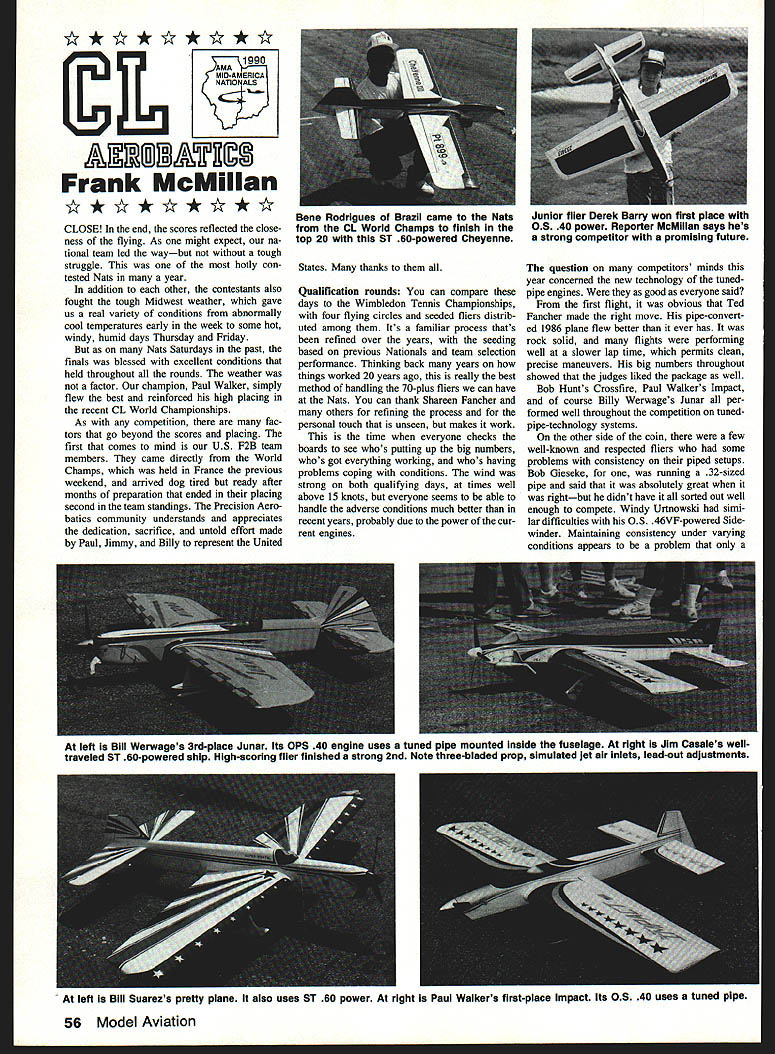
CL: Aerobatics
Frank McMillan
CLOSE! In the end, the scores reflected the closeness of the flying. As one might expect, our national team led the way — but not without a tough struggle. This was one of the most hotly contested Nats in many a year.
In addition to battling one another, the contestants also fought the tough Midwest weather, which produced a real variety of conditions: abnormally cool temperatures early in the week, then hot, windy, humid days on Thursday and Friday.
As on many Nats Saturdays in the past, the finals were blessed with excellent conditions that held throughout all the rounds. The weather was not a factor. Our champion, Paul Walker, simply flew the best and reinforced his high placing in the recent CL World Championships.
As with any competition, there are many factors that go beyond the scores and placings. The first that comes to mind is our U.S. F2B team members. They came directly from the World Champs, held in France the previous weekend, and arrived dog‑tired after months of preparation that ended in their placing second in the team standings. The Precision Aerobatics community understands and appreciates the dedication, sacrifice, and untold effort made by Paul, Jimmy, and Bill to represent the United States. Many thanks to them all.
Qualification rounds
You can compare these days to the Wimbledon Tennis Championships, where four flying circles and seeded fliers are distributed among them. It's a familiar process that's been refined over the years, with the seeding based on previous Nationals and team selection performance. Thinking back many years to how things worked 20 years ago, this is really the best method of handling the 70-plus fliers we can have. We can thank Shareen Fancher and many others for refining the process and for the personal touch that is unseen but makes it work.
This is the time when everyone checks the boards to see who's putting up the big numbers, who's got everything working, and who's having problems coping with the conditions. The wind was strong on both qualifying days, at times well above 15 knots, but everyone seemed to handle the adverse conditions much better than in recent years, probably due to the power of the current engines.
The question on many competitors' minds this year concerned the new technology of tuned-pipe engines. Were they as good as everyone said? From the first flights it was obvious that Ted Fancher had made the right move with his pipe-converted 1986 plane. It flew better than it ever has. It was rock solid, and many flights were performed at a slower lap time, which permits cleaner, more precise maneuvers. His big numbers throughout showed the judges liked the package as well.
Bob Hunt's Crossfire, Paul Walker's Impact, and Bill Werwage's Junar all performed well throughout the competition on tuned-pipe systems.
On the other side of the coin, a few well-known and respected fliers had problems with consistency on their piped setups. Bob Gieseke, for one, was running a .32-sized pipe and said it was absolutely great — but he didn't have it all sorted out well enough to compete. Windy Urtnowski had similar difficulties with his OS .46VF-powered Sidewinder. Maintaining consistency under varying conditions appears to be a problem only a few have.
After the first-flight scores were posted, Casale, Fancher, and Walker were clearly going to the next round. Paul, however, in a freak accident had the up line catch the runway, flipping the plane; it impacted and broke the fuselage stabilizer. Like a true world-class competitor, he repaired the break and put up two solid flights to advance. Bob Whitely, who had been flying well all week, had the misfortune of clipping the prop on takeoff; the engine ran away, forcing him to withdraw from the first flight.
The second round told the tale: midway through the round the 12–15 knot wind suddenly moderated, and the good competitors took advantage and punched in superior flights.
A story developing was the superior flying of Gid Adkisson and his Laser. He had been consistent throughout the previous rounds and qualified for his first inclusion in the final five.
Bill Werwage was on the bubble waiting for Bob Baron's last flight — a super effort by Bob which fell just three points shy of sixth place.
Windy Urtnowski put up the second-highest scoring flight of the day on his last try but could not overcome a low-scoring first round.
Returning to the competition, former World Champion Bob Hunt also put in a high-scoring second round for eighth place. Mike Rogers flew very well throughout the week and earned a solid ninth place. Frank McMillan rounded out a hard-fought top ten.
Junior and Senior competition
Look out — there are some tough competitors coming up.
Junior:
- Derek Berry, 11 years old, winner in the Junior age group.
- Robbie Hunt pushed Derek and has only been flying the pattern for a few weeks (and he's got heritage on his side).
Senior:
- Nat Gifford won again.
- Archie Adamisin and Todd Lee flew well and will be heard from for many years to come.
Final-five day
After hundreds of flights, the final placing came down to the last of the three rounds. Paul Walker had put up two great flights for what looked like an unassailable lead, but his two teammates reached down and pushed hard and almost got him, falling short by the narrowest of margins.
In the end the U.S. F2B team placed 1–2–3 — the same order in which they finished at the Control Line World Championships:
- Paul Walker
- Jim Casale
- Bill Werwage
Showing he truly deserved his fourth-place slot, Gid Adkisson flew the best semi-scale Stunter ever. Ted Fancher continued his superior, consistent flying to finish fifth.
Paul Walker was awarded the Walker Cup (named after CL inventor Jim Walker) in competition with the Junior and Senior champions, who flew exceptionally well. If you've never seen the Walker Cup finals, you need to make it, because it's the showcase of the premier event in Control Line modeling.
Acknowledgements
No national event ever runs smoothly without the efforts of many hard-working people doing their thing so that the competitors can do theirs. Special thanks to:
- Bruce Gifford, Event Director
- Our judges, who gave of themselves so that we could compete
- Our tabulators, headed by Shareen Fancher, who keep us going
All deserve our gratitude for a job well done. We cannot thank you enough.
Transcribed from original scans by AI. Minor OCR errors may remain.

