
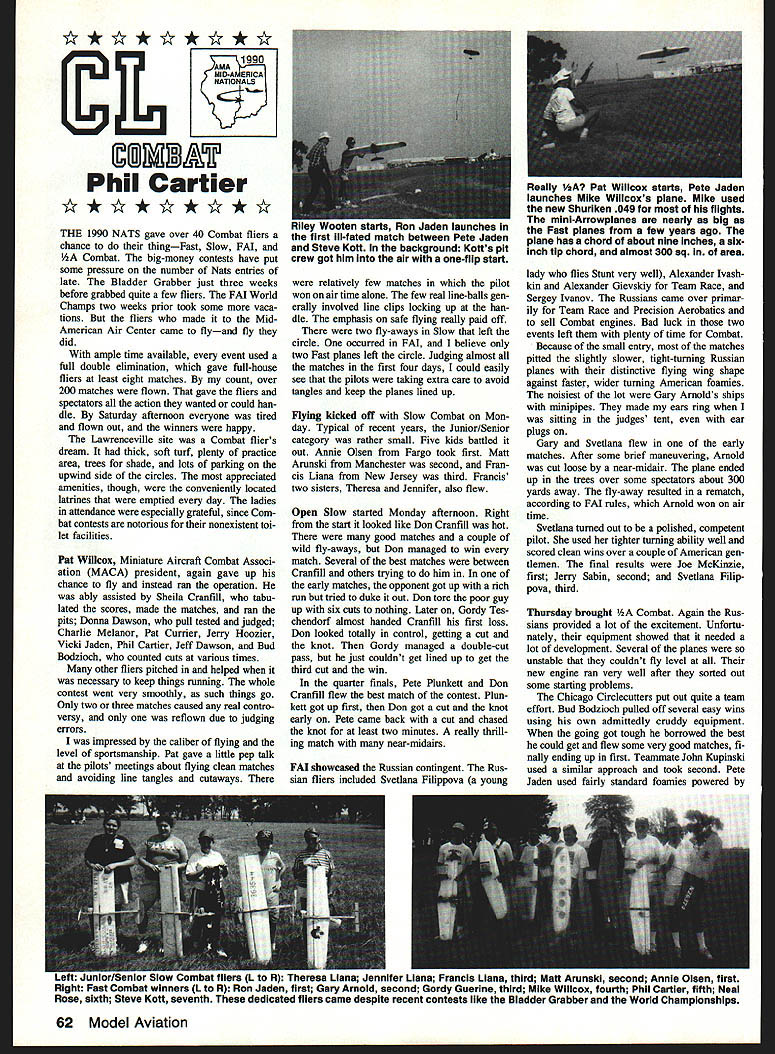
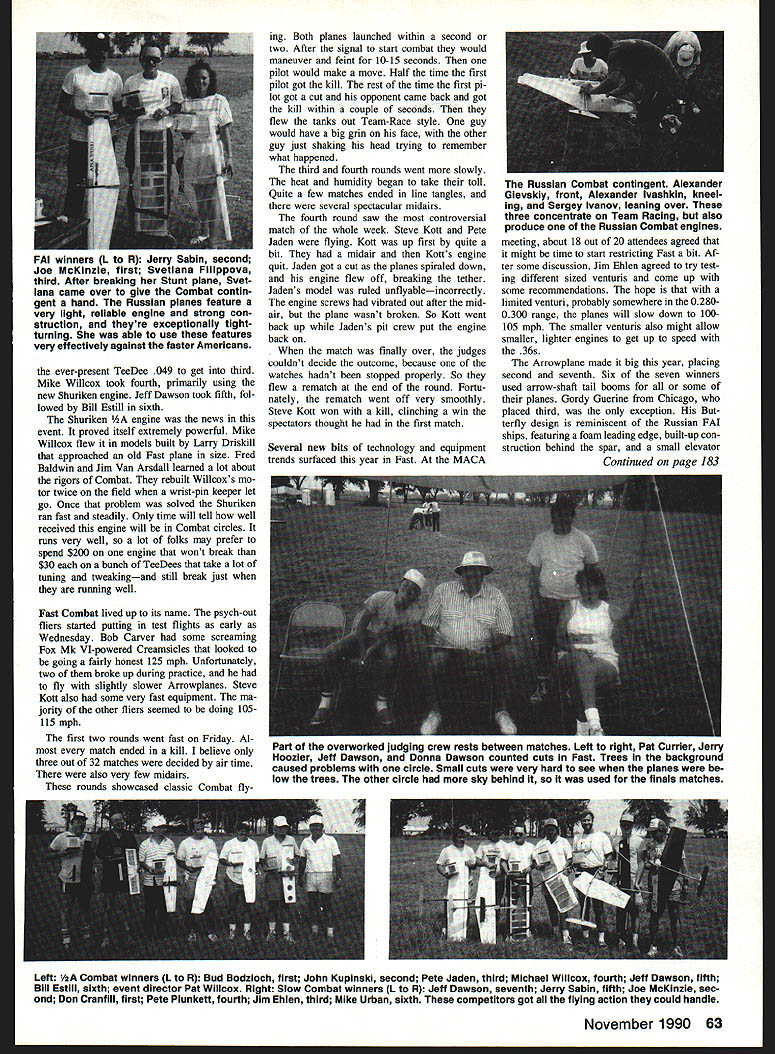
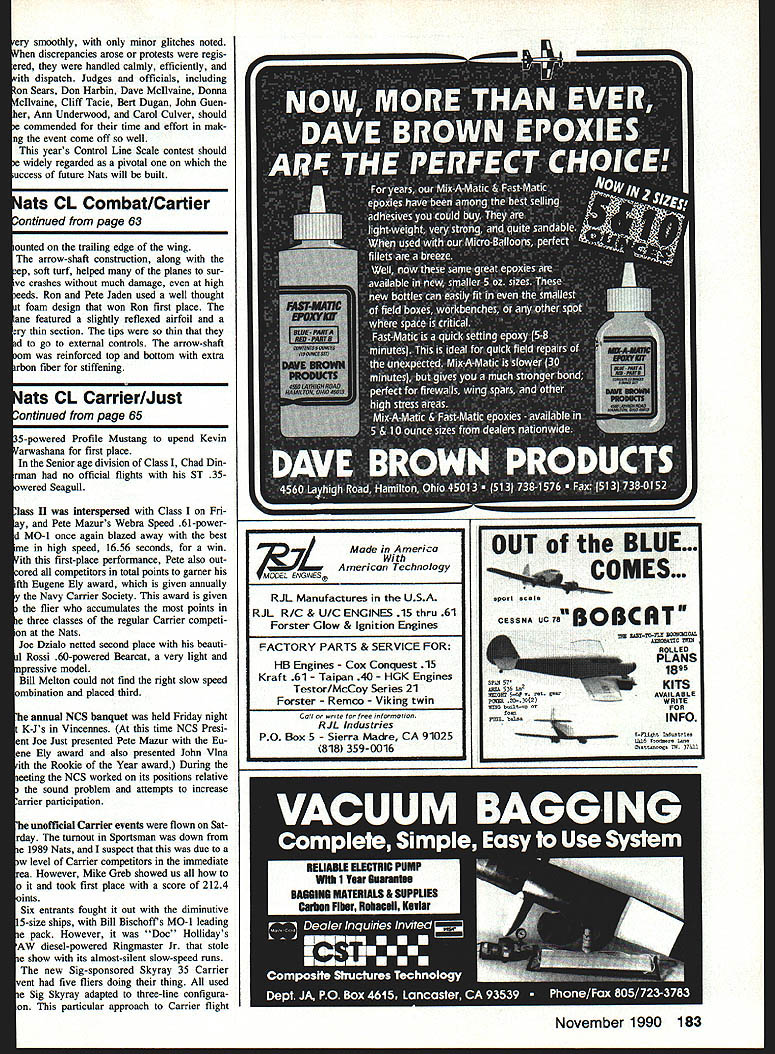
CL: Combat
Phil Cartier
Overview
The 1990 Nats drew over 40 Combat fliers to the Mid-American Air Center for Fast, Slow, FAI, and 1/2A Combat. Big-money contests elsewhere (the Bladder Grabber three weeks earlier and the FAI World Champs two weeks prior) reduced some entries, but those who attended came to fly—and fly they did.
With ample time available, every event used full double elimination, giving full-house fliers at least eight matches. By my count, over 200 matches were flown, providing plenty of action for competitors and spectators. By Saturday afternoon most people were tired and “flown out,” and the winners were happy.
Site and facilities
The Lawrenceville site was a Combat flier’s dream:
- Thick, soft turf that cushioned high-speed impacts
- Plenty of practice area
- Trees for shade
- Lots of parking on the upwind side of the circles
- Conveniences, notably latrines that were emptied daily (a welcome relief; Combat contests are notorious for nonexistent toilet facilities)
Organization and officials
Pat Willcox, Miniature Aircraft Combat Association (MACA) president, again gave up his chance to fly and ran the operation. Key volunteers included:
- Sheila Cranfill — tabulating scores, making matches, running the pits
- Donna Dawson — pull-testing and judging
- Charlie Melancon, Pat Currier, Jerry Hoozier, Vicki Jaden, Phil Cartier, Jeff Dawson, Bud Bodzioch — counting cuts at various times
Many other fliers pitched in as needed. The contest ran smoothly overall; only two or three matches caused real controversy, and only one was reflown due to judging errors.
Safety and sportsmanship
I was impressed by the caliber of flying and the level of sportsmanship. Pat Willcox gave a brief pep talk at pilots’ meetings emphasizing clean flying, avoiding line tangles, and minimizing cutaways. The emphasis paid off:
- Relatively few matches were decided on air time alone.
- Most close calls involved line-clip locking at the handle rather than reckless tactics.
- There were two Slow fly-aways that left the circle, one in FAI, and only two Fast planes left the circle.
- Pilots generally took extra care to avoid tangles and keep planes lined up.
Slow Combat
Junior / Senior
The Junior/Senior category was small—five kids competed. Results:
- Annie Olsen (Fargo)
- Matt Arunski (Manchester)
- Francis Llana (New Jersey)
(Francis’s sisters Theresa and Jennifer also flew.)
Open Slow
Open Slow began Monday afternoon. Don Cranfill dominated, winning every match. Several memorable matches included:
- An early match where an opponent got a rich run and Don scored six cuts to none.
- A near-upset by Gordy Teschendorf, who managed a double-cut pass but couldn’t line up for the deciding cut.
- A quarterfinal between Pete Plunkett and Don Cranfill that was probably the best match of the contest: Plunkett lifted first, Don scored an early cut and knot, then Pete came back to cut and chase the knot for about two minutes—many near-midairs and a thrilling finish.
FAI Combat
The Russian contingent added excitement to FAI. Team members included Svetlana Filippova (also a capable Stunt pilot), Alexander Ivashkin, Alexander Gievskiy, and Sergey Ivanov. They came primarily for Team Race and Precision Aerobatics but had time for Combat as well.
Because of the smaller entry, many matches pitted the slightly slower, tighter-turning Russian flying-wing ships against faster, wider-turning American foamies. Gary Arnold’s mini-pipe powered ships were especially loud; sitting in the judges’ tent with them was ear-ringing even with plugs.
One early match had Gary Arnold and Svetlana Filippova. After brief maneuvering Arnold made a near-midair cut; his plane flew into trees about 300 yards away and resulted in a fly-away. Under FAI rules Arnold won on air time. Svetlana proved a polished, competent pilot who used her ship’s tight-turning ability to good effect and scored several clean wins over American competitors.
FAI final placings:
- Joe McKinzie
- Jerry Sabin
- Svetlana Filippova
1/2A Combat
Held on Thursday, 1/2A Combat again saw strong Russian participation and excitement. Equipment problems surfaced—several planes were unstable or couldn’t fly level, and a new engine needed adjustments after starting issues.
The Chicago Circlecutters fielded a strong team:
- Bud Bodzioch scored several easy wins and, when needed, borrowed better equipment to fly strong matches, ultimately finishing first.
- John Kupinski took second, following a similar approach.
- Pete Jaden flew standard foamies and fast Fox Mk VI-powered Creamsicles (estimated ~125 mph), but two broke during practice so he flew slightly slower Arrowplanes in competition.
- Steve Kott also had very fast equipment; most other fliers were in the 105–115 mph range.
Early rounds on Friday were fast—almost every match ended in a kill. I believe only three of 32 matches were decided by air time. Matches often featured both planes launching nearly simultaneously, 10–15 seconds of feinting, then a decisive move: sometimes the first mover scored the kill, sometimes the opponent recovered to score the kill within seconds.
Heat and humidity slowed the third and fourth rounds, producing more tangles and several spectacular midairs. The fourth round produced the contest’s most controversial match between Steve Kott and Pete Jaden:
- They had a midair; Kott’s engine quit while Kott was comfortably ahead.
- Jaden got a cut as the planes spiraled down and Jaden’s engine flew off (screws had vibrated out after the midair), leaving his model temporarily unflyable.
- The judges initially ruled Jaden’s model unflyable (incorrectly), and confusion over watch timing prevented a clear decision.
- A rematch was flown at the end of the round; it went smoothly and Steve Kott won with a kill, which many spectators felt matched the first match outcome.
Fast Combat and equipment trends
Several equipment trends and technology notes emerged:
- At the MACA meeting, about 18 of 20 attendees favored fuel or power restrictions at major events. Jim Ehlen agreed to test different venturi sizes and propose recommendations. The working hope is to limit venturi to roughly 0.280–0.300, bringing top speeds down to about 100–105 mph and allowing slimmer, lighter engines to compete with .36s.
- The Aeroplane design made a strong showing (placing second and seventh in Fast).
- Six of the seven top finishers used arrow-shaft tail booms for at least some of their planes; the arrow-shaft boom plus the deep, soft turf helped many planes survive crashes with minimal damage even at high speeds.
- Gordy Guerin (third place) was an exception with his Butterfly design—reminiscent of Russian FAI ships—with a long, slim built-up boom behind the spar and a small elevator mounted on the wing trailing edge.
- Ron and Pete Jaden used a refined foam design; Ron’s entry—featuring a slightly reflexed, very thin airfoil with external controls at the tips and reinforced arrow-shaft booms—earned Ron first place in Fast.
Closing
The 1990 Nats gave over 40 Combat fliers many matches and plenty of competition across Fast, Slow, FAI, and 1/2A classes. The event was well run, sportsmanship was high, and the flying was exciting—despite a few controversies and some equipment development needs.
Transcribed from original scans by AI. Minor OCR errors may remain.

