

Columnist shares the origins of MACA
by Rich Lopez richnvon7@hotmail.com
I spoke with Howard Rush about the origins of the Miniature Aircraft Combat Association (MACA) in July at the AMA Nats. Howard and Neal White were inspired to found MACA in late 1973 or early 1974.
Howard was known for winning the Nats with his Nemesis II design, which was published in the August 1972 issue of American Aircraft Modeler (AAM). Neal was recognized for his elliptical-wing design called the Bosta, published in AAM in October 1973. The two were roommates at Purdue University in West Lafayette, Indiana, when they created these designs.
Howard promoted MACA through his column in AAM. The idea was to give Combat enthusiasts across the country a newsletter through which they could share ideas, report on contests, write technical articles about model designs and new engines, keep a current contest calendar, and promote Combat throughout the country and the world.
Recognition of the best Combat pilots in the United States was done through the establishment of the MACA Top 20 in those early years, and that recognition continues today.
In the first years of the all‑volunteer operation, the newsletter was sent via U.S. mail. Chris Sarnowski is the current newsletter editor and distributes it via email. The July issue was approximately 35 pages and included some great photographs of recent Combat contests. Electronic media give the organization the ability to quickly and easily send large files to many people for free.
MACA’s current officers are:
- James McKinney, president
- Tom Siegler, executive vice president
- Gene Berry, treasurer
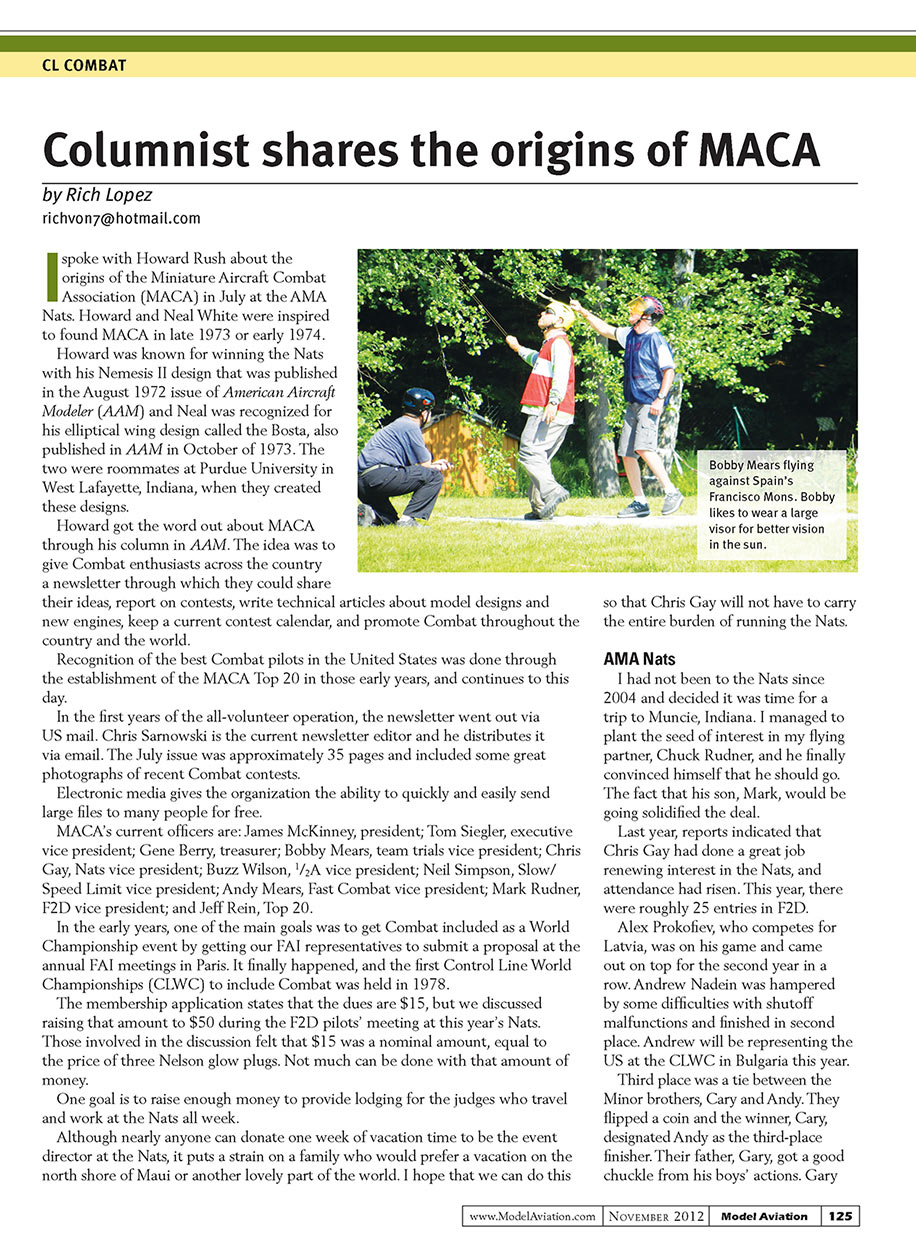
- Bobby Mears, team trials vice president
- Chris Gay, Nats vice president
- Buzz Wilson, 1/2A vice president
- Neil Simpson, Slow/Speed Limit vice president
- Andy Mears, Fast Combat vice president
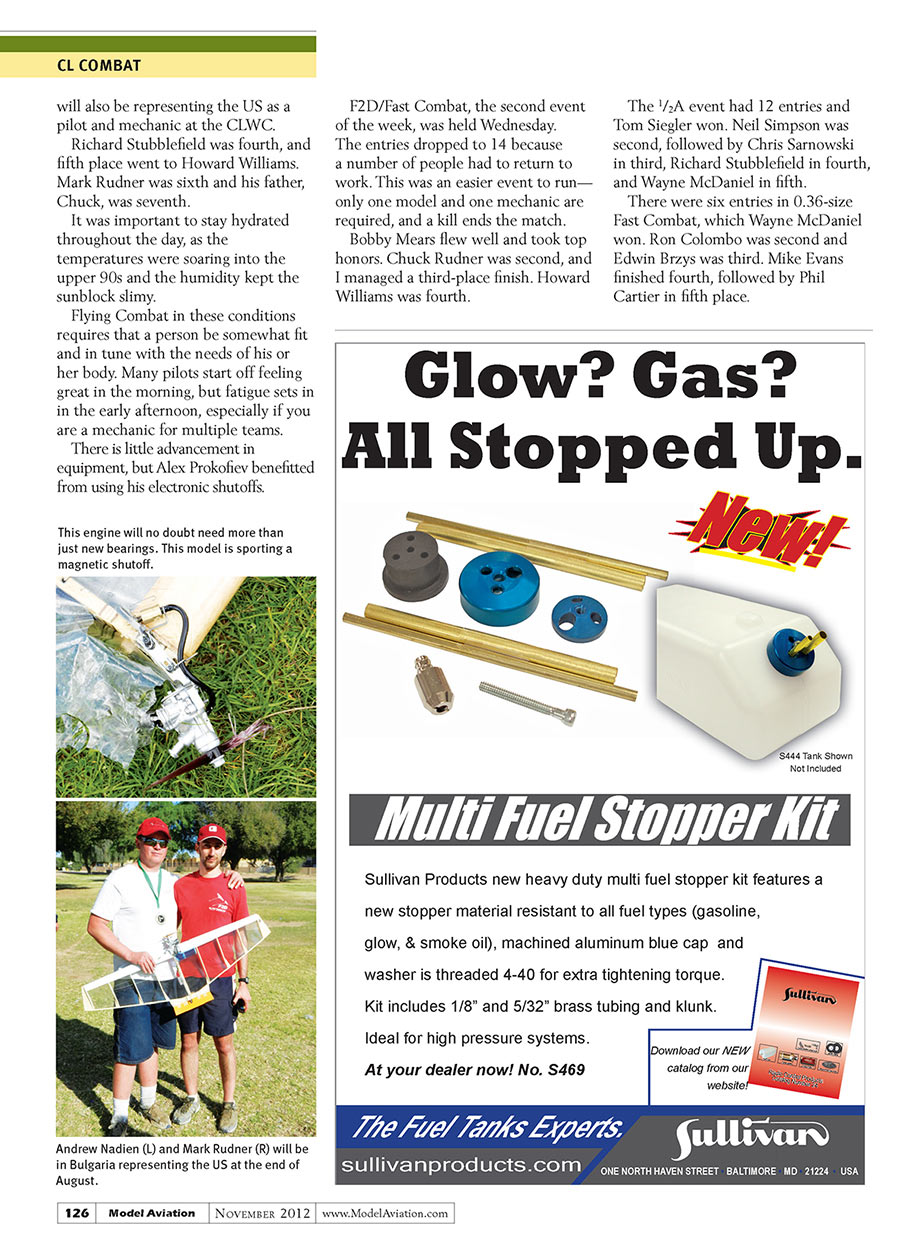
- Mark Rudner, F2D vice president
- Jeff Rein, Top 20
In the early years, one of the main goals was to get Combat included as a World Championship event by persuading our FAI representatives to submit a proposal at the annual FAI meetings in Paris. That effort succeeded, and the first Control Line World Championships (CLWC) to include Combat was held in 1978.
The membership application states that the dues are $15, but we discussed raising that amount to $50 during the F2D pilots’ meeting at this year’s Nats. Those involved in the discussion felt that $15 was a nominal amount—equal to the price of three Nelson glow plugs. Not much can be done with that amount of money. One goal is to raise enough money to provide lodging for the judges who travel and work at the Nats all week.
Although nearly anyone can donate one week of vacation time to be the event director at the Nats, it puts a strain on a family who would prefer a vacation on the north shore of Maui or another lovely part of the world. I hope we can provide support so Chris Gay will not have to carry the entire burden of running the Nats.
AMA Nats
I had not been to the Nats since 2004 and decided it was time for a trip to Muncie, Indiana. I managed to plant the seed of interest in my flying partner, Chuck Rudner, and he finally convinced himself to go. The fact that his son, Mark, would be going solidified the deal.
Last year, reports indicated that Chris Gay had done a great job renewing interest in the Nats, and attendance had risen. This year, there were roughly 25 entries in F2D.
F2D results:
- 1st: Alex Prokofiev (Latvia) — won for the second year in a row
- 2nd: Andrew Nadein — hampered by shutoff malfunctions; will represent the US at the CLWC in Bulgaria this year
- 3rd: Cary Minor (tied with Andy Minor; a coin flip determined Cary as 3rd and Andy as 4th)
- 4th: Richard Stubblefield
- 5th: Howard Williams
- 6th: Mark Rudner
- 7th: Chuck Rudner
Temperatures soared into the upper 90s with high humidity, so it was important to stay hydrated. Flying Combat in these conditions requires that a person be fit and in tune with the needs of his or her body. Many pilots start off feeling great in the morning, but fatigue sets in by early afternoon, especially if you are the mechanic for multiple teams.
There is little advancement in equipment, but Alex Prokofiev benefited from using electronic shutoffs.
F2D/Fast Combat (held Wednesday) had 14 entries because several people had to return to work. This event is easier to run—only one model and one mechanic are required, and a kill ends the match. Results:
- 1st: Bobby Mears
- 2nd: Chuck Rudner
- 3rd: Rich Lopez
- 4th: Howard Williams
The 1/2A event had 12 entries. Results:
- 1st: Tom Siegler
- 2nd: Neil Simpson
- 3rd: Chris Sarnowski
- 4th: Richard Stubblefield
- 5th: Wayne McDaniel
There were six entries in 0.36-size Fast Combat. Results:
- 1st: Wayne McDaniel
- 2nd: Ron Colombo
- 3rd: Edwin Brzys
- 4th: Mike Evans
- 5th: Phil Cartier
The scores and details of the CL Combat Nats can be viewed on the Nats website. See Sources.
Bearings Do Fail
If you fly an engine long enough, a bearing will likely go bad. The first indication is the engine begins making unusual sounds, such as rattling. You may think the problem is engine vibration, an out-of-balance propeller, a cracked motor mount, or a vibration in the model structure.
If you have had a midair collision or hit the ground, check for roughness in the bearing. The front bearing is more prone to getting dirt into the race and around the balls. The rear main bearing can acquire dirt through the venturi when crashing or colliding with another model. If the aircraft was in an engine-to-engine collision, small metal bits could have been ingested; these can damage the bearing, the piston, and the liner.
Russ Wilcox recently got too close to a shade tree and bit off a branch with the propeller and engine. Perhaps some of that vegetable matter made its way into the crankcase.
Another indicator of a bad main bearing is a high number of blown glow plugs. Sometimes the plastic cage on a bearing comes apart and bits get into the combustion chamber and knock out the glow-plug element. The balls can also crack and send extra chunks into the engine.
Bearings are inexpensive compared with the cost of blowing three consecutive glow plugs. You will lose power and performance with bad bearings. You can often feel "ticks" as you turn them; at times they can stop rotating. Use a high-powered magnifying glass to inspect the bearings closely and change any that appear or feel suspicious.
SOURCES
Transcribed from original scans by AI. Minor OCR errors may remain.

