
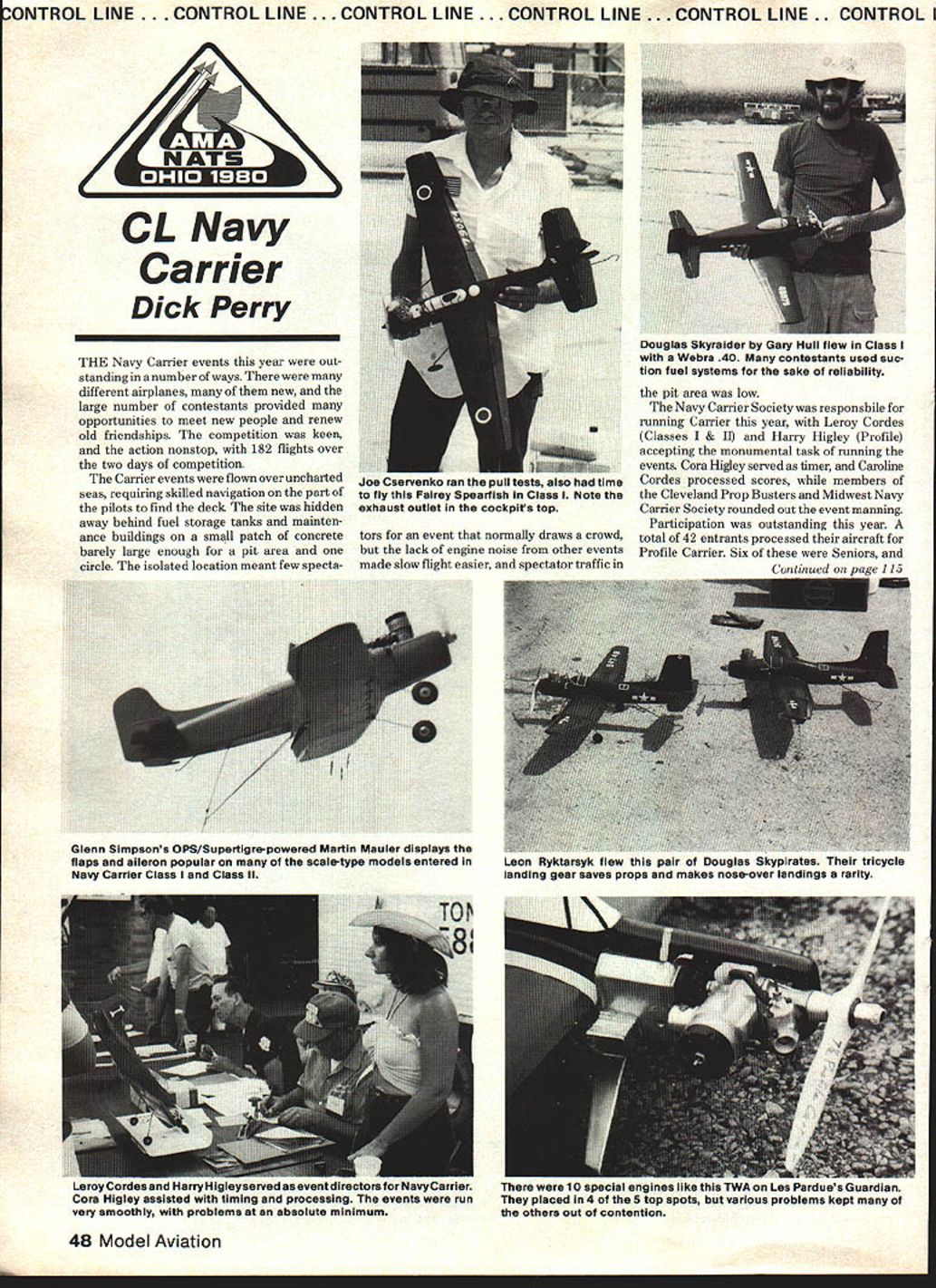
CL Navy Carrier
Dick Perry
The Navy Carrier events this year were outstanding in a number of ways. There were many different airplanes, many of them new, and the large number of contestants provided many opportunities to meet new people and renew old friendships. The competition was keen, and the action nonstop, with 182 flights over the two days of competition.
The Carrier events were flown over uncharted seas, requiring skilled navigation on the part of the pilots to find the deck. The site was hidden away behind fuel storage tanks and maintenance buildings on a small patch of concrete barely large enough for a pit area and one circle. The isolated location meant few spectators for an event that normally draws a crowd, but the lack of engine noise from other events made slow flight easier, and spectator traffic in the pit area was low.
Organization and Staffing
The Navy Carrier Society was responsible for running Carrier this year, with Leroy Cordes (Classes I & II) and Harry Higley (Profile) accepting the monumental task of running the events. Cora Higley served as timer, and Caroline Cordes processed scores, while members of the Cleveland Prop Busters and Midwest Navy Carrier Society rounded out the event manning.
Participation
Participation was outstanding this year.
- A total of 42 entrants processed their aircraft for Profile Carrier.
- Six of these were Seniors and three were Juniors, providing good competition in all age categories.
- Class I saw 20 aircraft processed.
- Class II had 24 aircraft processed.
- All but one entry in each event were in the Open category.
Scale Classes (Thursday)
Competition started on Thursday with the Scale classes. The early morning was calm and cool—near-perfect conditions. Bill Boss took advantage of the good weather and jumped to an early lead in both classes with his Guardians. As the morning passed, the wind began to build; although it was never strong, it was rather gusty at the Carrier site because of the many obstructions around the circle.
With wind causing difficulties for some pilots, and others having engine problems, there were only 12 flights completed through normal landing prior to the noon break. Since only two of these were in Class I (Bill Boss in Open and Neal Frisbie in Junior), Bill and Neal were well ahead at that point.
In Class II the early competition was considerably more intense. George Cox was in first place, but then Brian Silversmith overtook him and moved into first by a narrow margin, both flying Guardians. Bill and Brian improved their scores on their second official flights, and the standings at noon were Silversmith, Boss, and Cox, with a six-point spread between first and third place.
After lunch, Dave Wallick and Pete Mazur both had flights that threatened to take the Class II lead from Brian, but both lost 75 points on landing. Dave's second flight matched a 110-mph high with a 21.7-mph low and a 95-point landing to move into first place.
As the afternoon stretched on, others challenged the leaders but fell short, and the standings remained as they were.
Class I activity picked up in the afternoon, but scores were more spread than in Class II, and placings, once established, changed very little. Dave Wallick captured first place with a 114.3-mph high and a 21.9-mph low. Both of Dave's planes were 32-inch-span Guardians with K&B .65 engines. Both engines had left-hand rotation, and the Class II engine had been expanded to 6.6+ cc displacement.
Profile Carrier (Friday)
Profile Carrier got off to a slow start on Friday morning, as many contestants were reluctant to fly in the rain. One of the first to show up was George Cox with his Tune-Hill/OS-powered MO-1. George combined an 81.5-mph high and an 11.3-mph low for 263.6 points, 0.6 over the existing Open record. Dick Perry's Bearcat posted a 90.1-mph high, but could not match George's low-speed performance, moving into second at 256.3.
As the day passed, the rain subsided and the wind stayed almost dead calm. Dave Wallick, master of the preceding day's competition, brought out his K&B-powered Spearfish. High speed was 80.3 mph, and he settled into slow flight. Dave has always done well in slow flight, and everyone stopped to watch as he set his Spearfish at a little over 45° of pitch and started flying 30+-second laps. When he was done, almost four minutes later, he had flown a low speed of 8.2 mph and set the record at 258.4 points.
George Cox tried to catch Dave, but the small flaps on his MO-1 would allow a low speed of only 10.2 mph. George had to settle for second place at 274.1—11 points over the previous record.
The competition in Junior and Senior Profile Carrier was very keen, with the scores quite close together. Keith Higley topped the Juniors with a non-scale model, and Mike Briggs won Senior with an Airabonita. Both winners used the Supertigre .35 for power.
Flights, Scheduling, and Judging
A total of 99 flights were flown in Classes I and II, and 83 in Profile. Flying time was extended both days to attempt to accommodate the large number of contestants. There was a waiting list each day as the deck closed, but many of the scheduling problems arose because of entrants flying in other CL events and having limited time for Carrier. Most of the entries appreciated the consistency of judging that resulted from the use of one deck and one set of officials.
Awards and Closing
On Friday evening, 50 persons—contestants and their families—gathered for dinner and fellowship at the annual meeting of the Navy Carrier Society. Dave Wallick, by virtue of his wins in all three classes, was awarded the Eugene Ely Award as the outstanding Carrier pilot of the Nats. The meeting adjourned with happy memories and anticipation of next year's Nats.
Transcribed from original scans by AI. Minor OCR errors may remain.

