
CL Navy Carrier in NatsNews
by Dick Perry tailhooker@comcast.net
This month’s offerings include some comments about the 2014 Nats, my adventures in producing a control handle with 2.4 GHz radio capability for Carrier, and a couple of gorgeous profile biplanes by Randy Snow.
2014 Nats
The 2014 Nats, held in Muncie, Indiana, are history as you read this, and I hope you enjoyed the photos and commentary on all of the events, including (of course) CL Navy Carrier, in NatsNews on the AMA website.
The AMA Publications staff puts in a tremendous amount of work for NatsNews—editing the photos and reports from contributors for each of the events/categories competing in the Nats, and producing a daily newsletter covering the events that are flown.
Ashley Rauen, Rachelle Haughn, and Liz Helms were heavily involved in its production, but nothing of this magnitude could succeed without contributions from nearly every member of the Publications staff. I’ve worked as a NatsNews contributor for several years, and my hat’s off to these ladies and everyone else who participated—staff and contributors alike.
When I was unable to attend the Nats in 2012 and 2013, I relied on NatsNews to follow the happenings in Muncie.
I can’t provide any specifics on the Nats in this issue because my deadline for this column was before the competition, but I plan to have a rundown on any significant events and interesting models in my column in the January issue of Model Aviation.
2.4 GHz Radio Handles
2.4 GHz radio handles are appearing in many forms in Carrier and other events. I jumped into the fray shortly before the 2014 Nats. I discovered that converting an RC car transmitter to an RC CL handle is fraught with potential pitfalls. I’ll relate some of the lessons I’ve learned so that you might avoid some of the more time-consuming detours I took during my modification adventure.
I’ve seen a couple of handles based on a 4-inch-square aluminum frame produced by bandsawing a section from a 4 1/8-inch-square aluminum box beam. I decided to form my frame from 1/8 x 3/4-inch aluminum strap. That’s a lot more work than you need to do. Trust me on that!
A metal supplier/fabricator should be able to produce the box-beam frame in as many pieces as you require for roughly $3 a cut. I recommend you let the people at the metal shop do the work and forego the joys of fabricating your own. There are plenty of other ways to engage your creative instincts in this type of project!
Other projects have used a four-cell AA battery box from RadioShack as the power source. I highly recommend that approach. It’s easier than trying to preserve the existing battery box and wiring.
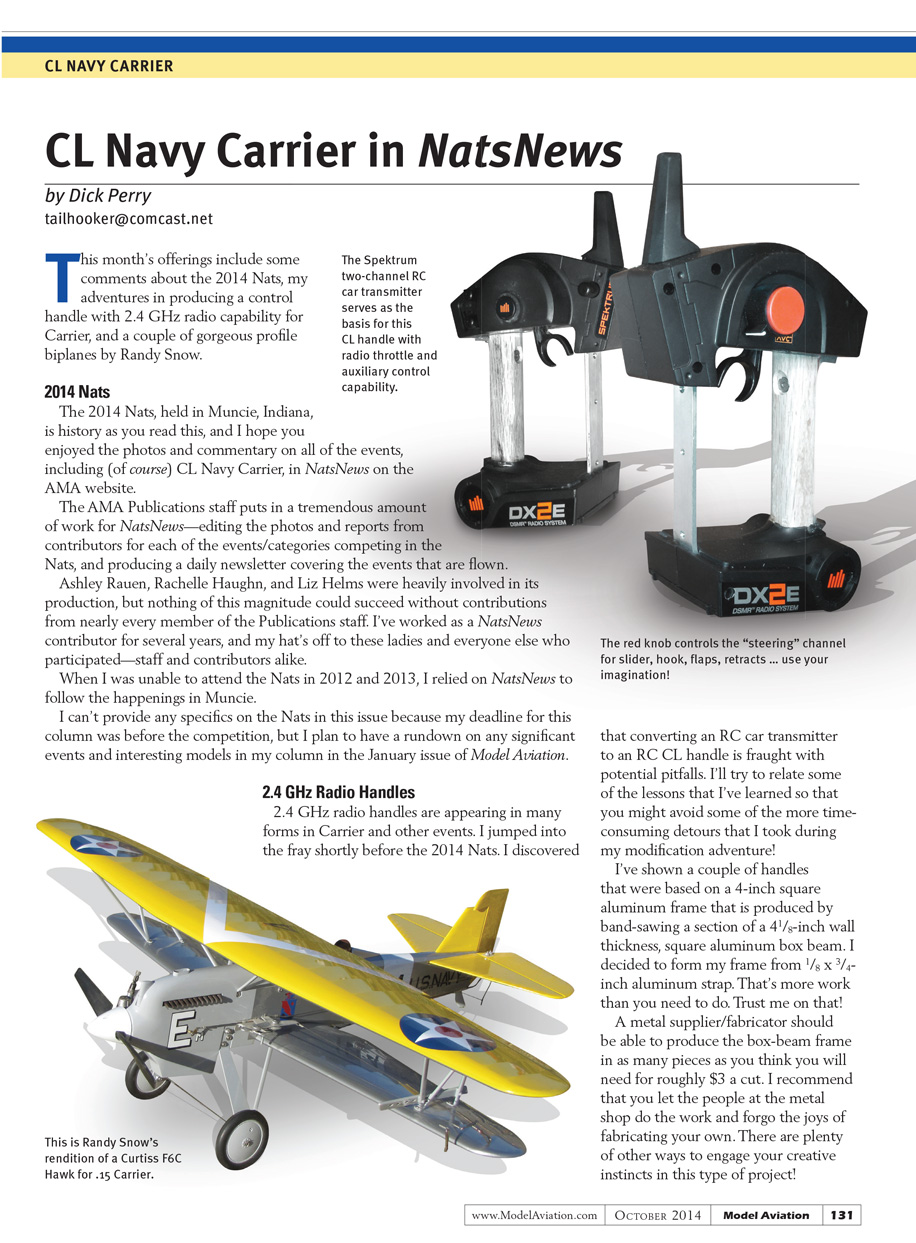
The radio I used as the basis for my handle was the Spektrum DX2E. It is inexpensive and simple. Because I planned to have one handle for each aircraft, I saw no need for the more expensive and more complex computer radios with additional channels and multiple-model capability. The DX2E, or an equivalent radio, provides a throttle channel that can be used much as our familiar Sturdi-Built, GS Products, Leon Ryktarsyk, and Brodak handles. The steering channel can be used for whatever function you desire, such as releasing a line slider or hook. The DX2E is simple and free of bells and whistles, but still provides trim, rate, and reverse functions for each channel.
The internal wiring is light, but it held up to my occasional rough handling. If you plan to have exposed wiring (such as from the power pack to the transmitter head), I recommend substituting a heavier-gauge wire for that function. You will need to cut and re-solder one end of the power wires anyway, so the substitution doesn’t require much added work.
Some car transmitters can be reversed to accommodate left-handed operation. Not so with the DX2E. If you are right-handed, the controls other than the throttle trigger will be on the "wrong" side for you. Most adjusting will be done on the ground, so this should not be an inconvenience. If you want to use the steering function as it comes on your transmitter, a reversible head might be something to consider.
I wanted to control the second channel with a rotary knob smaller than the steering wheel on the original transmitter, and use my left hand on the knob, so it had to be on the left side of the transmitter. I also had no need for the spring-centering of the steering function.
I could have moved the existing potentiometer, but I found it simpler to remove all of the steering mechanics and potentiometer and locate a new pot and knob on the other side of the transmitter. RadioShack is where I purchased the parts, but any electronics shop will have what you need.
Randy Snow's Biplanes
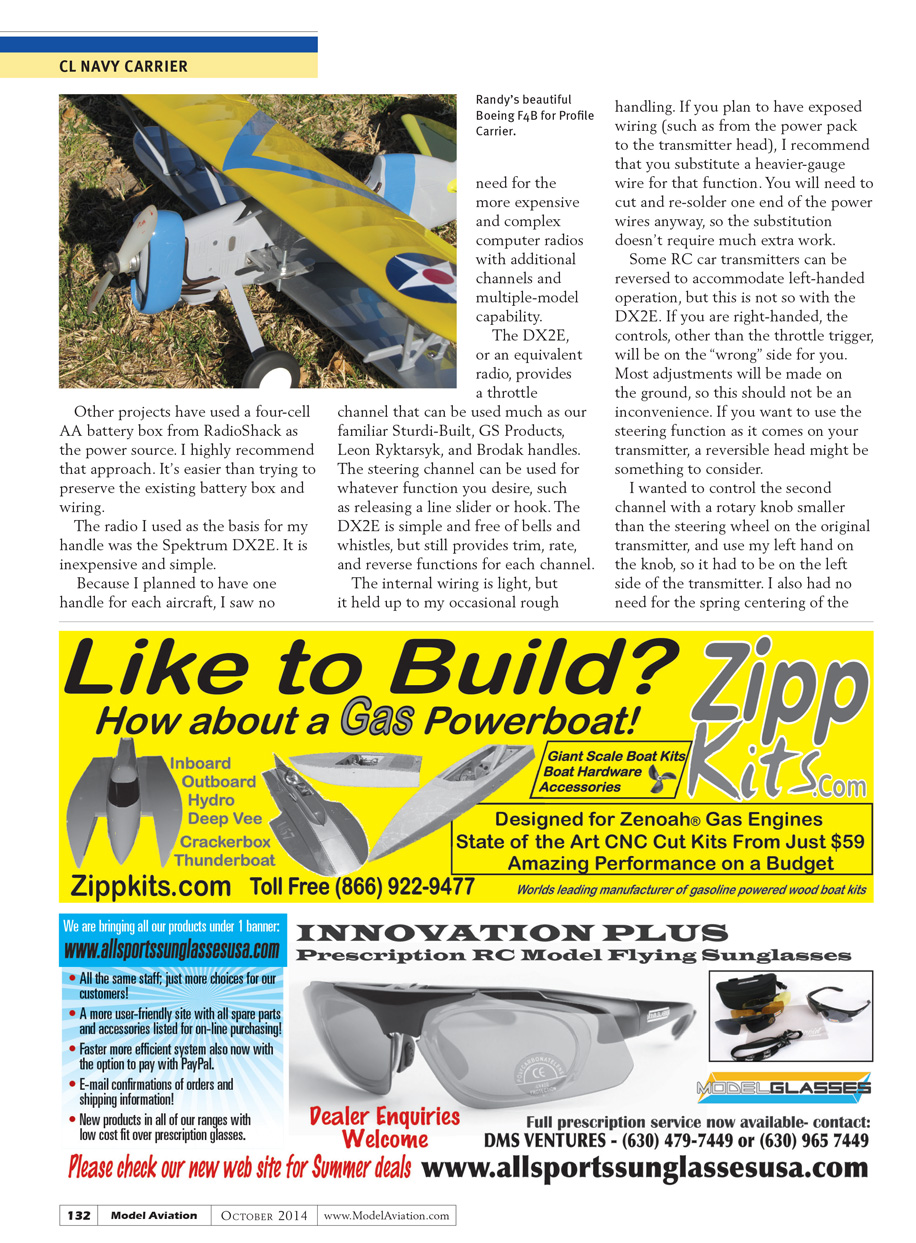
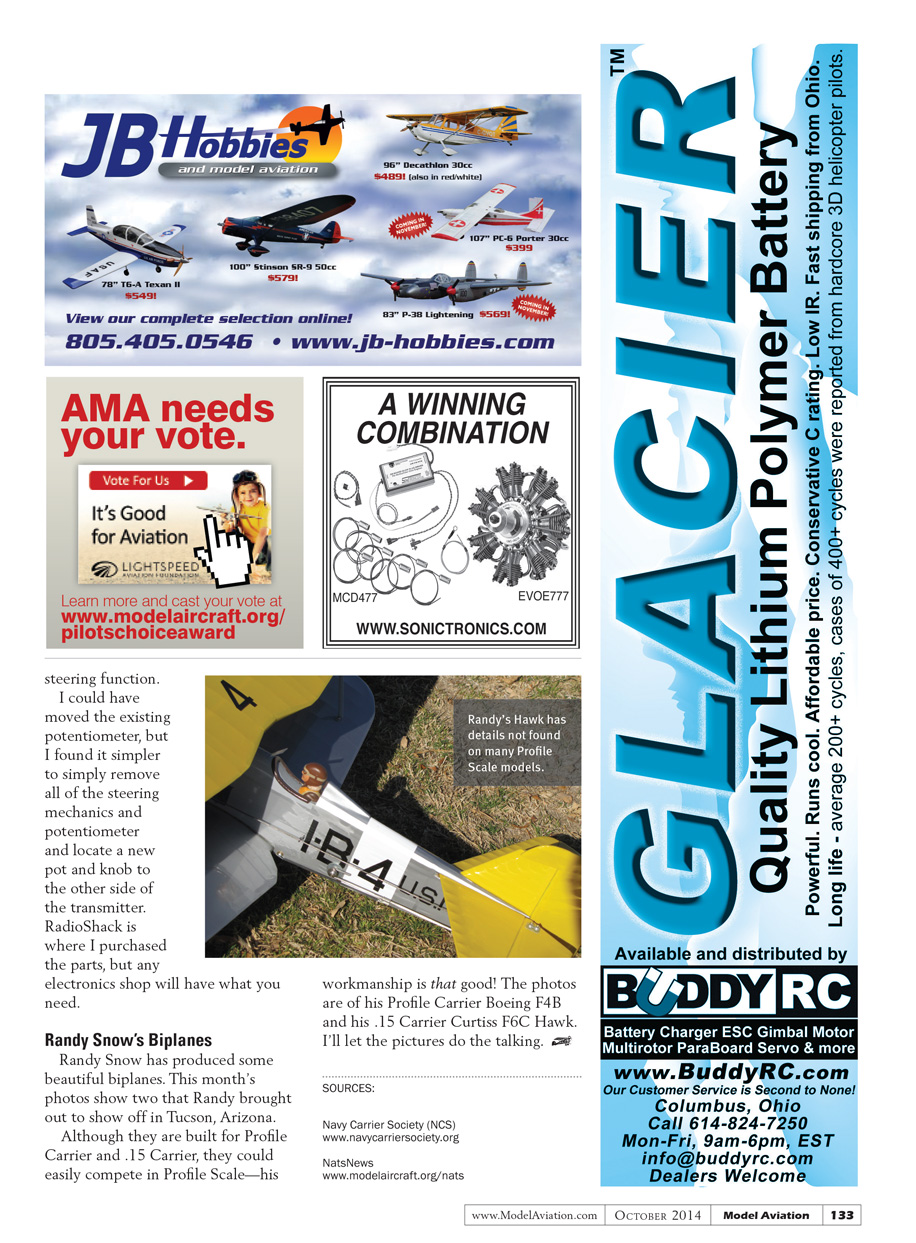
Randy Snow has produced some beautiful biplanes. This month's photos show two that Randy brought out to show off in Tucson, Arizona. Although they are built for Profile Carrier and .15 Carrier, they could easily compete in Profile Scale—his workmanship is that good! The photos are of his Profile Carrier Boeing F4B and his .15 Carrier Curtiss F6C Hawk. I’ll let the pictures do the talking.
Sources
- Navy Carrier Society (NCS) — www.navycarriersociety.org
- NatsNews — www.modelaircraft.org/nats
Transcribed from original scans by AI. Minor OCR errors may remain.

