
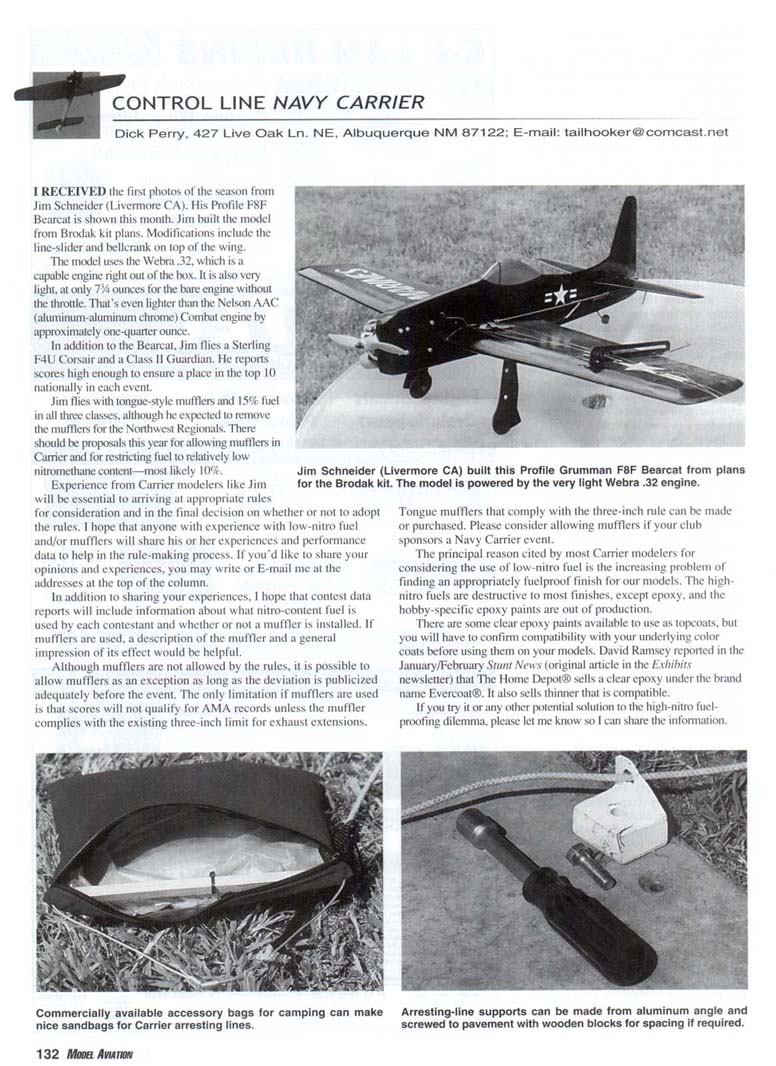
Control Line Navy Carrier
Dick Perry 427 Live Oak Ln. NE, Albuquerque NM 87122 E-mail: tailhooker@comcast.net
Photos and models
I received the first photos of the season from Jim Schneider (Livermore, CA). His profile F8F Bearcat is shown this month. Jim built the model from Brodak kit plans. Modifications include the line-slider and bellcrank mounted on top of the wing.
Jim also flies a Sterling F4U Corsair and a Class II Guardian. He reports scores high enough to ensure a place in the top 10 nationally in each event.
Engines and fuel
The Bearcat uses a Webra .32, which is a capable engine right out of the box. It is also very light — only 7 3/4 ounces for the bare engine without the throttle. That is even lighter than the Nelson AAC (aluminum-aluminum chrome) Combat engine by approximately one-quarter ounce.
Jim flies with tongue-style mufflers and 15% nitro fuel in all three classes, although he expected to remove the mufflers for the Northwest Regionals.
Rules proposals and data collection
There should be proposals this year for:
- allowing mufflers in Carrier, and
- restricting fuel to relatively low nitromethane content — most likely 10%.
Experience from Carrier modelers like Jim will be essential to arriving at appropriate rules for consideration and in the final decision on whether or not to adopt the rules. If you have experience with low-nitro fuel and/or mufflers, please share your experiences and performance data to help in the rule-making process. You may write or e-mail me at the address above.
In addition to sharing your experiences, contest data reports should include:
- the nitro-content of the fuel used by each contestant, and
- whether or not a muffler is installed.
If mufflers are used, include a description of the muffler and a general impression of its effect.
Although mufflers are not allowed by the current rules, it is possible to allow mufflers as an exception as long as the deviation is publicized adequately before the event. The only limitation if mufflers are used is that scores will not qualify for AMA records unless the muffler complies with the existing three-inch limit for exhaust extensions. Tongue mufflers that comply with the three-inch rule can be made or purchased. Please consider allowing mufflers if your club sponsors a Navy Carrier event.
Finish and fuelproofing
The principal reason cited by most Carrier modelers for considering low-nitro fuel is the increasing difficulty of finding an appropriately fuelproof finish. High-nitro fuels are destructive to most finishes except epoxy, and many hobby-specific epoxy paints are out of production. There are some clear epoxy topcoats available, but you must confirm compatibility with your underlying color coats before using them on your models.
David Ramsey reported in the January/February Stunt News (original article in the Exhibits newsletter) that The Home Depot sells a clear epoxy under the brand name Evercoat®. It also sells compatible thinner. If you try Evercoat or any other potential solution to the high-nitro fuel-proofing dilemma, please let me know so I can share the information.
Whittier Narrows deck refurbishment and arresting-line construction
Fred Cronenwett (Canoga Park, CA) provided photos following the refurbishment of the Whittier Narrows deck in the Los Angeles area. The deck is concrete on a grass circle, but the techniques are applicable to mounting lines on any paved surface. Putting a deck on a paved circle is relatively simple and offers the advantage of multiple uses for the circle without the need to build a plywood deck, which is necessary for flying from grass. Even a paved segment of a grass circle can be less expensive and easier than a plywood deck.
A significant consideration for any deck is the arresting-line construction.
Line materials and supports:
- Lines are made from parachute cord. The smooth nylon cord is relatively small in diameter, slides easily through line guides, meets minimum strength requirements, provides a little elasticity, and is usually easy to obtain at large hardware stores.
- Line supports can be made from aluminum angle and screwed to the pavement with wooden blocks for spacing if required.
Bags (arresting bags):
- If you have access to a heavy-duty sewing machine (or can use a large needle and heavy thread in a standard machine), the best material is denim — legs cut from old blue jeans make good bags.
- An alternative that avoids construction is a commercial “utility pocket” from camping product lines (Camp Inn brand / Cerf Brothers Bag Company). These are available in many outdoor stores.
Bag construction details Fred used:
- Size: 8 x 10 inches.
- Sand is placed inside a heavy-duty Ziploc® freezer bag, which then fits into the cloth bag.
- The zipper at the top allows a triangular wire harness to be inserted before closing.
- The wire is attached with plastic cable ties to a wooden stick the width of the bag. The wooden stick spreads the load on the bag and keeps the wire from deforming during arrested landings.
- The arresting cable is tied to the wire harness.
Line supports at Whittier Narrows:
- Supports are screwed into expandable screw anchors inserted in holes drilled in the concrete.
- When the line supports are not installed, the holes are plugged with setscrews matching the diameter and thread of the bolts used for the supports.
Alternative anchor methods:
- Threaded eye bolts are an alternative, though they slightly increase the likelihood of snagging a control line on a missed landing.
- If you are not concerned about debris filling the holes, or are willing to maintain them every few years, galvanized pipe large enough to accommodate screw eyes without threading has worked well.
- In asphalt, it might be possible to drive anchors through the surface without drilling, but be sure to try it before committing.
That’s all for now. I hope your summer flying season has been going well.
MA
Transcribed from original scans by AI. Minor OCR errors may remain.

