
CL Racing
By Bill Lee
The real story of racing at the 1980 Nats must include more than who won what and what equipment was used. First, there is the story of the Nats site itself.
Nats site and circle problems
The airbase at Wilmington, OH, is an active commercial field with some old, abandoned runways in addition to the active portion. Upon arriving on Sunday, the racing competitors found that the circles had been laid out on one of the abandoned runways — not bad if the runways were in good condition. But at this site the runway was only 148 ft. wide, and a 152-ft. circle had to be painted. The circle was painted off the edges of the runway into the grass on each side, so you were flying over corn on one side and over soybeans on the other.
That was not good, but the real problem was that the runway itself was so rough and dirty that it was not possible to fly on the circles without damaging the models. The concrete was old and badly broken up, the cracks between the slabs were large and filled with weeds, and adjacent slabs were quite uneven. There was one spot in the racing circle where a landing aircraft would hit a 2-inch curb due to the unevenness of the slabs. Clearly, it was an unacceptable situation, so the competitors went to Nats management with the ultimatum of better circles or no fliers.
About a mile across the field there was a large ramp adjacent to the taxiway where the RC flight areas were located. This ramp had perfect concrete — smooth as glass, clean, and even. The CL aerobatics circles were placed on that ramp, with the remaining 80% or so allocated for parking for the RC events and CL aerobatics. After some discussion between Nats management and the racing competitors, it was agreed that one more circle could be laid out adjacent to the stunt circles, but that the fliers themselves would have to lay it out and get it painted.
A number of us rounded up the painting machinery and a 100-ft. tape and proceeded to paint what turned out to be the best racing circle we’ve seen at the Nats in quite some time. But there was only one circle and no practice area. With the low entry level in the racing events, this provision proved just barely adequate.
Need for a CL Racing organization
A get-together after the Rat Race on Thursday made it increasingly apparent that Control Line (CL) Racing needs to organize as a special interest group along the lines of PAMPA, MACA, NMPRA, etc.
The need for this kind of organization has two major facets:
- Protecting the interests of CL Racing fliers when dealing with the AMA and other bodies. A functioning racing organization could have prevented the problems at Wilmington regarding circle layout.
- Encouraging increased participation in CL Racing. The advent of PAMPA sparked a resurgence in CL Aerobatics and made that event one of the most popular in CL flying today; a similar effort could boost racing.
The meeting after Rat may have been the beginnings of such an organization, with many of the "name" fliers present and agreeing on the need. Items that came from the meeting included:
- Skill-level classification
- Replace the outmoded Jr.–Sr.–Open age breakdown with skill-level classes (novice, expert, etc.), following the PAMPA approach. This keeps novices competing with novices and experts with experts and helps grow participation. John Ballard agreed to investigate PAMPA’s organization and report to interested racing people.
- Rule changes only after adequate testing
- Consensus was that racing rules should be changed only after adequate testing of changes before adoption. For example, there was strong sentiment to open Goodyear to .35-cc engines and larger planes. With proposals before the AMA, nobody knows what size new planes should be to stay competitive; current equipment could be rendered obsolete overnight. Rules should be changed based on experience and testing, not speculation.
- A very slow racing newcomer event
- Some form of very slow racing is needed as a newcomer entry event. Ideally flown nationwide under the same rules, it could become an AMA official event. Initially the rules should be set and controlled by the competing community (kept outside formal AMA procedures) so they can be quickly adjusted when conditions warrant, unlike the slow process required for formal AMA event formation.
A CL Racing special interest group will not happen overnight, but it will support people and events. John Ballard has agreed to be a focal point for activity. Interested people should contact John Ballard at:
John Ballard 10102 Kimblewick Dr. Louisville, KY 40223
Brief reports on events at the Nats
Full event winners and times are listed in the Competition News section of this magazine.
#### Goodyear Speeds in Goodyear were down substantially from a year ago, due to the increased line diameter and length. As reported earlier in the year, the larger lines have slowed models by about one second for a half mile; for example, a model that was reliably mid-14s last year was mid-15s this year. Lambert’s winning time was a little over six minutes. Basically, the event has reached a stable position, with the Rossi being the only competitive motor at the Nats and the same assortment of models. Props were mostly the Kelly–Willoughby and the Perkins–Ballard (or the Kelly equivalent).
#### Rat Race Fast Rat this year was notably quicker than in previous years. The fastest models were running regularly in the high 11-second range, with 11.6 not uncommon; a 12.0-flat Rat was fairly common. The big news was the Nashville Rat team's domination: their three entries took first through third, with virtually identical times between 4:38.8 and 4:39.9. The dominant engine this year was the K&B 6.5, with a few good-running K&B 40s, HP and OS .40s, and a lone Super Tigre X-40 from Vic Garner. Nashville used K&B 6.5 engines modified to use an OS .40 drum rotor assembly, claiming a 400 rpm increase over a stock steel K&B rotor.
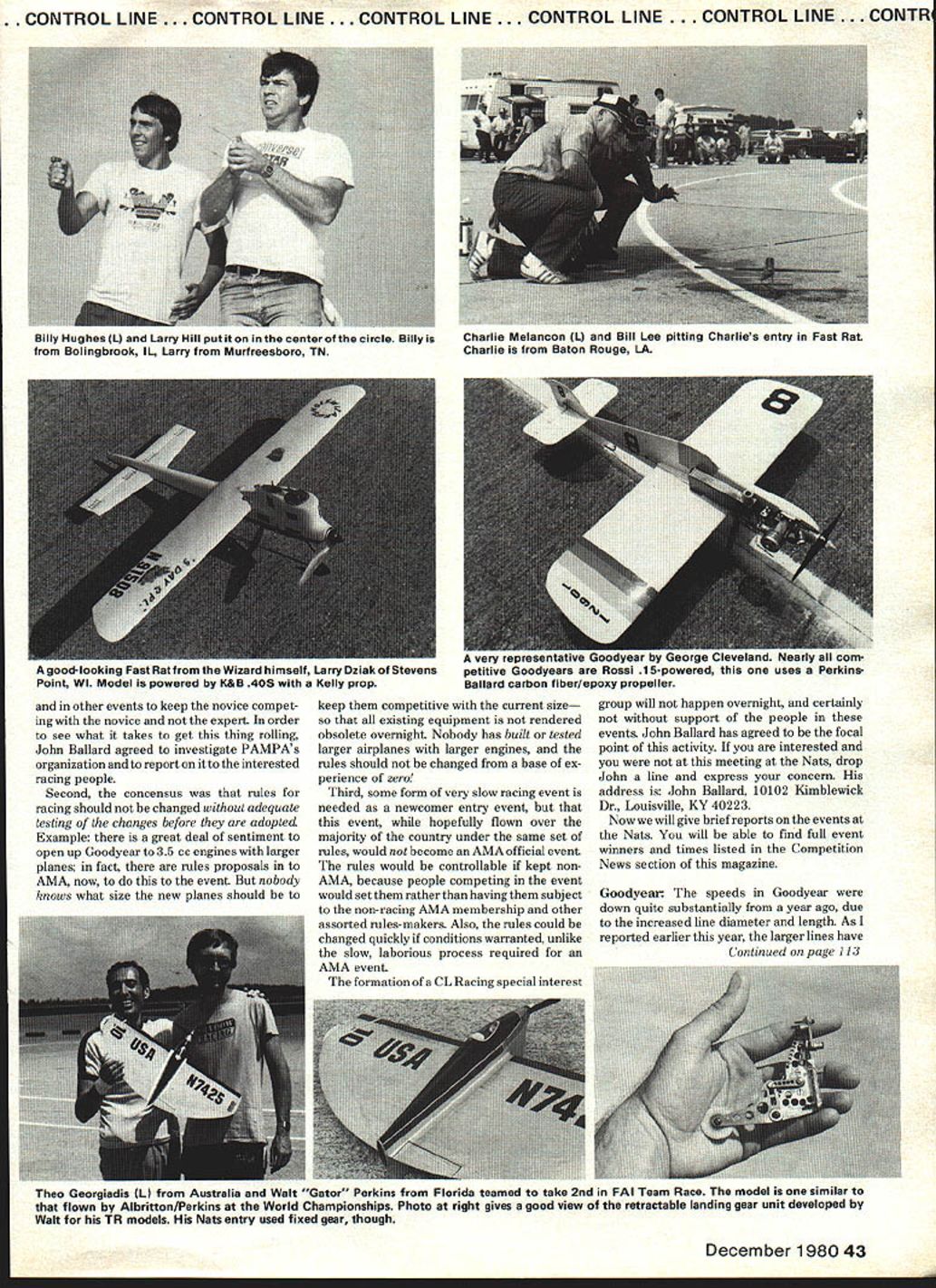
#### FAI Team Race Team Race was lightly entered this year, with only 12 entries and only six teams flying. Jim Ricketts, the CL Racing event director, added TR to his duties and received able assistance from Al Kelly in running the event. With the low number of entrants, only qualifying rounds were flown and the three best times were taken to the final.
The finals consisted of the international team of Walt Perkins/Theo Georgiadis, Les Pardue/Phil Shew of Albuquerque, and a Canadian team, Cottrell/Smith. The race was exciting: Phil and Theo essentially flew a two-up, as the Canadian team had a run-in on the first pit. The two planes were very closely matched in the air, with Shew/Pardue winning by 0.2 seconds over Perkins/Georgiadis at a very good time of about 7:50.
#### Slow Rat The Slow Rats were faster this year, mostly due to improved prop technology and the required solid .018 lines. Ron Esman from Houston won the event at around 5:27, using an HP .36 (a destroked HP .40 with X-29 crank). He was using a reworked Kelly-style prop.
Transcribed from original scans by AI. Minor OCR errors may remain.

