
CL Racing
John Ballard
The 1989 AMA Nationals held in the Tri-Cities area of Washington State is over. This Nats will certainly go down as a memorable event for many competitors who traveled from the East Coast to the great Northwest to pursue national competition. I made the drive with my son, averaging approximately 700–800 miles per day across the Midwest through the semi-arid areas of Wyoming, Idaho, and Utah. These regions definitely show a change in scenery from our typical Midwestern landscape.
The Control Line site, located at a small airport in Richland, WA, provided an excellent surface for all CL events. The area selected was somewhat remote, but restroom and food facilities were adequate. The Boy Scouts had a food and drink booth with low prices that ran daily throughout the competition.
Speed contestants and officials used the circles during the first part of the week. They were quite kind in allowing the Racing people to practice circles on Wednesday. Unfortunately for most Racing pilots, it’s a little unusual to have a foreign object (such as a Speed pylon) mounted in the center of the pilot circle.
Weather for the remaining four days of CL competition was quite unusual by Midwestern standards. Mornings were approximately 60–65°F with very low relative humidity (around 40%). As the sun rose, the temperature increased rapidly until around 1:00 p.m., when maximum temperatures of approximately 90–95°F made operation on the asphalt runways very uncomfortable. The lack of air pollution or cloud cover allowed extremely bright sun early morning until almost 8:00 p.m.
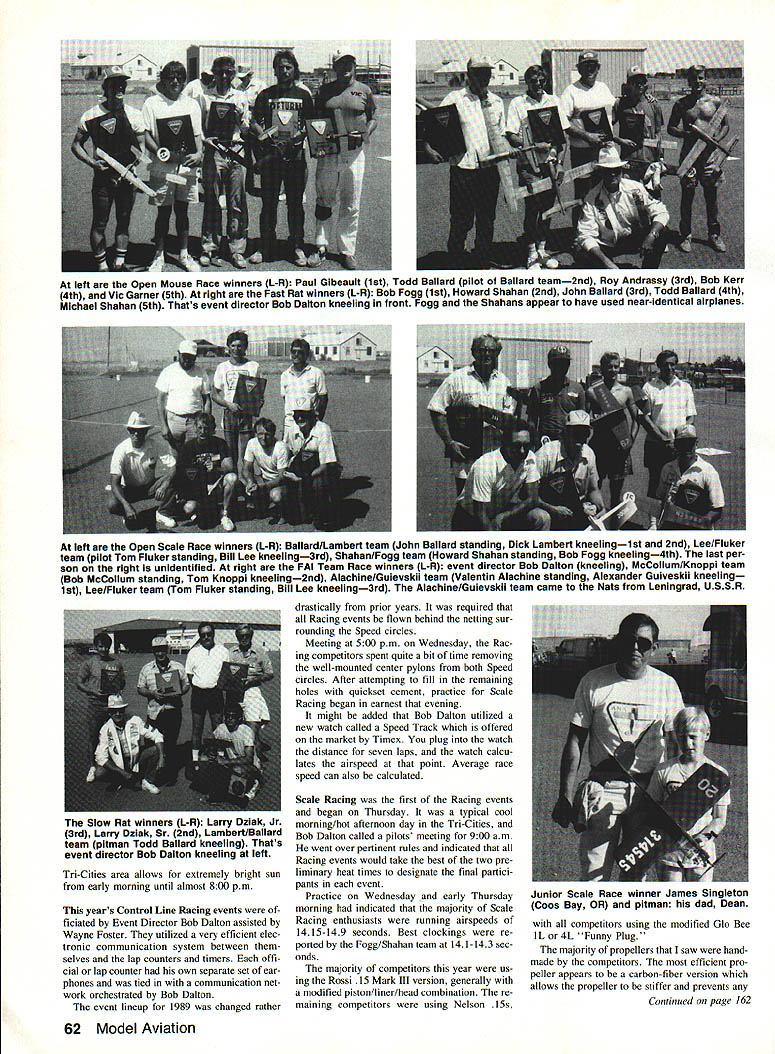
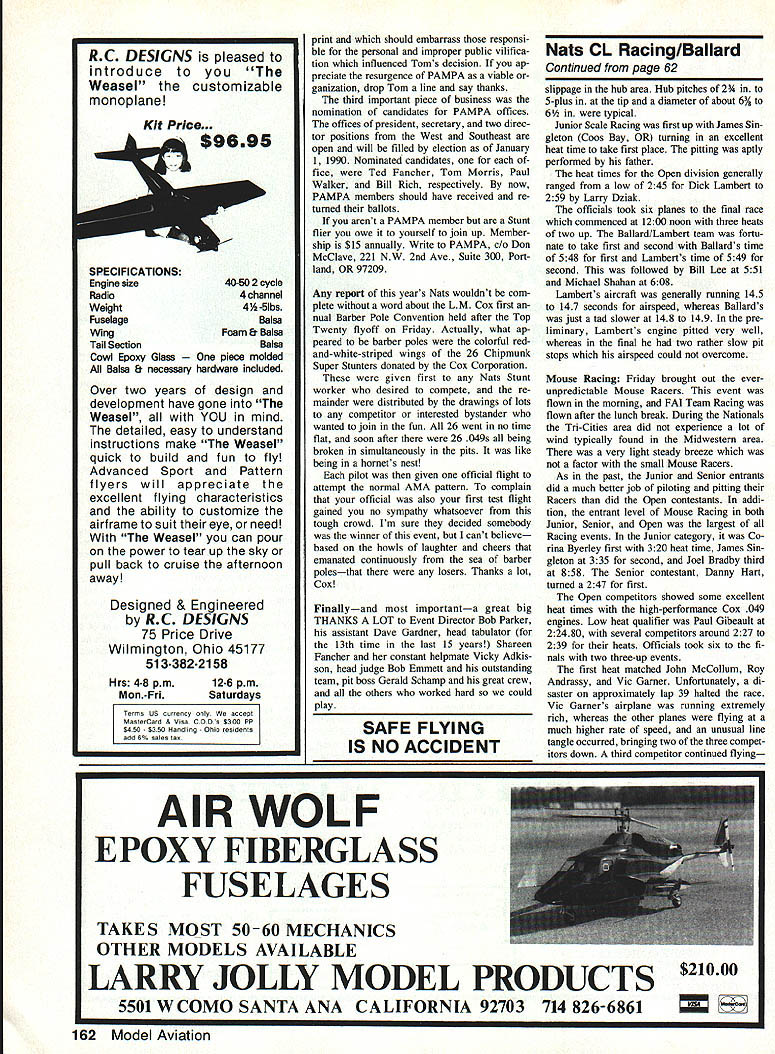
Event officiating and organization Event Director Bob Dalton, assisted by Wayne Foster, officiated the Control Line Racing events. They utilized a very efficient electronic communication system between themselves and the lap counters and timers. Each official or lap counter had his own set of earphones and was tied into a communication network orchestrated by Bob Dalton.
The event lineup for 1989 was changed rather drastically from prior years: it was required that all Racing events be flown behind the netting surrounding the Speed circles. Meeting at 5:00 p.m. on Wednesday, the Racing competitors spent quite a bit of time removing the well-mounted center pylons from both Speed circles. After attempting to fill the remaining holes with quickset cement, practice for Scale Racing began in earnest that evening.
Bob Dalton also utilized a new watch called the Speed Track, offered by Timex. You enter the distance for seven laps into the watch, and it calculates the airspeed at that point. Average race speed can also be calculated.
Scale Racing
Scale Racing was the first of the Racing events and began on Thursday. It was a typical cool-morning, hot-afternoon day in the Tri-Cities, and Bob Dalton called a pilots’ meeting for 9:00 a.m. We reviewed pertinent rules and indicated that all Racing events would take the best of the two preliminary heat times to designate the final participants in each event.
Practice on Wednesday and early Thursday morning indicated that the majority of Scale Racing entries were running airspeeds of 14.15–14.9 seconds. Best clockings were reported by the Fogg/Shahan team at 14.1–14.3 seconds.
Most competitors this year were using the Rossi .15 Mark III, generally with a modified piston/liner/head combination. The remaining competitors were using Nelson .15s. There was occasional slippage in the propeller hub area. Typical hub pitches were 2.5 in. to 5.5 in. at the tip, with diameters of about 6.5 to 6.75 in.
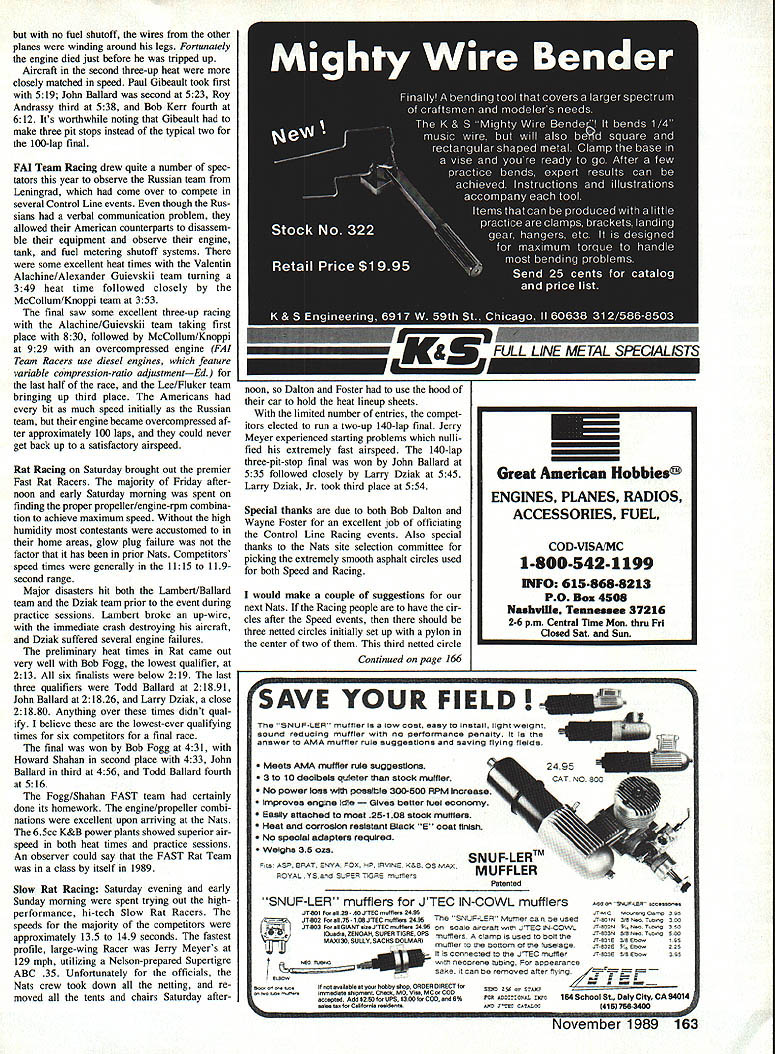
Junior Scale Racing was first, with James Singleton (Coos Bay, OR) turning in an excellent heat time to take first place; his father performed the pitting. Open division heat times generally ranged from a low of 2:45 (Dick Lambert) to 2:59 (Larry Dziak).
Officials took six planes to the final, which commenced at noon with three heats of two-up. The Ballard/Lambert team finished first and second: Ballard’s time was 5:48 for first and Lambert’s 5:49 for second. Bill Lee was next at 5:51, and Michael Shahan at 6:08. Lambert’s aircraft generally ran 14.5–14.7 seconds, whereas Ballard’s was just a tad slower at 14.8–14.9. In the preliminary, Lambert’s engine pitched very well, but in the final he had two slow pit stops that his airspeed could not overcome.
Mouse Racing
Friday brought out the unpredictable Mouse Racers. This event was flown in the morning, with RAF Team Racing after lunch. The Tri-Cities area experienced little of the wind typically found in the Midwest—only a very light steady breeze that did not affect the small Mouse Racers.
The Junior and Senior entrants generally did a much better job piloting and pitting their racers than the Open contestants. Mouse Racing had the largest entrant level of all Racing events.
- Junior: Corrina Jewell first (3:20), James Siner second (3:35), Joel Bradley third (3:58).
- Senior: Danny Hart first (2:47).
Open competitors showed excellent heat times with high-performance Cox .049 engines. Low heat qualifier was Paul Giebault at 2:24.80, with several competitors around 2:27–2:39 in their heats. Officials took six to nine finalists with two three-up events.
The first three-up heat matched John McCollum, Roy Andrassy, and Vic Garner. A disaster around lap 39 halted the race: Vic Garner’s airplane was running extremely rich while the other planes were at a much higher speed, producing an unusual line tangle that brought two of the three competitors down. A third competitor continued flying but, with no fuel shutoff, the wires from the other planes were winding around his legs. Fortunately the engine died just before he was tripped up.
In the second three-up heat, planes were more closely matched. Paul Giebault took first with 5:19; John Ballard second at 5:23; Roy Andrassy third at 5:38; and Bob Kerr fourth at 6:12. Notably, Giebault made three pit stops instead of the typical two for the 100-lap final.
FAI Team Racing
FAI Team Racing drew many spectators, especially to observe the Russian team from Leningrad, which came over to compete in several CL events. Despite a language barrier, the Russians allowed their American counterparts to disassemble their equipment and observe their engine, tank, and fuel-metering shutoff systems.
There were some excellent heat times: the Valentin Alachine/Alexander Guesviki team turned a 3:49 heat, followed closely by the McCollum/Knoppi team at 3:53.
The final produced excellent three-up racing. The Alachine/Guesviki team took first place with 8:30, followed by McCollum/Knoppi at 9:29 (with an overcompressed engine—the FAI Team Racers use diesel engines, which feature carburetor compression-ratio adjustment). The Lee/Fluker team finished third. The Americans had as much speed initially as the Russian team, but their engine became overcompressed after approximately 100 laps and could not regain satisfactory airspeed.
Rat Racing (Fast Rat)
Saturday’s Rat Racing brought out the premier Fast Rat Racers. Much of Friday afternoon and early Saturday morning was spent finding the proper propeller/engine-rpm combination for maximum speed. Without the high humidity many contestants were accustomed to, glow plug failure was less of a problem than in prior Nats. Competitors’ lap times were generally in the 11.50–11.90-second range.
Major practice disasters affected both the Lambert/Ballard team and the Dziak team: Lambert broke an up-wire, destroying his aircraft in the ensuing crash; Dziak suffered several engine failures.
Preliminary heat times in Rat were excellent, with Bob Fogg the lowest qualifier at 2:13. All six finalists were below 2:19. The last three qualifiers were Todd Ballard at 2:18.9, John Ballard at 2:18.26, and Larry Dziak at 2:18.80—likely the lowest-ever qualifying times for six competitors in a final race.
The final was won by Bob Fogg at 4:31, with Howard Shahan second at 4:33, John Ballard third at 4:56, and Todd Ballard fourth at 5:16. The Fogg/Shahan FAST Rat team had clearly done its homework; their .56 K&B engines and propeller combinations showed superior performance in both heats and practice.
Slow Rat Racing
Saturday evening and early Sunday morning were spent trying out high-performance, hi-tech Slow Rat Racers. Most competitors recorded approximately 13.5–14.9-second lap times. The fastest profile large-wing racer was Jerry Meyer’s at 129 mph, utilizing a Nelson-prepared Super Tigre ABC .35. Unfortunately for the officials, the Nats crew took down all the netting and removed tents and chairs Saturday afternoon, so Dalton and Foster had to use the hood of their car to hold the heat lineup sheets.
With a limited number of entries, competitors elected to run a two-up 140-lap final. Jerry Meyer experienced starting problems that nullified his extremely fast airspeed. The 140-lap, three-pit-stop final was won by John Ballard at 5:35, followed closely by Larry Dziak at 5:45. Larry Dziak, Jr. took third at 5:54.
Thanks and suggestions Special thanks to Bob Dalton and Wayne Foster for an excellent job officiating the Control Line Racing events, and to the Nats site selection committee for picking the extremely smooth asphalt circles used for both Speed and Racing.
A couple of suggestions for future Nats:
- If the Racing people are to have the circles after the Speed events, initially set up three netted circles with a pylon in the center of two of them. The third netted circle could be used for Racing practice and wouldn’t require using one of the Speed circles. In addition, there wouldn’t be a pylon to interfere with a Race pilot’s practicing pit stops as he enters and exits the center circle.
- Consider running Slow Rat Racing in the afternoon after a Rat Racing day or on the same day as Mouse and FAI Team Race. The high-tech, high-performance nature of Slow Rat has reduced the number of competitors, and it could easily be run off in an afternoon. This would allow Sunday for competitors to start their return trips home.
Transcribed from original scans by AI. Minor OCR errors may remain.

