
CL Speed
Chris Sackett
Overview
SURPRISE! When I first heard about the 1989 Nats being held up in the Tri‑Cities area of Washington State, I kind of figured it might be a small local affair with a few long‑distance participants. As it turned out, overall entry was about the usual level for recent Nats years, but the Speed entry was unusually high at over 130 — about a third of all 385 Control Line entries. It was great to see so many Speedsters make the trek to the Northwest corner of the continent.
We had people from Florida, New York, Ohio, Pennsylvania, Illinois, Indiana, and Iowa as well as from most of the Western states and the Western provinces of Canada, thereby making the first‑ever Northwest Nats truly national in character. Adding an international flavor to this year's Nats were three Speed fliers from Japan and two from Leningrad, U.S.S.R. All of these fellows did well and placed in most events they entered.
At about 7:30 p.m. we were greeted by 102°F temperatures. This was more like a Texas Nats than one in the cool air of the Northwest! Kennewick and Pasco, the Tri‑Cities, sit in a semi‑arid basin much akin to conditions found in the Southwest, though less humid.
The Speed site wasn't perfect, although it was quite good: flat and level with adequately sized pits. It looked to be a good Nats.
Participants and scene
We ran into the Midwest gang at AMA HQ eating dinner: Fred Randell, Al Stegens, Bill and Bud Hughes, and Chris Montaño swapping Speed stories with locals. Many of them drove all the way — that's a long haul.
Speed kicked off on Sunday, July 16, with 1/2A and 1/2A Profile Roto. The day started windy and variable; later the wind died down. Many guys held off hoping for improved conditions, but they didn't get them. The FAI flights were up next with very little trouble. Carl Dodge's FAI ship had a small FAI‑style .049 which flew very nicely. Fortunately he had qualified for FAI flights and was able to complete an official flight; the model showed real promise.
1/2A Speed and Profile
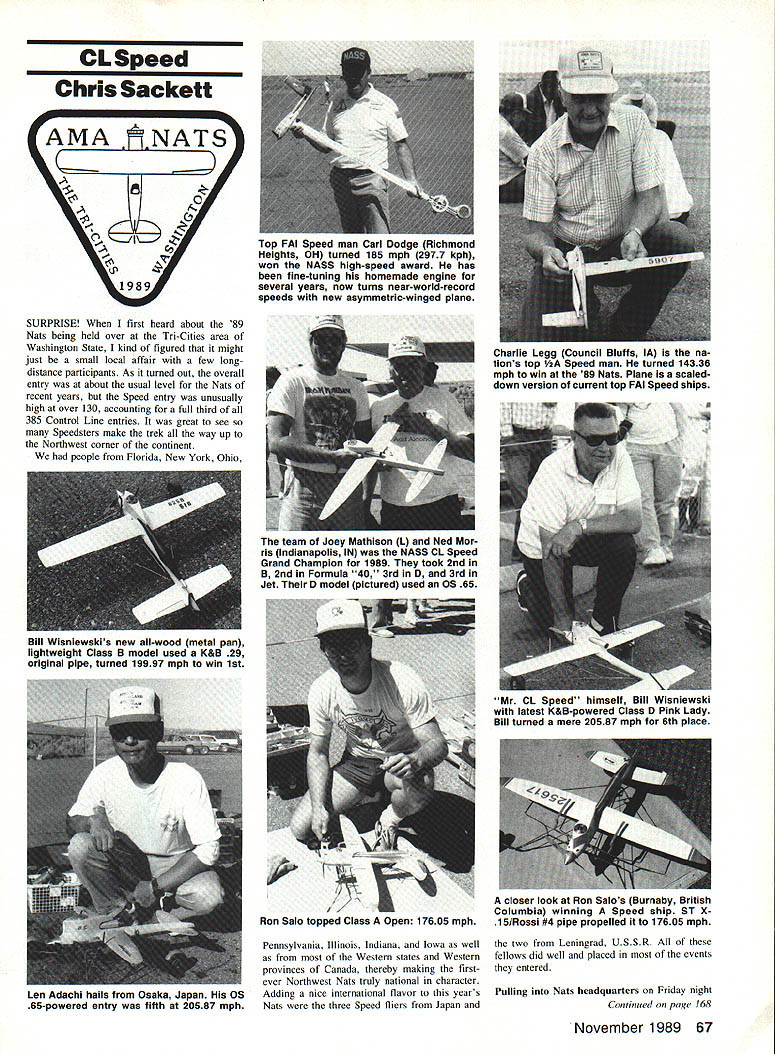
- Charlie Legg (Council Bluffs, IA), the U.S. national record holder for 1/2A, took first with a smooth hop of 143.36 mph. Charlie mentioned he had been testing it at over 150 mph (out of the pylon) back home lately, but was cautious about more flying on a gusty day.
- Warren Kurth (Davenport, IA) grabbed second with his faithful Tee-Dee-powered peanut at 109.60 mph.
- Bruce Duncan (Richmond, British Columbia) took third with 109.08 mph, flying a Sackett‑designed Lil' Dynamite. This flight established a new Canadian record for the class.
The Lil' Dynamite is constructed entirely with over‑the‑counter parts — no custom parts at all — and is still competitive. I hope to publish a construction article on this design in the near future; it makes a great starting Speed project.
Although there was a strong entry for Open class fliers throughout the contest, Junior and Senior classes had only a handful of entrants.
Senior 1/2A Speed:
- Jason Youck (Calgary, Alberta) — 67.84 mph
- James Singleton (Point Mugu, CA) — 52.71 mph
Senior 1/2A Profile Proto:
- Jason Youck — 66.60 mph
The high wind deterred many Open class fliers in 1/2A Profile Proto. Warren Kurth flew later and posted a strong 100.95 mph. His ship really rounds out after release, and the acceleration is terrific. Second went to Bob Yturarte (Brentwood, NY), and third to Chris Montaño (Cleveland, OH) at 81.16 mph.
Open A and FAI
There was a very good entry for Class A and FAI Speed: sixteen for the nitro-burning class and ten for the alkyl‑fueled event. A tremendous shootout occurred for the top three in Open A Speed.
- The Margarido team led most of the day with a Rossi .15‑powered ship at 170.38 mph.
- Len Adachi (Osaka, Japan) lapped them with 171.70 mph.
- Ron Salo (Burnaby, British Columbia) later found a clean tank setting and ran 176.05 mph, the top Open A Speed time and a new Canadian record for the event.
Ron Salo's setup details included a Glen Dye piston and cylinder rechrome job. The timing was stock, head clearance set at .004 in., and the prop was a 6 x 7/16 Rev‑Up. The intake venturi had a bore of .250 in. Fuel was about 70% nitromethane, 5% propylene oxide, 5% methanol, and 20% Klotz KL 100 synthetic oil. Ron's new ship is just starting to purr — look for over 185 mph in the near future.
Akashi Kusumoto showed a promising asymmetric‑winged, outboard‑cylinder design and managed 160.65 mph for fourth place. Slugger Brown (Chandler, AZ) rounded out the top five with 156.05 mph.
FAI at this year's Nats was a real class act. Often FAI turnout is low at a Nats because team flyers are away at world championships or trials; this year we had a good turnout of 10 alkyl burners from as far as Leningrad and Los Angeles.
The absolute highlight was Carl Dodge's new ship ripping off a winning time of 185+ mph (about 297 kph), just a couple of mph off the FAI world record. Carl actually matched the world mark of 301 kph (187 mph) at the Canadian Nationals a week earlier. His new ship features unitized construction (all one piece except cowl), asymmetric wing, outboard‑mounted cylinder, suction fuel tank, light weight, and a fine‑pitch, wide‑blade carbon‑fiber prop. The engine is Carl's own design — a .25‑cc rear‑rotor two‑stroke. He used a venturi bore around .344 in., large for a suction‑fed system, but it worked.
After his winning flight he received a huge round of applause usually reserved for world championships. Carl won the NASS high‑speed award and set the fastest official flight at 103% of his own national record.
Other top FAI placings:
- Carl Dodge (Richmond Heights, OH) — 185.97 mph (297.7 kph)
- Alex Guevitch (Leningrad, U.S.S.R.) — 169 mph
- Chuck Schuette (Vancouver, WA) — 168.76 mph
- Chris Sackett — (new unitized ship, still being debugged)
- Vladimir Panov (Leningrad) — 157.90 mph
The presence of the Soviet fliers gave the competition a real international flavor and prompted locals to sharpen up.
New .21 Sport Speed (unofficial)
This was the first occasion for many to see the new .21 Sport Speed class run unofficially. It looks like a lot of fun: low key, low maintenance, and accessible to newcomers — young or old. Two‑line control, 10% nitro fuel, and standard two‑bladed props make it ideal for aspiring circle‑burners. We must promote this event to newcomers and not let it become just a haven for old‑timers.
Top three in .21 Sport (predominant engine: Rossi .21):
- Chris Montaño — 145.69 mph
- Bob Yturarte — 143.83 mph
- Fred Randell — 142.46 mph
Formula .40 and Class B
Day Three featured howling Formula .40s and Class B models. The pits were jammed: 20 F.-40s and 14 Bs, with flying virtually nonstop.
In F.-40, morning rounds found both the Wisniewski and Morris/Mathison teams tied at 162.68 mph. Rick Wisniewski finally pulled a smooth 163.27 mph to take the lead. Ned Morris waited too long; the weather heated to around 95°F and their engine sagged on the later attempt, leaving them second.
Placings in F.-40:
- Rick Wisniewski — 163.27 mph
- Ned Morris / Joey Mathison — 162.68 mph (after weather effects)
- Bill Hughes (Bolingbrook, IL) — 156.59 mph
- Ted Black (Moncton, N.B.) — 155.18 mph (over‑propped run)
- "Old Blu" Glenn Lee — 154.84 mph
The F.-40 crew almost universally used the K&B .65cc engine.
Class B action started early to beat the heat. At exactly 8:00 a.m., Rick and Bill Wisniewski (Bellflower, CA) fired their K&B .29‑powered Class B ship with a somewhat lean setting, then returned to crank a showing 199.97‑mph run to claim top honors.
Bill's new B ship is an all‑wood version of his famed Pink Lady; the only metal part is the magnesium half‑pan. It's very similar to his D and F.-40 ships and is light.
Many Class B fliers had trouble with fuel systems: a lean takeoff run becoming rich and flooding the engine during flight. Solutions include mounting the tank low to ensure head pressure to the pickup tube or using a pressure tank. Ron Salo used a locally modified tank mounted so it won't shift and change fuel delivery.
Class B placings:
- Bill Wisniewski — 199.97 mph
- Morris/Mathison — 189.36 mph
- Akashi Kusumoto — 177.35 mph
- Slugger Brown — 175.13 mph
- Bill Hughes — 162.88 mph
Engines in B ranged from K&B 4.9s to Super Tiger X‑29s, OPS .29s, and D‑JS .29s.
Class D (big‑block) and Jet Speed
On the last day of Speed flying (Wednesday, July 19), we were treated to one of the finest big‑block shootouts in Nats history: 19 screaming .65‑powered airplanes in Class D.
With hot, windy weather, everyone tried for morning flights. One after another broke 200 mph. Wisniewski posted a 203‑mph blast, Len Adachi (Osaka, Japan) hit 205.87 mph with his OS Special, and a total of 14 flights exceeded 200 mph.
When the dust settled:
- Frank Garzon — 210.93 mph (national record holder in the class)
- Akeshi Kusumoto (Japan) — 206.81 mph
- Morris/Mathison — 206.58 mph
- Bill Hughes — 206.10 mph
- Len Adachi — 205.87 mph
- Wisniewski team — 205.87 mph (placed sixth on slower backup)
... Tommy Brown (Staten Island, NY) — 202.62 mph (rounded out the 200‑mph group)
The OS .65 DFP was the predominant engine in this class, with several K&B 6.5s also seen.
Jet Speed (Blowtorch) action was furious. The Jet Speed gang experimented with custom megaphone pipes showing bench promise but not much in the air yet. Bill Nusz (Carmichael, CA) turned a personal best to win with 206.15 mph using a modified Super Burp design; his jet is one of the loudest around and obviously fast.
Longtime Jet Speed veteran Jerry Thomas (Puyallup, WA) worked all day on combinations and finally posted 202.39 mph for second. Jerry was in the lead most of the day until Bill smoked him with the winning flight. Jerry's only previous Nats win was in 1967 at Los Alamitos.
Ned Morris and Joey Mathison took third in Jet Speed with 198.82 mph in a beautiful all‑wood jet. Glenn Lee used a welded Ironsides‑Two‑type ship to grab fourth at 177.97 mph. Ted Black took fifth with his lightweight, all‑wood design at 165.53 mph.
Banquet and awards
At the conclusion of the four days of Speed flying, the North American Speed Society held its annual banquet at the Holiday Inn/Richland, production coordinated by Mike Fiske. After a plentiful meal, the NASS perpetual awards were presented.
NASS awards highlights:
- NASS high‑speed award: Carl Dodge (Richmond Heights, OH) — 185.97 mph (297.7 kph)
- 1/2A Speed national: Charlie Legg (Council Bluffs, IA) — 143.36 mph
- Open Class winner: Ron Salo — 176.05 mph
It was great to see Speed entries from Pennsylvania, Illinois, Indiana, Iowa, the Western states, and the Western provinces of Canada — making the Northwest Nats a truly national event. Adding international flavor were three fliers from Japan and two from Leningrad. Bill Wisniewski, Mr. CL Speed himself, flew his latest K&B‑powered Class D Pink Lady to 205.87 mph for sixth place. Ron Salo of Burnaby, BC, flew his winning Open A ship (STX .15/Rossi #4 pipe) to 176.05 mph.
Transcribed from original scans by AI. Minor OCR errors may remain.

