
CL Speed FAI Team Finals
Dr. Laird Jackson
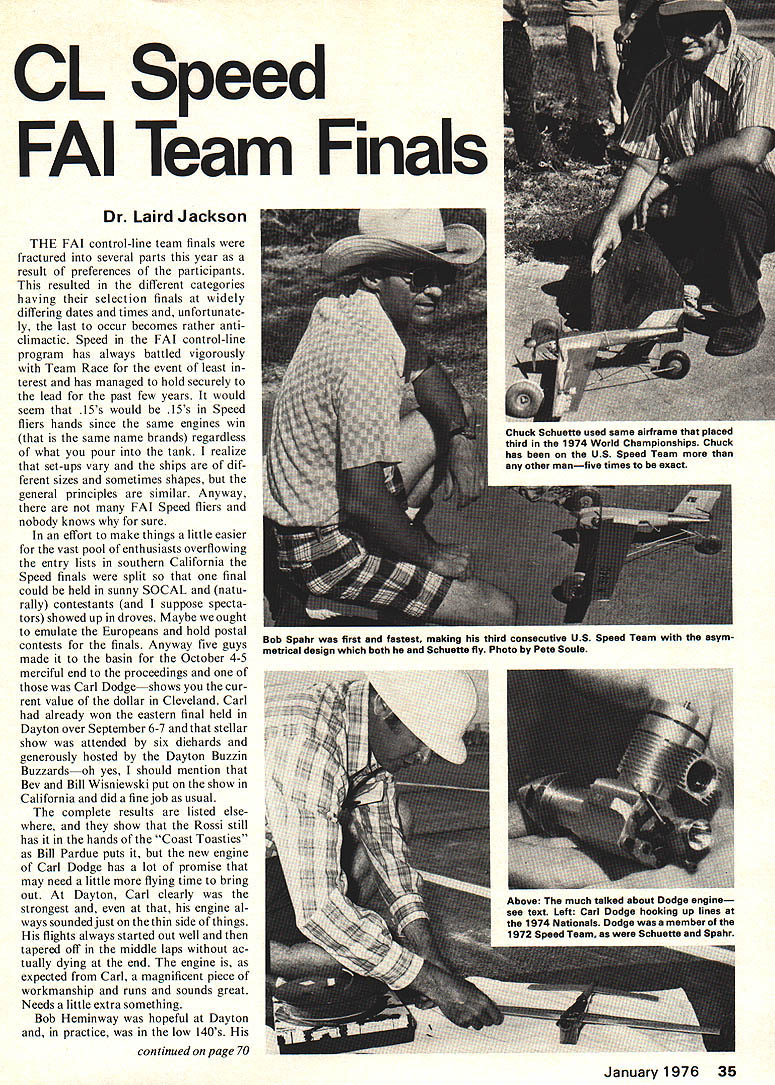
THE FAI control-line team finals were fractured into several parts this year as a result of preferences of the participants. This resulted in the different categories having their selection finals at widely differing dates and times and, unfortunately, the last to occur becomes rather anti-climactic. Speed in the FAI control-line program has always battled vigorously with Team Race for the event of least interest and has managed to hold securely the lead for the past few years. It would seem that .15's would be .15's in Speed fliers' hands since the same engines win (that is the same name brands) regardless of what you pour into the tank. I realize that set-ups vary and the ships are of different sizes and sometimes shapes, but the general principles are similar. Anyway, there are not many FAI Speed fliers and nobody knows why for sure.
In an effort to make things a little easier for the vast pool of enthusiasts overflowing the entry lists in southern California the Speed finals were split so that one final could be held in sunny SOCAL and (naturally) contestants (and I suppose spectators) showed up in droves. Maybe we ought to emulate the Europeans and hold postal contests for the finals. Anyway five guys made it to the basin for the October 4-5 merciful end to the proceedings and one of those was Carl Dodge — shows you the current value of the dollar in Cleveland. Carl had already won the eastern final held in Dayton over September 6-7 and that stellar show was attended by six diehards and generously hosted by the Dayton Buzzin Buzzards — oh yes, I should mention that Bev and Bill Wisniewski put on the show in California and did a fine job as usual.
The complete results are listed elsewhere, and they show that the Rossi still has it in the hands of the "Coast Toasties" as Bill Pardue puts it, but the new engine of Carl Dodge has a lot of promise that may need a little more flying time to bring out. At Dayton, Carl clearly was the strongest and, even at that, his engine always sounded just on the thin side of things. His flights always started out well and then tapered off in the middle laps without actually dying at the end. The engine is, as expected from Carl, a magnificent piece of workmanship and runs and sounds great. Needs a little extra something.
Bob Heminway was hopeful at Dayton and, in practice, was in the low 140's.
CL Speed FAI Team Finals
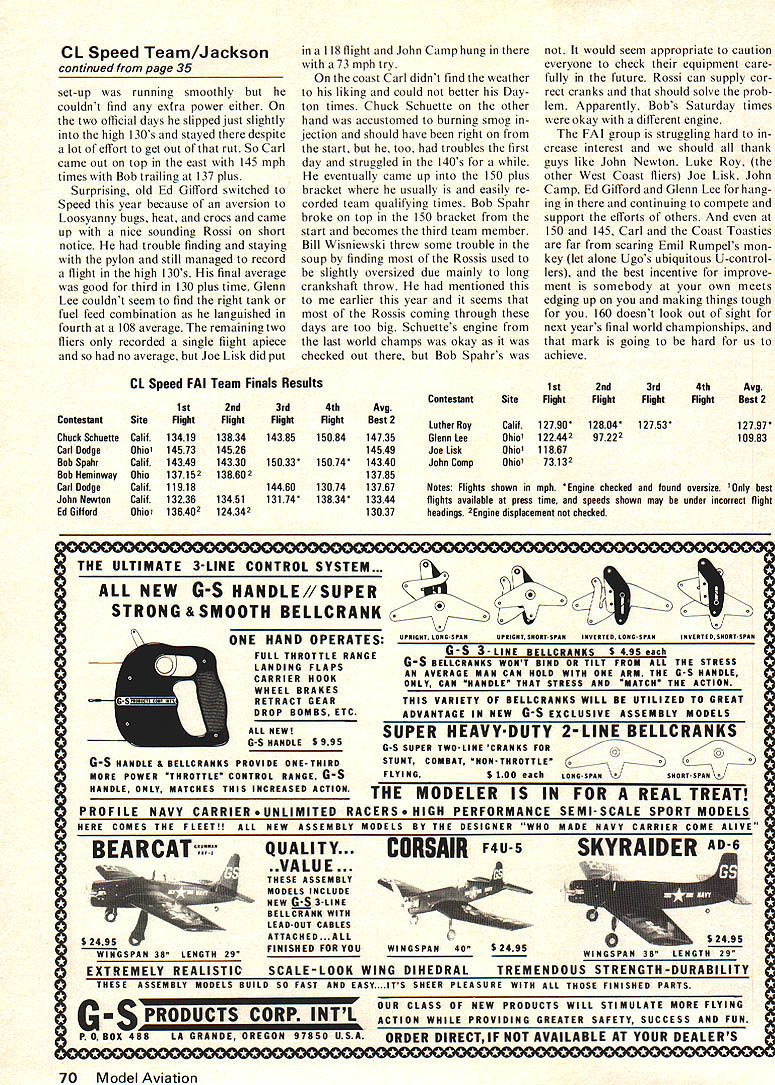
The set-up was running smoothly but he couldn't find any extra power either. On the two official days he slipped just slightly into the high 130's and stayed there despite a lot of effort to get out of that rut. So Carl came out on top in the east with 145 mph times with Bob trailing at 137 plus.
Surprisingly, Ed Gifford switched to Speed this year and came up with a nice sounding Rossi on short notice. He had trouble finding and staying with the pylon and still managed to score a flight in the high 130's. His final average was good for third in the 130's. Glenn Lee couldn't seem to find the right tank or fuel-feed combination as he languished in fourth at a 108 average. The remaining two fliers only recorded a single flight apiece and so had no average, but Joe Lisk did put in a 118 flight and John Camp hung in there with a 73 mph try.
On the coast Carl didn't find the weather to his liking and could not better his Dayton times. Chuck Schuette, on the other hand, was accustomed to burning smog injection and should have been right on from the start, but he, too, had troubles the first day and struggled in the 140's for a while. He eventually came up into the 150-plus bracket where he usually is and easily recorded team qualifying times. Bob Spahr broke onto the 150 bracket from the start and became the third team member. Bill Wisniewski threw some trouble into the soup by finding most of the Rossis used to be slightly oversized due mainly to long crankshaft throw. He had mentioned this to me earlier this year and it seems that most of the Rossis coming through these days are too big. Schuette's engine from the last world champs was okay as it was checked out there, but Bob Spahr's was not. It would seem appropriate to caution everyone to check their equipment carefully in the future. Rossi can supply correct cranks and that should solve the problem. Apparently Bob's Saturday times were okay with a different engine.
The FAI group is struggling hard to increase interest and we should all thank guys like John Newton, Luke Roy, Joe Lisk, John Camp, Ed Gifford and Glenn Lee for hanging in there and continuing to compete and support the efforts of others. And even at 145, Carl and the Coast Toasties are far from scaring Emil Rumpel's money (let alone Ougo's ubiquitous U-controller), and the best incentive for improvement is somebody at your own meet edging up on you and making things tough for you. 160 doesn't look out of sight for next year's final world championships, and that mark is going to be hard for us to achieve.
Transcribed from original scans by AI. Minor OCR errors may remain.

