
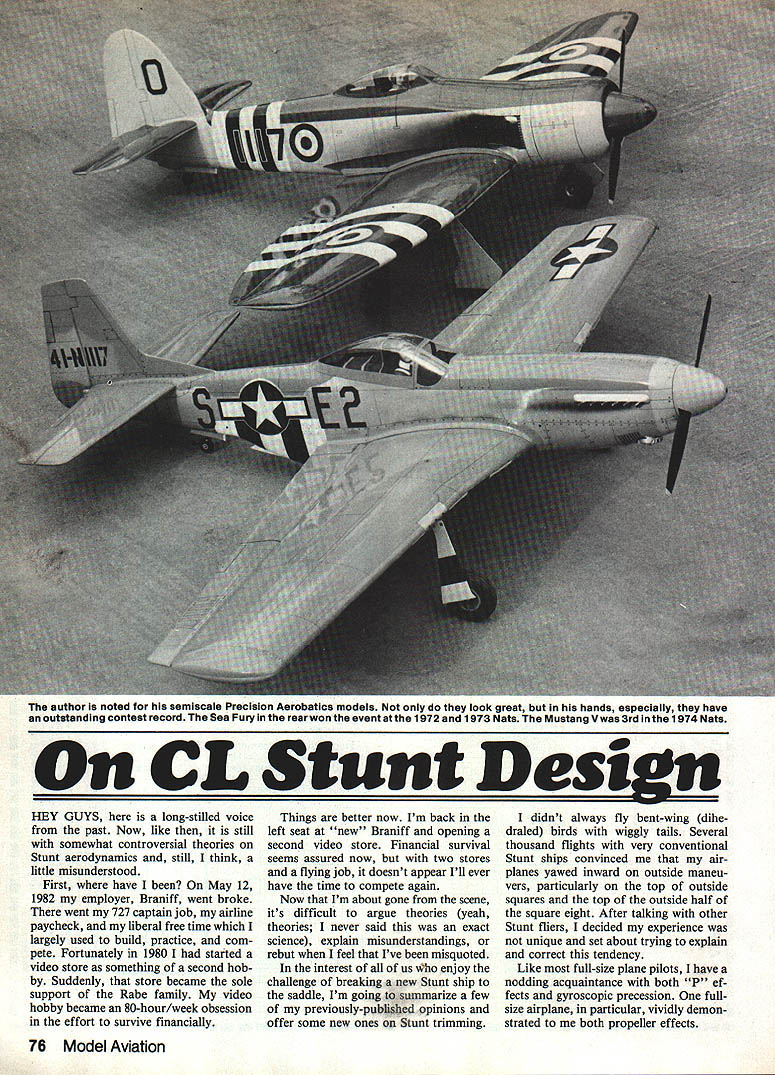
On CL Stunt Design
Introduction
Hey guys — here is a long-silenced voice from the past. My theories on Stunt aerodynamics have been somewhat controversial and, I still think, a little misunderstood. I want to summarize a few previously published opinions and offer some new ones on CL Stunt trimming.
Where I've Been
On May 12, 1982 my employer, Braniff, went broke. There went my 727 captain job, my airline paycheck, and the liberal free time I had used to build, practice, and compete. Fortunately, in 1980 I had started a video store as a second hobby. Suddenly that store became the sole support of the Rabe family, and the hobby became an 80-hour/week obsession to survive financially.
Things are better now. I'm back in the left seat at "new" Braniff and opening a second video store. Financial survival seems assured, but with two stores and a flying job, it doesn't appear I'll ever have time to compete again. Since I'm about gone from the scene, it's difficult to argue theories, explain misunderstandings, or rebut misquotes — so here's a summary of my thinking on trimming and design.
Full-Size Experience and Prop Effects
Mustang example
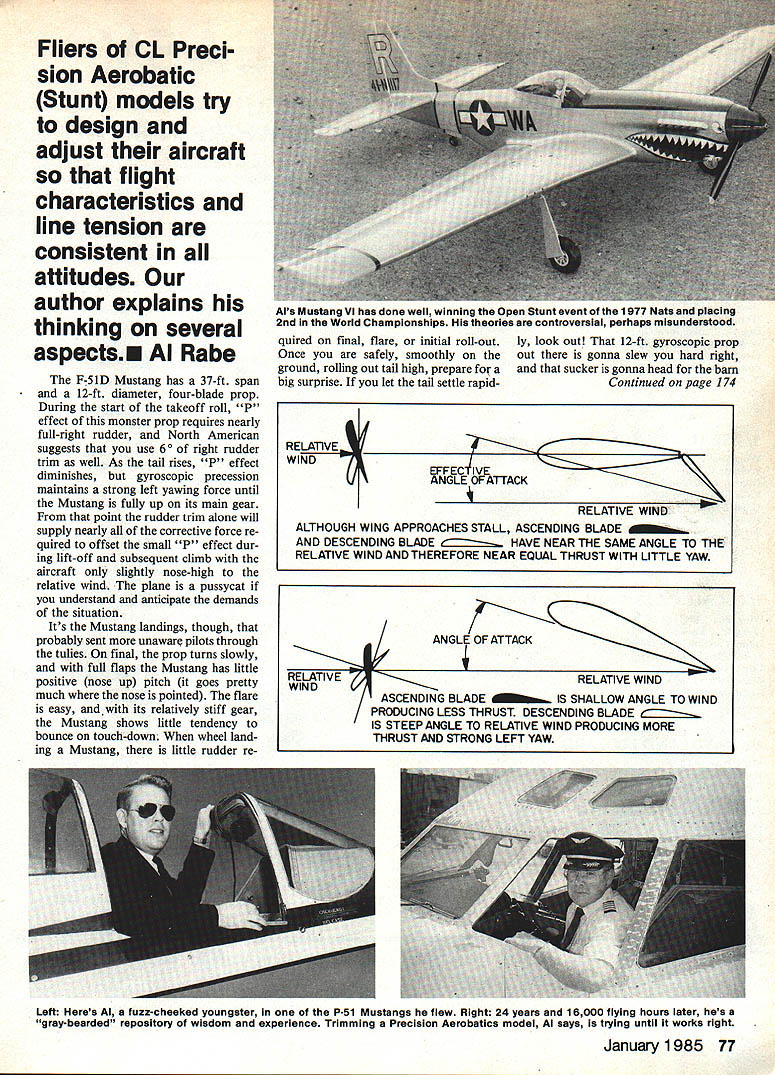
Like most full-size pilots, I have a nodding acquaintance with both "P" effects and gyroscopic precession. One full-size airplane illustrated both propeller effects vividly: the F-51D Mustang. With a 37-ft span and a 12-ft diameter four-blade prop, during the start of the takeoff roll the "P" effect requires nearly full-right rudder, and North American recommends about 6° of right rudder trim. As the tail rises, "P" effect diminishes, but gyroscopic precession maintains a strong left-yawing force until the Mustang is fully on its main gear. From that point the rudder trim supplies nearly all corrective force required during lift-off and climb.
Landings are the real trick. On final the prop turns slowly and with full flaps the Mustang has little positive pitch; it goes where the nose is pointed. Wheel landings need little rudder on final, flare, or initial rollout. But once rolling out tail-high, if the tail settles rapidly, that 12-ft gyroscopic prop will slew you hard right when rudder is nearly useless at slow speed. You must carefully control pitch attitude and rate on rollout; letting the tail settle slowly lets residual rudder effectiveness hold it, while letting it drop rapidly may require brakes to remain on the runway.
Application to CL Stunt
What does this full-size experience have to do with CL Stunt? My airplanes always got light on outside. That suggests to me that left-yawing gyroscopic precession can be stronger than the simultaneously occurring right yaw from "P" effects. A 1/2-oz prop on a 3–4 lb airplane doesn't supply a lot of yaw, but:
- It doesn't take much yaw to noticeably reduce tension on the outside wire(s).
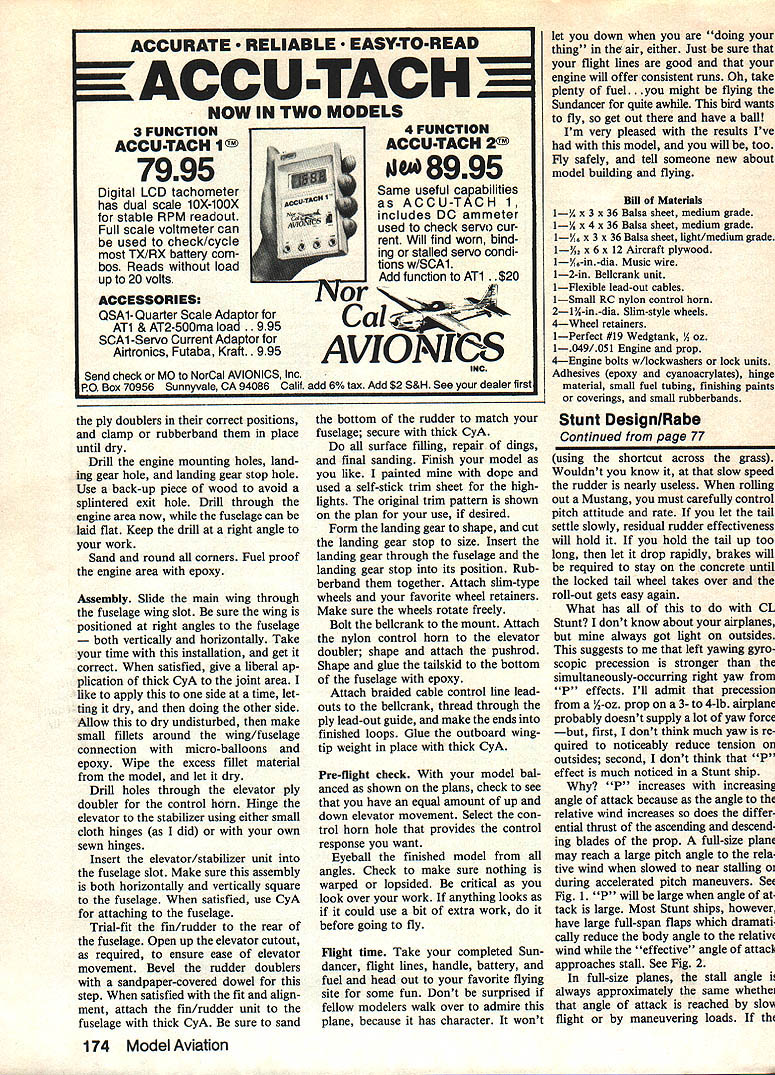
- I don't think "P" effect is much noticed in a typical Stunt ship because "P" increases with angle of attack. Full-size planes often have large body angles to the relative wind (e.g., during landing), producing large "P." Most Stunt ships, however, use large full-span flaps which reduce the body angle to the relative wind while the wing approaches its effective stall angle. Thus, Stunt ships stall with little nose-up pitch and so produce insignificant "P."
If you have less-than-full up on outsides, gyroscopic effects on your airplane are likely more significant than "P." In that case, a movable rudder whose position is controlled proportionately by elevator movement (the same elevator motion that produces the yawing pitch) should, in theory, neutralize the undesired yaw as it occurs.
Movable Rudder and Asymmetric Travel
Movable rudder concept
I honestly feel a movable rudder with deflection proportionally controlled by elevator movement can theoretically neutralize yaw. But do we want to fully neutralize it? If you want a large capability to trim both rudder offset and travel, why not use a moving rudder asymmetrically — undercompensate for outward yaw on insides and slightly overcompensate for inward yaw on outsides — to create a slight outward (line-tightening) yaw on all maneuvers? I use asymmetrically greater right rudder travel than left, and that is often misinterpreted as a right-rudder "kick" on outsides only. Not so: rudder travel both ways is required to obtain the smoothest, strongest corners.
Is a movable rudder worth the effort?
- If your Stunt ship is clean enough to coast through the pattern on relatively little power and you have plenty of side area aft, you can forget it.
- If you fly draggy airplanes with snarly engines and somewhat dirty fuselage side area for scale considerations, a movable rudder is definitely worth considering.
Practical notes on rudder problems
It has been suggested I had endless trouble making a straight-winged Mustang's rudder work. The February 1973 AAM summarized: asymmetry was reduced by creating extra lift from the outboard wing — adding a tab to the outboard flap. This reduced hinging. Further reductions in tip weight during a series of flights reduced hinging to the point that final rudder adjustments controlled it satisfactorily.
Also consider lead-out position. Reversed lead-outs (with the up lead-out in front) should help the typical Stunt ship's tendency to tighten tension on outsides. Having the up lead-out in the rear could theoretically aggravate tighter tension on outsides. In short, if lead-out position causes yaw, putting the up lead-out in front should lessen the need for compensating rudder travel — maybe even eliminate the need for a movable rudder altogether. If one correction doesn't solve the problem, the other might.
Torque, Wash-in/Wash-out, and Wing Twist
Torque overlooked
With all the discussion about "P" and gyroscopic precession, it's strange we've largely ignored torque. Torque is the twisting force on the entire airplane equal to, but opposite from, the force turning the propeller. Its effects include the spiraling propwash striking vertical and horizontal surfaces. This constant tendency to roll left under power should cause inside line tension to be less than outside.
Full-size designers often compensate for torque by offsetting the vertical fin leading edge to the left and by "washing in" the left wing (slightly increasing its incidence) and "washing out" the right wing (slightly decreasing its incidence). We Stunt designers tend to ignore torque: we add inboard wing and outboard tab weight until the airplane flies "normally" in upright level flight, then accept how it behaves in maneuvering flight.
I suspect a Stunt ship built with perhaps 1° of washin on the inboard wing and a corresponding 1° washout on the outboard wing might be more "honest" and "friendly" on the lines, with fewer trim problems.
Wing twist experiment
Uncompensated torque effects can obscure observations of yaw, roll, hinge, or wobble at various points in the pattern. This blending of effects makes it hard to analyze what trimming changes will do. I'm going to try a slightly twisted wing on my next Stunt ship. If it doesn't work, it should be possible to remove most undesired characteristics by twisting the flaps. Whether we correct for torque or not, Stunt ships can fly well — more by pragmatic cut-and-try than by strict analysis of cause and effect.
Dihedral (Bent Wings)
Some have suggested dihedral makes my Stunt ships unstable on outside maneuvers. If anyone really believes I won the Nationals and placed second in the World Championships with an unstable Mustang VI, I'd like to meet you. Seriously: if dihedral (or moderate anhedral) is used only moderately, and the lead-outs are kept very near the vertical center of gravity, there is no observable difference in how a Stunt ship with dihedral flies inside and outside maneuvers. If your ship hangs straight when suspended by its lead-outs, it should fly straight whether or not it has a bent wing.
Practical Trimming Experience
Example: Last Saturday Frank McMillan and I dusted off a Mustang V built by Ron Harding. Outside line tension was great and outside corners were smooth, but inside line tension was noticeably less and the ship tended to run into the circle on takeoff. I made the following adjustments over a few flights:
- Cranked in a couple turns more rudder offset on each of the next three flights. Inside line tension became excellent and the Mustang stopped trying to run in on takeoff, but outside corners suffered somewhat.
- Reduced overall rudder throw to maintain left rudder position while restoring right rudder travel to its initial value. That restored outside performance while keeping inside corners smooth.
It worked great. If only that Mustang had 2 oz more fuel and 2 in. more span — you know how it goes: a guy could get hooked on these things.
Conclusion and Final Hints
Trimming is largely "trying" until it works. Nobody's theory is entirely right or entirely wrong. If you're interested in my trimming ideas, note that my Mustang article (February 1973 American Aircraft Modeler) and the Sea Fury article (March 1973 AAM) were originally written as three articles: Mustangs, Sea Fury, and a long article on trimming. The third article was divided between the other two, with basic trimming in the Mustang article and advanced trimming in "Go For Broke."
- Summary recommendations:
- Consider gyroscopic precession as a likely cause of light outside tension; movable or asymmetric rudder travel can help.
- Check lead-out position — try the up lead-out in front if you have outside tightening.
- Don’t ignore torque — try small washin/washout or slight wing twist to compensate.
- Use pragmatic flight testing: adjust one thing at a time and observe.
Good luck trimming your ships — it’s a satisfying mix of art and science.
Transcribed from original scans by AI. Minor OCR errors may remain.

